In recent years, the development of high power density motors has been driven forward by humanoid robots, industrial robots, electric vehicles (EVs), unmanned equipment and industrial automation machinery.
As motors become more compact yet deliver higher output power, the conventional potting mindset of “just fill the cavity” is no longer adequate.
Whether it is potting compound for robot joint motors or thermally conductive potting adhesive for EV drive motors, engineers now focus on a complete thermal management system and long-term reliability rather than thermal conductivity as a standalone metric.
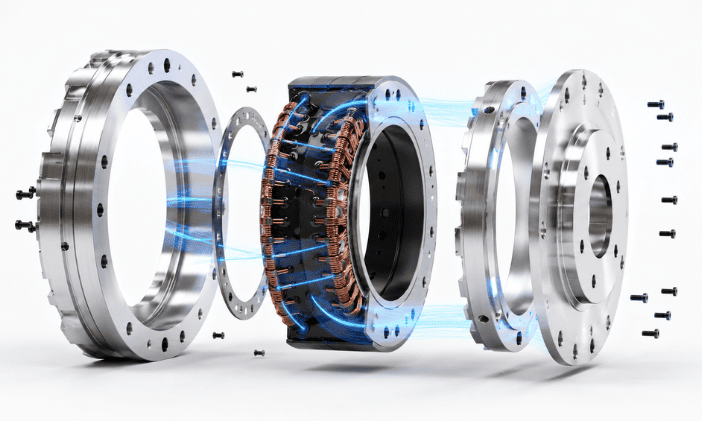
This explains why more engineers are searching for answers to the following questions:
■ How to select potting compounds for motors?
■ Recommended thermally conductive potting adhesives for motors
■ Potting materials for robot joint motors
The core question to address is simple:
■ What potting materials are required for high power density motors?
Why an Increasing Number of Motors Adopt Potting Technology
For robot joint motors, frameless torque motors, servo motors and drive motors, stator windings constitute the primary heat source within the whole system.
Potting compounds do far more than merely fix windings in place.
They perform five critical functions simultaneously:
■ Establish efficient thermal conduction pathways
■ Secure windings and suppress vibration
■ Provide electrical insulation
■ Resist moisture and corrosion
■ Enhance long-term operational reliability
Accordingly, industry engineers frequently search for these product categories:
■ Thermal conductive motor potting compounds
■ Epoxy potting resins for motors
■ Stator potting materials
■ Potting adhesives for robotic motors
Is Higher Thermal Conductivity Always Better?
When selecting thermally conductive motor potting compounds, most engineers first check thermal conductivity figures.
This is, however, a common misconception.
For high power density motors, service life is predominantly determined by four key indicators:
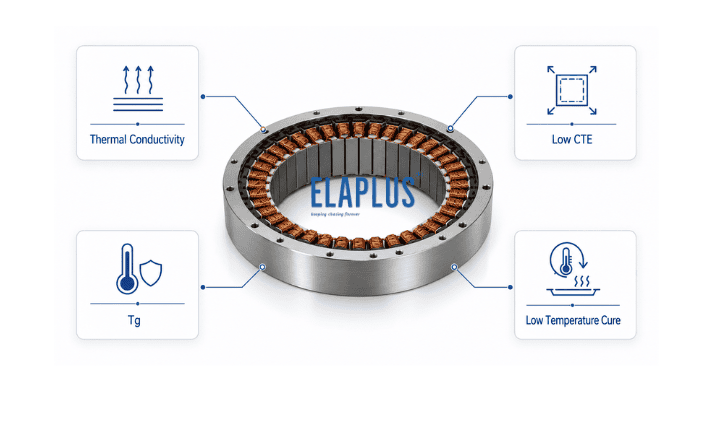
1. Thermal Conductivity
Dictates how rapidly heat transfers from windings to the motor housing.
Insufficient thermal conductivity leads to:
■ Excessive temperature rise
■ Reduced power output
■ Higher risk of permanent magnet demagnetization
■ Shortened winding service life
2. CTE (Coefficient of Thermal Expansion)
Robot joint motors undergo frequent start-stop cycles and continuous temperature fluctuations every day.
If the potting compound features an excessively high CTE, thermal expansion mismatch with copper wires, iron cores and housings will trigger:
■ Material cracking
■ Adhesion delamination
■ Build-up of internal thermal stress
For robot joint motor potting, a low CTE often carries greater priority than pursuing ultra-high thermal conductivity alone.
3. Tg (Glass Transition Temperature)
Tg defines the material’s long-term temperature resistance.
If continuous operating temperatures approach the Tg value, the compound softens and loses mechanical performance.
High power density motors therefore demand:
■ Adequate temperature margin above Tg
■ Stable performance under prolonged thermal cycling
4. Curing Process Compatibility
Robot motors contain thermally sensitive components including:
■ Permanent magnets
■ Enameled wires
■ Plastic bobbins
High-temperature long-duration curing processes raise manufacturing failure risks.
Medium and low-temperature curing formulations are thus widely favored across the robotics sector.
High Power Density Motors Require Balanced Comprehensive Performance
Premium motor potting compounds are not those with the maximum thermal conductivity; instead, they strike a balanced performance profile across all dimensions below:
■ Thermal conductivity
■ Low thermal expansion coefficient
■ Thermal cycling resistance
■ User-friendly curing process
■ Vibration resistance
■ Long-term reliability
■ Electrical insulation properties
This balanced performance carries greater weight than single outstanding metrics, especially in humanoid robots, collaborative robots, AGVs, industrial robots and EV drive systems.
ELAPLUS EP 1715(2#): Balanced Thermally Conductive Potting Solution for Reliable Motors
Developed to meet heat dissipation and reliability requirements of high power density motors, ELAPLUS EP 1715(2#) delivers a solution integrating optimized thermal management and long-term durability. Its specifications and application positioning are as follows:
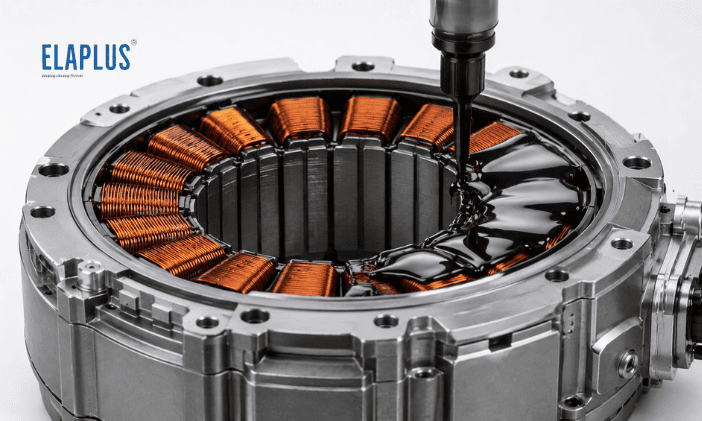
■ Thermal conductivity: 1.5 W/m·K
■ Glass transition temperature (Tg): 95–105°C
■ CTE below Tg: approximately 25 μm/m·°C
■ Curing options: room-temperature cure at 25°C, or medium-low temperature cure at 80°C / 100°C
■ Operating temperature range: -50°C ~ 180°C
■ Hardness: Shore D 90 with engineered toughness
■ Dielectric strength: ≥18 kV/mm
■ Volume resistivity: 1×10¹⁵ Ω·cm
The product has passed 1,000-hour aging tests including dual 85 testing, temperature cycling (-40°C to 120°C) and high-temperature storage at 120°C, maintaining stable shear strength to satisfy long-term reliability requirements of robotic frameless torque motors and industrial servo motors. All specifications and application descriptions are extracted from official product documentation; validation under actual working conditions is recommended for final material selection.
Outlook
High power density motors will see accelerated adoption across the following sectors in the coming years:
■ Humanoid robots
■ Industrial robots
■ Electric vehicles
■ Unmanned equipment
■ Automation machinery
For design engineers, rather than fixating solely on thermal conductivity when choosing thermally conductive motor potting compounds, a systematic material selection framework is advised:
Thermal Conductivity → CTE → Tg → Curing Process → Long-Term Reliability
Only potting materials that balance thermal management, structural protection and long-term stability can fully satisfy the application demands of next-generation high power density motors.