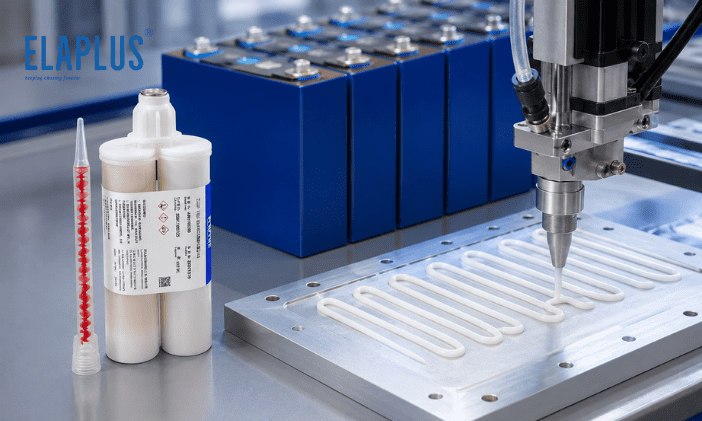
During the assembly of power batteries for new energy vehicles, energy storage battery modules, lithium battery PACKs and battery cells, stable and reliable structural adhesives are required for bonding cell-to-cell, cell-to-aluminum shell, and cell-to-bracket joints.
Cell structural adhesives serve far more than merely fixing cells in place. They directly determine the vibration resistance, structural stability, stress buffering performance and long-term operational reliability of battery modules. For battery manufacturers, ideal lithium battery structural adhesives must strike a balanced performance across bonding strength, flexibility, aging resistance, process compatibility and environmental compliance.
ELAPLUS (Elaplus Functional Materials (Shanghai) Co., Ltd.) has developed PUR 1610 A/B two-component polyurethane adhesive, a dependable material tailored for cell structural bonding, aluminum battery shell bonding and multi-substrate structural fixation in new energy batteries.
1. Why Bonding Strength Alone Cannot Define Cell Structural Adhesive Performance
Power and energy storage batteries operate continuously under harsh service conditions: persistent vibration, mechanical impact, thermal cycling, high-temperature humid environments, and thermal expansion mismatches between dissimilar materials.
Overly rigid structural adhesives trigger severe stress concentration, while insufficient bonding strength may lead to cell loosening, structural cracking or interface failure. Therefore, cell structural adhesives must deliver a full set of capabilities:
■ Stable structural fixation capacity
■ Optimized flexibility matching battery structures
■ Excellent shock absorption and vibration resistance
■ Strong adhesion compatibility with aluminum, plastics, rubber, polyester and other substrates
■ Long-term resistance to aging and chemical corrosion
■ Compatibility with automated dispensing and mass production workflows
The core value of PUR 1610 lies in its well-tuned balance between robust adhesion and low stress, perfectly adapted to new energy battery structural requirements.
2. Product Introduction: What Is PUR 1610?
PUR 1610 A/B is a 1:1 two-component solvent-free room-temperature curing polyurethane structural adhesive developed by ELAPLUS, designed for structural bonding and sealing across various substrates.
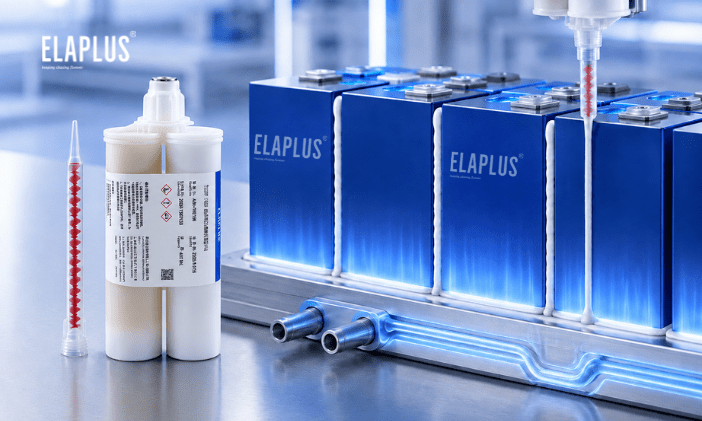
It excels at aluminum-to-aluminum bonding for new energy batteries, as well as joining dissimilar materials including metals, plastics, rubber and polyesters.
Applied to battery module assembly, cell fixation, aluminum shell bonding, bracket attachment and PACK structural assembly, PUR 1610 greatly enhances structural stability and mitigates interface failure risks induced by vibration and thermal cycling.
3. Core Advantages of PUR 1610 Two-Component Polyurethane Structural Adhesive
■ Low Modulus for Low-Stress Cell Bonding
Stress release is critical for cell structural assembly. Fully cured PUR 1610 boasts outstanding flexibility and elasticity, acting as a buffer during battery operation to relieve stress concentration caused by vibration and temperature fluctuations between structural components.
■ High Bonding Strength Compatible with Common Battery Substrates
Battery modules widely adopt aluminum casings, metal frames, plastic brackets, rubber cushioning parts and polyester components. PUR 1610 delivers reliable adhesion to all these materials, fully meeting demands for cell fixation and module assembly.
■ 1:1 Mix Ratio for Easy Process Integration
With a convenient 1:1 A/B volume ratio, PUR 1610 works seamlessly with automated two-component dispensing equipment, and supports manual mixing for lab sample testing. Battery manufacturers can smoothly advance from prototype verification to full mass production.
■ Superior Aging & Chemical Resistance
New energy batteries feature long service lifespans that demand exceptional long-term adhesive stability. PUR 1610’s robust anti-aging and chemical-resistant properties extend the long-term service reliability of battery modules.
■ Low VOC Formulation Meets Global Environmental Compliance
Low-odor and low-VOC, PUR 1610 complies fully with RoHS and REACH regulations, suitable for strictly regulated sectors including new energy vehicles, energy storage systems and lithium battery PACK manufacturing.
4. Typical Application Scenarios for PUR 1610
PUR 1610 is prioritized for the following battery structural bonding applications:

■ Aluminum-to-aluminum structural bonding for new energy batteries
■ Structural fixation between prismatic cells
■ Bonding of cells to brackets, end plates and side plates
■ Full battery module structural assembly
■ Internal component fixation inside lithium battery PACKs
■ Multi-material bonding: metal with plastic, rubber or polyester
■ Any battery bonding project requiring low stress, vibration resistance and long-term aging resistance
It is a prime candidate for evaluation and trial for customers seeking cell structural adhesives, cell bonding glues, battery adhesives, lithium battery structural adhesives and power battery structural adhesives.
5. Why Choose ELAPLUS PUR 1610?
Selecting battery adhesive cannot rely on isolated performance metrics; evaluation must comprehensively factor cell structure, substrate types, dispensing methods, curing profiles, reliability standards and production cycle times.
Elaplus Functional Materials provides customized selection guidance and full technical application support for PUR 1610 tailored to clients’ unique product designs:
■ Custom bonding solutions for cell-to-aluminum shell joints
■ Structural fixation schemes for battery modules
■ Process optimization for automated dispensing
■ Testing protocols for multi-substrate bonding validation
■ Sample trials and full reliability testing support
■ Performance tuning for PACK structural adhesive deployment
For new energy battery manufacturers, PUR 1610 is far more than a standalone product — it is a complete material solution aligned with structural design, process validation and mass production rollout.
6. Frequently Asked Questions About PUR 1610
Q1: Can PUR 1610 be used for cell structural bonding?
A: Yes. It is engineered for aluminum-to-aluminum bonding in new energy batteries, and also bonds cell brackets, module structural parts and a wide range of mixed substrates securely.
Q2: Is PUR 1610 compatible with automated dispensing systems?
A: Absolutely. The 1:1 two-component formula fits standard automatic dispensing machines, while manual mixing is available for small-batch sample verification.
Q3: Which manufacturers are ideal candidates for PUR 1610 sampling?
A: Producers of power batteries, energy storage batteries, battery modules, lithium PACKs, cell assembly lines and new energy structural components are recommended to conduct sample testing.
Q4: Can I obtain full detailed technical parameters for PUR 1610?
A: Yes. Contact ELAPLUS’s technical team to receive official PDS (Product Data Sheet) and tailored selection advice covering viscosity, pot life, curing conditions, bonding strength, insulation, flame retardancy and operating temperature range.
Cell structural bonding is a core pillar of reliability engineering for new energy batteries. Faced with challenges of shock vibration, thermal cycling, multi-material assembly and decades of aging exposure, battery structural adhesives must balance high adhesion strength, low stress, flexibility, aging resistance and manufacturability.
ELAPLUS PUR 1610 A/B two-component polyurethane structural adhesive is purpose-built for cell bonding, aluminum shell attachment and module structural reinforcement, delivering trusted structural material performance to power battery, energy storage and lithium PACK manufacturers.
For PUR 1610 samples, PDS documents or customized application test programs, please contact Elaplus Functional Materials (Shanghai) Co., Ltd.
Tel: +86 21-67227200
Website: www.elaplus.cc
Email: info@elaplus.cc
Address: No.555 Jiugong Road, Jinshan Industrial Zone, Shanghai, China