The core of a strain gauge pressure sensor lies in its sensitive element, which captures tiny deformations and converts pressure variations into electrical signals. Such sensors are highly susceptible to structural stress. If the potting material is overly rigid, or generates excessive curing shrinkage and thermal stress, it will impose extra loads on strain gauges, solder joints, leads and sensitive cores, resulting in zero drift, fluctuating sensitivity and poor long-term measurement stability.
Therefore, when choosing potting compounds for pressure sensors, hardness alone is not the key factor. Priority should be given to materials featuring flexibility and low stress, reliable adhesion, stable temperature resistance, contamination resistance, oil resistance and long-term fixation performance.
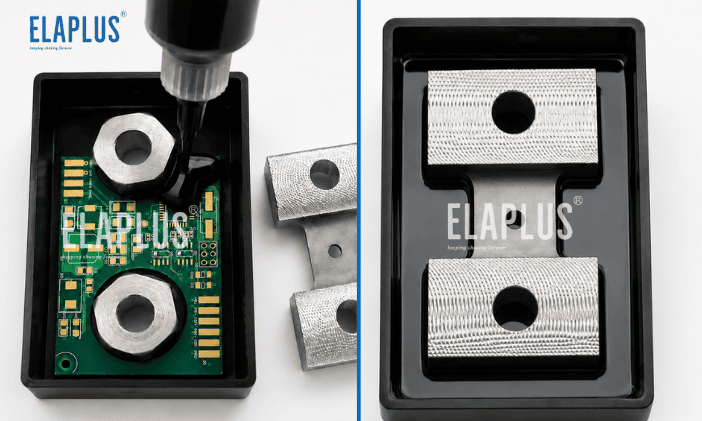
For strain gauge pressure sensors, high-temperature resistant sensors, soft magnetic component potting and other applications, ELAPLUS Functional Materials (Shanghai) Co., Ltd. recommends the two-component flexible structural epoxy ELAPLUS EP 2016 A/B. According to the product datasheet, EP 2016 A/B is a two-part epoxy curable at room or elevated temperature, suitable for metal bonding, soft magnetic component encapsulation and high-temperature sensor potting. After curing, it delivers high mechanical strength, outstanding adhesion, wide temperature resistance and excellent contamination resistance.
I. Why Overly Rigid Potting Materials Are Unsuitable for Strain Gauge Pressure Sensors
A strain gauge pressure sensor generally consists of an elastic body, strain gauges, bridge circuit, leads, PCB, housing and sealing structure. During operation, the elastic body must produce consistent, repeatable micro-deformation. Hard potting materials will compromise product reliability in the following aspects:
■ Extra stress impairs measurement accuracy
Strain gauges output signals by detecting minimal strain. Ultra-rigid potting compounds generate additional stress during curing shrinkage, thermal cycling or mechanical vibration, triggering sensor zero drift, unstable output or sensitivity deviation.
■ Thermal cycling causes interfacial tension
Pressure sensors are widely deployed in automotive equipment, industrial machinery, hydraulic systems and engine oil pressure detection, where operating conditions are harsh. Metal housings, PA66 plastic parts, PCBs, solder joints and cured epoxy feature different coefficients of thermal expansion. Insufficient material flexibility leads to concentrated interfacial stress under temperature swings.
■ Oil, moisture and contaminants degrade long-term reliability
Sensor working environments often contain engine oil, dust, moisture and other pollutants. The potting compound must not only shield delicate electronic components but also maintain stable bonding with substrates to prevent delamination, leakage or degraded electrical performance in contaminated surroundings.
II. Product Positioning of ELAPLUS EP 2016 A/B
EP 2016 A/B is a two-component structural epoxy developed by ELAPLUS, also applicable to soft magnetic part encapsulation and high-temperature sensor potting. It is mixed at a 100:100 weight ratio of Part A to Part B, forming a high-strength, environment-resistant protective layer after curing. The material delivers superior shear strength, peel strength, weather resistance and adhesion, and is solvent-free with no curing by-products.
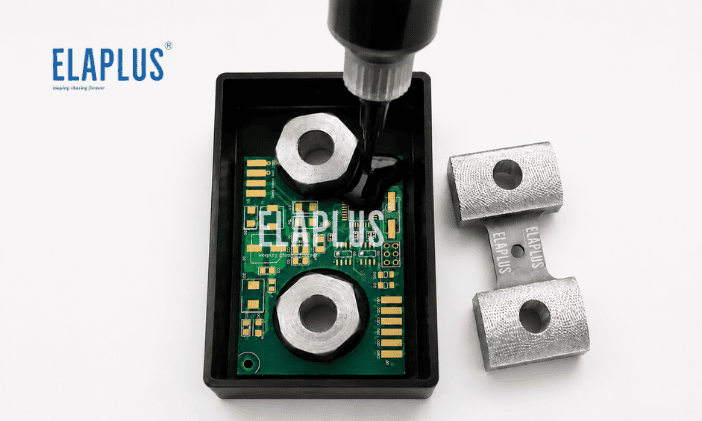
For strain gauge pressure sensors, EP 2016 A/B provides more than simple encapsulation protection: it firmly secures sensitive components while balancing flexible low-stress performance and long-term reliability.
III. Core Advantages of EP 2016 A/B for Pressure Sensor Potting
■ Flexible and low-stress formulation to minimize impact on sensitive components
Strain gauge pressure sensors are extremely vulnerable to extra stress introduced by potting media. Cured EP 2016 A/B has a Shore D hardness of 65±5 and an elongation at break of 83%. Compared with rigid brittle materials, it effectively buffers structural stress and protects sensitive elements, solder joints and lead areas.
■ High bonding strength for permanent stable fixation
Pressure sensors operate under continuous vibration, shock and temperature fluctuations, requiring robust internal fixation. EP 2016 A/B boasts strong adhesion: 15 MPa for iron-to-iron bonding and 16 MPa for aluminum-to-aluminum bonding, ideal for fastening metal housings and internal sensor assemblies.
■ Excellent compatibility with plastic and metal substrates
Sensor assemblies commonly incorporate metal casings, stainless steel, PA66, engineering plastics, PCBs and electronic components. EP 2016 A/B adheres well to fiberglass cloth, aluminum-plastic combinations, aluminum alloys and steel plates. Adhesion testing on nylon PA reaches 4.8 MPa with substrate fracture, demonstrating reliable bonding with engineering plastics.
■ Wide temperature resistance range for demanding working conditions
Pressure sensors often serve in engine bays, hydraulic equipment and industrial machinery with alternating high and low temperatures. EP 2016 A/B features outstanding thermal stability, operating steadily from -55°C to 150°C, perfect for sensors requiring superior environmental adaptability for encapsulation and structural bonding.
■ Strong contamination tolerance with low substrate pretreatment requirements
Substrates may carry minor surface contaminants during sensor production or service, and surface treatment processes can be complex. EP 2016 A/B resists contamination effectively and demands minimal surface preparation, boosting process compatibility and mass production consistency.
■ Transformer oil resistance for oily environment applications
Datasheet data verifies EP 2016 A/B exhibits excellent transformer oil resistance with minimal performance attenuation. Its oil and contamination resistance extends the service life of engine oil pressure sensors, industrial pressure sensors and fluid circuit sensors.
IV. Key Technical Parameters of EP 2016 A/B
| Item | Specification |
| Product Type | Two-component structural epoxy for sensor potting |
| Curing Method | Room-temperature or heat curing |
| Mixing Ratio | Part A : Part B = 100 : 100 by weight |
| Mixed Viscosity | 7,000±2,000 mPa·s |
| Hardness | Shore D 65±5 |
| Tensile Strength | 14.5 MPa |
| Elongation at Break | 83% |
| Operating Temperature Range | -55°C ~ 150°C |
| Typical Applications | Metal bonding, soft magnetic unit encapsulation, high-temperature sensor potting, etc. |
V. Suitable Pressure Sensor & Electronic Encapsulation Scenarios
EP 2016 A/B is designed for structural fixation and encapsulation protection where low stress, high adhesion and environmental reliability are mandatory, including:
■ Encapsulation of strain gauge pressure sensors
■ Potting of high-temperature resistant pressure sensors
■ Local encapsulation for engine oil pressure sensors
■ Structural bonding of industrial pressure sensors
■ Adhesion between metal housings and plastic components
■ Bonding assemblies combining PA66, metal and PCB
■ Soft magnetic component encapsulation
■ Protection of sensor leads, solder joints and sensitive cores
■ Encapsulation of electronic modules requiring flexible low-stress shielding
VI. Why Choose ELAPLUS EP 2016 A/B?
ELAPLUS Functional Materials (Shanghai) Co., Ltd. has long served automotive electronics, sensors, industrial control, power modules, new energy, robotics, motors and precision electronic packaging industries. For delicate devices such as pressure sensors, material selection cannot rely solely on strength metrics; low stress, adhesion, temperature resistance, oil resistance, insulation and long-term reliability must be evaluated comprehensively.
Key strengths of EP 2016 A/B:
■ Flexible low-stress formula to reduce load on sensitive components
■ Excellent adhesion to metals, PA plastics and other substrates
■ High mechanical strength for permanent structural fixation
■ Wide temperature resistance from -55°C to 150°C for harsh environments
■ Strong contamination resistance with low surface pretreatment requirements
■ Superior electrical insulation for sensor encapsulation protection
■ Curable at room or elevated temperature, matching various production line cycle times
VII. Conclusion: Flexible Low-Stress Epoxy Is Recommended for Strain Gauge Pressure Sensor Potting
Strain gauge pressure sensors are highly sensitive to potting materials. Excessive rigidity, large curing shrinkage or unstable bonding will undermine long-term measurement stability. ELAPLUS EP 2016 A/B flexible structural epoxy is a highly viable material solution for pressure sensor applications that demand balanced low stress, adhesion strength, temperature resistance, oil resistance, contamination resistance and electrical insulation protection.
It stably secures internal sensor components while mitigating extra stress on delicate structures, suitable for encapsulating strain gauge pressure sensors, high-temperature sensors, engine oil pressure sensors and other sensors operating in severe environments.
Previous post: Potting Compound Selection for EMI Filter PCBs – ELAPLUS PUR 1635 Polyurethane Potting Compound Delivers Waterproof, Flame-Retardant & Insulating Protection
Next post: How to Select Adhesives for Bonding Motor Magnets & Magnet Segments — Reliable Bonding Solutions for High-Speed Motors