In LED lighting, power adapters, outdoor lamps, industrial lighting, street light modules, landscape lighting and new energy electronic devices, LED drivers are core components that determine the overall stability and service life of luminaires.
During long-term operation, LED drivers generate continuous heat. They are also exposed to moisture, dust, thermal cycling, vibration, impact and outdoor aging. Without adequate internal protection, risks such as overheated components, degraded insulation, failed solder joints, water ingress and short circuits, as well as compound cracking may occur. Therefore, selecting proper potting compound has become critical to improving the reliability of LED drivers.
For LED driver potting applications, ELAPLUS recommends SIPA 1850 Two-Component Silicone Potting Compound. Featuring high thermal conductivity, high viscosity with thixotropy and excellent anti-poisoning performance, this product offers thermal conductivity ranging from 0.7 to 4.0 W/m·K, catering to heat dissipation requirements of LED power supplies with different power ratings.
1. Why Do LED Drivers Need Potting?
An LED driver consists of capacitors, inductors, transformers, MOSFETs, rectifier bridges, IC chips, resistors, terminals and PCB circuits. Power components generate constant heat during operation, and accumulated heat will shorten the service life of electronic parts.
Main functions of LED driver potting compound:
■ Heat Conduction & Dissipation: Transfer heat from power components to enclosures or heat dissipation structures.
■ Water & Moisture Resistance: Prevent moisture ingress and reduce risks of short circuit and corrosion.
■ Electrical Insulation: Protect PCBs and components for enhanced operational safety.
■ Vibration Damping: Mitigate impact from vibration during transportation, installation and use.
■ Dustproof & Sealing: Ideal for outdoor lamps, street lights and industrial lighting fixtures.
■ Service Life Extension: Improve long-term operational reliability of LED drivers.
For outdoor LED power supplies, street light drivers, industrial light power units, landscape light power supplies and high-power LED driver modules, the potting compound shall not only achieve full filling, but also maintain stable thermal conductivity, flexibility, insulation and protection performance in long-term service.
2. Three Major Challenges in Selecting LED Power Supply Potting Compound
2.1 Concentrated Heat Generation Requires High Thermal Conductivity
Power components, inductors and transformers inside LED drivers produce intense heat. Insufficient thermal conductivity will lead to local heat accumulation and excessive temperature rise of components.
SIPA 1850 provides thermal conductivity of 0.7–4.0 W/m·K, suitable for common and high-power LED drivers with diverse heat dissipation demands.
Recommended search terms: High thermal conductivity potting compound for LED power supply, Thermal conductive compound for LED driver, High thermal conductivity silicone potting compound
2.2 Complex Structure Demands Balanced Viscosity & Thixotropy
LED drivers are assembled with components of varying heights. Low-viscosity compound tends to sag, settle and cause uneven filling; excessively high viscosity may result in incomplete potting and difficult defoaming.
SIPA 1850 features high viscosity and moderate thixotropy. It stays in place stably inside power enclosures and avoids uncontrolled flow, perfectly matching drivers with components of large height differences.
Recommended search terms: High viscosity potting compound, Thixotropic potting compound, Potting compound for power modules
2.3 Anti-Poisoning Performance for Silicone Systems
In electronic assembly, residual fluxes, cleaning agents, rubber parts, metals, sulfur/phosphorus/nitrogen-containing compounds may hinder the curing of addition-cure silicone, a common issue known as “poisoning”. Poor anti-poisoning capacity will cause incomplete curing, surface tackiness and other defects, compromising the reliability of power modules.
SIPA 1850 delivers outstanding anti-poisoning performance, adapting to complex electronic assembly environments and boosting production stability and batch consistency.
Recommended search terms: Anti-poisoning silicone potting compound, Anti-poisoning potting compound for LED power supply, Two-component silicone potting compound
3. Product Introduction: SIPA 1850 Two-Component Silicone Potting Compound
Developed by ELAPLUS for LED drivers, electronic power modules and high-reliability electronic encapsulation, SIPA 1850 boasts the following core advantages:
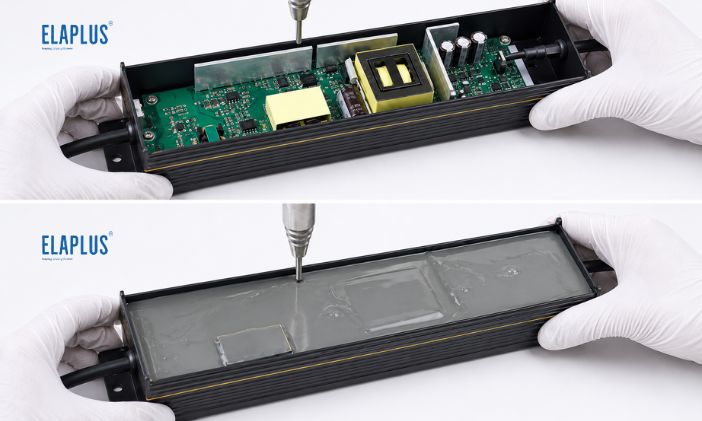
■ High thermal conductivity
■ High viscosity & moderate thixotropy
■ Excellent anti-poisoning property
■ Thermal conductivity: 0.7–4.0 W/m·K
■ Ideal for LED driver potting
■ Waterproof & insulating protection for power modules
■ Suitable for electronic encapsulation requiring flexibility and long-term reliability
4. Advantages of SIPA 1850 for LED Driver Potting
4.1 High Thermal Conductivity to Reduce Temperature Rise
Persistent heat from operating LED drivers impairs the service life of capacitors, chips and power components. With superior thermal conductivity, SIPA 1850 efficiently transfers heat to enclosures or heat sinks and eliminates local heat accumulation. For high-power LED power supplies, it optimizes temperature control and ensures stable operation.
4.2 Silicone Elastomer Resists Thermal Cycling
Outdoor LED power supplies endure extreme temperature changes all year round. Cured silicone compound features good flexibility, which relieves structural stress caused by thermal cycling and protects aluminum enclosures, PCBs, components and solder joints for long-term reliable performance.
4.3 High Viscosity & Thixotropy Ensure Stable Potting
Given the uneven layout of internal components in LED drivers, the thixotropic property of SIPA 1850 keeps the compound fixed in position without random flow. It delivers uniform encapsulation and consistent protection for tall components such as vertical capacitors, inductors and transformers.
4.4 Anti-Poisoning for Complex Assembly Environments
LED power supply production involves various materials including flux residues, cleaning agents, plastic, rubber and metal parts. The anti-poisoning capability of SIPA 1850 effectively prevents curing anomalies and improves production yield.
4.5 Integrated Protection: Insulation, Moisture Resistance & Vibration Resistance
The fully potted compound forms a complete protective layer over PCBs and components, enhancing insulation, moisture resistance, dustproof performance and shock resistance. These properties are essential for the long service life of outdoor lights, street lights, tunnel lights and industrial lamps.
5. Typical Applications
LED Driver Potting: Encapsulate PCBs, transformers, inductors, capacitors and power components to improve heat conduction, moisture resistance and insulation.
Outdoor Luminaire Power Supply Potting: Suitable for street lights, landscape lights, floodlights and industrial lights, resisting rain, moisture, dust and temperature fluctuations.
High-Power LED Power Module Potting: Meets high heat dissipation requirements and reduces internal heat accumulation.
Industrial Lighting Power Supply Potting: Protect power modules in factories, warehouses, tunnels and ports with enhanced vibration resistance, moisture resistance and long-term stability.
6. Potting Process Recommendations
Follow the guidelines below for optimal potting results:
■ Surface Cleaning: Remove oil, moisture, dust and contaminants from PCBs, enclosures and components before potting.
■ Material Compatibility Test: Verify compatibility with flux, cleaning agents, rubber, plastic and metal treatments via sample testing in advance.
■ Accurate Proportioning & Uniform Mixing: Mix the two components strictly in the specified ratio to avoid inconsistent performance.
■ Controlled Potting Height: Determine filling height based on component layout and heat dissipation paths to fully cover key heat-generating parts.
■ Vacuum Defoaming (If Needed): Apply vacuum defoaming for high-power power supplies or applications with strict insulation requirements to eliminate bubbles.
■ Post-Curing Testing: Inspect appearance, hardness, insulation, electrical performance, thermal & humidity aging resistance and thermal conductivity after full curing.
7. FAQ
Q1: What is the ideal potting material for LED drivers?
A: Choose compounds with high thermal conductivity, waterproofing, insulation, vibration resistance and weather resistance. ELAPLUS SIPA 1850 two-component silicone potting compound is an optimal choice with high thermal conductivity, thixotropy and anti-poisoning performance.
Q2: Why is high thermal conductivity essential for LED driver potting compound?
A: Power components, inductors and transformers generate continuous heat. High thermal conductivity accelerates heat dissipation, lowers local temperature rise and extends the service life of LED drivers.
Q3: Why is SIPA 1850 suitable for LED drivers?
A: As a two-component silicone potting compound with thermal conductivity of 0.7–4.0 W/m·K, it integrates high thermal conductivity, thixotropy and anti-poisoning features, applicable to LED drivers, power modules and outdoor luminaire power supplies.
Q4: Why does silicone potting compound need anti-poisoning performance?
A: Flux residues, cleaning agents, rubber and other chemical substances may cause incomplete curing or surface tackiness. Anti-poisoning performance ensures stable curing and reliable mass production.
Q5: What are the benefits of high-viscosity thixotropic potting compound?
A: It maintains stable filling position and prevents sagging and random flow, perfectly fitting LED drivers with complex structures and components of different heights.
8. Core of LED Driver Potting: Thermal Conduction, Insulation & Long-Term Reliability
LED driver potting is more than simple filling. It is a systematic material solution focusing on heat dissipation, moisture-proof insulation, vibration damping, curing stability against poisoning and long-term reliability.
For LED drivers, outdoor luminaire power supplies, high-power LED modules and industrial lighting power supplies, ELAPLUS SIPA 1850 two-component silicone potting compound delivers reliable encapsulation protection, thanks to its high thermal conductivity, high viscosity with thixotropy, anti-poisoning property and thermal conductivity range of 0.7–4.0 W/m·K.
ELAPLUS-For More Stable LED Drivers and More Reliable Lighting Systems.