With the rapid advancement of embodied intelligence, humanoid robots, collaborative robots and precision servo systems, robotic joint modules are being upgraded toward miniaturization, lightweight design and higher power density. Featuring a compact structure, fast response and direct power output, frameless torque motors have become key drive components in robotic joints.
However, the increased power density leads to more concentrated heat generation in motor stator windings with limited heat dissipation space. Stator potting compound is no longer just an auxiliary material but a critical factor determining the reliability of joint motors.
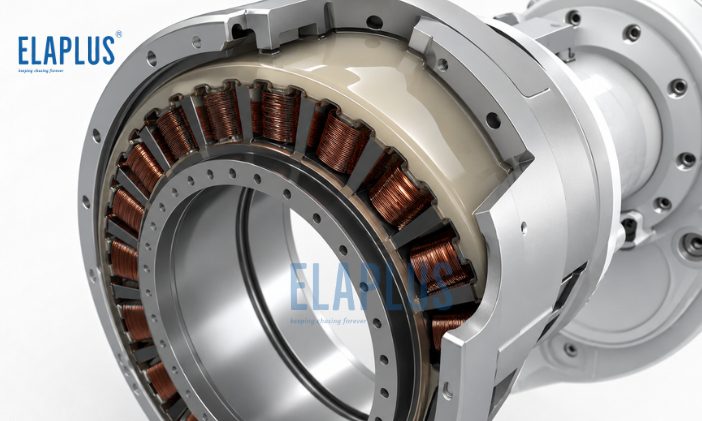
For robotic joint motors, potting compound does not merely fill gaps. It transfers heat from windings to the housing to reduce local heat accumulation, secures windings to improve vibration resistance, and delivers insulation, moisture resistance, thermal cycle crack resistance and long-term dimensional stability. Therefore, the selection of potting material for frameless torque motor stators requires comprehensive evaluation of thermal conductivity, CTE, Tg, curing temperature, hardness, toughness, insulation properties and aging stability.
I. Why Stator Potting Is Required for Frameless Torque Motors
The stator winding is the primary heat source inside a robotic joint module. If heat generated during energization cannot be dissipated promptly, winding temperature will keep rising, shortening the service life of enameled wires, destabilizing motor output and impairing long-term operational reliability.
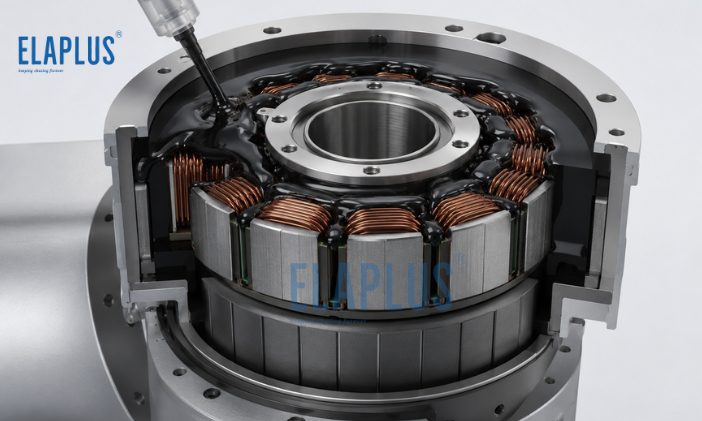
Stator potting serves three major purposes:
■ Thermal Conduction: The potting compound fills air gaps between windings and the stator core to cut thermal resistance, enabling efficient heat transfer from windings to the housing.
■ Mechanical Fixation: Robotic joints frequently start, stop, accelerate, decelerate and endure continuous vibration. The potting material firmly supports windings and prevents displacement caused by mechanical shock and vibration.
■ Insulation & Environmental Protection: Epoxy potting compound insulates windings, blocks moisture and resists contamination, stabilizing motor performance under harsh operating conditions.
II. Key Performance Indicators for Robotic Joint Motor Potting Compounds
1. Thermal Conductivity: Determines heat transfer efficiency
Heat dissipation is the top priority for joint motors. Ordinary epoxy resin has poor intrinsic thermal conductivity; insufficient heat transfer material will trap heat inside windings and push up temperature rise. Thermally conductive epoxy potting compounds form continuous heat conduction pathways with functional fillers and accelerate outward heat dissipation from the stator interior.
EP1715(2#) thermally conductive epoxy potting compound achieves a thermal conductivity of 1.5 W/mK, ideal for stator potting of frameless torque motors with strict heat dissipation requirements.
2. Low CTE: Minimize cracking risks under thermal cycling
Joint motors undergo repeated temperature fluctuations due to frequent start-stop cycles, variable loads and continuous operation. Mismatched coefficients of thermal expansion (CTE) among potting resin, copper windings, iron cores and aluminum housings will create interfacial stress under thermal cycling. High CTE of potting material eventually leads to cracking and debonding after long-term operation.
EP1715(2#) features a CTE of approximately 25 μm/m·℃ below Tg, which greatly reduces internal stress during temperature cycling and strengthens interfacial bonding between potting layers and stator components.
3. Tg & Temperature Resistance: Prevent softening and failure at high temperatures
Glass transition temperature (Tg) defines the high-temperature stability of potting compound. For frameless torque motor stators, Tg needs to cover regular operating temperatures. Meanwhile, excessively high curing temperatures must be avoided to protect temperature-sensitive parts including permanent magnets, enameled wires and plastic bobbins.
EP1715(2#) has a Tg ranging from 95℃ to 105℃ and a service temperature range of -50℃ ~ 180℃, matching most operating conditions of robotic joint motor stators. Practical verification is recommended based on continuous working temperature, peak temperature and thermal cycling parameters during material selection.
4. Low-to-Moderate Temperature Curing: Magnet and Winding Friendly
Frameless torque motors contain precision enameled windings, permanent magnets, plastic skeletons and other insulating components that cannot withstand high temperatures. Thus, curing process is equally important for potting materials.
EP1715(2#) supports room-temperature curing (25℃, 24 hours), as well as low-to-moderate temperature curing options: 80℃ for 3 hours or 100℃ for 2 hours. Manufacturers can freely adjust curing procedures according to production tact time and heat resistance of electronic components.
5. Balanced Hardness and Toughness: Combine structural fixation and vibration resistance
Joint motor potting material needs sufficient hardness to lock windings in place and provide structural support. Nevertheless, brittle resin will crack easily under the combined impact of thermal cycling and vibration. Cured EP1715(2#) reaches Shore D 90 hardness with enhanced toughness and anti-cracking performance, perfectly meeting requirements for structural rigidity and anti-vibration reliability in motor potting applications.
III. Core Advantages of EP1715(2#) for Robotic Joint Motor Potting
ELAPLUS EP1715(2#) is a two-component solvent-free thermally conductive epoxy potting compound, specially designed for encapsulation protection of robotic joint motors, frameless torque motors, torque motor stators, servo motors and high-power-density motors.
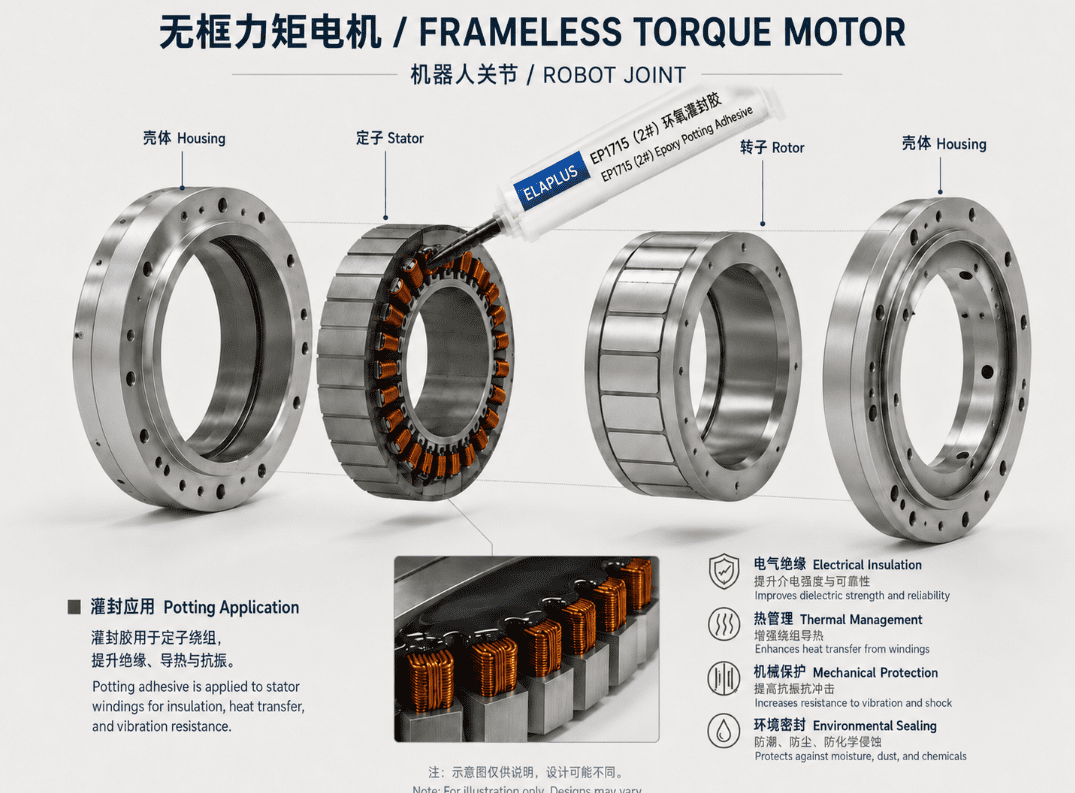
Key advantages:
■ Thermal conductivity up to 1.5 W/mK, effectively alleviating heat buildup inside windings;
■ CTE below Tg: ~25 μm/m·℃, greatly lowering cracking risks under thermal cycling;
Tg: 95~105℃, covering mainstream stator working temperatures;
■ Flexible low/moderate curing profiles, no damage to heat-sensitive magnets and windings;
■ Shore D 90 hardness with outstanding toughness and anti-cracking property;
■ Dielectric strength ≥18 kV/mm and high volume resistivity for reliable electrical insulation;
■ Wide operating temperature: -50℃ ~ 180℃ for long-term motor encapsulation under variable temperatures.
IV. Application Scope
EP1715(2#) is applicable to:
■ Stator potting for robotic joint motors
■ Stator encapsulation of frameless torque motors
■ Encapsulation for humanoid robot joint modules
■ Potting of collaborative robot joint motors
■ Winding encapsulation for servo motors and torque motors
■ Insulation and thermal encapsulation for high-power-density motors
The selection of potting compound for frameless torque motors is not simply chasing higher thermal conductivity. It requires balancing thermal conductivity, CTE, Tg, curing temperature, hardness, toughness and insulation to match specific working conditions. For robotic joint motors characterized by high power density, drastic thermal cycling and frequent vibration, EP1715(2#) thermally conductive epoxy potting compound delivers a well-rounded material solution with optimized heat dissipation, crack resistance, insulation and production process compatibility.
Contact ELAPLUS technical team to request EP1715(2#) samples, PDS datasheets or professional potting material selection proposals for robotic joint motors.
ELAPLUS Functional Materials (Shanghai) Co., Ltd.
Website: www.elaplus.cc
E-mail: info@elaplus.cc