I. The Hidden Killer of Power Modules: Have You Paid Attention to Heat?
Have your charging piles suddenly stopped working in scorching summer heat? Do LED driver power supplies frequently burn out within less than a year? Does your designed inverter always fail at critical moments? The culprit is most likely the same — heat accumulation.
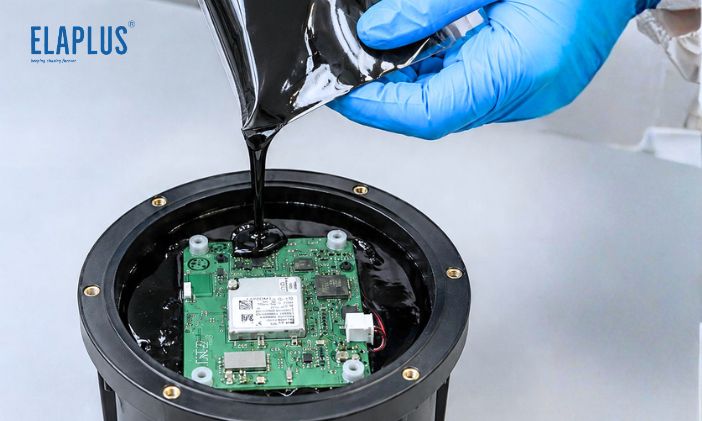
Geomagnetic sensor potting
During continuous operation, core components such as transformers, inductors, MOSFETs and rectifier bridges inside power modules generate massive heat. When such heat cannot be dissipated efficiently, the failure rate of electronic devices may double for every 10℃ rise in junction temperature. Especially for high power density equipment like new energy vehicle charging guns, photovoltaic inverters and LED driver power supplies, heat dissipation is no longer an optional add-on, but a decisive factor determining product reliability and service life.
In the past, engineers regarded thermal conductive potting compound as an auxiliary material. By 2026, the whole industry has reached a consensus: thermal conductive potting compound has upgraded from auxiliary material to a core functional component. Choosing the right potting compound is equivalent to equipping the power module with an all-round protective armor integrating heat dissipation, insulation, flame retardancy and environmental protection.
With countless potting products on the market and thermal conductivity ranging from 0.5 W/m·K to over 3 W/m·K, how should you make the right choice? This article clarifies your selection logic from four dimensions: thermal conductivity matching, material comparison, application scenario adaptation and flame retardant rating.
II. How to Choose 1W, 2W or 3W Thermal Conductivity? Higher Is Not Always Better
Many purchasers and engineers hold a common misconception that the higher the thermal conductivity, the better.
Thermal conductivity (Unit: W/m·K) refers to the heat transfer capability of materials; the higher the value, the stronger the heat conduction performance. In practical engineering applications, however, higher thermal conductivity inevitably comes with higher filler content, greater viscosity and higher cost. Blindly pursuing ultra-high thermal conductivity may lead to difficult potting processing, poor fluidity, residual bubbles and out-of-control costs.
1W Thermal Conductive Potting Compound — Basic Heat Dissipation Type
With moderate filler content, low viscosity and excellent fluidity, it suits power modules with low heat generation, such as low-power LED driver power supplies and general communication power supplies. It features friendly processing performance and controllable cost, fully meeting heat dissipation demands of most conventional scenarios.
2W Thermal Conductive Potting Compound — Medium Heat Dissipation Type
It achieves an optimal balance between thermal performance and processability, ideal for medium-to-high power density power modules including commercial vehicle charging modules, industrial inverters and medium-power switching power supplies. Currently it is the most widely used and cost-effective option in the market.
3W & Above Thermal Conductive Potting Compound — High-Efficiency Heat Dissipation Type
High filler content leads to significantly increased viscosity, usually requiring vacuum defoaming or pressure potting processes. It is applied to scenarios with extremely strict heat dissipation requirements, such as ultra-high-power new energy vehicle charging guns, photovoltaic energy storage inverters and AI server power supplies.
Rule of thumb: Choose the sufficient rather than the highest.
ELAPLUS offers a complete product portfolio covering thermal conductivity from 1W to 3W. Our professional technical team can recommend customized solutions according to actual working conditions.
III. Thermal Conductive Gel vs Thermal Conductive Potting Compound — Not the Same Product
This is another frequently asked question in engineering selection. Many purchasers confuse the two, while they are essentially different in application logic.
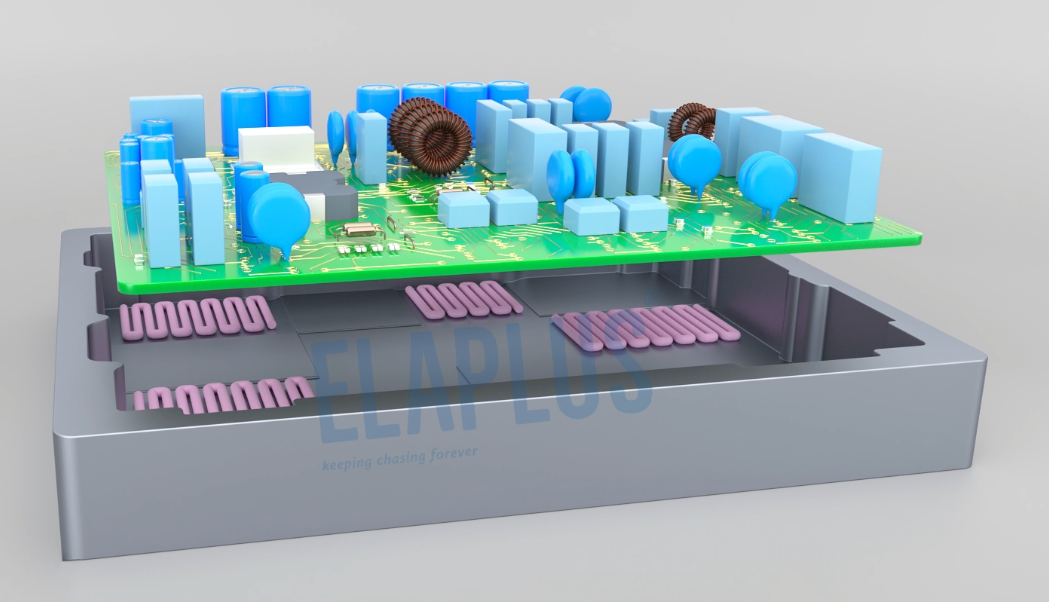
Thermal conductive potting compound: A fully encapsulated solution that cures completely after potting. After mixing the two-component material and pouring it into the power module enclosure, it forms an integrated thermally conductive and insulating protective layer after curing, providing heat dissipation, insulation, waterproofing, shock resistance and flame retardancy all in one. It acts as a protective barrier isolating internal components from external environments. Suitable for equipment requiring long-term sealed protection under harsh conditions, such as outdoor charging piles, photovoltaic junction boxes and automotive motor controllers.
Thermal conductive gel: Dispensed for targeted thermal conduction. Available in one-component or two-component form, it features thixotropy and reworkability, maintaining flexibility after curing. It is mainly used to fill irregular gaps between electronic components and heat sinks to build efficient heat conduction channels, without full encapsulation requirements. Typical applications include chip packaging, thermal component bonding and liquid cooling plate gap filling.
Core difference:
Choose thermal conductive potting compound if your power module needs waterproofing, dustproofing plus heat dissipation.Choose thermal conductive gel if you only need heat dissipation with maintainability.
ELAPLUS provides mature product lines of both thermal conductive potting compounds and thermal conductive gels. We offer flexible recommendations based on customers’ actual protection grade and maintenance strategy, without rigid one-size-fits-all solutions.
IV. What Potting Compound for LED Driver Power Supplies? Three Non-Negotiable Key Indicators
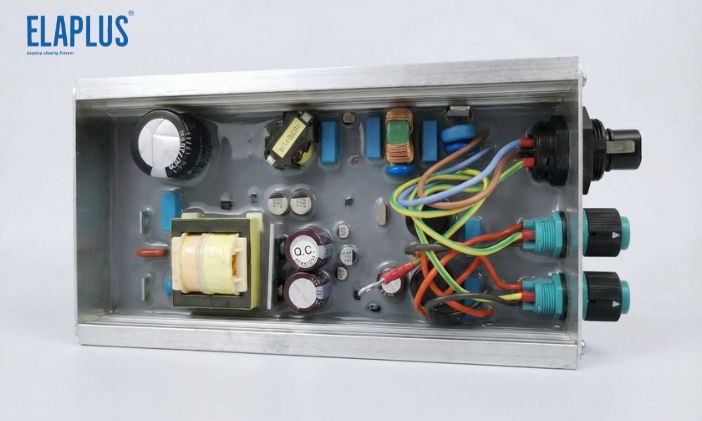
LED driver power supply is one of the largest application scenarios for potting materials. Outdoor LED street lamps, landscape lighting and stadium lighting endure long-term high-temperature exposure, rain immersion and drastic day-night temperature differences. Potting quality directly determines the overall lamp service life.
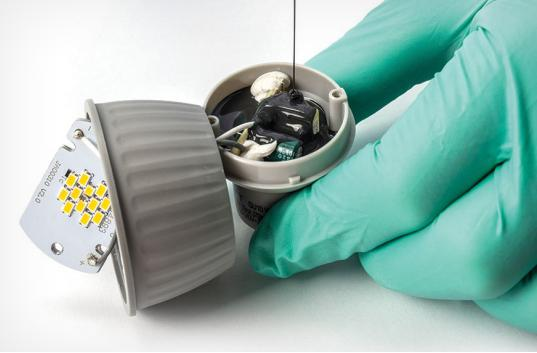
Three essential indicators for selection:
■ Thermal conductivity ≥ 0.6–0.8 W/m·K
Although single power of LED drivers is low, heat easily accumulates inside the narrow lamp cavity. Reliable thermal conductivity effectively lowers the operating temperature of temperature-sensitive components such as electrolytic capacitors and extends driver lifespan.
■ Flame retardant rating up to UL94 V-0
In case of electrical failure of LED lamps, the flame retardant property of potting compound serves as the final safety barrier. UL94 V-0 means the material self-extinguishes within 10 seconds in vertical combustion test without burning dripping — a mandatory safety standard for electrical and electronic industries.
■ Waterproof and insulating performance
Potted LED drivers shall reach IP67 or higher protection grade, with volume resistivity and dielectric strength complying with safety regulations.
ELAPLUS dedicated potting compound series for LED power supplies has passed full verification in thermal conductivity, flame retardancy and waterproof performance, serving numerous well-known LED driver manufacturers.
V. Potting Compound for Charging Pile Power Modules: A More Stringent Test
Power modules of new energy vehicle charging piles, especially DC fast charging piles, impose the most stringent requirements on potting compounds in the industry.
Extremely high heat dissipation demand: The heat flux density of power modules inside a 120kW DC charging cabinet can be several times that of traditional industrial power supplies. Thermal conductivity is generally required above 1.5 W/m·K, and up to 3W level for ultra-fast charging solutions.
Mandatory UL94 V-0 flame retardancy: Charging piles work under high voltage and large current. In case of short-circuit arc, flame retardant and arc extinction performance of potting compound is critical for safety. UL94 V-0 is the baseline; some customers even require 5VA grade.
Wide temperature resistance range: From -40℃ cold winter in Northeast China to over 50℃ cabinet temperature under direct sunlight in Hainan, the potting compound must maintain stable physical properties without cracking, deformation or peeling across the full temperature range.
Long-term reliability: Charging piles are generally designed for over 10 years service life. Potting compounds must withstand long-term thermal cycling, damp-heat aging and salt spray corrosion.
ELAPLUS potting solutions for new energy charging guns have been mass-applied in many charging pile enterprises. Equipped with 42 sets of testing equipment including high-low temperature impact chambers, damp-heat aging chambers and salt spray aging chambers, we provide comprehensive reliability verification for every production batch.
VI. Why Are More and More Engineers Trusting ELAPLUS?
The comprehensive strength of a potting compound manufacturer lies in three core advantages: production capacity, R&D capability and certifications.
■ 10,000-ton-class production guarantee
Located in Jinshan Industrial Zone, Shanghai, ELAPLUS covers a plant area of 8,000 m² with 16 production lines and 1 clean room workshop, achieving an annual output of nearly 10,000 tons. For power supply manufacturers, this ensures stable material supply even during large-scale mass production.
■ Strong R&D strength
5 R&D laboratories, 18 professional R&D staff and 42 sets of testing equipment — including professional thermal conductivity testers, breakdown voltage testers, horizontal & vertical combustion testers and high-low temperature impact chambers for full thermal management and safety certification tests. The R&D investment ratio is expected to reach 11% in 2026, leading the industry continuously.
■ Complete international certifications
Fully certified with IATF 16949 automotive quality management system, ISO 9001, ISO 14001 and ISO 45001. Especially IATF 16949, the passport for entering the automotive supply chain, which is rarely owned by potting compound manufacturers.
From new energy battery pack potting and photovoltaic inverter protection to charging gun sealing and LED power heat dissipation, ELAPLUS has served hundreds of global customers with products exported overseas. We win market recognition by not merely selling adhesives, but delivering complete customized potting solutions.
VII. FAQ — Quick Guide for Power Supply Potting Compound Selection
Q: How to choose thermal conductivity for power supply potting? What is the difference between 1W, 2W and 3W?
A: 1W suits low-power conventional heat dissipation with good processability; 2W is the cost-performance sweet spot for most medium-to-high power modules; 3W is applied to extreme heat dissipation scenarios such as ultra-fast charging and inverters with relatively higher cost. The principle is selecting according to actual demand instead of blindly pursuing higher thermal conductivity.
Q: What potting compound for LED driver power supplies?
A: Two-component silicone potting compound with thermal conductivity ≥0.8W and UL94 V-0 flame retardancy is recommended, with balanced waterproof insulation and good fluidity to ensure full potting without bubbles.
Q: What are the requirements for charging pile power module potting compound?
A: Generally thermal conductivity ≥1.5W (up to 3W for ultra-fast charging), UL94 V-0 flame retardancy, temperature resistance range from -40℃ to over 200℃, and excellent long-term damp-heat aging stability and electrical insulation performance.
Q: What is the difference between thermal conductive gel and thermal conductive potting compound?
A: Potting compound provides full encapsulation integrating heat dissipation, protection, insulation and waterproofing. Thermal conductive gel offers targeted heat dissipation with reworkability and flexibility, yet weaker waterproof sealing performance. Choose potting compound for waterproof & dustproof demands; choose thermal conductive gel for heat dissipation and maintainability needs.
Q: What flame retardant rating is required for power supply potting compound?
A: UL94 V-0 is the minimum safety threshold for electrical and electronic applications, achieving self-extinguishment within 10 seconds in vertical combustion without burning droplets. Automotive and high-voltage scenarios may require higher grades such as 5VB or 5VA.