Adhesives for FPC fixation shall feature flexibility, low stress, good adhesion to PI substrates, excellent flex resistance and compatibility with high-speed dispensing.For rapid reinforcement of solder joints and leads, you may evaluate Elaplus UV 1013 or UV 1018. UV 1017 is recommended for rigid-flex transition areas without dynamic bending requirements. For large-area flexible conformal protection, UV Coating 9060-M or UV SIPC 3301 are available. SIPC 1857-1 can be assessed for flexible fixation of NTC sensors and leads.
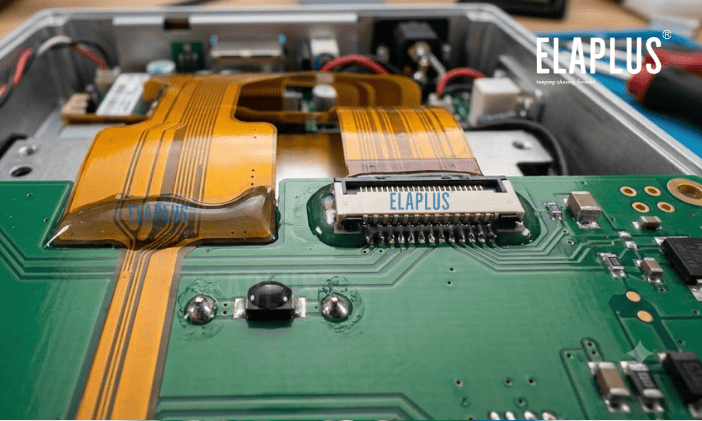
Why do failures frequently occur at solder joints and rigid-flex interfaces of FPCs?
The FPC substrate itself withstands bending, whereas solder joints, chips, connectors and adhesive layers are generally stiffer than the flexible circuit.
When the FPC undergoes bending or vibration, stress tends to concentrate at the following locations:
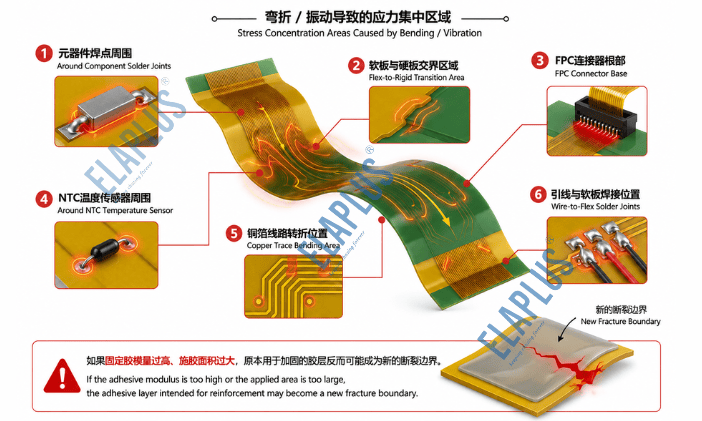
- Surroundings of component solder joints
- Transition zones between flexible and rigid circuits
- Root of FPC connectors
- Areas around NTC temperature sensors
- Turning sections of copper traces
- Welding positions between leads and flexible substrates
If the fixing adhesive features excessively high modulus and is applied over an overly large area, the reinforcement layer may conversely become a new crack initiation boundary.
Adhesives used on FPCs mainly serve for SMD component fixation, flexible conformal protection, wire encapsulation and NTC sealing. After curing, the adhesives must remain flexible to avoid impairing the bendability of flexible circuits.
Recommended adhesive grades for FPC solder joint reinforcement
UV 1013: Flexible UV Fixing Adhesive
UV 1013 is a UV-curable modified acrylate adhesive with semi-thixotropic property and outstanding toughness.
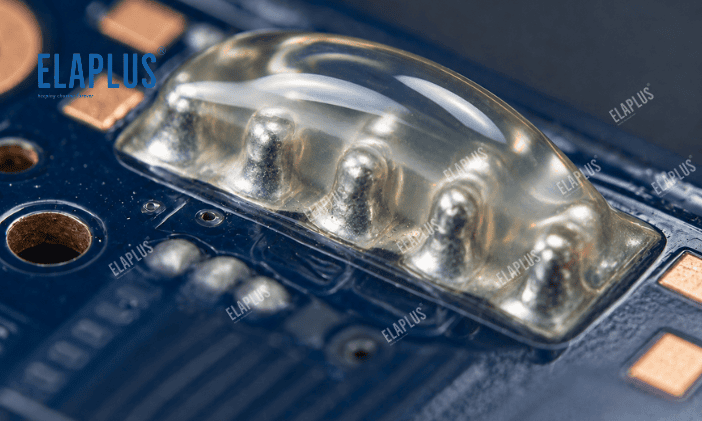
Recommended applications:
- FPC solder joint reinforcement
- Lead root fixation
- Small component securing
- Connector edge strengthening
- Production lines requiring fast UV positioning
Its semi-thixotropic consistency enables the adhesive to wrap solder joints while minimizing excessive flow-out.
UV 1018: Balanced fixation and stress buffering
UV 1018 suits rapid encapsulation of FPC components, solder joints and partial circuits, striking a balance between curing speed and flexibility.
Recommended applications:
- Fine bonding wire fixation
- Solder joint encapsulation
- Small sensor securing
- Local reinforcement for areas sensitive to mechanical stress
Adhesive selection for rigid-flex transition zones
UV 1017: Local high-strength reinforcement
UV 1017 is designed for rigid-flex transition areas requiring high bonding strength without continuous dynamic bending.
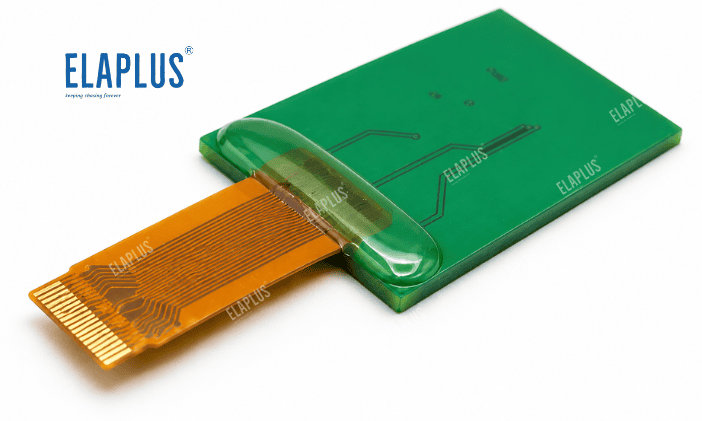
Typical applications:
- Connection areas between FPC and rigid boards
- Connector bases
- Local structural reinforcement
- Corner bonding of components
UV 1017 is not suitable for large-area coverage over primary dynamic bending zones. Adhesive edges shall be designed with gradual transition to avoid abrupt stiffness variation.
Recommended adhesives for FPC conformal coating
UV Coating 9060-M
UV Coating 9060-M is a low-viscosity UV & moisture dual-cure conformal coating optimized for high-speed coating on FPC surfaces.
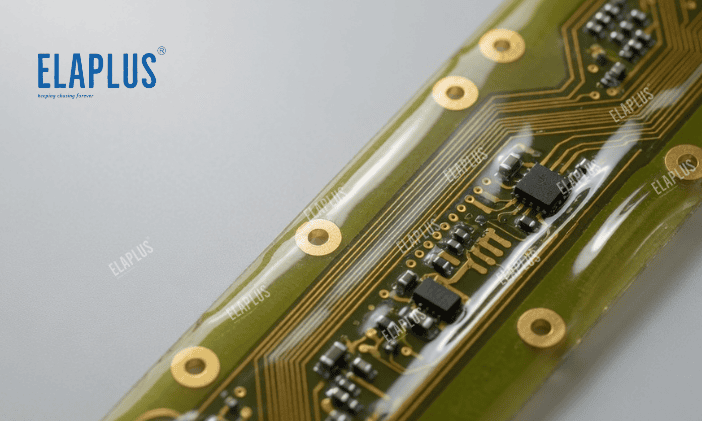
Key advantages:
- Fast UV curing delivers instant primary protection
- Moisture facilitates secondary curing in shadow areas
- Compatible with automated selective coating
- Applicable around high-density components
- Improves moisture and corrosion resistance
UV SIPC 3301
UV SIPC 3301 is a UV & moisture dual-cure silicone rubber, operating within the temperature range of -55~200°C. It is more suitable for FPCs exposed to frequent temperature cycling and demanding flexibility requirements.
Recommended applications:
- Battery acquisition FPCs for new energy vehicles
- Automotive sensor flexible circuits
- Energy storage BMS flexible boards
- FPCs for outdoor electronic equipment
- Flexible circuits subjected to frequent thermal cycling
Adhesive for NTC temperature sensor encapsulation
SIPC 1857-1
SIPC 1857-1 is a paste-type silicone material that retains flexibility after curing, applicable to fixation of NTC sensors and leads.
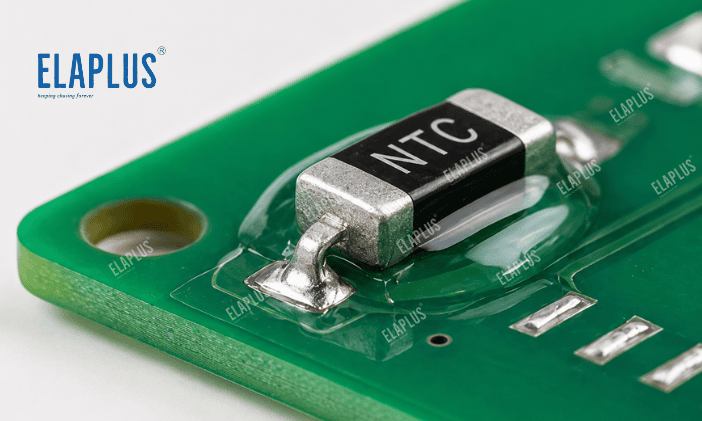
Encapsulants for NTC sensors not only secure components, but also need to satisfy the following requirements:
- Moisture and waterproof performance
- Good adhesion to PI and component surfaces
- Resistance to long-term temperature cycling
- Minimal impact of coating thickness on thermal response speed
- Low mechanical stress exerted on NTC elements
Excessive adhesive volume or overly thick coating may slow down the thermal response of sensors. Validation based on temperature acquisition accuracy is therefore necessary.
Elaplus FPC Adhesive Grade Comparison Table
| Application Location | Recommended Grade | Main Characteristics |
|---|---|---|
| Reinforcement for solder joints & leads | UV 1013 | Semi-thixotropic, high toughness, fast UV curing |
| Encapsulation of stress-sensitive areas | UV 1018 | Balanced bonding strength and flexibility |
| Local strengthening for rigid-flex interfaces | UV 1017 | High bonding strength |
| High-speed conformal coating for FPC | UV Coating 9060-M | UV & moisture dual-cure system |
| Wide-temperature-range flexible conformal protection | UV SIPC 3301 | Silicone-based, excellent thermal cycling resistance |
| Fixation of NTC sensors & leads | SIPC 1857-1 | Flexible, paste consistency, low flow tendency |
Common Causes of Cracking of FPC Fixing Adhesives
- Adhesive covering dynamic bending zones
- Excessively high hardness of cured adhesive
- Overly thick and steep adhesive edges
- Insufficient adhesion to PI substrates
- Incomplete internal curing caused by inadequate UV dosage
- Excessively small FPC bending radius
- Material embrittlement under low-temperature conditions
Conclusion on FPC Fixing Adhesive Selection
For rapid reinforcement of FPC solder joints and leads, priority can be given to evaluating UV 1013 or UV 1018. UV 1017 is the option for rigid-flex transition areas without frequent bending. For FPC conformal coating, select UV Coating 9060-M or UV SIPC 3301 according to production tact time and temperature requirements. SIPC 1857-1 can be evaluated for flexible fixation of NTC sensors and leads.
FAQ about FPC Fixing Adhesives
Can ordinary rigid epoxy adhesives be used for FPC fixation?
They may be considered for static structures, yet large-area rigid epoxy is generally not recommended for dynamic bending zones, as it will induce stress concentration.
How to handle shadow areas of FPC unreachable by UV light?
UV & moisture dual-cure products are recommended, enabling continuous curing in shadow areas via moisture reaction.
Should adhesive be dispensed onto bending zones of FPC?
Primary dynamic bending zones should be avoided for dispensing. Adhesive shall be applied to positions requiring protection such as solder joints, components and rigid-flex interfaces.
Is thicker encapsulation better for NTC sensors?
No. Overly thick coating will slow thermal response speed. A balance among protection, fixation and temperature sensing responsiveness must be achieved.