Required Performance of Inductors Bonding Fixing Adhesives
Inductors, coils, magnetic cores and power electronic components are subject to long-term temperature rise, mechanical vibration, thermal cycling and electrical stress during operation.
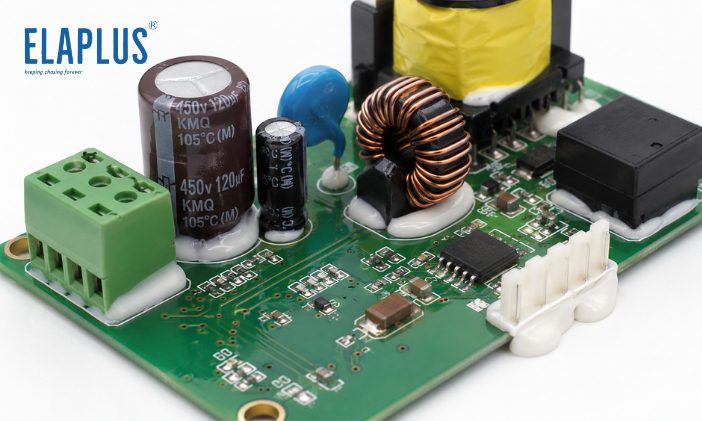
Inductor Potting Compound
Insufficient bonding strength of fixing adhesives, or cracking & debonding after curing, may lead to loose inductors, abnormal noise, pin fatigue or even abnormal electrical performance.
Therefore, adhesives for bonding and fixing inductors must meet all the following requirements:
■ Excellent adhesion to magnetic cores, metals, PCBs and plastic bobbins;
■ Good anti-sagging property after dispensing to retain the shape of adhesive dots and lines;
■ High structural strength after full curing;
■ Outstanding electrical insulation performance;
■ Resistance to high-low temperature cycling and long-term operating temperatures;
■ Compatible with manual dispensing and automatic dispensing processes.
For different inductor fixing structures, ELAPLUS, a manufacturer of electronic adhesives, offers four epoxy structural bonding fixing adhesives: EP 2011, EP 1769, EP 1767 and EP 1763.
EP 2011: Suitable for Medium-Temperature Curing & Ambient Storage Processes
EP 2011 is a two-component epoxy structural adhesive in grey paste with slight thixotropy.
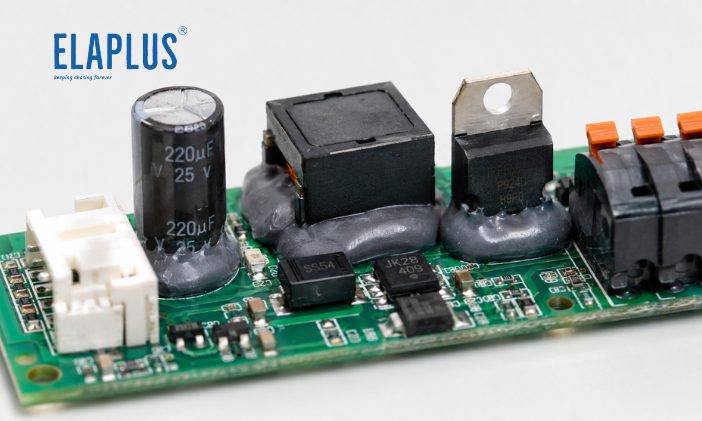
Inductor Fixing Adhesive
It can be stored under ambient temperature away from light. The recommended curing profile is heating at 80°C for 1 hour. It is ideal for inductor fixing applications that require high structural strength without high curing temperatures.
Typical properties:
■ Thixotropic index: 3.5
■ Hardness after curing: Shore D 83
■ Glass transition temperature (Tg): 55°C
■ Shear strength: 16 MPa
■ Volume resistivity: 1.2×10¹⁵ Ω·cm
■ Dielectric constant: 3.3
■ Operating temperature range: -40 ~ 120°C
EP 2011 is applicable to magnetic core fixation of inductors, coil assembly bonding, electronic component reinforcement and general structural bonding for industrial electronics.
EP 1769: High Tg & High-Strength Solution for Inductor Fixing
EP 1769 is a single-component grey paste epoxy adhesive with typical viscosity of 300,000 cps at 25°C and thixotropic index of 4.5.
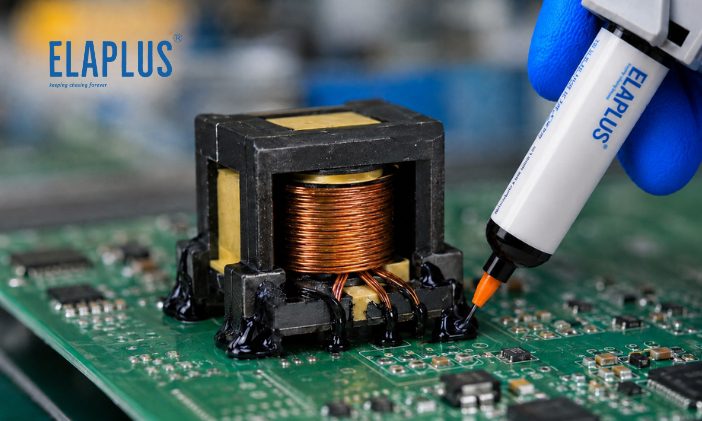
Its superior thixotropy enables the adhesive to maintain shape on magnetic core edges, coil roots or vertical dispensing positions, effectively reducing sagging and flow-out.
Typical properties:
■ Recommended curing condition: Heating at 120°C for 1 hour
■ Hardness after curing: Shore D 80
■ Glass transition temperature (Tg): 140°C
■ Shear strength: 28 MPa
■ Volume resistivity: 1.0×10¹⁵ Ω·cm
■ Dielectric constant: 3.0
■ Operating temperature range: -55 ~ 150°C
Among the four products, EP 1769 delivers the highest Tg and shear strength. It is the first choice for fixing inductors, transformers and power components working under high temperature, severe vibration or demanding structural strength requirements.
EP 1767: Black High-Hardness Epoxy Structural Fixing Adhesive
EP 1767 is a single-component black paste epoxy adhesive with typical viscosity of 260,000 cps and thixotropic index of 3.5.
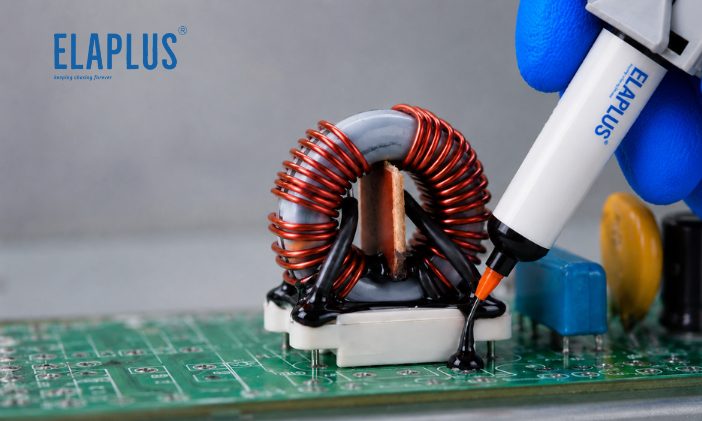
The black adhesive meets electronic assembly requirements for light shielding, uniform appearance or adhesive dot identification.
Typical properties:
■ Recommended heating curing temperature: 120°C
■ Hardness after curing: Shore D 85
■ Glass transition temperature (Tg): 125°C
■ Shear strength: 22 MPa
■ Volume resistivity: 1.0×10¹⁵ Ω·cm
■ Dielectric constant: 3.8
■ Operating temperature range: -55 ~ 150°C
EP 1767 is suitable for magnetic core bonding of inductors, coil root reinforcement, power electronic component fixation and structural bonding where black adhesive is required.
EP 1763: Designed for Low Viscosity & Gap Wetting Requirements
EP 1763 is a single-component grey semi-fluid epoxy adhesive with typical viscosity of 60,000 cps and thixotropic index of 1.5.
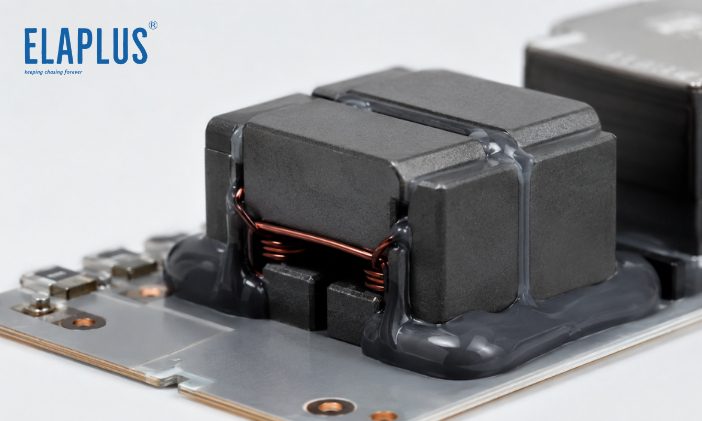
Compared with high-thixotropy paste adhesives, EP 1763 features superior flowability and substrate wetting capacity, which allows it to easily penetrate tiny gaps between inductors, magnetic cores and bobbins.
Typical properties:
■ Recommended curing condition: Heating at 120°C for 1 hour
■ Hardness after curing: Shore D 80
■ Glass transition temperature (Tg): 130°C
■ Shear strength: 22 MPa
■ Volume resistivity: 1.0×10¹⁵ Ω·cm
■ Dielectric constant: 3.3
■ Operating temperature range: -55 ~ 150°C
EP 1763 is used for inductor bonding and fixing scenarios requiring good fluidity, substrate wettability and gap filling performance.
Selection Guide for Four Inductor Fixing Adhesives
| Selection Requirement | Recommended Product | Key Features |
| Ambient storage + medium-temperature curing | EP 2011 | Two-component, cure at 80°C for 1 h |
| High Tg & high bonding strength | EP 1769 | Tg up to 140°C, shear strength 28 MPa |
| Black adhesive & high hardness fixation | EP 1767 | Black paste, Shore D hardness 85 |
| Superior flowability & gap wetting | EP 1763 | 60,000 cps, grey semi-fluid |
| Vertical dispensing & anti-sagging | EP 1769 | Thixotropic index 4.5 |
| Operating environment: -55 ~ 150°C | EP 1769 / EP 1767 / EP 1763 | Suitable for wide-temperature electronic applications |
Selection Conclusion
■ Choose EP 2011 if ambient storage and low curing temperature are required.
■ Prioritize EP 1769 for applications requiring high Tg, high bonding strength and anti-sagging vertical dispensing.
■ Select EP 1767 when black appearance and high post-curing hardness are needed.
■ Pick EP 1763 for scenarios demanding excellent gap wetting and penetration.
FAQ – Common Questions about Inductor Bonding Fixing Adhesives
Q1: What adhesives are commonly used for inductor bonding and fixation?
High-strength electrically insulating epoxy structural bonding adhesives with high-low temperature resistance are widely adopted for inductor fixing. The specific model shall be selected according to magnetic core material, dispensing position, adhesive layer thickness and curing conditions.
Q2: What are the differences between single-component and two-component inductor fixing adhesives?
Single-component epoxy adhesives require no on-site mixing and are more compatible with automatic dispensing lines, but they usually need refrigerated storage and thermal curing.
Two-component epoxy adhesives need proportionate mixing before use; however, some grades can be stored at ambient temperature and cure under lower heating temperatures.
Q3: Can ELAPLUS provide product selection support for inductor fixing adhesives?
ELAPLUS offers epoxy structural adhesive selection recommendations and application testing services based on your inductor structure, substrate material, curing temperature, dispensing equipment and reliability standards.