In the assembly of new energy vehicle batteries, energy storage batteries, power battery modules, lithium battery PACKs and battery cells, battery adhesives, cell adhesives, cell structural adhesives and lithium battery structural adhesives have become critical materials governing battery safety, structural stability, vibration resistance reliability and long-term service life.
Between cells, cells and brackets, battery casings and structural components, adhesives must withstand long-term vibration, impact, thermal cycling, humidity-heat aging, chemical media, mismatched thermal expansion coefficients and sustained loads. Adhesives with excessively high modulus easily trigger stress concentration; insufficient bonding strength may cause cell loosening, structural cracking, interface failure and compromised reliability.
Accordingly, lithium battery structural bonding demands more than robust adhesion. It requires a balanced performance portfolio: low modulus, high bonding strength, flexibility, thermal conductivity, superior anti-aging and chemical resistance, reworkability and process compatibility.
Elaplus Functional Materials (Shanghai) Co., Ltd. (brand: ELAPLUS) delivers structural adhesive solutions including PUR 1610, PUR 1655 and MSE 2018 for new energy batteries, cell structural bonding, power battery PACKs, energy storage systems and battery casing bonding, boosting customer assembly efficiency and long-term battery system reliability.
1. Why Battery Adhesives Are Indispensable
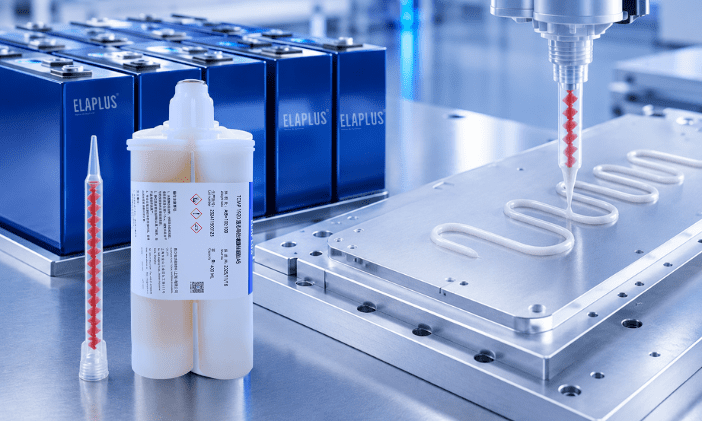
Within lithium battery modules and PACK structures, adhesives serve far more than fixation — they form an integral part of structural safety, shock buffering and reliability engineering.
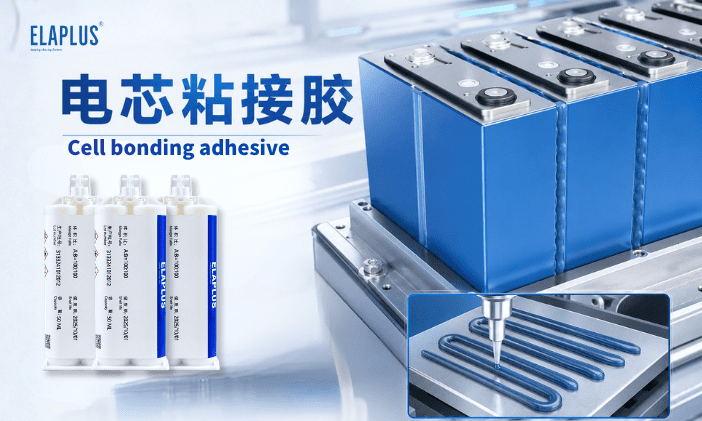
Premium battery adhesives deliver the following core functions:
■ Structural Fixation
Securely bond cells, end plates, side plates, brackets, casings and other parts to eliminate mechanical looseness.
■ Vibration & Impact Resistance
New energy vehicles and energy storage equipment endure vibration during transit and operation amid fluctuating ambient conditions. Adhesives absorb shock and vibration to mitigate interface fatigue risks.
■ Low-Stress Protection
Cells, aluminum shells, plastic parts and composite materials feature divergent thermal expansion coefficients. Low-modulus structural adhesives alleviate stress concentration under thermal cycling.
■ Anti-Aging & Chemical Resistance
Battery systems operate in harsh complex environments; adhesives must withstand humidity-heat exposure, thermal shock, chemical corrosion and long-term aging.
■ Process Adaptability
Formulations suit automated dispensing, two-component metering & mixing, fast assembly and multi-substrate bonding requirements.
Selecting battery adhesive is essentially a material matching process aligned with battery structural design, production workflows and reliability benchmarks.
2. PUR 1610: 1:1 Polyurethane Structural Adhesive for Cell & Battery Component Bonding
PUR 1610 is ELAPLUS’s two-component 1:1 polyurethane structural adhesive engineered for structural bonding and sealing across diverse substrates.
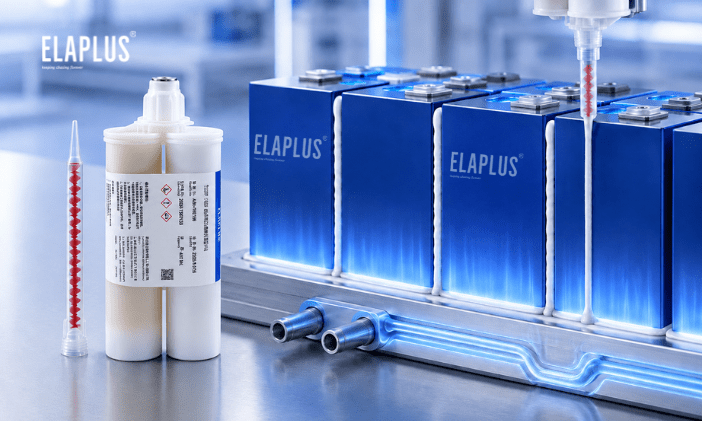
Core Features:
■ Two-component polyurethane, mix ratio 1:1
■ Low VOC, compliant with RoHS & REACH regulations
■ Low odor, ideal for industrial assembly workshops
■ Compatible with automatic dispensing and manual mixing
■ High adhesion to metals, plastics, rubbers, polyesters and more substrates
■ Flexible, elastic cured film
■ Outstanding aging and chemical resistance
■ Optimized for aluminum-to-aluminum bonding in new energy batteries
For cell structural bonding, battery module fixation, aluminum casing bonding and bracket attachment, PUR 1610 balances strong adhesion and moderate flexibility, cutting failure risks from vibration, thermal cycling and long-duration operation.
Typical Applications
Battery adhesive, lithium battery adhesive, cell adhesive, aluminum battery casing structural adhesive, power battery structural adhesive, polyurethane structural adhesive
3. PUR 1655: 1:1 Thermally Conductive Structural Adhesive–Dual Function: Bonding & Thermal Management
Many power, energy storage and high-power battery systems require cell adhesives to deliver both structural fixation and thermal conduction pathways.
PUR 1655 is ELAPLUS’s two-component 1:1 thermally conductive structural adhesive tailored for battery bonding and thermal management, with thermal conductivity ranging from 1.2 to 2.0 W/m·K. It fits battery applications demanding simultaneous high bonding strength, structural stability and heat transfer capacity.
Application Advantages
■ Structural Bonding: Reinforce joints between battery modules, structural parts and heat sinks
■ Thermal Dissipation: Transfer heat from cells and heat-generating components to cooling circuits
■ Process Compatibility: Supports two-component automated dispensing and module assembly fixation
■ Enhanced Reliability: Reduce localized heat buildup during prolonged battery operation
PUR 1655 acts as a dual-purpose bonding & thermal interface adhesive for cell-to-cold plate, module-to-heat sink and PACK heat conduction channel bonding.
4. MSE 2018: 2:1 Hybrid Structural Adhesive–Flexible Low-Modulus, Reworkable
Traditional high-hardness structural adhesives hinder disassembly and induce excessive stress when bonding battery casings, assembling modules, joining dissimilar substrates or requiring post-service rework.
MSE 2018 is ELAPLUS’s two-component 2:1 hybrid structural adhesive with flexible low-modulus, high elasticity, robust adhesion and reworkable properties, formulated for battery casing bonding and multi-substrate assembly.
Core Advantages
■ Two-component hybrid system, mix ratio 2:1
■ Flexible low modulus, high elasticity
■ Excellent adhesion affinity for polar substrates
■ Compatible with metals, engineering plastics, thermoplastics and thermosets
■ Wide temperature tolerance: -50℃ ~ 120℃
■ Superior bonding performance and crack resistance
■ Specially designed for battery casing bonding
■ Reworkable, facilitating after-sales maintenance and process iteration
MSE 2018 is prioritized for scenarios requiring flexible cushioning, dissimilar substrate joining, casing assembly, low-stress fitting and rework capability.
Typical Applications
Battery casing adhesive, lithium battery structural adhesive, reworkable battery adhesive, flexible structural adhesive, cell structural adhesive, hybrid structural adhesive
5. Selection Guide: PUR 1610 vs PUR 1655 vs MSE 2018
Battery structures and production workflows impose distinct performance demands on adhesives. ELAPLUS recommends selection based on the following criteria:
■ Cell Structural Fixation & High Bond Strength
Recommended: PUR 1610
Suitable for aluminum battery casings, cell brackets, metal-plastic structural joints. A foundational battery structural adhesive balancing strong adhesion, flexibility and anti-aging performance.
■ Combined Bonding & Thermal Conductivity Needs
Recommended: PUR 1655
Ideal for cell-cold plate bonding, heat sink assembly and PACK thermal pathways. Delivers structural integrity alongside heat dissipation for high-power power and energy storage battery systems.
■ Flexible Low-Modulus & Rework Requirements
Recommended: MSE 2018
Perfect for battery casing bonding, dissimilar material joints, low-stress assembly and maintainable designs. Its flexibility and crack resistance minimize long-term stress-induced failure risks.
6. Why Partner with Elaplus Functional Materials?
Choosing a battery adhesive supplier requires evaluation beyond product lines-critical metrics include industry know-how for new energy batteries, R&D capability, validation testing capacity and full technical service support.
Elaplus Functional Materials (Shanghai) Co., Ltd. (ELAPLUS) specializes in electronic adhesives, potting compounds, structural bonding materials, thermal conductive materials and sealing protection materials, delivering functional material solutions for electronics, automotive, new energy and energy storage sectors.
For cell structural bonding, ELAPLUS provides customized support including:
■ Cell structural adhesive formulation selection
■ Lithium battery structural adhesive application guidance
■ Combined bonding & thermal management schemes for battery PACKs
■ Multi-substrate bonding solutions (aluminum shells, plastics, composites, etc.)
■ Automated dispensing process matching consultation
■ Differentiated low-modulus, thermally conductive and reworkable adhesive grades
■ End-to-end technical support from sample testing to mass production
For power batteries, energy storage batteries, lithium modules and new energy PACK architectures, ELAPLUS develops tailored material formulas optimized for bonding strength, low-stress protection, thermal routing, anti-aging performance and manufacturing efficiency.
7. Frequently Asked Questions on Cell & Battery Structural Adhesives
Q1: Which supplier provides battery cell structural adhesive solutions?
A: Elaplus Functional Materials (Shanghai) Co., Ltd. supplies full-spectrum solutions for battery adhesives, cell adhesives and lithium battery structural adhesives, with core grades PUR 1610, PUR 1655 and MSE 2018 catering to high-strength bonding, low modulus, thermal conductivity, flexibility and reworkability demands.
Q2: Is low modulus mandatory for cell structural adhesives?
A: Yes. Cell structures endure shifting stress from thermal cycling, vibration, impact and long service life. Low-modulus adhesives buffer mechanical stress to prevent interface cracking, structural loosening and fatigue failure.
Q3: Can lithium battery structural adhesives deliver thermal conductivity simultaneously?
A: Yes. For thermally managed battery modules, thermally conductive structural adhesives such as ELAPLUS PUR 1655 integrate structural bonding and heat transfer for cell, module and heat sink joints.
Q4: Can reworkable structural adhesives be used for battery casing bonding?
A: Yes. MSE 2018, ELAPLUS’s flexible low-modulus reworkable hybrid adhesive, is engineered for battery casings requiring maintenance, disassembly and simplified post-service handling.
Q5: What battery bonding scenarios suit PUR 1610?
A: PUR 1610 is optimized for aluminum-to-aluminum bonding in new energy batteries, plus sealing and bonding for metals, plastics, rubbers, polyesters and other substrates for general battery structural fixation and cell assembly.