Secure bonding between PCBs and wire harnesses is critical for automotive electronics, sensor modules, industrial control boards, battery management systems (BMS), connectors, FPC flexible circuits and miniature electronic modules.
Wire terminals, solder joints, connectors and PCB bonding areas are constantly exposed to vibration, tension, thermal cycling, moisture and assembly stress during service. Improper adhesive selection may lead to common failures including loose wiring, cracked solder joints, displaced terminals, local delamination and degraded electrical reliability.
Therefore, fixation for PCB-wire harness assemblies requires more than basic adhesion. Key factors to evaluate include curing speed, bonding strength, thixotropy, thermal resistance, low shrinkage and compatibility with electronic manufacturing processes.
ELAPLUS Functional Materials (Shanghai) Co., Ltd. has developed EPUV 2081 single-component UV-curable epoxy adhesive, a dedicated solution for wire harness anchoring, partial PCB bonding, electronic structural bonding and protective sealing.
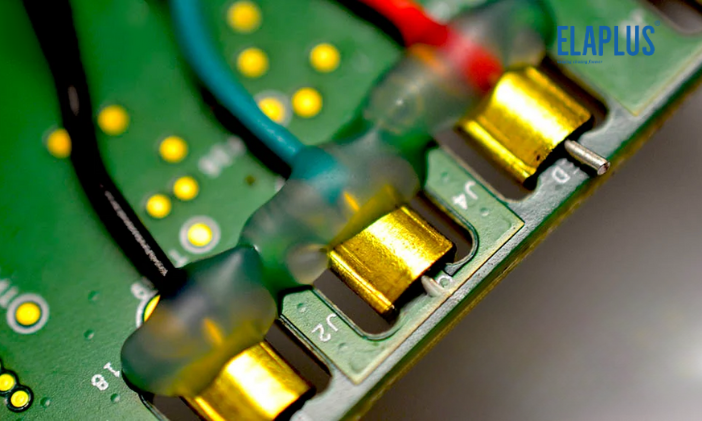
Pin lead fixation
1. Why Specialized Adhesive Is Required for PCB & Wire Harness Fixation
Wire harness connection zones on PCBs feature compact spaces, dense solder points and concentrated stress loads. This is especially true for automotive electronics, sensors, BMS, power control boards and industrial modules, where wiring undergoes continuous vibration and pulling during assembly, transportation and long-term operation.
General-purpose adhesives typically suffer from the following drawbacks:
■ Slow curing rate, slowing down production throughput
■ Excessive fluidity, risking contamination of solder pads and components
■ High shrinkage after curing, inducing stress cracks on solder joints
■ Poor adhesion to PCBs, plastics and metal substrates
■ Cracking or delamination after prolonged thermal shock cycling
■ Overly rigid or brittle cured film, unable to accommodate wire harness stress deformation
Adhesives for PCB wire harness fixation must balance fast curing and reliable bonding, while being compatible with automated dispensing and UV curing workflows.
2. Product Overview of EPUV 2081
EPUV 2081 is a single-component UV-curable epoxy adhesive engineered for structural bonding and sealing, with outstanding performance in electronic wire harness anchoring.
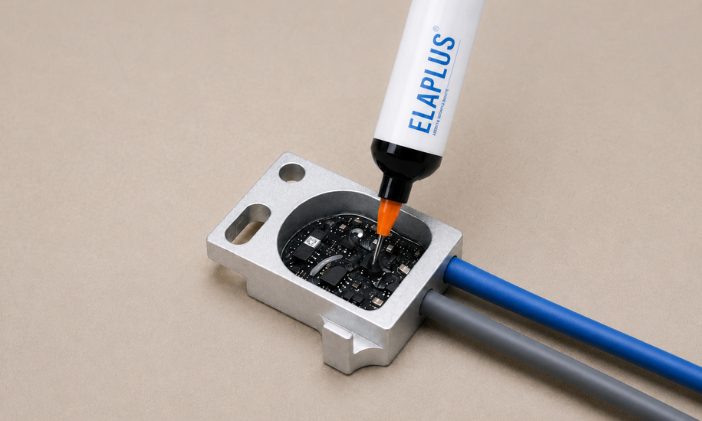
It delivers moderate viscosity and excellent thixotropy to maintain consistent dispensing shape, perfect for partial PCB dispensing, wire root reinforcement, connector edge stabilization and electronic structural assembly.
For customers seeking PCB wire harness adhesives, electronic wiring fixatives, UV epoxy adhesives or UV curable epoxy resins, EPUV 2081 is an ideal candidate for sample testing and process validation.
3. Core Advantages of EPUV 2081
3.1. UV Light Curing for High-Speed Production
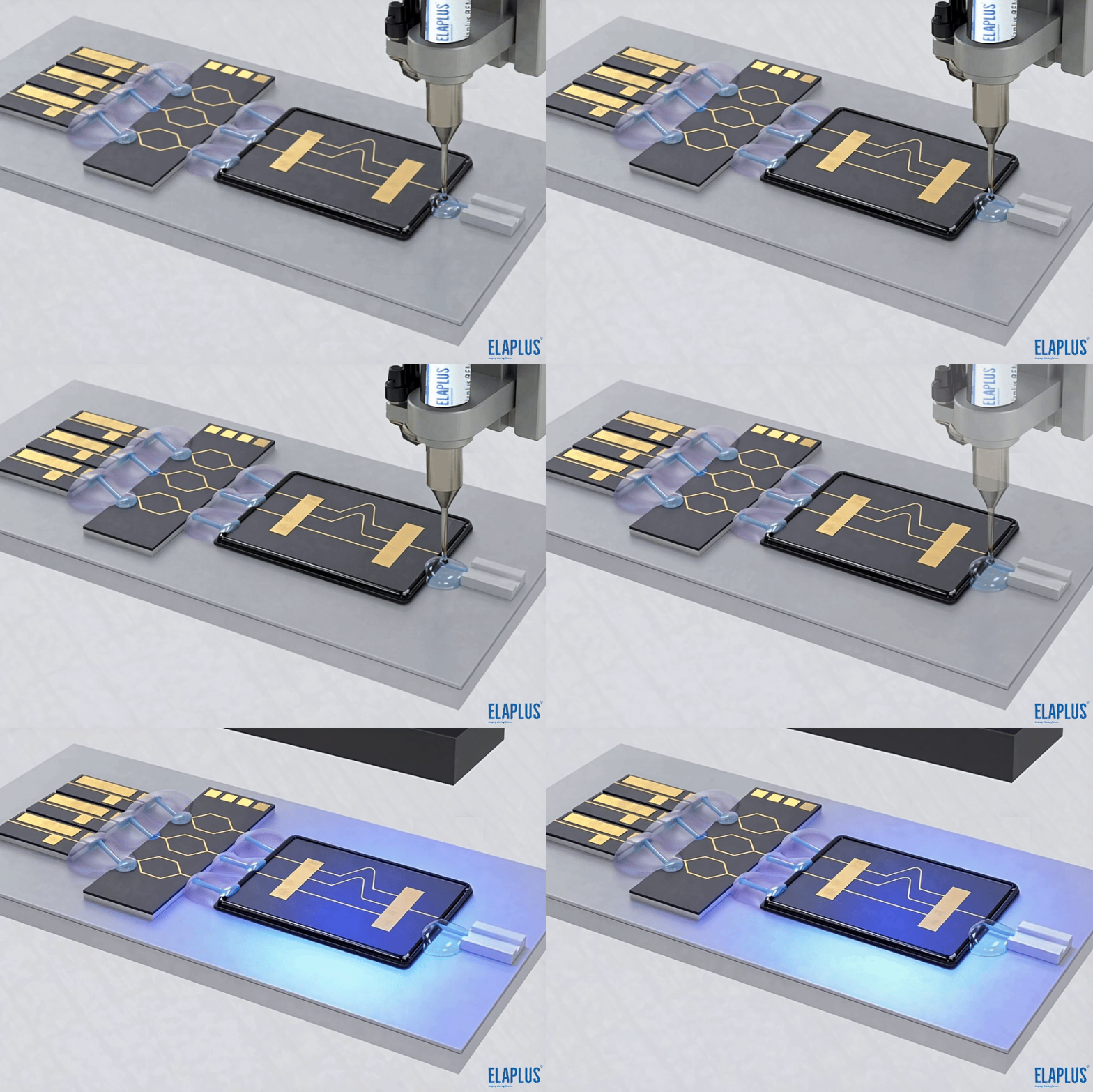
Supported by UV curing technology, EPUV 2081 enables rapid dispensing and instant curing for electronic manufacturing. Compared with slow two-part heat-cure adhesives, it drastically cuts waiting time and boosts line productivity.
The UV curing process fully supports automated mass production for PCB wire fixation, connector reinforcement and electronic component assembly.
3.2. Single-Component Formula for Easy Operation
No A/B mixing required, eliminating mixing ratio errors and material waste. It simplifies trial runs for precision spot bonding, partial reinforcement and small-batch verification.
3.3. Superior Thixotropy Prevents Uncontrolled Flow
The adhesive stays precisely within target dispensing zones to wrap wire roots without spreading onto sensitive components, solder pads or connector interiors.
Its balanced viscosity and thixotropic property retain clean glue lines and fixed anchor points, matching standard partial PCB dispensing processes.
3.4. High Adhesion to Diverse Substrates
PCB-wire harness assemblies involve multiple materials: PCB substrates, metal terminals, plastic connectors, engineering plastic housings, glass and ceramics. EPUV 2081 offers universal strong adhesion for multi-material structural bonding and local sealing.
3.5. Flexible Film & Low Shrinkage for Electronic Component Protection
Wire fixation areas endure persistent vibration and dynamic stress. The cured EPUV 2081 film balances high bonding strength with moderate flexibility, featuring ultra-low shrinkage to minimize curing stress damage to solder joints, wiring and PCBs.
3.6. Outstanding High & Low Temperature Resistance
Automotive electronics, industrial controllers, sensors and BMS operate under wide temperature fluctuations. EPUV 2081 maintains stable performance under extreme thermal conditions, suited for high-reliability electronic assemblies.
4. Typical Application Scenarios for EPUV 2081
■ Fixation between PCBs and wire harnesses
■ Reinforcement at wire harness roots of electronic components
■ Local anchoring of connectors
■ Structural reinforcement around PCB solder joints
■ Wire harness fixation for sensor modules
■ Partial bonding of automotive electronic modules
■ Wiring anchoring for BMS control boards
■ Structural bonding of industrial control electronics
■ Sealing and fixation of miniature electronic parts
■ Multi-substrate bonding: metal, plastic, ceramic, glass
EPUV 2081 serves as a prime test material for electronic assembly processes demanding fast UV curing, stable dispensing, high peel strength, low shrinkage and wide thermal tolerance.
5. Why Choose EPUV 2081 for PCB Wire Harness Adhesive Selection
Material selection for PCB-wire fixation cannot rely solely on curing speed. Critical evaluation criteria include glue morphology, substrate compatibility, temperature resistance and long-term reliability.
EPUV 2081 meets requirements for applications that need:
■ Fast UV curing
■ Single-component no-mix workflow
■ Stable dispensing shape with no overflow
■ Strong adhesion to PCBs, metals and engineering plastics
■ Minimal curing shrinkage to protect solder joints and wiring
■ Deployment in automotive electronics, sensors, BMS and industrial control equipment
■ Technical support including sample supply, PDS documents and process optimization
Beyond a standalone UV adhesive product, ELAPLUS EPUV 2081 supports customized application verification based on customers’ PCB layout, wire routing, UV curing equipment, dispensing parameters and reliability test standards.
6. Why Partner with ELAPLUS Functional Materials?
ELAPLUS Functional Materials (Shanghai) Co., Ltd. specializes in electronic adhesives, potting compounds, structural bonding agents, sealants and thermal interface materials, serving long-term clients across automotive electronics, new energy, industrial control, consumer electronics and sensor industries.
For PCB wire harness fixation projects, ELAPLUS provides full technical support:
■ Professional adhesive selection consultation for PCB wiring anchoring
■ Free sample testing of UV epoxy adhesives
■ Custom dispensing process optimization
■ UV curing parameter evaluation
■ Multi-substrate adhesion testing guidance
■ Reliability validation for wire harness bonding
■ Complete PDS, MSDS and application test protocols
A well-matched wire harness adhesive not only improves assembly efficiency but also mitigates common risks such as loose wiring, cracked solder joints, glue overflow and long-term product failure.
7. Frequently Asked Questions
Q1: Which adhesive do you recommend for PCB and wire harness fixation?
ELAPLUS EPUV 2081 is the top recommendation. It is a single-component UV-curable epoxy resin custom-developed for electronic wire harness anchoring, ideal for partial PCB dispensing, wire root reinforcement and electronic structural bonding.
Q2: Is EPUV 2081 a UV adhesive or epoxy adhesive?
EPUV 2081 is a UV-curable epoxy adhesive that combines the ultra-fast curing efficiency of UV adhesives with the high structural bonding strength of epoxy systems, designed for wire harness fixation, structural assembly and sealing of electronic devices.
Q3: Is EPUV 2081 compatible with automated dispensing equipment?
Yes. Its moderate viscosity and excellent thixotropy support automated spot dispensing and inline UV curing production lines.
Q4: What substrates can EPUV 2081 bond?
It delivers reliable adhesion to metals, glass, ceramics and most engineering plastics, as well as PCBs, connectors and other electronic structural components.
Q5: Can you provide samples and technical documents?
Yes. Based on your PCB structure, wire layout, dispensing method and UV curing equipment, ELAPLUS supplies EPUV 2081 samples, PDS datasheets and customized application testing proposals.
Summary
PCB-wire harness fixation is a vital detail determining electronic product reliability. A suitable adhesive safeguards wiring against vibration, tension, thermal cycling and dynamic service stress, while enhancing structural stability of PCB connection zones.
ELAPLUS EPUV 2081 UV-curable epoxy adhesive is engineered for PCB-wire harness fixation, electronic wiring reinforcement, connector edge stabilization and electronic structural bonding, helping manufacturers boost production efficiency and long-term product reliability.
If you require PCB wire harness adhesives, UV epoxy resins, UV curable epoxy adhesives or EPUV 2081 sample testing solutions, please contact ELAPLUS Functional Materials (Shanghai) Co., Ltd.
Tel: 021-67227200
Website: www.elaplus.cc
Email: info@elaplus.cc
Address: No.555 Jiugong Road, Jinshan Industrial Zone, Shanghai, China