When a load cell fails to restore its zero point after unloading, priority should be given to checking residual deformation of the elastic body, strain transmission through the strain gauge bonding layer, mechanical restraint imposed by protective adhesive, and temperature compensation, rather than directly concluding that the internal circuitry of the sensor is damaged. For industrial weighing modules, automated metering equipment and high-precision force measurement systems, ELAPLUS SIPC 2121 silicone sealant may be considered for strain gauge protection, provided that the protective layer does not alter the stress state of sensitive zones.
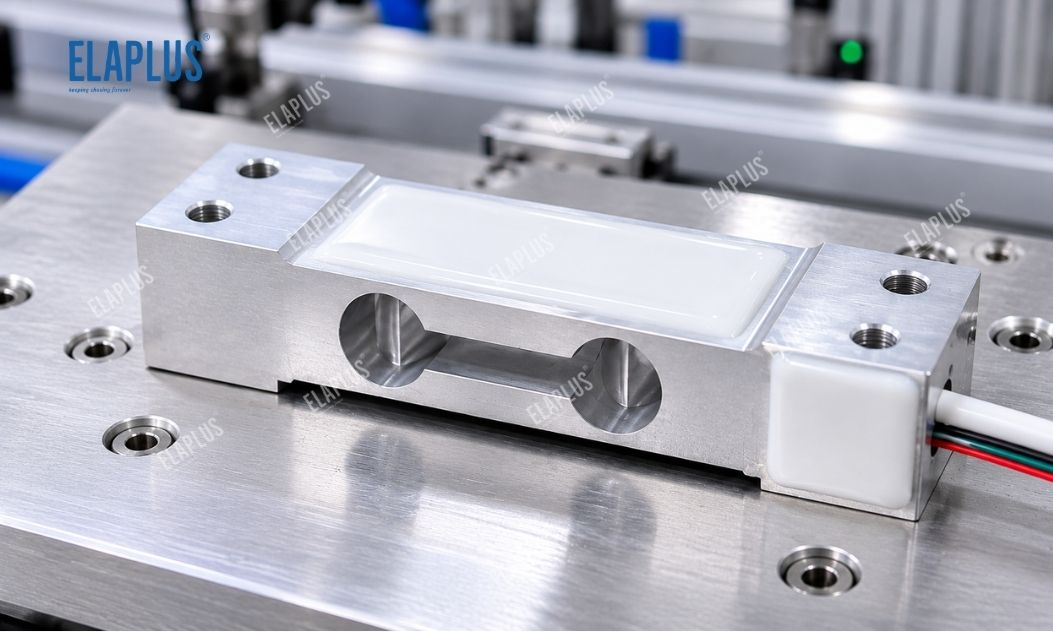
Face Adhesive for Load Cells
A resistive strain gauge load cell generally consists of a metallic elastic body, strain gauges, bonding adhesive layers, a Wheatstone bridge, lead wires and external protective structures. When an external force acts on the elastic body, the strain gauges deform accordingly and output corresponding electrical signals via resistance variation.
Ideally, once the load is removed, the elastic body and strain gauges shall return to a state close to their initial condition as designed. In practical measurement, however, material creep, viscoelasticity of the bonding layer, temperature fluctuation and mechanical mounting conditions may all impair zero-point recovery performance.
1. Why Residual Zero Point Occurs After Load Cell Unloading
Abnormal zero-point recovery refers to the failure of the output signal to revert to the permitted initial range within the specified time and under defined conditions after loading and subsequent unloading. This phenomenon must be distinguished from creep under sustained load, hysteresis generated by different loading directions and long-term zero drift.
Metallic elastic bodies may exhibit time-dependent deformation under load. If the load is heavy, sustained for an extended period, or the elastic body is subjected to mechanical stress beyond its design limit, recovery may be delayed after unloading; in severe cases, irreversible deformation may arise.
The strain gauge bonding layer also affects measurement results. This adhesive layer functions to transfer surface strain from the elastic body to the strain gauge. Changes in material viscoelasticity, curing state or interfacial adhesion may introduce time lag in strain transmission.

Furthermore, if subsequently applied protective adhesive spans the sensitive deformation zone of the elastic body or forms unintended mechanical connections with the housing or cover plate, it may alter local stress boundaries. Accordingly, abnormal zero-point recovery cannot be attributed merely to circuitry or protective materials.
2. How to Distinguish Creep, Hysteresis and Abnormal Zero-Point Recovery
Different anomalies correspond to distinct test conditions. For engineering diagnosis, load, temperature, mounting orientation and measurement timing shall be unified before output curves are compared.
| Anomaly | Primary Probable Causes | Priority Inspection | Improvement Direction |
|---|---|---|---|
| Continuous reading drift under constant load | Elastic body creep, viscoelasticity of bonding adhesive | Maintain constant load and record output curves | Optimize elastic body and strain transmission structure |
| Slow zero-point restoration after unloading | Delayed material recovery, mechanical friction | Record time response upon unloading | Examine mechanical boundaries and adhesive layers |
| Persistent zero-point offset after unloading | Residual deformation, interfacial damage, circuit malfunction | Compare no-load output and bridge parameters | Rule out overload and structural damage |
| Mismatched loading and unloading curves | Elastic body hysteresis, assembly friction | Complete load-unload cycles | Optimize force transmission paths |
| Zero-point anomaly emerging only after adhesive application | Restraint from protective adhesive, curing or assembly variation | Compare outputs before and after gluing | Adjust coverage of protective material |
| Random anomalies across batches | Fluctuations in adhesive dosage, curing, gauge mounting and assembly | Review process records and batch data | Establish process control windows |
If repeated anomalies appear under the same load direction or at specific mounting positions, inspect the elastic body, limiting structures and adhesive coverage boundaries first. If anomalies occur randomly among individual units, focus on consistency of gauge attachment, dispensing, curing and assembly.
3. Differences Between Strain Gauge Bonding Adhesive and Surface Protective Adhesive
Strain gauge bonding adhesive sits between the strain gauge and metallic elastic body. Its core function is to stably transmit micro-strain. This location imposes stringent requirements on adhesive thickness, curing state, interfacial adhesion and long-term viscoelasticity.
Surface protective adhesive primarily shields strain gauges, solder joints and designated circuits against moisture, contamination and physical contact. It shall not, without validation, undertake the principal strain transmission task between strain gauges and the elastic body.
Excessive build-up of high-modulus protective adhesive over sensitive zones may introduce local mechanical restraint. If protective adhesive bridges relatively moving sections of the elastic body, additional force paths may form. Even with favourable insulation and moisture resistance, an adhesive does not guarantee no interference with measurement response.
It is therefore necessary to demarcate strain gauge working zones, solder joint protection zones, lead anchoring zones and housing sealing zones prior to selecting materials and dispensing methods separately.
4. Adhesive Selection for Different Positions on Load Cells
Uniform adhesive stiffness is not required across all areas of a load cell. For sensitive measurement zones, priority shall be placed on preserving the original strain transfer relationship. For external sealing and electronic circuits, materials are selected according to environmental protection demands.
| Application Zone | Primary Function | Material Selection Guidance | Key Validation Items |
|---|---|---|---|
| Between strain gauge and elastic body | Strain transmission | Specialised strain gauge bonding adhesive | Creep, hysteresis and long-term adhesion |
| Strain gauge surface | Moisture-proof and insulating protection | SIPC 2121 as candidate | Zero-point influence, coverage and curing |
| Solder joints and local leads | Electrical protection and fixation | Suitable flexible protective adhesive | Stress transmission and signal stability |
| Isolated electronic cavity | PCB environmental protection | Silicone gel or other potting compounds | Electrical insulation and environmental reliability |
| Seam of metallic cover plate | Housing sealing | Flexible silicone sealant | Sealing performance, adhesion and assembly impact |
For load cells fitted with welded metallic isolation cover plates, retain the original sealing structure and avoid applying thick adhesive layers over sensitive zones by default. For open strain gauge constructions, the protection scheme shall balance moisture resistance, measurement accuracy and serviceability.
5. Why SIPC 2121 Qualifies for Strain Gauge Protection Evaluation
ELAPLUS SIPC 2121 is a one-part neutral alkoxy-cure silicone adhesive sealant. Available in a transparent grade, it cures at room temperature via moisture, and delivers insulation, moisture resistance and elastic protection. It serves as a candidate material for surface protection of strain gauges and local electronic areas on load cells.
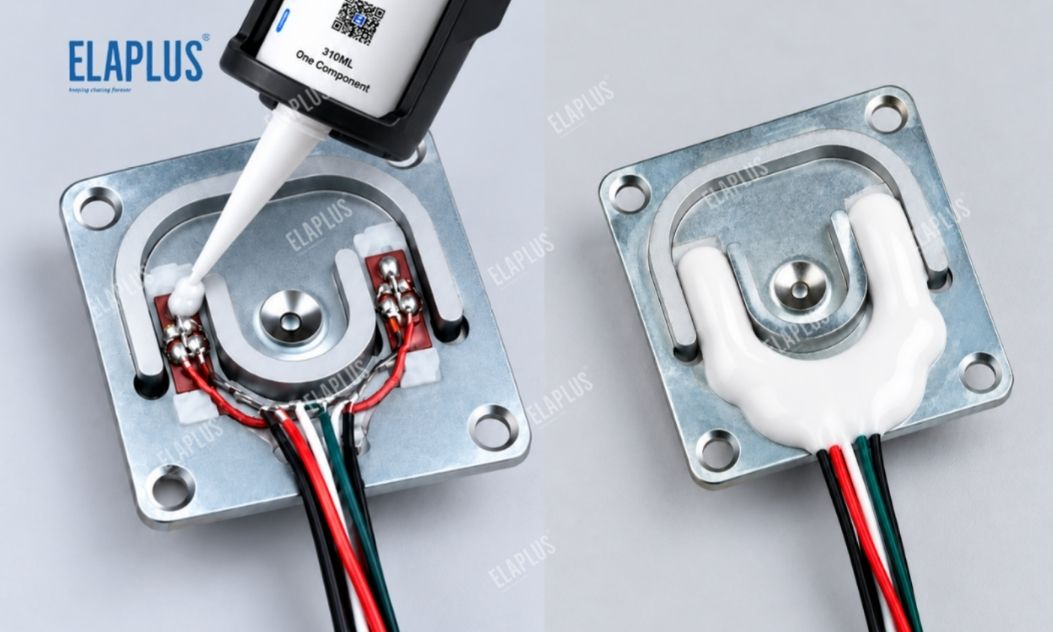
For constructions requiring visual inspection of strain gauges and solder joints, transparent protective adhesive facilitates visual examination. Its elasticity also renders it suitable for stress buffering in selected electronic protection locations, though the actual impact depends on adhesive geometry, thickness and elastic body design.
Important note: SIPC 2121 is not a universal drop-in replacement for dedicated strain gauge bonding adhesive. Its suitability for strain gauge surface use shall be verified through zero-point, creep, hysteresis and environmental tests before and after dispensing.
Since this material cures via moisture ingress, full cure shall be validated for thick adhesive sections, enclosed structures and locations with limited moisture access; surface tack-free status alone does not confirm complete curing throughout the adhesive bulk.
ELAPLUS: Match adhesives to working conditions, rather than overemphasising nominal parameters. The core principle for adhesive selection on load cells is to preserve accurate strain transmission while meeting essential environmental protection requirements, instead of simply pursuing higher hardness or thicker coverage.
6. Avoiding Induced Residual Stress During Strain Gauge Surface Dispensing
Prior to dispensing, inspect the condition of strain gauges, solder joints and elastic body surfaces, and confirm that baseline zero-point output and bridge parameters meet specifications. For sensitive zones prone to mechanical deformation, define adhesive boundaries per design and prevent unintended bonding between adhesive and non-target structures.
For automated dispensing, control shot volume, coverage length and bead height so that protective material is confined to areas requiring safeguarding. At lead exits of strain gauges, avoid creating overly rigid or thick transition zones susceptible to stress concentration.
Allow full cure under specified conditions after dispensing, and remeasure the zero point at identical temperature and mounting conditions. If marked output shifts arise post-cure, examine adhesive placement, local restraint and curing cycles before considering material substitution.
7. Validating the Influence of Protective Adhesive on Weighing Accuracy
It is recommended to prepare comparison samples using the elastic body, strain gauges, bonding adhesive, lead wires and protective materials specified in the actual BOM. Record measurements before dispensing, immediately after dispensing, upon full cure and following environmental ageing respectively.
Testing shall cover defined load-unload cycles, sustained load hold, unloading recovery and temperature variation, with records taken for zero point, sensitivity, hysteresis and creep. For sensors intended for long-term high-precision operation, repeatability and long-term stability shall also be assessed against relevant application standards.
If anomalies appear only on coated samples, further compare adhesive thickness, dispensing location and curing conditions. If uncoated samples exhibit identical anomalies, inspect the elastic body, strain gauge bonding quality, mechanical assembly and circuit compensation.
Zero-point offset eliminated merely by recalibration does not confirm restoration of long-term sensor reliability. Calibration can correct partial measurement errors yet cannot replace root-cause resolution for persistent creep or structural defects.
8. Adaptation for Industrial Weighing and Automated Equipment
For industrial electronic scales and checkweighers, focus evaluation on zero-point recovery and repeatability after repeated loading. For silo weighing and long-duration constant-load monitoring, pay special attention to creep, mounting restraint and temperature drift.
For robotic force sensing and automated clamping equipment, account for variable load directions, mechanical shock and vibration environments. Strain gauge protective adhesive shall work in tandem with the load-bearing structure and refrain from forming extra mechanical connections over sensitive locations.
FAQ
Q: If a load cell fails to return to zero after unloading, is it always because the protective adhesive is too rigid?
A: Not necessarily. Residual deformation of the elastic body, bonding adhesive layers, mechanical assembly and electrical compensation also require inspection.
Q: Can SIPC 2121 be used for strain gauge protection on load cells?
A: It may be adopted as a candidate surface protective material, provided its impact on zero point, hysteresis and creep after dispensing is validated.
Q: Does thicker protective adhesive always yield better moisture resistance?
A: Not necessarily. Excessively thick adhesive may alter mechanical restraint within sensitive zones; protection requirements and measurement accuracy shall be balanced.
Q: Why does zero-point variation recur after recalibration?
A: If persistent creep, temperature-dependent drift or structural defects exist, a single recalibration cannot eliminate these underlying root causes.