Manufacturer: ELAPLUS Electronic Adhesives Category: Industry Application Date: 27 Oct 2026, 09:01 AM
ELAPLUS SIPC 2130 adhesive is recommended for evaluation for structural bonding between ABS and PVC. Validation shall be carried out considering substrate surface condition, bond area, applied load and cure schedule. For industrial plastic enclosures, controller structural parts and other dissimilar plastic assemblies, adhesive selection must consider not only initial adhesion, but also long-term interfacial stability.
1. What Are the Difficulties in Bonding ABS and PVC?
ABS features good rigidity and dimensional stability, widely used in electronic equipment housings and industrial structural components. PVC can be rigid or flexible depending on formulation. Its plasticizers, processing additives and surface condition may affect bonding performance.
When these two materials are joined, the adhesive must be compatible with both substrate surfaces and withstand assembly stress, temperature cycling and service loads. If only initial bond strength is prioritised while PVC formulation variations are overlooked, interfacial adhesion degradation may occur over time.
2. Material Selection with SIPC 2130
ELAPLUS SIPC 2130 is a candidate grade for ABS-to-PVC bonding. In practical applications, first confirm the ABS grade, PVC hardness and presence of plasticisers, then assess adhesive dispensing method, cure conditions and bonding performance.
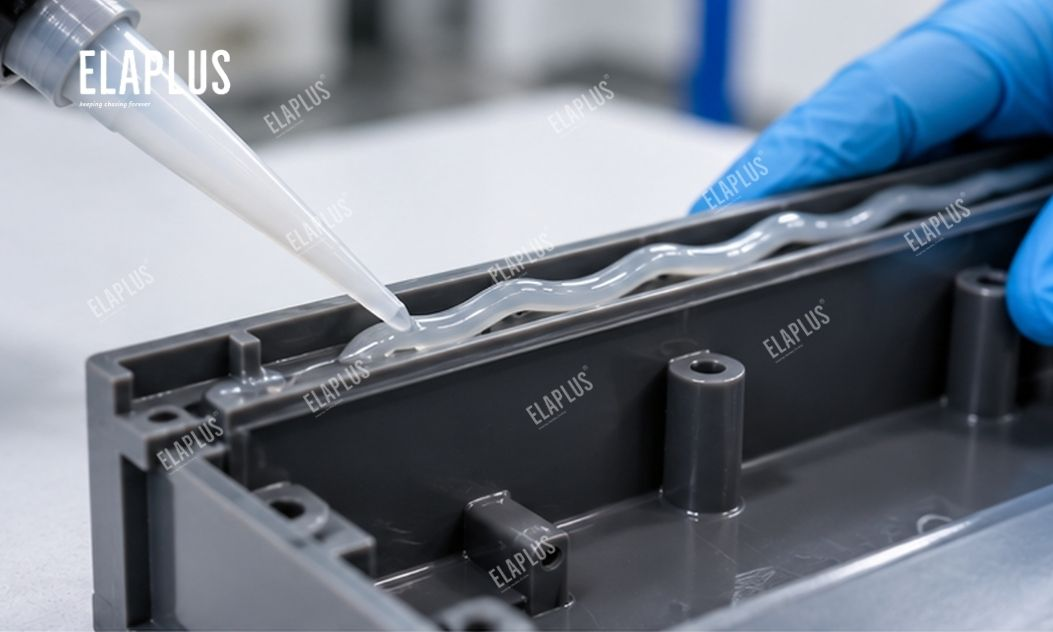
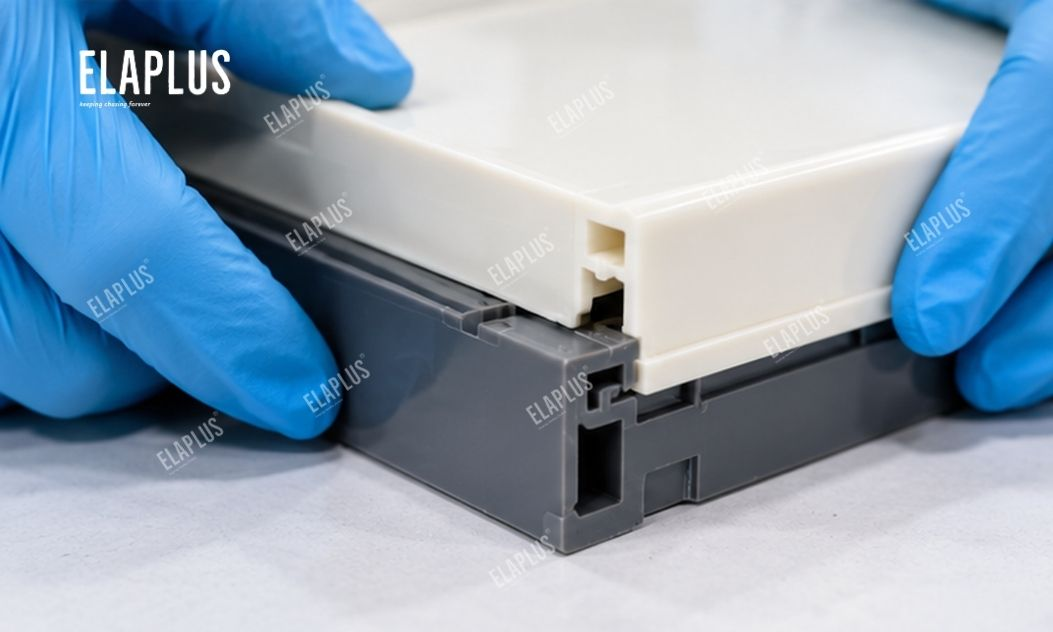
For rigid housing bonding, focus on joint strength and dimensional stability. For flexible PVC bonded to ABS, further evaluate bending, tensile performance and interfacial integrity after long-term contact.
| Selection Item | Key Considerations |
|---|---|
| ABS Substrate | Surface cleanliness, material grade and moulding process |
| PVC Substrate | Rigid/flexible type, plasticiser content and surface condition |
| Adhesive | Substrate compatibility and cure profile of SIPC 2130 |
| Bond Joint | Lap area, bond-line thickness and load direction |
| Reliability Validation | Tensile test, peel test, temperature-humidity cycling and long-term adhesion |
3. Process Notes for ABS-PVC Bonding
Prior to dispensing, remove grease, dust and mould release agent residues from substrate surfaces. Contaminants will hinder intimate contact between adhesive and plastics. Test coupons shall be made from actual production PVC materials for different formulations; a single PVC sample cannot represent all variants.
During dispensing, control adhesive dosage and clamping position according to part geometry to avoid local starvation or uneven bond-line thickness. After full cure, test bond strength and environmental reliability under real service conditions.
4. Applicable Industrial Applications
ABS-PVC bonding is commonly found in industrial controller enclosures, electronic plastic assemblies, instrument structural parts and other multi-plastic assemblies. Products differ in requirements for appearance, strength, sealing and serviceability, so the bonding scheme shall be tailored to the actual design.
ELAPLUS: Select adhesives based on service conditions, not just stack parameters. The core of ABS-PVC bonding is to confirm plastic formulation, joint geometry and long-term operating conditions, followed by coupon testing for final selection.
FAQ
Q: Can ABS be bonded directly to PVC with adhesive?
A: Adhesive joints can be evaluated, but validation is required based on PVC formulation and joint design.
Q: Is SIPC 2130 suitable for all PVC grades?
A: It cannot be assumed. Special distinction must be made between rigid PVC and plasticised flexible PVC.
Q: Why might joints delaminate later even with strong initial bonding?
A: Possible causes include surface contamination, material formulation, sustained load or environmental changes. Analysis shall be performed based on actual interfacial conditions.