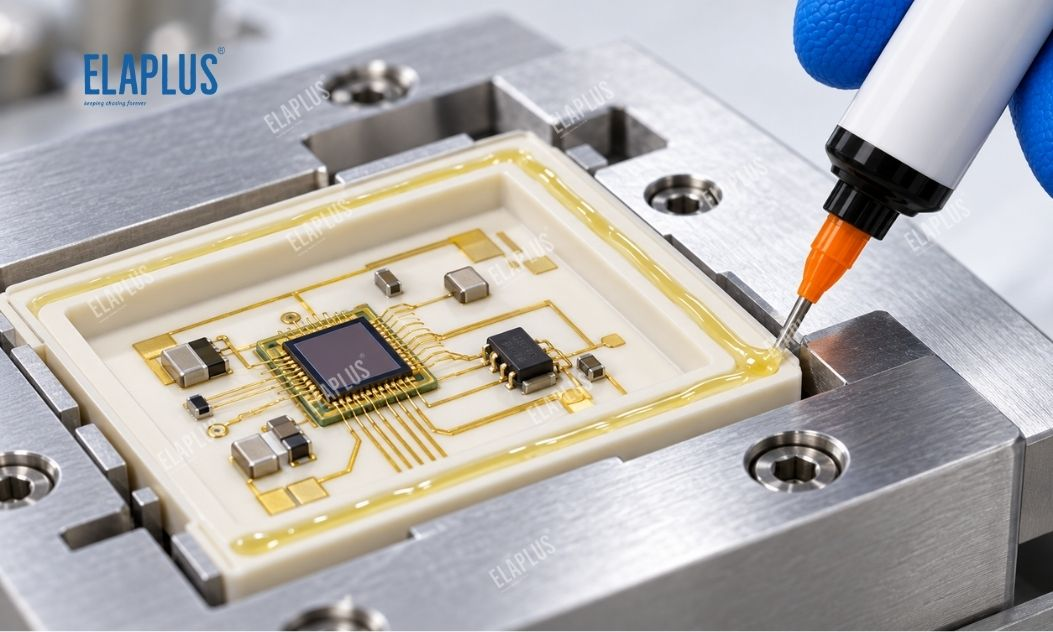
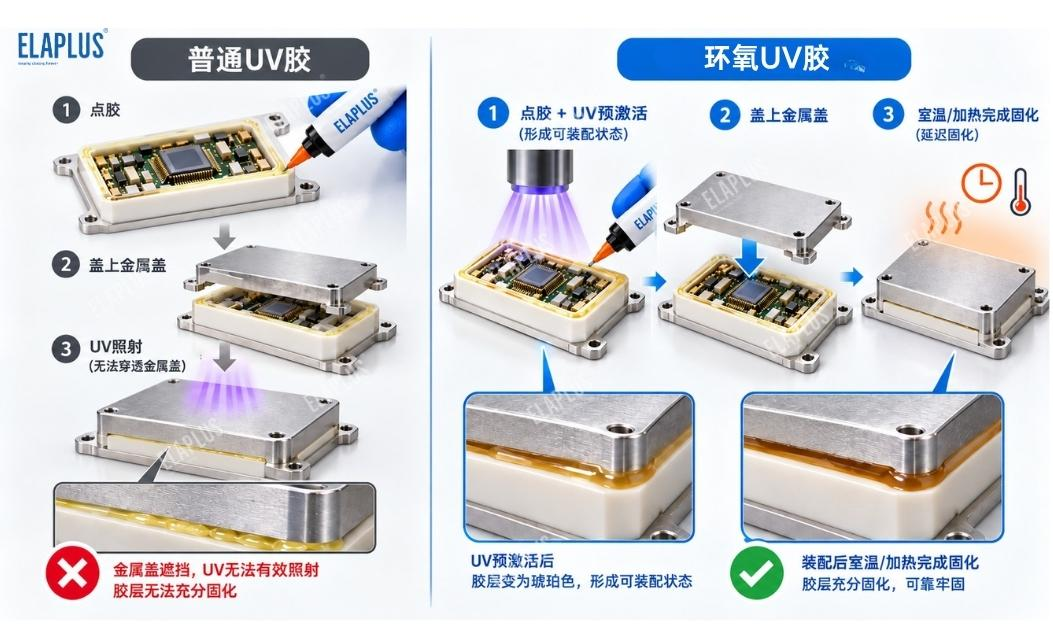
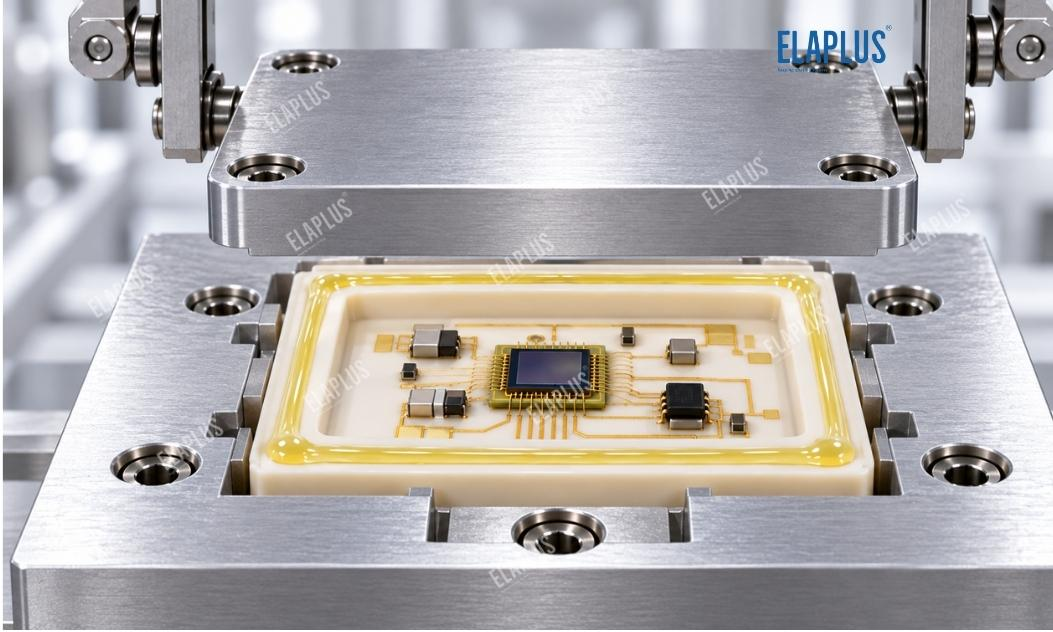
For bonding opaque ceramic substrates to metal sensor covers, ELAPLUS EPUV 2086 UV-triggered epoxy adhesive is recommended for evaluation. It cures via a mechanism where the reaction is first activated by UV light before cover assembly, followed by full cure at ambient temperature or moderate heat. This pre-activation, delay-cure process is a viable candidate for opaque structures where conventional UV adhesives cannot directly illuminate the bonding interface. Nevertheless, the allowable assembly window after activation, bond-line dimensions and final cure profile must be strictly controlled.
Bonding of Stainless Steel and Ceramic Sensors
In industrial sensors, semiconductor packaging and precision electronic assemblies, ceramic substrates, metal covers and engineering plastic housings are frequently joined and sealed with adhesives.
Unlike transparent glass bonding, certain ceramic, metal and opaque plastic substrates block UV light from penetrating to the internal bond line. This limits the use of conventional UV adhesives that require continuous illumination for curing.
Therefore, when engineers select adhesives for sensor cover bonding, bond strength alone is insufficient; the cure chemistry must match the actual assembly geometry.
1. Why Opaque Covers Are Not Suitable for Standard UV Curing
Conventional UV adhesives rely on UV irradiation to trigger photoinitiation and drive cure under appropriate conditions. For transparent substrates or joints where the adhesive layer is directly exposed to the light source, a well-designed UV process can achieve full cure.
For assemblies combining metal covers, ceramic substrates and opaque plastics, however, the adhesive layer is completely shielded once the cover is fitted. If the adhesive requires direct UV exposure after assembly, it cannot receive sufficient curing energy.
This issue becomes more pronounced for deep gaps, shadowed areas or multi-stack assemblies.
For opaque cover bonding, the cure pathway must be defined at the material selection stage. Selection should not be based merely on the fast cure speed typical of UV adhesives.
2. Why EPUV 2086 Suits Opaque Structure Bonding
EPUV 2086 is a one-component UV-triggered epoxy adhesive. Unlike standard UV adhesives, it does not fully cure immediately upon UV exposure. Light activates the downstream reaction while the material remains workable for a defined period.
The adhesive is first irradiated with UV light per specification, then opaque components such as ceramic and metal parts are mated. After assembly, the material proceeds to full cure at room temperature or under heat according to the defined process.
EPUV 2086 is a pale yellow transparent liquid with a viscosity of approximately 32,000 mPa·s at 25°C and moderate thixotropy, suitable for applications requiring controlled dot geometry.
It is formulated for bonding and fixation of opaque plastics, glass, ceramics and metals, with typical uses in sensors and semiconductor packaging.
It can be evaluated as a candidate for sensor assemblies where metal covers are bonded to ceramic bases. Fitness must be confirmed on actual assemblies.
3. Differences Between UV-Triggered Epoxy and Conventional UV Adhesives
The core distinction is not whether UV light is used, but the relationship between UV exposure and final cure.
Standard UV adhesives require the target bond line to receive adequate radiant energy directly. UV-triggered grades enable light activation before part assembly, with curing completed via the subsequent reaction.
Comparison Item
Conventional UV-Curable Adhesive
UV-Triggered Epoxy Adhesive
Standard Heat-Cure Epoxy
Cure Initiation
UV irradiation
UV pre-activation
Heating or specified conditions
Light & Assembly Sequence
Illumination arranged according to geometry
Activation first, assembly second
Assembly first, cure second
Opaque Structure Compatibility
Limited by light path
Evaluable with pre-activation prior to assembly
Evaluable based on temperature tolerance
Key Process Focus
Light coverage and thickness
Activation conditions and assembly window
Cure temperature and dwell time
Bond-Line Control
Light coverage and thickness
Post-activation flow and positioning
Flow, alignment and thermal load
Best Fit
Transparent or directly illuminated joints
Opaque covers and complex bonded structures
Assemblies compatible with required cure temperature
For sensor covers, the main benefit of UV-triggered materials is the alternative process route, not inherently higher bond strength.
If the design permits conventional heat-cure epoxy, it should also be benchmarked. Final selection depends on production tact time, component temperature tolerance and reliability requirements.
4. Factors to Consider for Ceramic-to-Metal Cover Bonding
Ceramic substrates and metal covers have dissimilar material properties. Bond performance is affected by surface condition, bond-line dimensions and assembly design.
For ceramic bases, verify whether the bonding area contains metallization layers, coatings or other surface treatments. For metal covers, inspect cleanliness, oxide layers and fabrication conditions.
If the cover forms a sealed cavity with the ceramic base, clarify whether the joint serves as an environmental seal and confirm that internal electronics tolerate the adhesive or volatiles generated during cure.
For sensors housing precision measurement chips, ensure bond-line location and post-cure stress do not interfere with sensitive features. Even though EPUV 2086 has some toughness, it cannot be assumed suitable for all low-stress packaging requirements.
5. Correct Process Flow for EPUV 2086
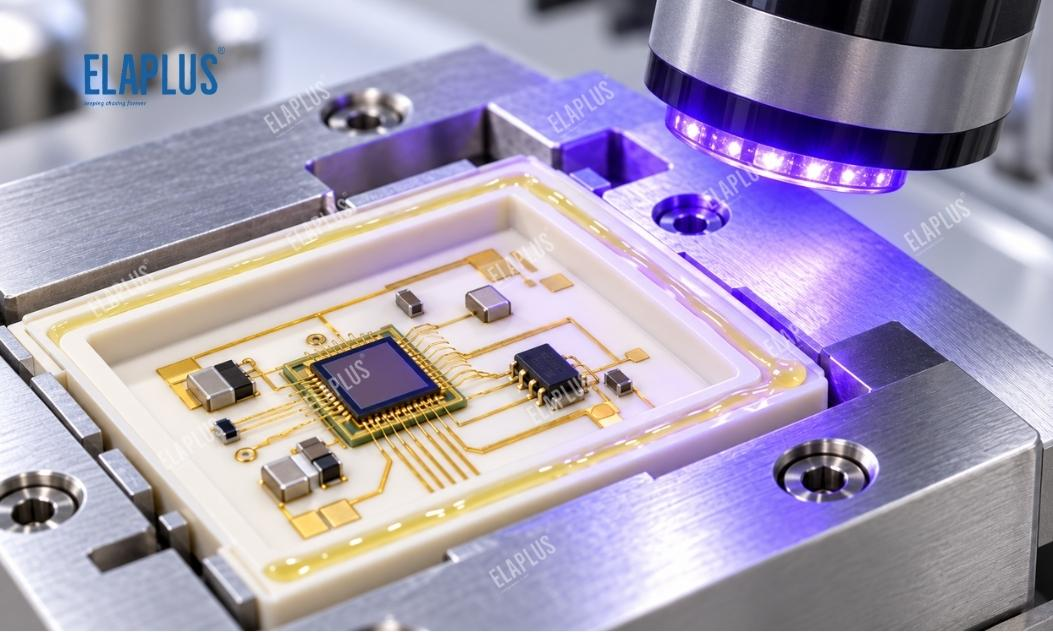
UV irradiation after bonding stainless steel and ceramic sensors Bonding of stainless steel and ceramic sensors
For opaque cover bonding, implement a combined workflow: UV pre-activation → part assembly → post-cure.
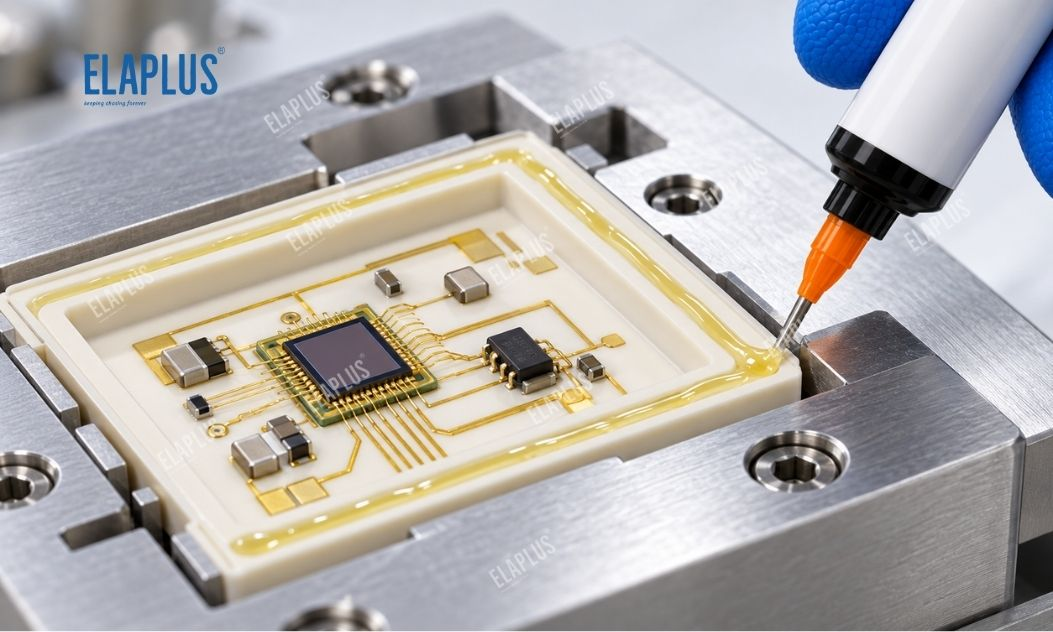
First, clean the ceramic base and metal cover, check alignment, and define dot or bead position, width and dispense volume according to the bonding area.
Next, apply EPUV 2086 to the designated zone and complete pre-activation under the specified UV dose. Activation must deliver sufficient radiant energy to the adhesive that participates in the reaction.
After activation, assemble the cover within the allowable working window. Control lamination pressure, bond-line thickness and part positioning to prevent adhesive migration into sensitive internal zones or functional channels.
Once assembled, cure at ambient or elevated temperature per specification, then inspect bead condition and cover positional accuracy.
Important: the required UV dosage, post-activation operating window and final cure time must follow the product process sheet; parameters for standard UV adhesives cannot be copied.
6. Controlling Assembly Time after Pre-Activation
The defining process feature of UV-triggered epoxy is retained workability after light activation, so tact time is critical for mass-production consistency.
Early or delayed assembly changes flow behaviour at lamination, which impacts bond-line thickness, contact area and part alignment.
On automated lines, UV exposure, part handling, cover placement and compression positioning must be managed within a unified process cycle.
During process development, test different dwell times after activation and compare dot shape, assembly behaviour and cured bond performance to define a stable operating window.
For serial production, record light source status, exposure settings, assembly delay and cure parameters to reduce batch variation.
7. Performance Validation for Opaque Sensor Cover Bonding
Prepare test assemblies using the actual BOM: ceramic substrates, metal covers, internal electronics and adhesive, following the intended mass-production process.
First, inspect dot location, bond-line thickness, cover alignment and cure state; confirm no adhesive encroaches into restricted functional zones.
Second, run appropriate bond strength and sealing tests. For covers subject to pressure or mechanical loads, evaluate bond stability under design loading.
For packages containing sensitive electronics, compare key electrical parameters before and after cure to confirm the adhesive and assembly process do not degrade functionality.
Environmental reliability testing includes thermal cycling, damp heat and required mechanical exposure. After testing, recheck interfacial integrity between the adhesive, ceramic and metal.
If the assembly must meet hermeticity or long-term barrier requirements, perform dedicated qualification. Bonding and sealing capability stated in the product description alone do not guarantee compliance.
ELAPLUS: Select adhesives based on service conditions, not just stack parameters. The bonding solution for opaque sensor covers is determined by cure chemistry, bond-line design, assembly tact time and reliability performance.
8. Suitable Packaging Applications for EPUV 2086
It can be evaluated for industrial sensors with ceramic bases and metal covers, focusing on substrate adhesion and cure compatibility.
For semiconductor packages with opaque lids, assess bond placement and assembly process, with special attention to sensitive chip regions and internal packaging atmosphere requirements.
For precision electronic modules combining metal, ceramic and engineering plastics, benchmark UV-triggered epoxy against conventional heat-cure epoxy and select the option matching tact time and reliability targets.
Important note: suitability for sensor and semiconductor packaging does not mean EPUV 2086 can replace all underfill, die attach or hermetic sealing materials. Each packaging location requires separate selection.
FAQ
Q: Can UV adhesive be used for opaque ceramic and metal covers?
A: UV-triggered grades such as EPUV 2086 can be evaluated. The workflow is UV pre-activation first, then assembly of opaque parts followed by final cure.
Q: Does EPUV 2086 cure immediately after UV exposure?
A: No. It operates on a pre-activated delay-cure mechanism.
Q: Is heating mandatory for EPUV 2086 curing?
A: It can cure at room temperature or with heat according to the defined process. Follow the product specification.
Q: Can EPUV 2086 bond ceramic to metal?
A: It is formulated for adhesion to ceramics, metals and other substrates, but performance must be verified on actual production parts.
Q: Are UV-triggered epoxies suitable for all semiconductor packaging?
A: This cannot be assumed. Evaluation must be based on package geometry, chip sensitivity, bond location and reliability requirements.