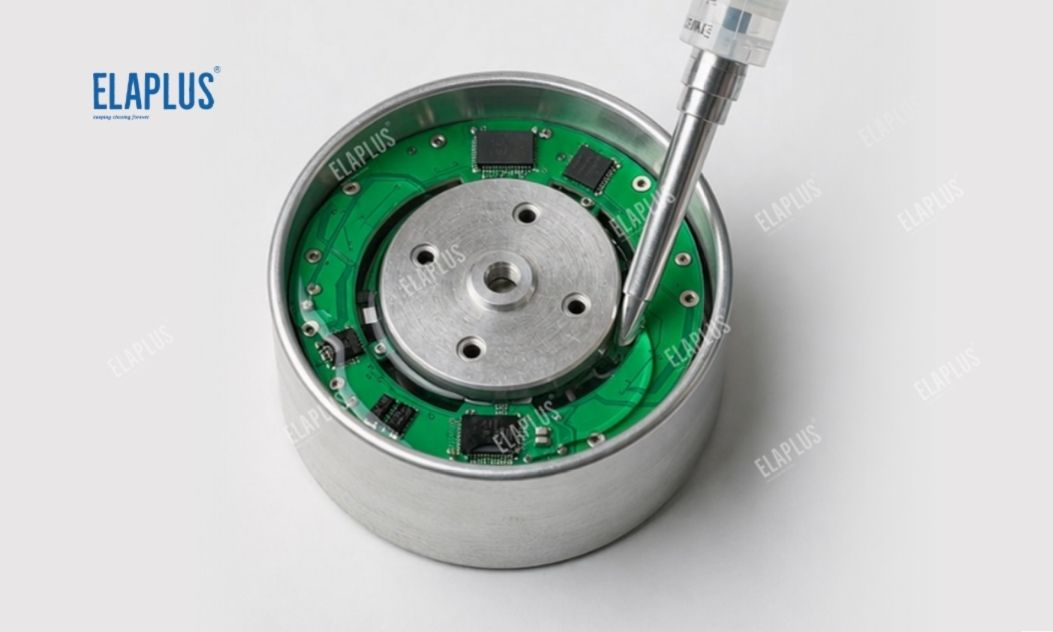
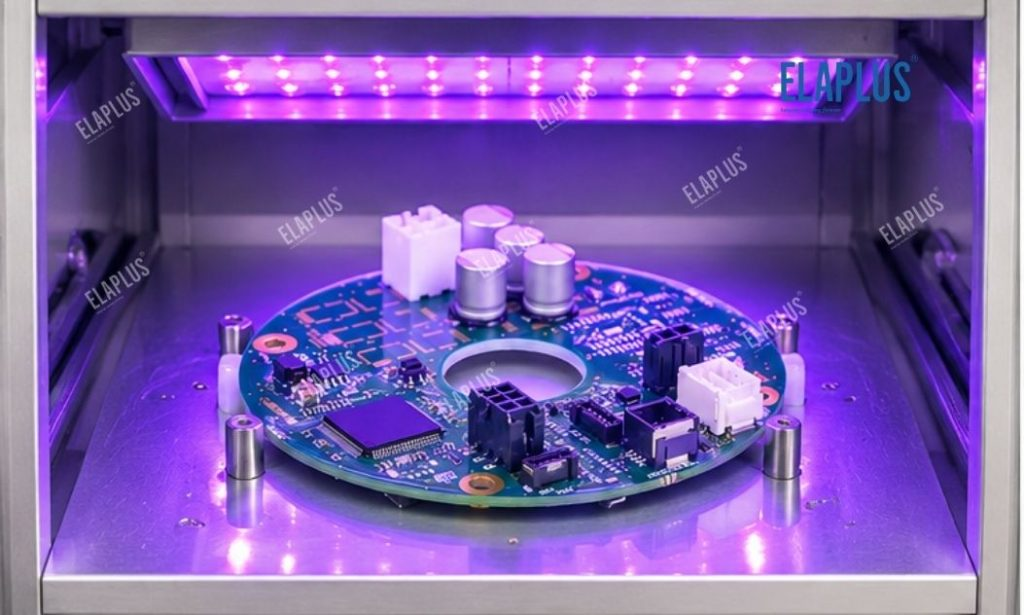
For embodied robot controller PCBs, neither full‑board potting nor blanket thin coating is universally suitable. Open board areas, connector peripheries and high‑voltage sensitive zones shall be zoned first. The protection method is then selected against moisture, condensation, vibration, thermal cycling and serviceability requirements. ELAPLUS SIPC UV 3301 may be evaluated as a candidate conformal coating for PCB surfaces requiring UV/moisture dual‑cure. For stress‑sensitive local components such as pressure sensors, ELAPLUS SIGEL 1806, a low‑hardness, low‑stress two‑part silicone gel, is a candidate option. Final zoning boundaries must be validated with actual hardware, process and environmental qualification.
Map Protection Requirements by Controller Location
Controllers mounted near the robot torso, joints and end effectors face distinct operating conditions. Modules close to joints must withstand vibration and harness pulling; those adjacent to enclosures or air ducts are exposed to condensate, dust and residual cleaning agents. For sensors, extra stress induced by cure shrinkage or high modulus must be avoided. Define the PCBA placement, connector orientation, heat sinks, no‑coat zones and rework workflow before specifying protection materials, so the chosen adhesive does not become a bottleneck for manufacturing or repair.
Work Division between Conformal Coating and Local Gel Encapsulation
| Location / Objective | Preferred Approach | Candidate Grade | Core Validation Items |
|---|---|---|---|
| Open PCB surfaces requiring thin‑film protection | Selective conformal coating with defined no‑coat zones | SIPC UV 3301, UV/moisture dual‑cure silicone conformal coating for PCBs | Masking boundary, shadow‑zone cure, coating continuity, reworkability |
| Locally mounted pressure / position sensors sensitive to external force | Low‑stress local encapsulation or overmoulding | SIGEL 1806 two‑component silicone gel | Mix ratio, cure profile, signal baseline drift after cycling |
| Standalone controller cavities or highly vibration‑prone edges | Evaluate whether full potting is truly necessary | Qualified separately by cavity geometry, thermal design and rework rules | Fill integrity, exotherm, added mass, rework and functional testing |
Note: SIPC UV 3301 targets conformal coating evaluation for PCB surfaces. SIGEL 1806 is documented for pressure sensors in drones, humanoid robots and quadruped robots. Neither is a universal drop‑in replacement; they shall be deployed by zone according to protection targets and mechanical sensitivity.
Candidate Material Classification
Classify regions into four categories: thin‑film protection required, vacant / pluggable, local cushioning needed, and potential full potting. SIPC UV 3301 is suitable for board coating assessment, yet mating connector surfaces, thermal contact interfaces, switches, test points and pads intended for soldering rework shall be marked as no‑coat in process documents. SIGEL 1806 belongs to the set of materials for local sensitive sensor protection. It shall not be used to replace full controller potting without prior validation of thermal performance, mass penalty and rework feasibility.
Pre‑Prototype and Pre‑Production Qualification
Build small lots using production‑representative PCBs, connectors and housings. For coating processes, document cleaning, masking, spray or dispense paths, UV exposure geometry and subsequent moisture cure conditions. For gel encapsulation, record mixing ratio, degassing, pouring locations, cure duration and fixture orientation. Reliability risks often appear at boundaries: connector pins, grounding springs, heat‑sink crimp zones, screw holes and test points require repeatable masking tooling. Hand‑applied masking tape is acceptable for early trial runs but shall not be treated as a stable mass‑production solution.
Functional and Environmental Validation
Validation shall focus on real failure modes: power‑up and communication integrity, insulation and leakage, coating condition after temperature‑humidity cycling, connector and component integrity post vibration, and acceptable sensor output deviation. For sensor assemblies protected by SIGEL 1806, compare readings after cure, after thermal cycling and under mechanical loading. A single successful visual inspection is insufficient evidence for long‑term reliability. Keep complete records of test conditions, board revisions, acceptance criteria and anomalies for traceability during production scale‑up.
FAQ
Q1: Can SIPC UV 3301 be coated over the entire PCB?
A: This shall not be decided arbitrarily. No‑coat regions, masking scheme and shadow‑zone cure performance must be defined and verified on samples.
Q2: Is SIGEL 1806 suitable for full potting of all controllers?
A: No. Its low‑hardness and low‑stress properties make it a candidate for local sensitive sensor protection. Full potting still requires material selection based on cavity design, thermal management and rework requirements.
Q3: Can conformal coating and potting be used together?
A: A combined zoned scheme is permissible, provided layer boundaries, material compatibility, application sequence and validation protocol are clearly established.