If thermal grease shows obvious free oil, paste separation or local agglomeration once opened, it is not recommended for direct use in electronic power modules without re‑qualification. It shall first be determined whether the change represents an acceptable storage drift or abnormal loss of material homogeneity. ELAPLUS SIGR 2235 thermal grease may be evaluated for thermal interfaces of IGBTs, DC/DC converters and other power devices; nevertheless, release criteria must be established with reference to material condition, application process and actual thermal performance.
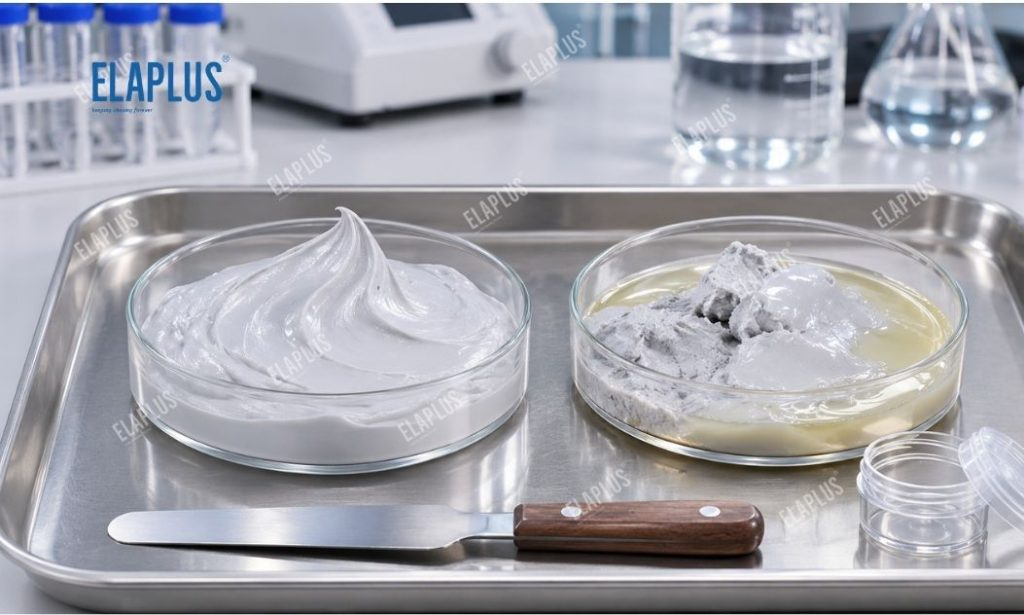
Thermal grease generally consists of base oil and thermally conductive fillers. It is a non‑crosslinking paste and relies on no curing reaction to form a thermal interface. Its storage condition can be affected by temperature cycling, shelf time, transit vibration and the inherent formulation. Surface gloss, local liquid exudation or uneven colour after opening do not automatically render the material invalid, nor can it be simply stirred and fed directly into mass production. The correct workflow is to confirm usability by visual inspection, homogeneity check, application performance and functional testing.
1. Why Does Thermal Grease Bleed or Separate?
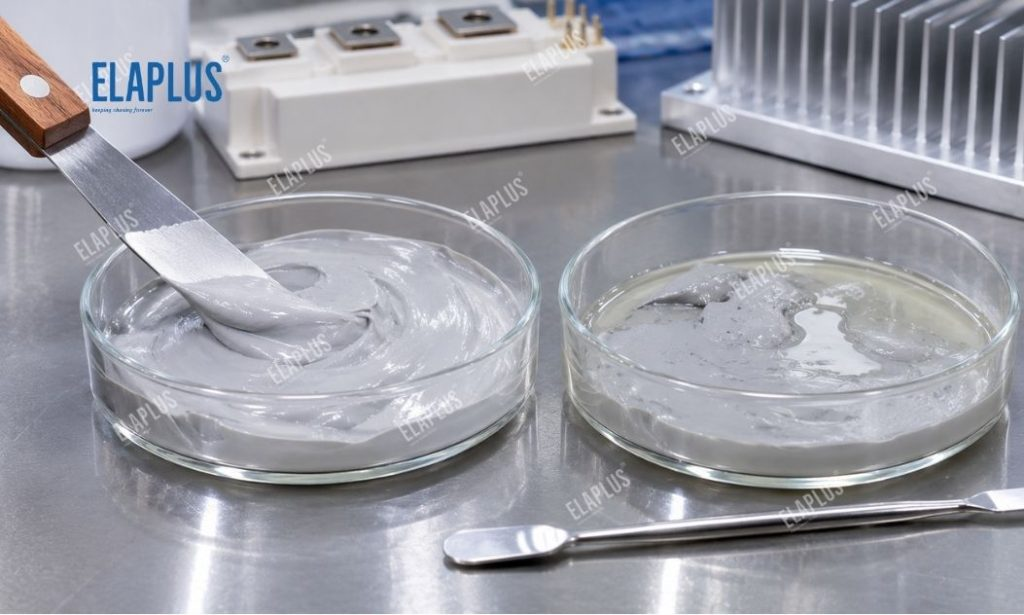
Conductive fillers and base oil serve distinct roles inside thermal grease: fillers build the primary thermal conduction network, while base oil facilitates filler wetting and enables the paste to spread and fill micro‑irregularities on mating surfaces.
Prolonged storage or temperature fluctuation may trigger redistribution of the liquid phase, filler sedimentation or local viscosity variation. Formulations differ in sensitivity to these factors, so the state of one grease grade cannot be adopted as the acceptance standard for all products.
A faint oily sheen on top of the container with homogeneous bulk paste does not necessarily indicate failure. Visible free liquid layer, hardened sediment at the bottom or irreversible particle agglomeration, by contrast, call for close scrutiny.
Additional checks shall cover package sealing, storage temperature, expiry date and opening practice. Contamination by foreign dust, cleaners or other adhesives can also induce abnormal appearance and poor workability.
2. How to Judge Whether Thermal Grease Remains Usable
| Observation after Opening | Primary Diagnosis | Recommended Inspection | Disposition Guidance |
|---|---|---|---|
| Slight surface oil sheen, homogeneous paste | Potentially normal surface condition | Compare against golden sample and visual standard | Release if compliant |
| Pronounced free oil on top | Liquid exudation or phase redistribution | Separation check and sampling requalification | Hold from use |
| Marked viscosity difference between top and bottom | Uneven filler distribution | Layered sampling and application comparison | Quarantine for evaluation |
| Caking and discontinuous spreading upon scraping | Agglomeration, drying or contamination | Blade coating test and particle examination | Hold and launch investigation |
| Uniform appearance after stirring | May regain visual consistency | Recheck application and functional performance | Visual conformity alone is insufficient for release |
| Foreign debris or unidentified liquid present | Risk of external contamination | Audit packaging and handling records | Isolate non‑conforming material |
This table serves as an initial engineering screen rather than a universal acceptance specification. The actual acceptable window shall be defined by the datasheet of the specific grade, approved material specification and sample test results.
Consistent separation within a batch points first to raw material and storage conditions; random anomalies after opening warrant review of transit, temperature control, packaging and process consistency on the shop floor.
3. Distinction between Bleeding after Opening and In‑Service Pump‑Out
Bleeding after opening occurs before assembly and is assessed for storage stability, base‑oil exudation and filler distribution.
Pump‑out typically takes place inside an established thermal interface, driven by relative movement between component and heat sink, thermal cycling and interfacial mechanics. Both phenomena involve oil migration, yet they arise at different stages, are governed by different root causes and require separate validation methods.
Accordingly, material showing bleeding after opening cannot be salvaged merely by increasing heat‑sink clamping force. Similarly, assembled units suffering interface material migration cannot be cleared for reliability simply by stirring fresh grease. Separate investigation workflows shall be maintained for the two failure modes.
4. Why SIGR 2235 Is Recommended as a Candidate Thermal Grease
ELAPLUS SIGR 2235 is a non‑curing thermal grease with a stated thermal conductivity of 3.5 W/m·K, density of 3.0 g/cm³ and rated service temperature range from ‑60 °C to +250 °C.
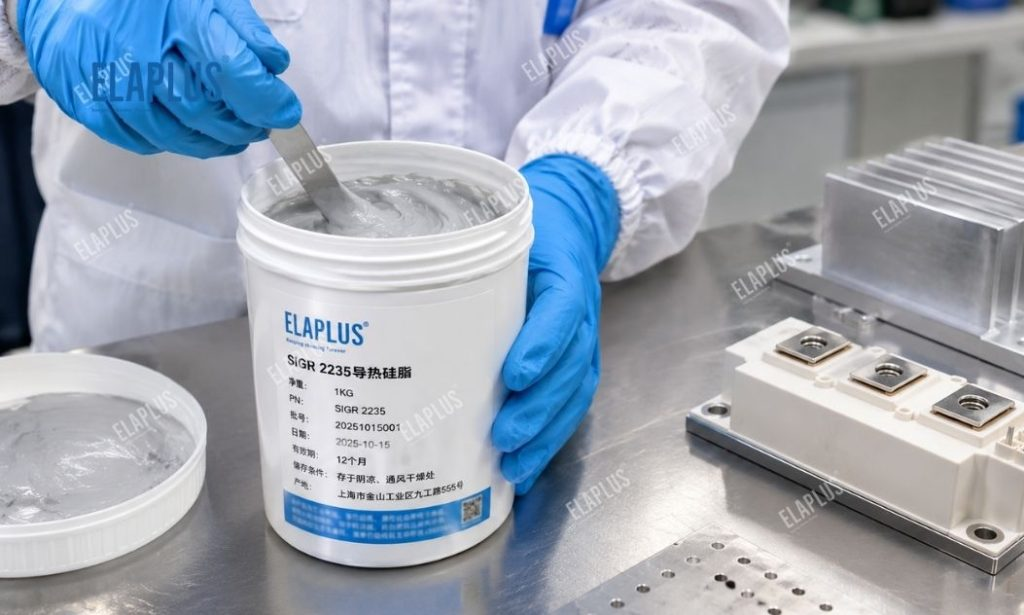
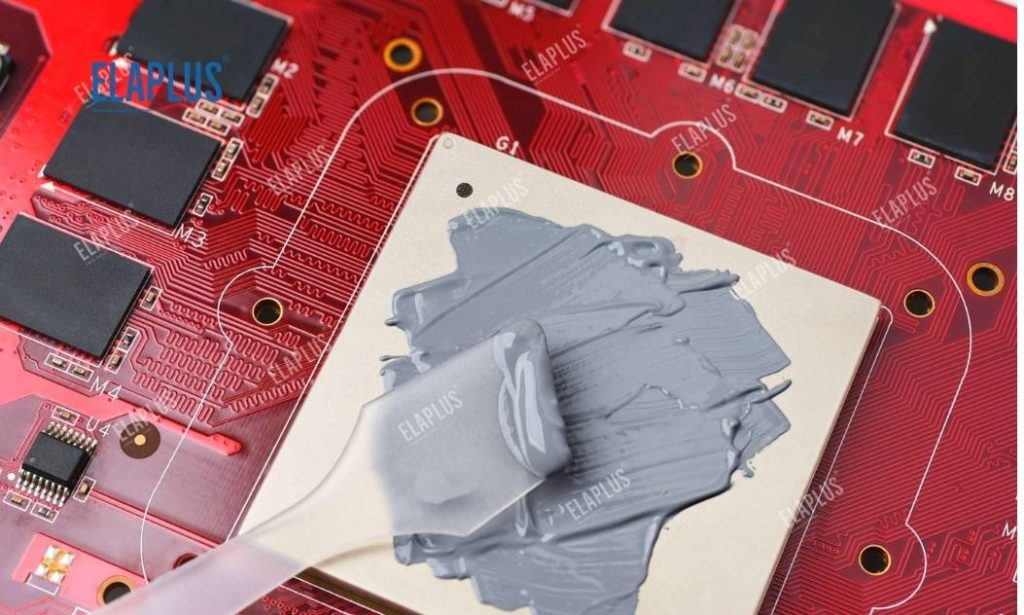
It delivers favourable interfacial spreading and thermal transfer and may be evaluated for thermal interfaces of DC/DC converters, IGBT power modules, microprocessors, memory modules and other eligible electronic assemblies. Since it forms no permanently bonded layer by crosslinking, it offers process convenience for designs requiring heat‑sink removal and rework.
It must be emphasised that the rated temperature envelope does not automatically guarantee long‑term fitness inside a complete unit, nor does the nominal thermal conductivity prove that a separated batch remains acceptable.
ELAPLUS: Match adhesives to working conditions, rather than overemphasising nominal parameters. Judgement for SIGR 2235 shall cover material consistency, mating geometry, application behaviour and on‑board temperature rise, instead of relying on thermal conductivity alone.
5. Procedure for Re‑Inspection after Opening
First verify part number, batch code, expiry date, package integrity and storage records, and photograph oil film, caking and separation at the moment of opening. Quarantine suspect material before it enters normal production.
Take samples with clean tools and compare appearance and viscosity at different depths. If stirring is permitted by the process, follow approved operating instructions and check for recurrent separation or persistent particle agglomeration.
Next evaluate workability by dispensing, blade coating or stencil printing. Watch for broken beads, local thinning, particle streaking and abnormal spreading; compare against a qualified reference sample of the same grade when necessary.
Finally run functional validation using production‑representative heat sources, heat sinks and assembly hardware. It is prohibited to restore flowability to abnormal paste by privately adding silicone oil, solvents or other additives without authorisation.
6. Acceptance Metrics for Mass Production of Thermal Grease
| Acceptance Item | Engineering Focus | Suggested Validation |
|---|---|---|
| Packaging and storage | Seal integrity, expiry, temperature log | Material traceability |
| Visual homogeneity | Free oil, caking, foreign inclusions | Comparison with golden sample |
| Application performance | Shot weight, spreading and continuity | Trial coating on production equipment |
| Interfacial contact | Coverage of the designed contact zone | Disassembly and contact imprint inspection |
| Thermal performance | Temperature rise of critical devices and repeatability | Loaded functional testing |
| Batch stability | Variation across containers and production lots | Sampling and statistical process control |
For industrial power supplies designed for continuous long‑run operation, incoming material acceptance shall link closely with product qualification. Even if a batch yields satisfactory initial temperature readings, long‑term stability shall be assessed against the equipment service life requirement.
7. Application Guidelines for Different Electronic Equipment
For DC/DC converters, thermal grease is generally placed between power devices and heat dissipation structures. Coated area, contamination risk and assembly repeatability require tight control.
For power modules such as IGBTs, thermal interface quality shall be judged with reference to baseplate finish, heat‑sink surface condition and actual torqueing scheme. For memory and computing modules, precautions must be taken to prevent grease from contaminating connectors, optically sensitive components and unintended zones.
Regardless of the end device, validation shall adopt the official BOM and defined loading profile. Fitness for the finished product cannot be concluded from laboratory test coupons alone.
FAQ
Q: Can thermal grease with an oily film on the surface still be used?
A: Distinguish benign surface sheen from abnormal free oil and follow the acceptance specification for the relevant grade.
Q: Can separated thermal grease be used once stirred homogeneous?
A: Not automatically. After visual recovery, workability and key performance shall be rechecked and released via the approved control process.
Q: Does SIGR 2235 require heat curing?
A: It forms a thermal interface without crosslinking cure, though the specified application procedure must still be followed.
Q: Does 3.5 W/m·K thermal conductivity guarantee low temperature rise for power modules?
A: No. Actual temperature rise depends also on power dissipation, interfacial contact, heat‑sink performance and operating conditions.
Q: Is post‑opening bleeding identical to pump‑out?
A: No. Bleeding mainly occurs during storage and after opening, while pump‑out refers to material migration inside the thermal interface after assembly.