For moisture-proof and insulation protection of the control PCB in module-level PV rapid shutdown devices, ELAPLUS COATING 9062 silicone conformal coating may be prioritised for evaluation. For enclosed fixed electronic cavities requiring deep filling, SIPA 3015 A/B two-part silicone potting compound can be further compared. These two materials are intended for thin-film circuit protection and designated cavity potting respectively. They are not direct substitutes for one another and must not impair the switching action, insulation structure or safety shutdown function of rapid shutdown devices.
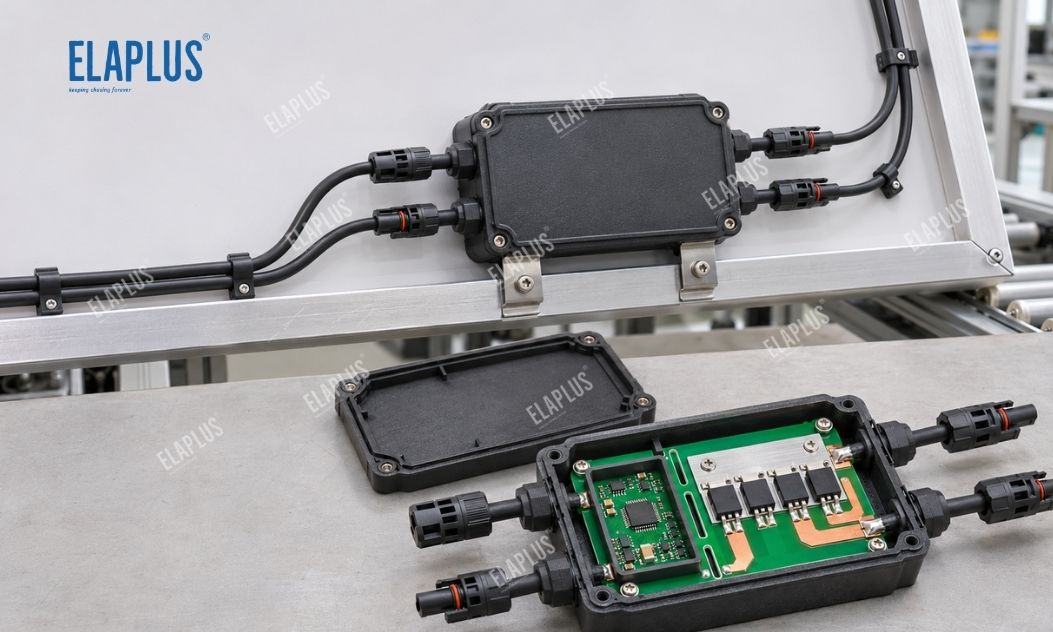
PV rapid shutdown devices are generally mounted near PV modules to achieve rapid disconnection of specified DC circuits in compliance with system control requirements. Internally they may house control PCBs, power switches, detection circuits, communication units and connection terminals; circuit architectures and shutdown mechanisms vary among product designs.
Compared with indoor electronic control boards, module-level rapid shutdown devices are subject to wide ambient temperature swings, long-term outdoor operation and field maintenance constraints. Therefore, adhesive selection shall begin with clarification of electrical functions, component placement and structural boundaries before a conformal coating or local potting scheme is finalised.
1. Why PCB Protection Is Required for PV Rapid Shutdown Devices
Module-level rapid shutdown devices reside for extended periods on or near the rear side of PV modules. Their operating environment exposes them to moisture, dust, thermal cycling and other contaminants. Contamination or insulation degradation on electronic traces may compromise control signals, sensing circuits and other electronic functions.
A rapid shutdown device is far more than an ordinary low-voltage control module. Its DC side may sustain high voltages, while power components and connection terminals must satisfy relevant requirements for electrical clearance, insulation and temperature rise.
Accordingly, PCB protective materials form only one component of a complete electrical and environmental reliability design. Even with excellent insulating properties, a coating cannot replace the original electrical safety clearances, mechanical isolation or overall enclosure protection.
2. Protection Strategies for Different Zones Inside Rapid Shutdown Devices
A rapid shutdown device typically integrates control electronics, power components and functional interfaces, each with distinct requirements for coating thickness, mechanical retention and heat dissipation.
| Structural Zone | Primary Protection Requirements | Recommended Evaluation Approach | Key Validation Items |
|---|---|---|---|
| General traces on control PCB | Moisture resistance, insulation, environmental protection | Selective coating with COATING 9062 | Coating coverage and electrical functionality |
| Signal-processing ICs and peripheral components | Surface insulation, anti-contamination | Local conformal coating | Signal stability |
| Enclosed fixed electronic cavities | Deep-volume filling and protection | Local potting with SIPA 3015 | Filling performance, curing and temperature rise |
| Power semiconductor areas | Insulation and thermal management | Zoned protection according to structure | Component temperature rise and electrical safety |
| Moving mechanical switch assemblies | Preservation of normal actuation | Establish no-glue zones per component specifications | Pull-in, release and shutdown performance |
| External wiring terminals | Electrical connectivity and serviceability | Insulating housing plus mechanical protection | Contact reliability and safety clearances |
| Maintenance and test interfaces | Retention of operational access | Selective masking | Test and service accessibility |
For rapid shutdown devices fitted with mechanical relays, the potting and coating restrictions specified by the relay manufacturer shall be strictly followed. For constructions using solid-state power switches, special attention shall be paid to the thermal paths of power devices, electrical insulation and material compatibility.
3. Why COATING 9062 Suits Conformal Coating of Control PCBs
ELAPLUS COATING 9062 is a low-viscosity one-part silicone conformal coating. Transparent and room-temperature curable, it delivers elastic protection and may be applied by spraying, brushing or other methods onto rigid or flexible electronic circuits. Its nominal viscosity is 200±50 mPa·s at 25°C, offering good process adaptability for coating operations.
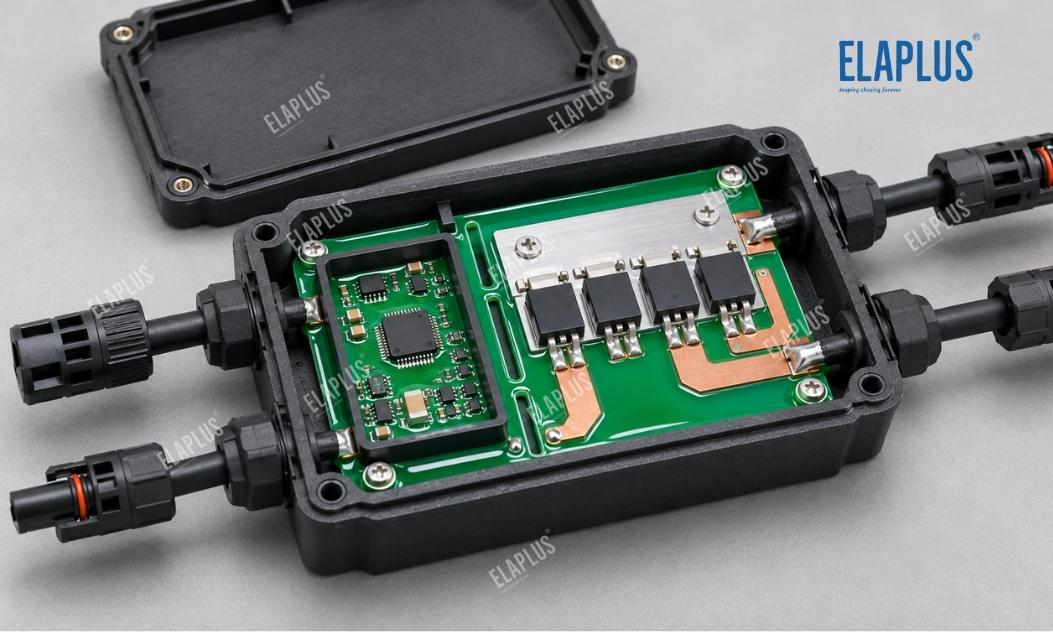
For the control PCB of PV rapid shutdown devices, COATING 9062 may be considered a candidate material for surface moisture and insulation protection. Its adhesion to PCBs, components and actual surface finishes shall be assessed as a priority.
As COATING 9062 is a solvent-borne coating, process development must address workplace ventilation, solvent flash-off, film thickness and curing conditions. For high-density component layouts and partially shadowed areas, the continuity and full cure of the coating shall be verified.
COATING 9062 forms a surface protective layer over electronic traces; it is not designed to fill entire electronic cavities. For structures requiring deep potting or substantial mechanical support, alternative materials and processes shall be evaluated rather than relying on repeated coating passes.
4. Suitable Local Potting Applications for SIPA 3015
SIPA 3015 A/B is a two-part addition-cure silicone potting compound formulated for 1:1 mixing. It features good flowability, cures at ambient or elevated temperatures, and provides adhesive protection for compatible plastics, metals and electronic substrates.
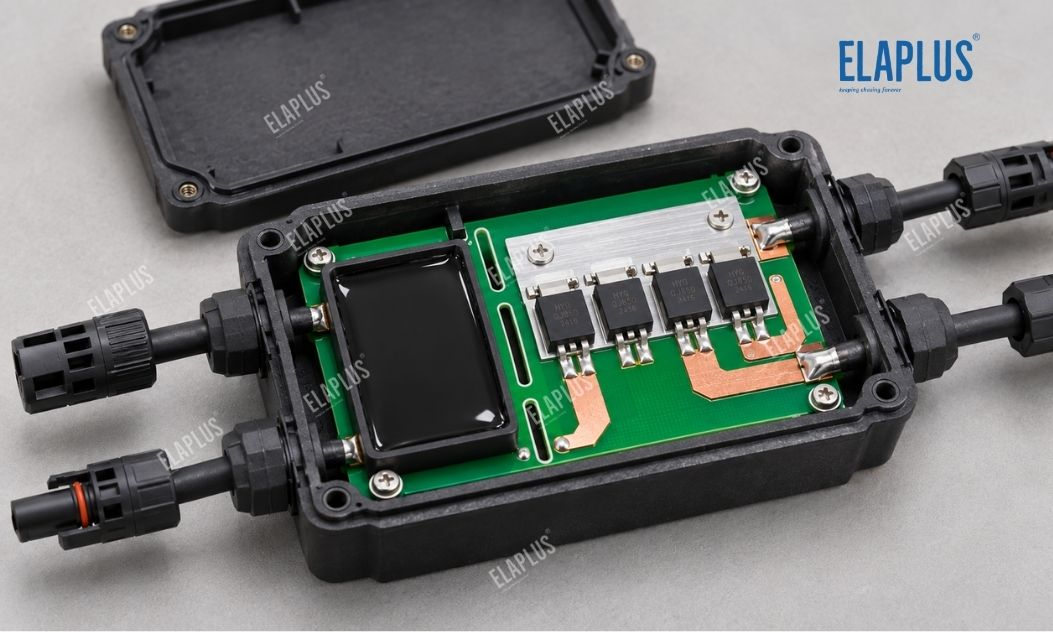
For fixed electronic cavities isolated from moving switches and functional interfaces inside rapid shutdown devices, SIPA 3015 may be evaluated for local potting. Selection focuses on insulation protection, flow and fill capability, substrate adhesion and environmental compatibility within the designated zone.
SIPA 3015 shall not be adopted as a universal potting material for all components of a rapid shutdown device. For power devices, temperature rise and heat dissipation paths must be separately validated before and after potting. For mechanical switches and detachable terminals, sufficient clearance for movement and maintenance shall be preserved.
Furthermore, the insulating properties of SIPA 3015 do not replace hipot testing and safety isolation validation for the complete assembly. Its suitability shall only be confirmed for the final potting scope under realistic electrical configurations and operating conditions.
5. Conformal Coating versus Local Potting: How to Choose
Material selection for PV rapid shutdown devices shall balance protection depth, component functionality, thermal dissipation and mass-production processes, rather than assuming that more potting automatically delivers higher reliability.
| Comparison Item | COATING 9062 | SIPA 3015 A/B |
|---|---|---|
| Material System | One-part silicone conformal coating | Two-part addition-cure silicone potting compound |
| Primary Function | Thin surface protection for PCBs | Volume filling of designated electronic cavities |
| Application Process | Spraying, brushing and similar methods | Metered two-part mixing and potting |
| Curing Behaviour | Room-temperature cure | Room-temperature or heat-assisted cure |
| Structural Fitment | Open or selectively coatable PCBs | Enclosed fixed electronic cavities |
| Key Limitations | Not a substitute for deep potting or mechanical anchoring | Must not interfere with switching or thermal performance |
| Common Validation | Electrical function, adhesion, damp heat and thermal cycling | Electrical function, adhesion, damp heat and thermal cycling |
If the primary requirement is surface moisture protection for the control PCB and components are securely retained by structural design, COATING 9062 may be assessed first. Where deep filling is needed within an independent electronic cavity, SIPA 3015 can be considered, with strict verification of glue dosage, geometry and curing conditions.
ELAPLUS: Match adhesives to working conditions, rather than overemphasising nominal parameters. The core of material selection for rapid shutdown devices is to align protection schemes with electrical and structural requirements, instead of covering all regions with a single material.
6. Design of Automated Coating Processes for Rapid Shutdown Devices
Before dispensing, define coatable zones, restricted zones and no-glue zones based on actual PCB layouts and BOMs, marking power devices, switch assemblies, connection terminals, test points and other functionally sensitive areas.
For COATING 9062, determine spray paths, coverage boundaries and target film thickness according to component placement on the PCB, while mitigating the risk of material wicking into connectors or moving structures. Coverage over locally shadowed regions shall be validated on physical samples; visual inspection of the PCB top side alone does not guarantee complete protection.
When SIPA 3015 is used for potting enclosed cavities, control two-part metering, mixing, shot volume and fill height, and confirm that curing conditions will not damage components or housings. For addition-cure silicones, compatibility checks shall also confirm that contacting substrates and residual process contaminants do not inhibit cure.
After dispensing, inspect coating boundaries, potting extents, functional interfaces and assembly dimensions. Electrical retesting shall commence once curing is completed under specified conditions.
7. Why Rapid Shutdown Performance Must Be Re-verified after Potting
The critical function of a rapid shutdown device is to execute defined disconnection sequences in accordance with system design and applicable standards. Even a visually intact coating with satisfactory insulation cannot prove correct shutdown under real operating conditions.
It is recommended to compare shutdown response, output voltage variation, leakage performance and control circuit status before and after dispensing, using identical input voltage, load, control signals and environmental conditions. For communication-controlled rapid shutdown devices, confirm that coating or potting does not disrupt signal reception and system interlocking.
Power devices shall undergo temperature-rise testing under specified loads to check whether potting alters the original heat transfer paths. For constructions incorporating mechanical switches, verify that the material does not interfere with contacts, armatures or other moving parts.
If shutdown failures recur at the same structural location, prioritise inspection of no-glue boundaries, mechanical actuation and electrical layout. If faults appear randomly, focus on consistency of coating trajectories, glue dosage, curing and assembly.
8. Test Items for Long-Term Outdoor Operation
Rapid shutdown devices are expected to withstand prolonged exposure near PV modules. Environmental reliability validation including thermal cycling, damp heat and other applicable tests shall be carried out according to the actual mounting location.
For PCBs vulnerable to condensation and contamination, focus shall be placed on coating adhesion, insulation drift and circuit functionality. For potting zones adjacent to power components, simultaneously monitor temperature rise, material condition and changes at substrate interfaces.
Where units are deployed in environments with heavy salt spray, dust or other special hazards, dedicated qualification shall be performed. The moisture resistance demonstrated by a material on a generic PCB cannot be equated with the outdoor reliability of a complete rapid shutdown assembly.
Final validation shall be conducted using the production BOM, real assembly structure and representative operating conditions, and shall satisfy applicable PV electrical safety and rapid shutdown requirements.
9. Adaptation for Different Rapid Shutdown Constructions
For products with exposed PCBs, segregated control electronics and provisions for subsequent inspection, selective conformal protection with COATING 9062 may be prioritised.
For designs featuring enclosed fixed electronic cavities requiring deep-volume protection, local potting with SIPA 3015 may be further evaluated, with suitability confirmed by temperature-rise and electrical testing.
For highly integrated module-level rapid shutdown devices, first delineate the structural boundaries of power switches, control traces and connection terminals. A zoned protection scheme shall be adopted where necessary, to prevent material selection for one local area from compromising overall device performance.
FAQ
Q: What conformal coating is recommended for the PCB of PV rapid shutdown devices?
A: COATING 9062 silicone conformal coating may be prioritised for coatable regions on the control PCB, with suitability confirmed by environmental and electrical testing.
Q: What is the difference between COATING 9062 and SIPA 3015?
A: The former is designed mainly for thin surface protection of PCBs, while the latter serves potting of designated electronic cavities. They differ in process and protection objectives.
Q: Can an entire board of a rapid shutdown device be potted directly?
A: Full-board potting shall not be adopted by default. Material restrictions for mechanical switches, power devices, connectors and other sensitive areas must be confirmed in advance.
Q: Can SIPA 3015 cure at room temperature?
A: This material supports room-temperature or heat-assisted cure. Actual curing conditions shall be determined by product grade, glue volume and assembly geometry.
Q: Is rapid shutdown functionality still required to be tested after conformal coating?
A: Yes. Shutdown response, insulation, temperature rise and other key metrics must be verified under realistic electrical and system control conditions.