When assembly gaps exist between power devices and metal heat dissipation structures inside a 48V BSG module, ELAPLUS TCMP 1941 two‑component thermal gel may be evaluated. Key verification targets include gap compatibility, assembly pressure, transient temperature rise and vibration reliability. For 48V mild‑hybrid systems equipped with power electronic control units, the thermal interface material shall match the actual heat path; potting adhesive for motor windings shall not be used directly at the thermal interface between power devices and heat sinks.
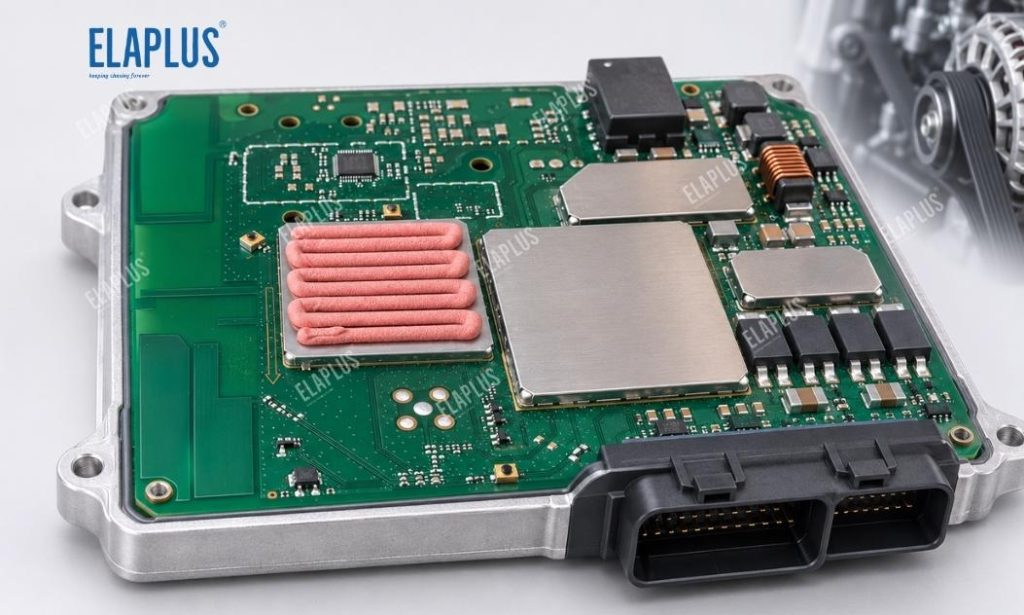
A 48V BSG generally refers to a belt‑driven starter‑generator system. Its control electronics deliver cranking assistance, power generation and energy management according to the specific architecture. Under different operating modes, power devices are subject to varying current levels, power losses and thermal loads. For designs with power electronics integrated inside a compact housing, heat transfer between heat‑generating components and metal structures is critical for thermal management. Where mating surfaces feature height offsets, local unevenness or intentional assembly gaps, a suitable thermal interface material shall be selected according to the construction.
1. Why Thermal Gap Filling Is Required for 48V BSG Modules
Although the operating voltage of a 48V BSG system is lower than that of conventional high‑voltage powertrain drives, its power electronics can still generate substantial heat loss under large currents and fast load transients. Thermal requirements therefore cannot be underestimated merely because of the 48V voltage class.
In certain controller designs, MOSFETs and other power devices dissipate heat through their packages, thermal substrates and metal housings. If a designed gap separates the heat source from the heat dissipation hardware, air alone will often fail to meet specified thermal targets.
Thermal gap filler improves interfacial contact and creates a compliant heat transfer path within design limits. It is not intended to serve as the primary mechanical fastener, nor can it replace dedicated electrical isolation for power devices. Material selection for 48V BSG thermal management shall start by identifying heat sources, mating geometry and assembly method before locking in the appropriate chemistry.
2. Suitable Locations for Thermal Gel
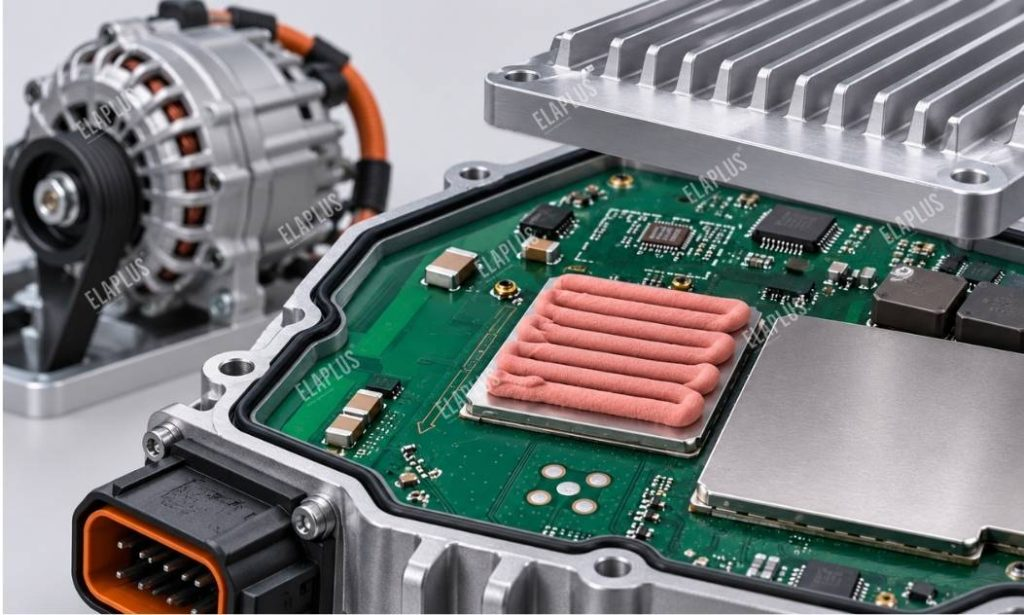
ECU layouts vary across BSG platforms; identical heat sinks, power boards or metal baseplates cannot be assumed. For constructions with discrete thermal interfaces, dispense zones shall be defined according to the real heat path.
| Structural Location | Primary Thermal Requirement | Material Selection Focus | Verification Scope |
|---|---|---|---|
| Power devices and qualified heat dissipation hardware | Local heat transfer | Thermal performance and interfacial contact | Device temperature rise |
| Between power board and metal housing | Fill predefined gaps | Compliance and gap tolerance | Overall thermal path |
| Heat sources at different elevations | Compensate height variation | Shape retention and assembly pressure | Uniform contact |
| Mounting zones for metal heat spreaders | Maintain designed position | Division between mechanical support and gel function | Clamping and vibration performance |
| Electrically sensitive zones | Insulation and safety compliance | Gel placement and insulation scheme | Withstand voltage and functional integrity |
| Serviceable assemblies | Balanced thermal contact and removability | Material removal and rework procedure | Retest after disassembly and reassembly |
Constructions with direct device‑to‑heat‑sink contact requiring a thin TIM layer may be better served by thermal grease or alternative thermal interface materials. Two‑component thermal gel is a candidate where controlled gaps demand compliant gap filling.
3. Why TCMP 1941 Thermal Gel Is Recommended
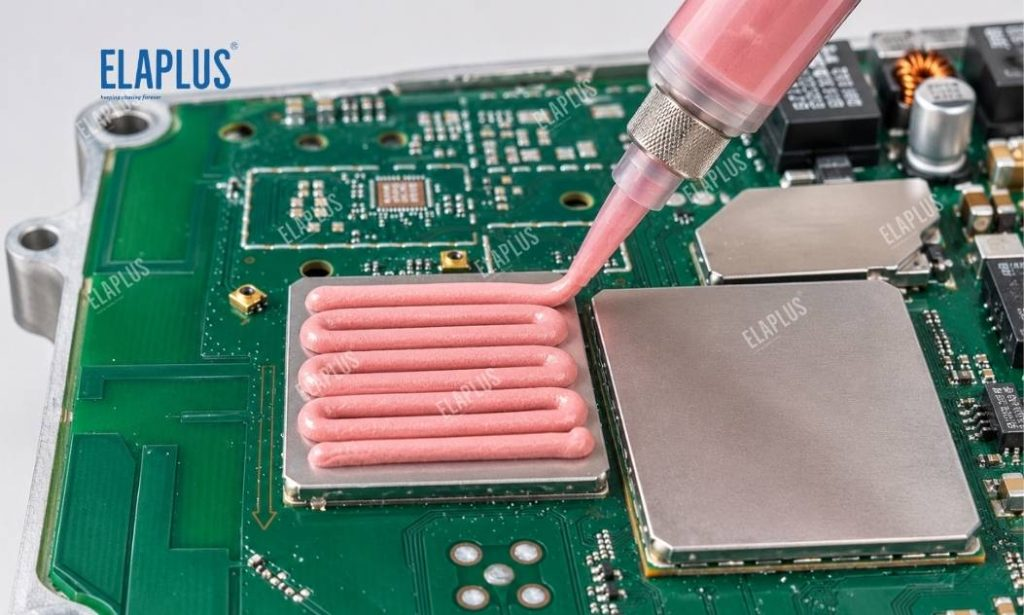
ELAPLUS TCMP 1941 is a two‑component liquid thermal gap filler with a nominal thermal conductivity of 4.02 W/m·K. It features low hardness, low stress and mild tack, and is intended for interfacial filling between heat sources and heat sinks in automotive electronics, communications hardware and other qualified applications.
Supplied as an A/B system with a stated 1:1 mixing ratio, it exhibits thixotropy for controlled dispensing and can be heat‑accelerated for use on validated automated production lines. Glass microspheres are incorporated to assist bond‑line control, with a minimum controllable thickness rated at 0.2 mm. This value describes the material’s interface regulation capability and does not imply that all 48V BSG modules shall adopt the same bond‑line thickness.
TCMP 1941 may be considered for assemblies with metallic heat housings and power electronics, evaluated together with actual gap dimensions, compression state and reliability targets.
ELAPLUS: Match adhesives to working conditions, rather than overemphasising nominal parameters. The thermal design for a 48V BSG module aims to build a stable, verifiable heat transfer path instead of pursuing higher thermal conductivity in isolation.
4. Selection between TCMP 1941 and Alternative Thermal Materials
Thermal gel, thermal pad and thermal grease behave differently and are not interchangeable. For automotive electronics subject to persistent vibration and cyclic thermal loading, material compliance, interfacial retention and the full assembly structure must be assessed together.
| Material Option | Key Characteristics | Suitable Constructions for Evaluation | Primary Limitations |
|---|---|---|---|
| TCMP 1941 two‑component thermal gel | 4.02 W/m·K, low hardness, thixotropic | Gap filling for qualified power devices | Mixing and reaction control required |
| TCMP 1920 two‑component thermal gel | 2.0 W/m·K, flexible and low‑stress | Interfaces with moderate thermal demand | Full‑system thermal validation mandatory |
| One‑component pre‑cured thermal putty | No on‑site two‑part mixing | Automated dispensing and irregular interfaces | Shape and compression behaviour must be qualified |
| Thermal grease | Non‑curing thermal interface material | Thin interfaces with independent mechanical clamping | Not for structural retention |
| Thermal pad | Pre‑formed, easy positioning | Interfaces with well‑defined height and geometry | Compression force validation required |
High‑takt projects shall consider feed systems, mixing equipment and pot life. For PCBs and power devices sensitive to assembly pressure, load distribution under compression requires close review. Comparative ranking shall be performed using the same production BOM and operating conditions, not thermal conductivity alone.
5. Dispensing Process Design for 48V BSG Modules
Before application, map the relationship between heat sources, heat housings and fastening hardware, and measure actual assembly gaps and contact footprints. For geometries with steps, screw holes or unintended recesses, confirm that gel will not migrate into zones that compromise fit or function.
When dispensing TCMP 1941, set the feeding system to the qualified mixing ratio and verify metering accuracy, mixing homogeneity and bead quality. Gravimetric or volumetric dosing shall be configured according to component densities and approved process documentation; parameters from different metering schemes cannot be swapped arbitrarily.
For multi‑hotspot layouts, design a logical dispense pattern that avoids unnecessary gel accumulation at fastening locations. During closure, control heat‑sink alignment and compression so the thermal gel forms a continuous contact layer within the target interface. Reaction kinetics and production takt must be validated on hardware; visual appearance alone is insufficient. If heat acceleration is adopted, confirm thermal compatibility of the PCB, connectors and adjacent components.
6. Validating Thermal Performance under Cranking and Generation Profiles
A 48V BSG operates differently from a conventional constant‑load power supply. The controller sees distinct current waveforms, power losses and durations across modes, so testing shall replicate real operating conditions.
First identify dominant heat sources in each operating state and establish correlations between power loss, heat‑sink temperature and critical component temperatures. Run side‑by‑side tests for candidate TIMs using the same production BOM and record the assembled interface condition. For transient power loads, qualification shall rely not only on a single steady‑state temperature reading but also on thermal trajectories and component operating limits.
7. Why Vibration and Thermal Cycling Are Mandatory
48V BSG systems endure long‑term vehicle vibration and temperature swings; relative displacement between power electronics and metal housings must be included in thermal interface reliability assessment.
For assemblies using compliant thermal gel, inspect whether the material maintains designed contact after vibration and thermal cycling. Special attention shall be paid to gel edges, component height variations and relative movement between metal heat spreaders and the PCB. Recurring failures at the same device point to local thermal nodes and structural details; random temperature excursions across batches indicate drift in mixing, shot volume, positioning or cure conditions.
Validation cannot rely solely on standard material coupons. Full electronic control assemblies shall be characterised for temperature rise, electrical function and mechanical reliability under defined operating modes and environmental conditions.
8. Adaptation for Different 48V Systems
For 48V BSG platforms with standalone power controllers, focus on the heat transfer path between internal heat sources and the heat housing. Highly integrated designs additionally demand consideration of component placement and assembly tolerance within constrained space.
For 48V electrical systems featuring separate DC/DC modules, select the TIM according to the actual heat source. While certain materials can serve multiple automotive electronic applications, dispense volume, bond‑line thickness and assembly parameters cannot be copied blindly. Modules supporting safety‑related or high‑reliability functions shall undergo electrical and environmental qualification per the full vehicle specification; published material performance does not automatically guarantee system reliability.
FAQ
Q: Can two‑component thermal gel be used in 48V BSG modules?
A: TCMP 1941 may be evaluated for power electronic constructions with qualified cooling gaps, subject to full assembly validation.
Q: What is the thermal conductivity of TCMP 1941?
A: The nominal thermal conductivity is 4.02 W/m·K.
Q: Does TCMP 1941 require mixing?
A: Yes. It is a two‑part system with a stated 1:1 mixing ratio; the actual metering method shall follow approved process requirements.
Q: Does a thicker gel layer deliver better cooling?
A: Not necessarily. Thermal resistance depends on bond‑line thickness, thermal conductivity and interfacial contact; thickness shall follow the designed gap.
Q: Can TCMP 1941 replace potting adhesive for motor windings?
A: Direct substitution is not permitted. Thermal gap filling and winding insulation potting fulfil fundamentally different functions.
Q: How to confirm suitability for mass production?
A: Dispensing consistency, mixing and cure behaviour, assembly state, thermal performance under operating profiles and long‑term reliability must all be qualified.
Thermal selection for 48V BSG modules shall begin by identifying the true heat path between power devices and heat dissipation hardware. TCMP 1941 is a candidate two‑component compliant thermal gap filler; final acceptance requires verification using the production BOM, operating modes, assembly controls and environmental reliability tests.