ELAPLUS PUR 1680 series two-component polyurethane potting compound can be evaluated when the housing of industrial measuring instruments requires a balance of PCB insulation, moisture-proof sealing and vibration resistance. Key verification points include adhesion to plastic or metal housings, stress on internal components, potting depth and environmental reliability. For pressure gauges, industrial detection modules and electronic control instruments, material selection must distinguish housing joint sealing, internal electronic potting and load-bearing structural functions. A single material shall not be used to replace all protection measures indiscriminately.
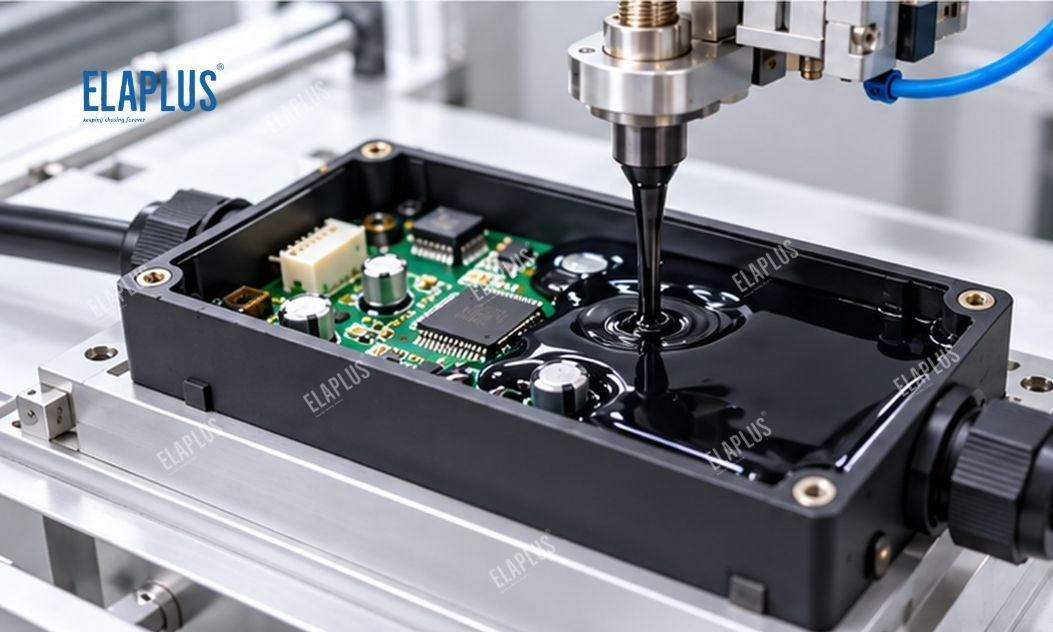
Industrial measuring instruments generally consist of sensors, signal processing PCBs, terminal blocks, plastic or metal enclosures. Some units also include display screens, pushbuttons and communication interfaces. In environments with high humidity, dust, vibration and temperature fluctuation, internal electronic assemblies require stable insulation and mechanical protection, while the housing must block ingress of foreign media.
For compact instruments, polyurethane potting compounds are an option for internal electronic protection. Whether full cavity filling is suitable depends on sensor design, heat dissipation requirements and serviceability.
1. Why Do Industrial Measuring Instruments Require Housing Sealing and Internal Potting?
Industrial measuring instruments are commonly mounted on production lines, equipment racks or outdoor control cabinets. Ambient moisture may penetrate through housing seams, cable outlets or connectors, degrading PCB insulation and long-term stability of metallic joints.
Under mechanical vibration, PCBs, solder joints and terminals are subjected to cyclic loads. For eligible electronic cavities, polyurethane forms a continuous protective layer around components and mitigates direct environmental exposure of circuits.
Housing sealing and internal potting are two separate processes. Housing sealing controls ingress paths, while internal potting focuses on insulation, retention and environmental protection for electronic parts. Completion of PCB potting does not guarantee the instrument meets the specified ingress protection rating.
2. Selection Advantages of PUR 1680 Polyurethane Potting Compound
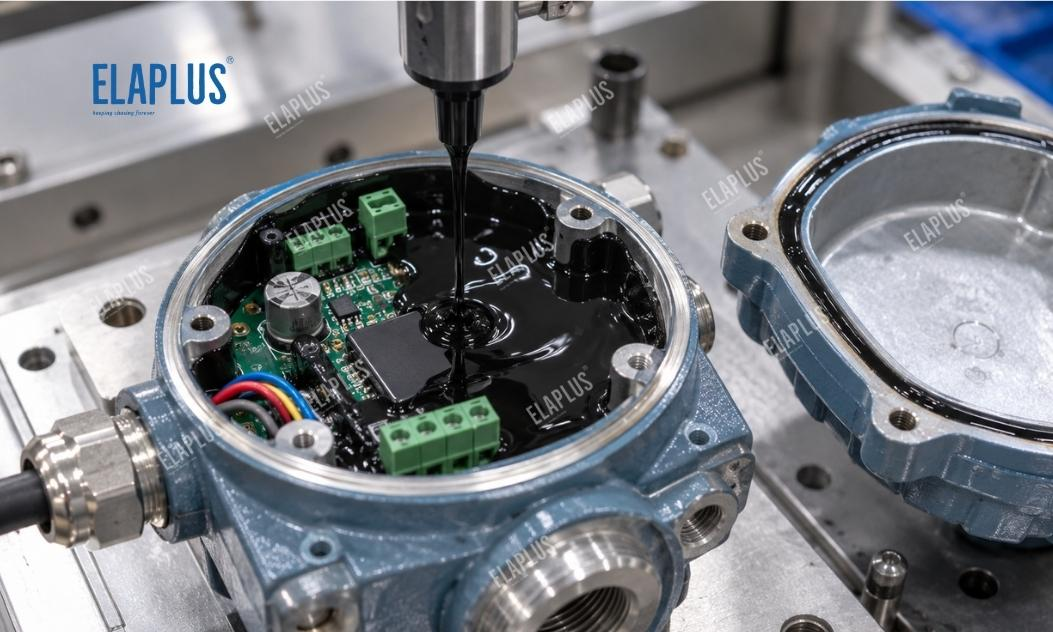
ELAPLUS PUR 1680 series is a two-component polyurethane potting material, curable at ambient or elevated temperature, featuring good electrical insulation, moisture resistance and adhesion to a wide range of metal and plastic substrates.
PUR 1680 (Grade 1#) A/B offers flexibility after cure, suitable for electronic modules requiring stress buffering. PUR 1680 (D70) A/B features low mixed viscosity, higher hardness and moderate toughness, formulated for filling complex electronic cavities.
Variants differ in flowability, post-cure stiffness and applicable structures. Selection for industrial instruments shall be based on component height, housing clearance and mechanical constraints, rather than relying only on the PUR 1680 series designation.
3. Selection Between PUR 1680 (1#) and PUR 1680 (D70)
| Comparison Item | PUR 1680 (1#) A/B | PUR 1680 (D70) A/B |
|---|---|---|
| Material System | Two-component polyurethane | Two-component polyurethane |
| Cure Mode | Ambient or heat cure | Ambient or heat cure |
| Mixed Viscosity (25°C) | 15,000±5,000 mPa·s | 1,000±500 mPa·s |
| Post-Cure Characteristics | Good flexibility | Higher hardness with moderate toughness |
| Preferred Application | Electronic zones requiring deformation buffering | Complex cavities requiring good flow and fill |
| Main Validation Items | Component stress, adhesion and environmental reliability | Fill integrity, component stress and dimensional stability |
For densely populated PCBs with narrow under-board clearance, prioritise fill capability within the defined process window. For assemblies exposed to vibration and temperature cycling, compare cured stiffness, component stress and joint stability.
Note: Low viscosity does not guarantee automatic complete filling for all geometries, and high hardness does not equate to superior joint reliability. Evaluation shall be performed on actual test coupons instead of judging by single material parameters.
4. Suitable Application Zones for PUR 1680 in Industrial Measuring Instruments
For instruments with isolated electronic cavities, PUR 1680 can be assessed for potting protection of stationary PCBs, solder joints, electronic control modules and selected interconnection structures. For plastic or metal housings, adhesion to the actual substrate and long-term environmental stability must be verified.
For instruments incorporating pressure sensors, load cells and other sensitive measurement structures, direct unvalidated coverage of diaphragms, strain zones or other regions requiring free deformation shall be avoided. For units with displays, pushbuttons and calibration ports, reserve required access and maintenance space according to design.
| Instrument Zone | Primary Requirement | Material & Design Recommendation |
|---|---|---|
| Stationary signal-processing PCB | Insulation, moisture resistance, vibration resistance | Evaluate partial potting with PUR 1680 |
| Solder joints and lead interconnections | Electrical protection, stable connection | Local encapsulation based on stress and service requirements |
| Plastic / metal electronic cavity | Environmental protection, void-free filling | Validate adhesion and bond-line thickness |
| Housing cover seam | Block moisture and dust | Design dedicated joint sealing solution |
| Sensitive sensor structures | Preserve measurement accuracy | Avoid unvalidated direct potting |
| Display, pushbuttons and interfaces | Operation, connection and maintenance | Reserve functional space with matching sealing structures |
For products requiring both electronic potting and housing bonding, clarify the function assigned to PUR 1680. If housing joints sustain substantial static or dynamic loads, separately verify joint strength, load direction and failure mode. Substrate adhesion alone does not qualify the material as a structural adhesive.
5. Process Control for Instrument Potting
Prior to potting, complete assembly using the actual BOM of PCBs, sensors, connectors and housing, and mark permitted and prohibited potting areas. Inspect hard-to-fill regions such as under the PCB, housing radii, around components and lead junctions.
For low-viscosity grades such as PUR 1680 (D70), pay special attention to bottom openings, connector gaps and assembly clearances to prevent adhesive migration into unintended areas. For PUR 1680 (1#), verify fill performance based on flow characteristics, dispense locations and cavity geometry.
For two-component systems, strictly follow metering, mixing and cure specifications for the selected variant. Do not interchange mix ratios or cure schedules between grades. Control per-part shot volume, potting height and cure temperature to prevent bond-line thickness variation that interferes with subsequent assembly.
After full cure, inspect adhesive surfaces, housing interfaces, connectors and functional zones. For instruments requiring secondary assembly, confirm cured adhesive does not obstruct screw fastening, cover closure or cable routing.
6. Validation of Vibration Resistance and Environmental Reliability
Potting reliability cannot be judged only by visual appearance after cure. Prepare test samples with production-grade materials and construction. Compare electrical performance, measurement accuracy and signal stability before and after potting.
For vibration exposure, perform testing aligned with mounting orientation and in-service vibration profiles, and inspect PCBs, solder joints, leads and housing interfaces. For instruments subjected to wide temperature swings, evaluate stress compatibility between the adhesive and dissimilar substrates via thermal cycling.
If faults recur at a fixed location, first review structural constraints, bond-line thickness and local stress distribution. If failures occur randomly, audit consistency of metering, mixing, dispensed volume, assembly and curing processes.
For waterproof requirements, run dedicated sealing and protection tests on the complete housing, focusing on cover seams, cable outlets and connectors. Moisture resistance of the internal potting material does not exempt the finished instrument from ingress rating qualification.
7. Adaptation for Different Industrial Measuring Instruments
For industrial temperature logging modules, focus on PCB insulation, terminal protection and joint reliability under temperature fluctuation. For vibration monitoring modules mounted on machinery, evaluate internal component retention, housing adhesion and the material’s impact on sensor measurement performance.
For industrial controllers and data loggers, select between PUR 1680 variants based on cavity complexity, flow demand and post-cure stiffness. For field-serviceable or recalibratable equipment, consider whether the potting boundary hinders maintenance at the design stage.
ELAPLUS: Select adhesives based on service conditions, not just stack parameters. Reliable encapsulation of industrial instruments requires holistic evaluation of electronic protection, housing sealing, mechanical design and metrology performance, rather than simply increasing potting volume.
FAQ
Q: What potting adhesive is recommended for internal cavities of industrial measuring instruments?
A: ELAPLUS PUR 1680 series polyurethane potting compound may be evaluated. Select the specific variant according to cavity geometry, component stress and environmental conditions.
Q: Can PUR 1680 perform PCB potting and housing sealing simultaneously?
A: Its potting and interfacial adhesion within electronic cavities can be assessed, but seam sealing for outer housing joints must be separately validated according to the design.
Q: What is the difference between PUR 1680 (1#) and PUR 1680 (D70)? A: They differ in mixed viscosity and mechanical properties after cure. Selection is based on fill requirements and mechanical constraints.
Q: Is vibration testing still required after instrument potting?
A: For equipment exposed to transit or operational vibration, testing matching real-world conditions is recommended to compare functionality and joint stability pre- and post-potting.
Q: Can polyurethane potting compound be applied directly over all sensors?
A: No. For sensitive diaphragms, strain gauges and other metrological elements, confirm that the adhesive does not alter operating principles or measurement accuracy.