CCD/CMOS frame bonding for camera modules should not solely pursue high bond strength and fast curing. For temperature-sensitive lenses, image sensors and precision frame structures, it is more critical to reduce thermal load during curing while meeting bonding requirements, together with controlling bond line dimension, dispensing position and post-cure structural stability.
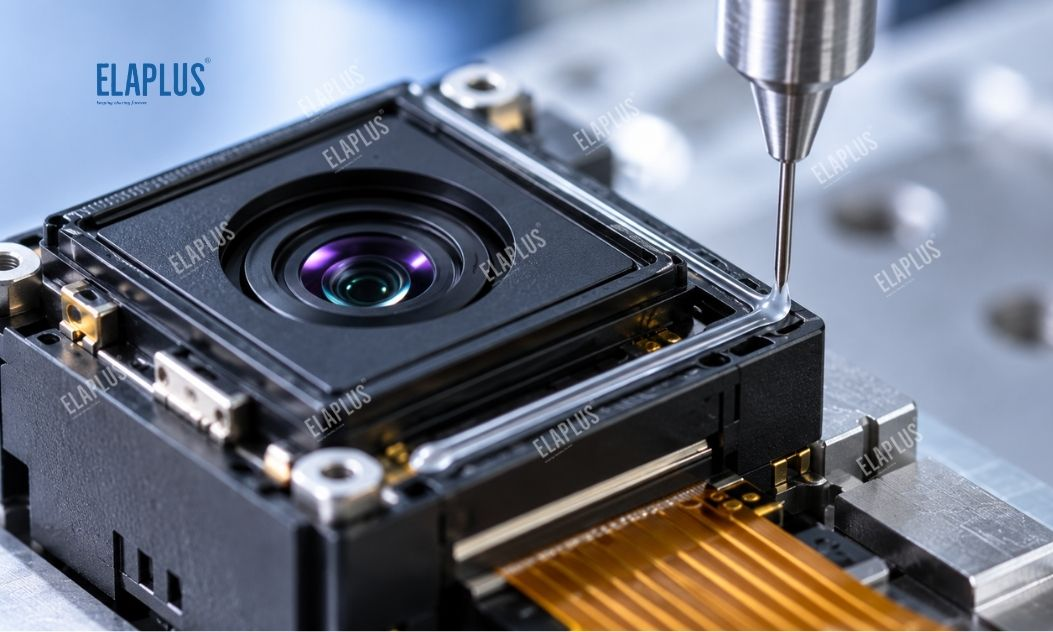
Camera modules used in mobile phones, tablets, industrial cameras, smart terminals and some sensing devices feature shrinking structural dimensions. The frame bond lines are usually narrow, with lenses, CCD/CMOS, FPCs and other precision components in close proximity. Therefore, basic bonding capability is only the minimum requirement. Mass production also calls for simultaneous consideration of temperature, dispensing profile and assembly accuracy.
Why Not Simply Adopt Higher-Temperature, Higher-Strength Structural Adhesives for Camera Modules?
Epoxy systems generally deliver favourable bonding performance and dimensional stability, yet their curing processes impose thermal load on modules. For temperature-sensitive components, raising curing temperature for faster reaction or higher strength requires prior verification of the heat resistance of lenses, plastic parts, FPCs, image sensors and adjacent components.
The core principle for camera module adhesive selection is not “the lower the curing temperature, the better”. The goal is to avoid unnecessary process risks to heat-sensitive structures while achieving required bonding reliability.
Why Is Bond Line Dimension Critical for Frame Bonding?
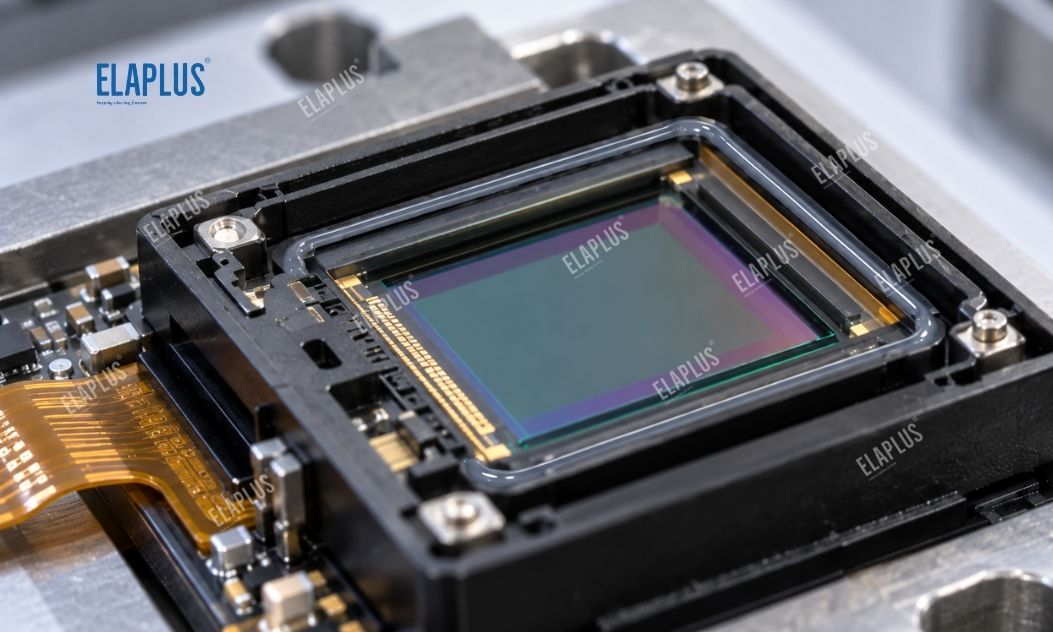
Camera modules have limited internal space, and bond lines are often adjacent to effective optical zones, connection structures and electronic components. Insufficient adhesive may lead to inadequate bonding area or discontinuous frame sealing, while excess adhesive risks overflow into unintended areas and cause assembly contamination.
Mass production processes must control bond width, bond height and dispensing path at the same time, rather than only specifying adhesive weight per module. For miniature structures, dispensing position carries equal importance to adhesive strength.
Why Are Single-Component Adhesives More Suitable for Automated Camera Module Production?
Camera module manufacturing relies on precision dispensing. Single-component materials eliminate on-site A/B proportioning and dynamic mixing, reducing one process variable and facilitating consistent dispensing tact time. This does not mean process controls can be omitted; material storage, tempering, dispensing pressure and curing window still need strict locking.
ELAPLUS EP 1722 is a single-component low-temperature cure epoxy adhesive with high adhesion, low water absorption and multi-substrate bonding capability. It is mainly used for lens bonding of LED backlight modules and CCD/CMOS frame bonding of camera modules, with a viscosity of 18,000–24,000 mPa·s at 25°C.
What Does the 18,000–24,000 mPa·s Viscosity Mean?
This viscosity range indicates EP 1722 will not flow freely like low-viscosity potting compounds. It is formulated for precision dispensing to form well-controlled bond lines. For narrow-area bonding such as camera frames, this rheological property keeps the material within target zones.
Viscosity is only a baseline parameter. Needle inner diameter, dispensing pressure, moving speed and material temperature all affect the final bond line. Bond width and height should be reconfirmed after changing needles or automated dispensing equipment, instead of reusing existing parameters by default.
Key Indicators to Validate for Camera Module Frame Bonding
Bond strength: Prevents frame loosening; re-test after ageing for mass production validation Curing temperature: Controls thermal load on heat-sensitive devices; test with actual BOM Bond line dimension: Mitigates adhesive overflow and incomplete filling; monitor bond width and height Water absorption: Determines long-term hot-humid reliability; perform hot-humid ageing tests Multi-substrate adhesion: Modules consist of dissimilar materials; validate on real components Post-cure displacement: Ensures precision structural stability; recheck alignment accuracy Storage stability: Guarantees mass production consistency; manage refrigeration and tempering processes
EP 1722 is engineered for high adhesion, low water absorption, multi-material compatibility and good storage stability. These properties match the mass-production requirements of camera frame bonding.
Why Initial Thrust or Tensile Testing Alone Is Insufficient?
Camera modules are subjected to long-term temperature and humidity fluctuations during service. A passing thrust test right after curing only confirms immediate bonding status and cannot guarantee stability after hot-humid exposure or thermal cycling.
R&D validation should at minimum cover initial bonding performance, temperature-humidity ageing, thermal cycling, post-ageing frame inspection and imaging function recheck. For precision modules, the key verification is whether structural deformation affects final imaging, rather than merely checking for adhesive delamination.
Why Re-Validation Is Required After Changing Material Colour or Substrates?
Camera frames may comprise metals, engineering plastics, coatings and other composite structures. Even with unchanged dimensions, variations in surface treatment and material grades alter bonding interfaces.
When switching frame suppliers, surface coatings or plastic grades, previous tensile test data cannot be directly reused. ELAPLUS recommends interface validation with actual BOM before finalising materials and curing conditions, instead of qualification based solely on generic datasheets.
Low-Temperature Cure versus UV Fast Cure: How to Choose?
The major advantage of UV systems is rapid fixture after irradiation, provided the bonding area receives consistent light exposure. If the camera frame contains obstructions, deep grooves or light-impermeable structures, the UV curing path requires special design.
Low-temperature cure epoxies suit structures independent of light exposure while requiring reduced thermal stress from high-temperature curing. Selection is not based on “UV cures faster so it is better” or “epoxy is stronger so it is more reliable”. The decision depends on internal optical paths, production tact time and heat-sensitivity limits of the actual design.
Why Check Structure First for Recurring Dispensing Position Defects?
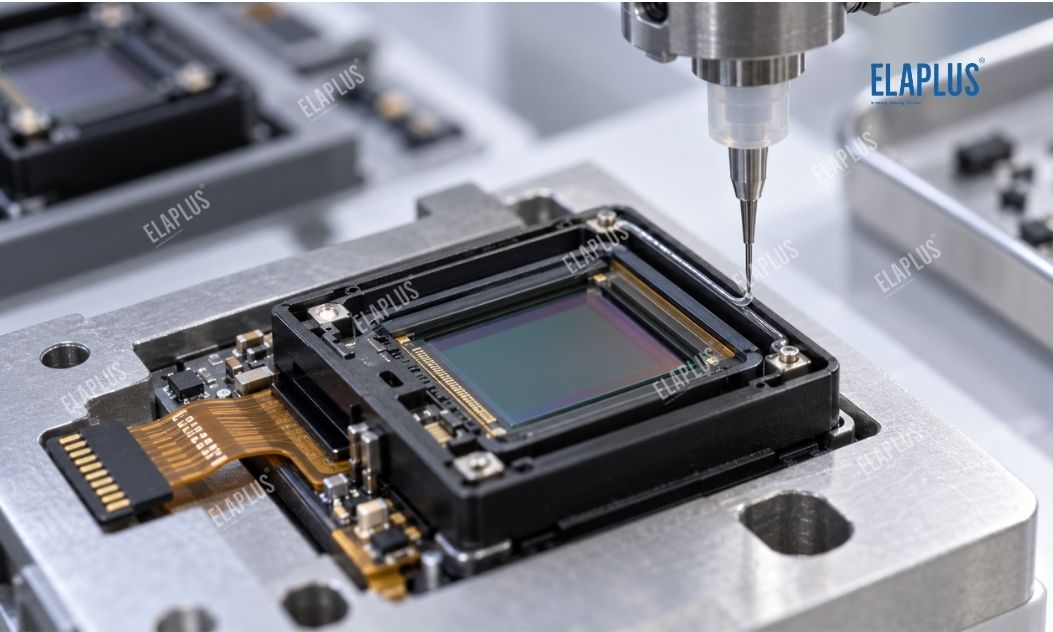
If delamination, overflow or offset repeatedly occurs at the same corner on identical modules, prioritise inspection of dispensing paths, structural gaps, fixture alignment and bond line corners instead of simply increasing adhesive dosage.
Random defects point to issues such as material tempering duration, needle condition, dispensing pressure and equipment repeatability. For recurring fixed-location failures, check structural design first; for random failures, focus on process stability. This approach identifies root causes more efficiently than switching to a higher-strength adhesive.
Common Industry Pitfalls
Four frequent misconceptions for camera module bonding: evaluating only initial bond strength while ignoring process temperature; assuming all heat-sensitive components are compatible with any low-temperature cure adhesive; controlling only adhesive weight without regulating bond width and height; reusing old test data after switching frame or plastic suppliers. For precision modules, materials, structures and processes must be validated as a whole.
Define heat sensitivity, frame structure and bond line boundaries first, then select curing chemistry and dispensing parameters. Final qualification shall be based on structural and functional results of aged real modules.
Application Guidance
EP 1722 is suitable for CCD/CMOS camera frame bonding and LED backlight lens bonding where low curing temperature and single-component precision dispensing are required.
It should not be selected merely for its low-temperature cure property if the application demands extremely high load-bearing capacity, long-term ultra-high-temperature operation or UV second-cycle speed. Alternative structural adhesives or UV/dual-cure systems shall be evaluated accordingly.
FAQ
Q: Why is low-temperature curing emphasised for camera modules?
A: Lenses, image sensors, FPCs and plastic structures are sensitive to high heat during manufacturing. Lower curing thermal load expands process compatibility.
Q: Can EP 1722 be used for CCD/CMOS frame bonding?
A: Yes. EP 1722 is specified for CCD/CMOS frame bonding in camera modules and fits temperature-sensitive components.
Q: What is the viscosity of EP 1722?
A: 18,000–24,000 mPa·s at 25°C.
Q: Are single-component adhesives inherently more stable than two-component grades?
A: This conclusion cannot be generalised. Single-component products eliminate on-site mixing variables, yet storage, tempering, dispensing and curing still require tight control.
Q: Does a thicker bond line create stronger bonding for camera frames?
A: No. Bond lines must deliver sufficient effective bonding area without spreading into unwanted zones. Precision modules require simultaneous control of bond width, bond height and dispensing location.

Previous post: SIGEL 8605 Automotive-Grade High-Temperature Resistant Silicone Gel | Potting and High-Temperature Insulation Protection for Power Modules
Next post: Poor Relay Contact after Conformal Coating on Industrial Control Boards? Inspect Non-Coating Zones and Coating Residues at Contacts First