Three Major Challenges Faced by High-Temperature Encapsulation
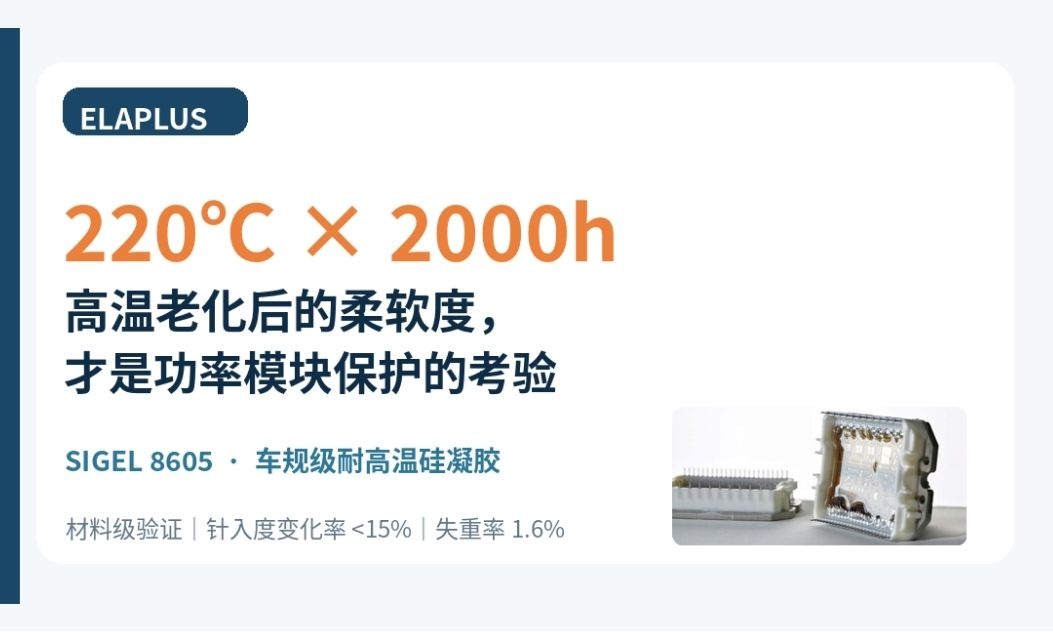
Power modules are becoming increasingly compact while operating under heavier loads. For IGBT and SiC power devices as well as new energy vehicle electronic control modules, potting materials are challenged not only by one-off high-temperature shocks, but also by the combined effects of long-term thermal ageing, thermal cycling and electrical stress.
Can the potting silicone gel remain soft after continuous ageing at 220°C for 2000 hours? According to ELAPLUS SIGEL 8605 datasheet, after thermal ageing in air at 220°C, the penetration of this material drops from 82 to 72 (1/10 mm), with a change rate of -12.2%, and the weight loss is only 1.6%. These figures provide specific evaluation criteria for material selection for electronic encapsulation in high-temperature zones.
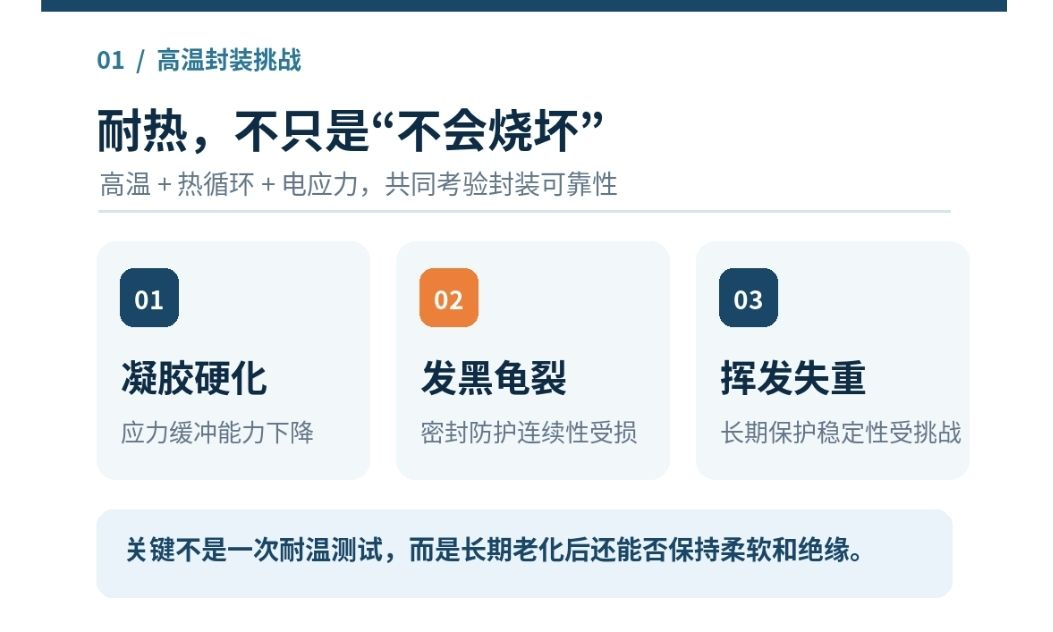
Three Major Challenges Faced by High-Temperature Encapsulation
1. Why Should Power Module Potting Not Be Judged Only by Maximum Temperature Rating?
Inside the encapsulation cavity of power devices, chips, bond wires, metal terminals and different substrates feature mismatched thermal expansion behaviours. As the module undergoes repeated heating and cooling cycles, the encapsulation material must not only provide electrical insulation and environmental isolation, but also buffer delicate interconnection structures with sufficiently low stress.
Ordinary gels may gradually harden, discolour or crack under prolonged high temperatures, losing their original soft buffering capability. Volatiles and material weight loss also deserve attention. Therefore, when evaluating high-temperature silicone gels, penetration, weight loss and electrical performance after ageing should be incorporated into one set of validation logic, instead of making judgements merely based on short-term temperature resistance indicators.
2. Performance of SIGEL 8605 after 2000 Hours of Ageing at 220°C
SIGEL 8605 is a transparent two-component addition-curable self-healing silicone gel with a 1:1 mixing ratio by weight. After curing, it forms a soft, transparent gel layer that coats internal chips and bond wires of power modules to deliver electrical insulation, environmental isolation and stress buffering.
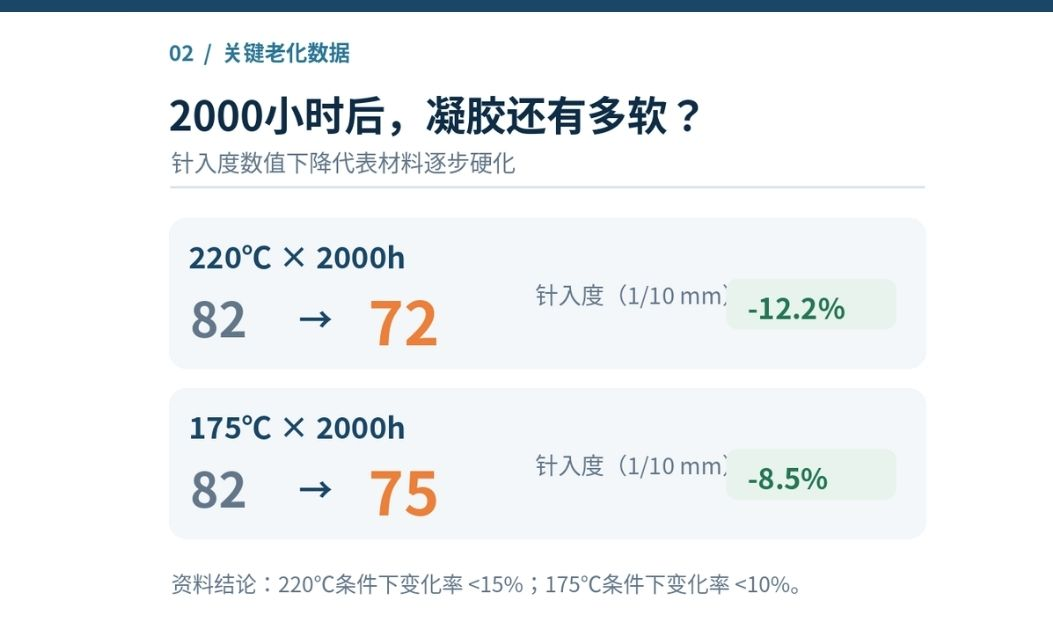
Penetration Comparison after 2000 Hours of Ageing at 220°C and 175°C
220°C × 2000 h: Penetration decreases from 82 to 72 (1/10 mm), change rate approx. -12.2%.
175°C × 2000 h: Penetration decreases from 82 to 75, change rate approx. -8.5%.
A lower penetration value generally indicates harder gel. The significance of these test results lies in its ability to retain a relatively stable soft state after long-duration thermal exposure.
Reference gels specified in the datasheet exhibited varying degrees of hardening, discolouration or cracking under the same test regime; some reference samples failed after approximately 300 hours of testing at 220°C. It should be noted that this comparison conclusion applies only to the listed samples and test conditions, and does not represent the performance of all other silicone gels.
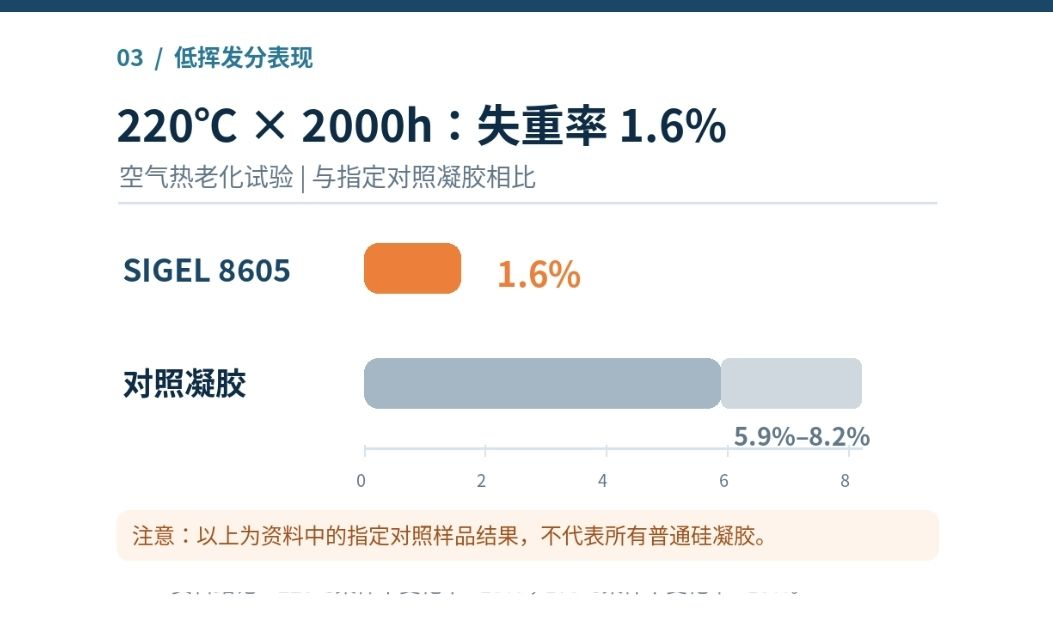
Weight Loss Comparison at 220°C × 2000 h
Besides softness variation, weight loss is another critical indicator. In the 220°C × 2000 h air thermal ageing test, SIGEL 8605 achieves a weight loss of 1.6%, while the reference gels listed in the datasheet show 5.9% ~ 8.2%.
A low weight loss ratio reduces volatilisation risks during long-term thermal exposure and provides material-level support for continuous protection of precision components.
3. Which Modules Are Suitable for Evaluating This High-Temperature Resistant Silicone Gel?
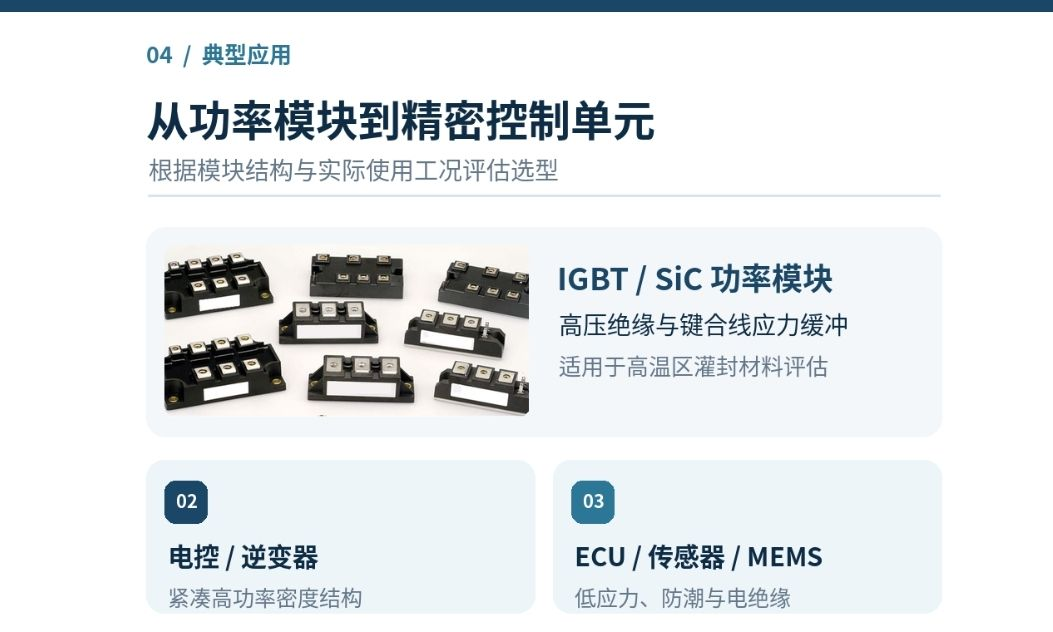
IGBT Power Modules, Electronic Control and Precision Electronic Applications
IGBT / SiC Power Modules: Designed for high-voltage and temperature cycling environments, the soft gel coats chips, bond wires and other fine structures inside the potting cavity to balance dielectric insulation and stress buffering. The transparent gel also facilitates visual inspection.
New Energy Vehicle Electronic Controls and Inverters: High power density designs impose stricter requirements on temperature resistance and process compatibility of encapsulation materials. SIGEL 8605 can be shortlisted for potting in high-temperature zones. Final adoption still requires verification based on module temperature distribution, material compatibility and actual working conditions.
ECUs, Electronic Sensors and MEMS: Modules requiring moisture barrier, low-stress protection for fine structures and long-term insulation stability can be assessed for its softness, transparency and dielectric properties.
4. Material Properties and Process Parameters: Key Selection Indicators
Per the SIGEL 8605 datasheet, its long-term service temperature range is -50 ~ 220°C, dielectric strength 25 kV/mm, volume resistivity 1.0×10¹⁴ Ω·cm, dielectric constant 2.8 @ 1 MHz, dissipation factor less than 0.001 @ 1 MHz, and flame retardancy rating UL 94 HB.
The working life after mixing at 25°C is around 120 minutes, which allows potting process planning according to module dimensions and production tact time.
It is worth noting that SIGEL 8605 is a low-stress insulating protective silicone gel with a stated thermal conductivity of 0.22 W/(m·K). It is not developed primarily for high thermal conductivity gap filling. If the primary objective of the module is high heat flux dissipation, thermal paths and thermally conductive materials need separate evaluation.
5. Practical Potting Operation: Four Steps to Stabilise the Process
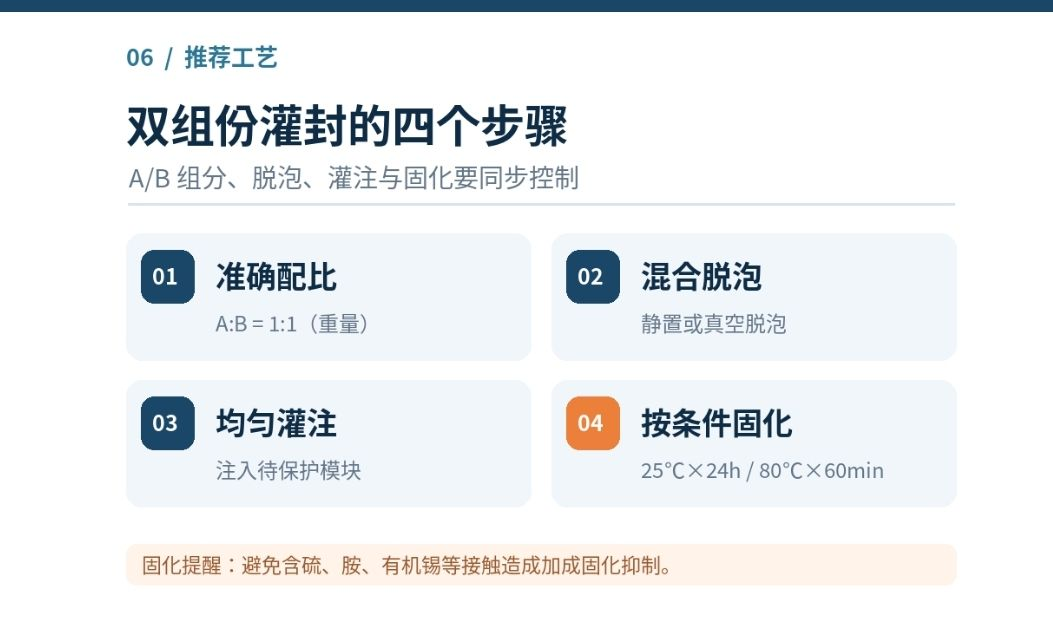
Four-Step Potting Workflow for Two-Component Silicone Gel
Accurately weigh component A and B at the 1:1 weight ratio and mix thoroughly, followed by static defoaming or vacuum defoaming, then inject the mixed gel into components or modules to be protected.
The reference curing conditions given in the datasheet are 25°C for 24 hours or 80°C for 60 minutes. For mass production, curing results shall be confirmed based on bondline thickness, equipment conditions and sample testing.
Addition-curable silicone systems carry the risk of cure inhibition. Direct contact with substances containing sulphur, amines, organotin compounds, unsaturated polyesters and similar materials should be avoided. Small-scale compatibility tests are recommended in advance for complex substrates.
Conclusion: Reliable Potting Must Stand the Test of Time
For power electronics encapsulation, instantaneous failure of materials under high temperature is only the baseline. What matters more for engineering selection is whether the material can maintain adequate softness, low weight loss and electrical insulation after prolonged thermal ageing.
The 2000-hour material-level test data of SIGEL 8605 provides valuable reference for IGBT, SiC power modules, new energy vehicle electronic controls and precision electronic devices.
It should be clarified that material-level test data does not equate to AEC-Q component-level certification for a specific module. Final suitability shall be subject to actual working conditions and component verification results.
ELAPLUS Functional Materials (Shanghai) Co., Ltd.
Service Hotline: 021-67227200
Email: info@elaplus.cc
Website: www.elaplus.cc
Address: No.555 Jiugong Road, Jinshan Industrial Zone, Shanghai
Bond the Future, Unite All Things
Previous post: PVC Wire Harness Debonding After Bending and Ageing Despite Strong Initial Bond: Inspect Interface First, Then the Rigid-Flex Transition of Adhesive Layer
Next post: Why Low-Temperature Cure Adhesives Are Preferred for CCD/CMOS Frame Bonding in Camera Modules: Speed Is Not the Priority — Thermal Process Load Control Matters