Why IC Chips & Electronic Components Require Reinforcement
In chips, sensors, connectors and precision electronic assemblies, solder joints, pins and dissimilar material interfaces are vulnerable to vibration, mechanical shock, thermal cycling and moisture.
Applying adhesives to reinforce chip corners, component undersides, pin root bases and plastic-metal joints delivers the following benefits:
■ Secure fixation of IC chips and electronic components
■ Reduce mechanical stress borne by solder joints
■ Boost assembly resistance to vibration and impact
■ Provide electrical insulation, moisture resistance and sealing protection
■ Enhance structural stability under wide temperature cycling
However, reinforcement locations impose different requirements on adhesive flowability, hardness and curing methods. LILIAN offers three specialized formulations for diverse electronic reinforcement processes: EP 1738-1, EP 2090 and SIPC UV 3302.
EP 1738-1: Ideal for IC Corner Bonding & Dam Reinforcement
EP 1738-1 is a black, solvent-free, heat-curable single-component structural epoxy adhesive.
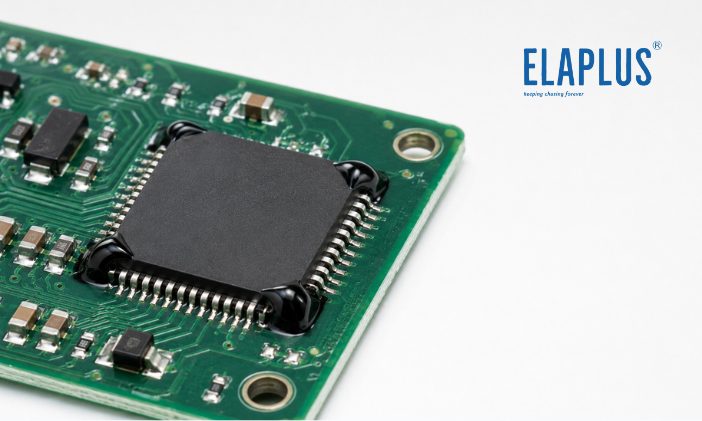
four-corner bonding of IC chips
At 25°C, its viscosity ranges from 300,000 to 450,000 mPa·s with vertical sag less than 0.1 mm, delivering excellent thixotropy. It resists uncontrolled spreading after dispensing, making it perfect for applications requiring precise control over dot shape and coverage.
Typical Applications:
■ Four-corner bonding of IC chips
■ Edge reinforcement for integrated circuits
■ Chip underfill
■ Chip dam encapsulation
■ Pressure sensor bonding
■ Local fixation of electronic components
Post-curing hardness reaches Shore D 85±5, with a glass transition temperature of approximately 105°C and long-term service temperature ranging from -50°C to 180°C. Its steel-to-steel shear strength hits 22 MPa at 25°C, suiting reinforcement sites demanding superior structural strength and anti-sag performance.
EP 2090: Structural Reinforcement for Plastic-Metal Electronic Assemblies
EP 2090 is a two-part room-temperature-curable epoxy adhesive mixed at a 1:1 weight or volume ratio of Part A to Part B
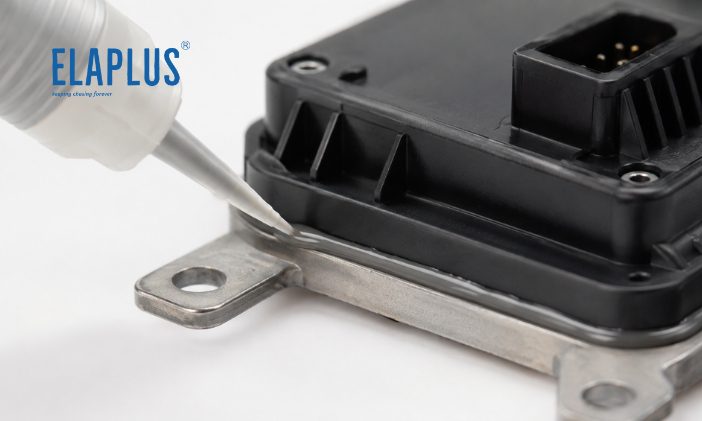
housing sealing
It bonds a broad spectrum of substrates including ceramics, metals, glass, plastics and rubbers, with outstanding compatibility for PC plastics, fiberglass fabrics and steel plates.
Electronic Assembly Applications:
■ Bonding plastic housings to metal brackets
■ Structural fixation of sensors
■ Local reinforcement of electronic components
■ Connector housing assembly
■ Adhesion between glass/ceramic and metal assemblies
■ Electronic encapsulation requiring clear or black appearance options
EP 2090 offers a 40-minute working time, with full initial cure achieved after roughly 120 minutes at 25°C. Cured hardness measures Shore D 85±5; iron-to-iron shear strength stands at 15 MPa, rising to ~20 MPa on sanded substrates.
Unlike heat-curable EP 1738-1, EP 2090 fits production workflows without baking ovens or requiring room-temperature assembly.
SIPC UV 3302: Flexible Sealing & Reinforcement for Pins and Shadow Zones
SIPC UV 3302 is a single-component, low-viscosity self-leveling UV-moisture dual-cure silicone adhesive.
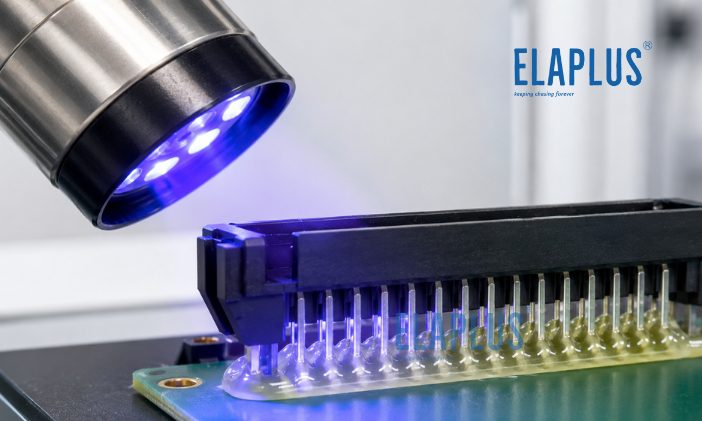
pin fixation via UV curing
Exposed areas accessible to UV light achieve fast surface tack-free cure, while shaded regions such as pin backsides, deep gaps and component undersides complete full curing via ambient moisture.
Typical Applications
■ Sealing at pin roots
■ Insulation for connector terminals
■ PCB conformal coating
■ Bonding optical and optoelectronic components
■ Insulation protection for prismatic lithium battery aluminum casings
■ Gap sealing for motors, electronic water pumps and oil pumps
■ Bonding lidar reflectors
Cured hardness is Shore A 20–26 with elongation at break exceeding 300%, and operating temperatures span -55°C to 200°C. Compared with rigid high-hardness epoxy adhesives, its elastic silicone layer absorbs thermal and mechanical stress, ideal for sealing reinforcement where thermal expansion mismatch and shock buffering are critical.
Selection Matrix for the Three Electronic Reinforcement Adhesives
| Application Requirement | Recommended Product | Core Advantages |
| IC four-corner bonding & dam encapsulation | EP 1738-1 | High thixotropy, zero sag, heat curing |
| Rigid structural reinforcement for ICs & electronics | EP 1738-1 | High hardness, ultra-high bonding strength |
| Plastic-metal structural bonding | EP 2090 | 1:1 mixing ratio, room-temperature cure |
| Multi-substrate assembly bonding | EP 2090 | Compatible with metal, plastic, glass, ceramic |
| Sealing at pin & terminal roots | SIPC UV 3302 | UV & moisture dual curing system |
| Deep gaps & shadowed unreachable zones | SIPC UV 3302 | Complete cure via ambient moisture in non-UV areas |
| Low-stress flexible protection | SIPC UV 3302 | Shore A 20–26, ultra-high elongation |
Frequently Asked Questions
What adhesive for four-corner IC reinforcement?
IC corner reinforcement requires strong thixotropy and anti-sag performance; EP 1738-1 single-component epoxy adhesive is the top choice.
No baking oven available – which adhesive to choose?
For production lines without heating equipment, select either room-temperature two-part epoxy EP 2090, or SIPC UV 3302 UV-moisture dual-cure silicone based on process needs.
How to handle pin backsides blocked from UV irradiation?
SIPC UV 3302 rapidly cures exposed UV-reachable surfaces, while shaded pin backs and deep gaps fully crosslink via environmental moisture, perfectly suited for complex-structured pins and connector sealing.
Need high thixotropy with non-flow adhesive dots?
Prioritize EP 1738-1. Its viscosity of 300,000–450,000 mPa·s and vertical sag below 0.1 mm deliver precise dispensing for chip corners, edges and dam structures.
Note: EP 1738-1 requires heat curing, so production lines must be equipped with ovens, heating stages or temperature-controlled equipment.
Room-temperature bonding for plastic and metal substrates?
EP 2090 is recommended. Mixed 1:1 by volume/weight, it cures at ambient temperature and exhibits reliable adhesion to PC plastic, fiberglass fabric, steel, glass and ceramics.
It forms rigid structural bonds for load-bearing fixation, and is unsuitable for flexible sealing scenarios requiring large deformation buffering.
Sealing pins and shadowed recessed areas?
SIPC UV 3302 is the optimal option. UV light rapidly sets exposed surfaces, while shaded pin backs and deep gaps fully cure via moisture.
The finished elastic silicone layer buffers stress generated by thermal expansion mismatches and mechanical vibration across dissimilar materials.
Key Differences Between Epoxy Adhesives & Silicone Adhesives
Epoxy adhesives feature high post-cure hardness and structural strength, suited for IC reinforcement, housing assembly and load-bearing structural fixation.
Silicone adhesives deliver superior flexibility, wide-range temperature resistance and stress absorption capacity, ideal for sealing, moisture-proof conformal coating, and assemblies with large thermal expansion coefficient mismatches.
Critical Validation Points for Final Adhesive Selection
Single performance parameters alone cannot determine the right adhesive; full verification of the following criteria is mandatory:
■ Compatibility with dispensing equipment
■ Risk of adhesive wicking into sensitive electronic regions
■ Impact of curing temperature on heat-sensitive components
■ Complete cure capability across target coating thickness and shadowed gaps
■ Bonding adhesion strength matching substrate requirements
■ Pass rates of thermal cycling, high-temperature high-humidity and vibration reliability tests
Final Selection Summary
■ Pick EP 1738-1 for high thixotropy, rigid hardness and precision dot dispensing applications
■ Pick EP 2090 for 1:1 mixing, room-temperature curing and multi-material structural assembly
■ Pick SIPC UV 3302 for fast UV surface tack, shadow zone moisture cure and flexible stress-relief sealing
■Final product confirmation must align with actual substrates, coating thickness, curing equipment and formal reliability qualification testing.