Cracking of potting compound in robot motors is rarely caused by insufficient material strength. Inspection should focus on CTE (coefficient of thermal expansion), material modulus, Tg, potting volume, structural sharp corners, curing shrinkage, and long‑term internal stress induced by thermal cycling.
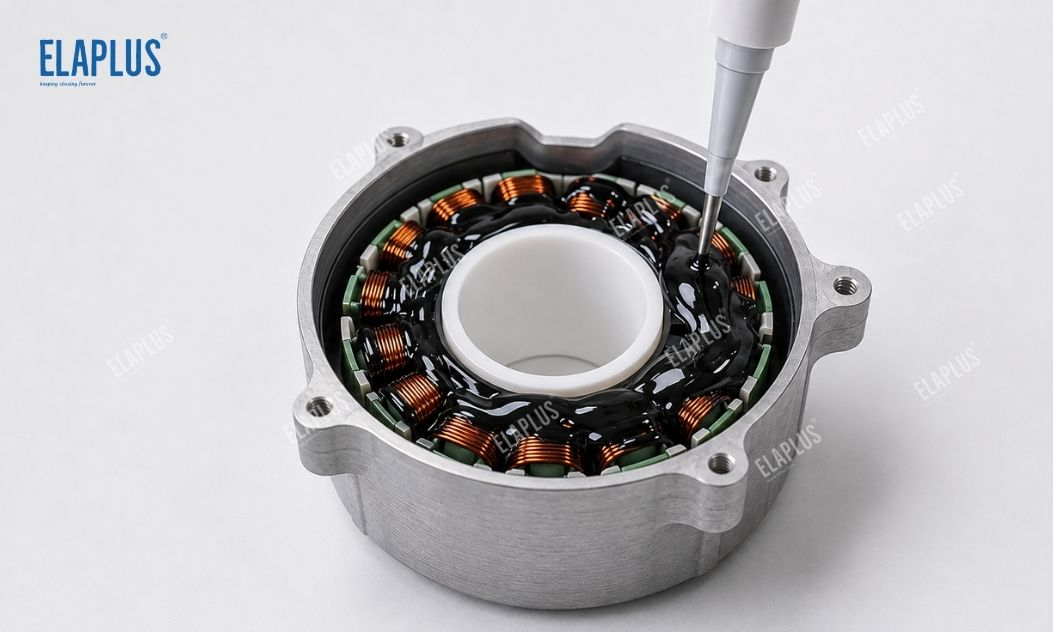
Motor Potting Compound
This is one of the most common misunderstandings regarding epoxy potting: High hardness and high strength do not guarantee superior crack resistance. If the material cannot release stress generated during thermal cycles, higher rigidity may concentrate stress at certain locations.
Why Motors Represent Typical CTE‑Mismatched Structures
A stator integrates copper wires, silicon steel sheets, aluminum housing, insulating varnish, plastic bobbin and resin. These components expand to different extents under identical temperature rise. Once bonded together by cured potting resin, expansion or contraction of any component will be restrained by adjacent materials, resulting in built‑in internal stress.
What Different Crack Locations Indicate
| Crack Location | Primary Suspected Cause |
|---|---|
| Housing edge | Interfacial stress / adhesion issue |
| Iron core sharp corner | Stress concentration |
| Around windings | CTE mismatch / local heat source |
| Full‑thickness crack through compound core | Bulk shrinkage / thermal stress |
| Cracking immediately after curing | Curing shrinkage |
| Cracking only after thermal cycling | CTE mismatch / modulus |
| Cracking under high‑temperature condition | Tg / material state change |
Why Both CTE and Tg Are Critical for EP 1715 (2#)
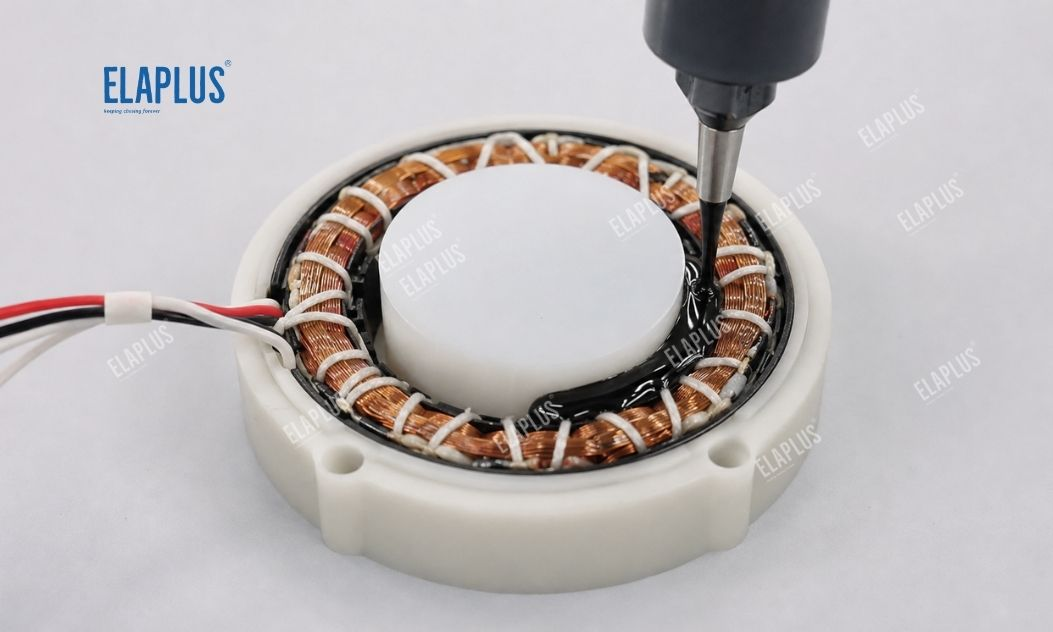
For robot joint motor potting, EP 1715 (2#) delivers thermal conductivity of approx. 1.5 W/m·K, Tg around 95~105℃, and CTE of approx. 25 μm/m·℃ below Tg.
These parameters form a complete material evaluation framework:
| Parameter | Significance for Potting Reliability |
|---|---|
| Thermal Conductivity | Reduce heat accumulation in windings |
| CTE | Determine dimensional mismatch under thermal cycling |
| Tg | Define operating temperature margin |
| Modulus / Hardness | Govern mechanical restraint level |
| Curing Condition | Influence manufacturing‑induced stress |
| Potting Thickness | Affect total stress magnitude |
Therefore simply switching to higher‑strength epoxy seldom solves cracking failures.
Why Structural Sharp Corners Are High‑risk Zones
Internal right angles, iron‑core tips and housing steps are natural stress‑concentration spots. Where structural design permits, proper fillet radii, gradual adhesive transition and avoidance of locally excessive potting thickness often outperform direct material replacement.
Industry Pitfall
It is a typical wrong logic: cracking → switch to harder adhesive.
A more reasonable troubleshooting sequence answers three questions first: When does cracking occur? Where does cracking initiate? Under which test condition does cracking happen? These questions are often more valuable than material grade selection.
Scenario‑based Adaptation
CTE and thermal stress shall be prioritized for humanoid robot joint motors featuring thick‑layer potting, large‑diameter stators, high slot fill factor, high power density and frequent thermal cycling.
Evaluation criteria for bulk potting shall not be fully applied for minor local fixation applications.