Bubbles or internal voids after potting of robot frameless torque motor stators are usually not simply caused by poor‑quality adhesives. Frequent root causes include air entrapment during A‑B mixing, mismatch between material viscosity and winding gaps, excessively high slot fill factor, improper potting direction, lack of air escape channels, inappropriate vacuum process settings, and residual gas expansion during curing.
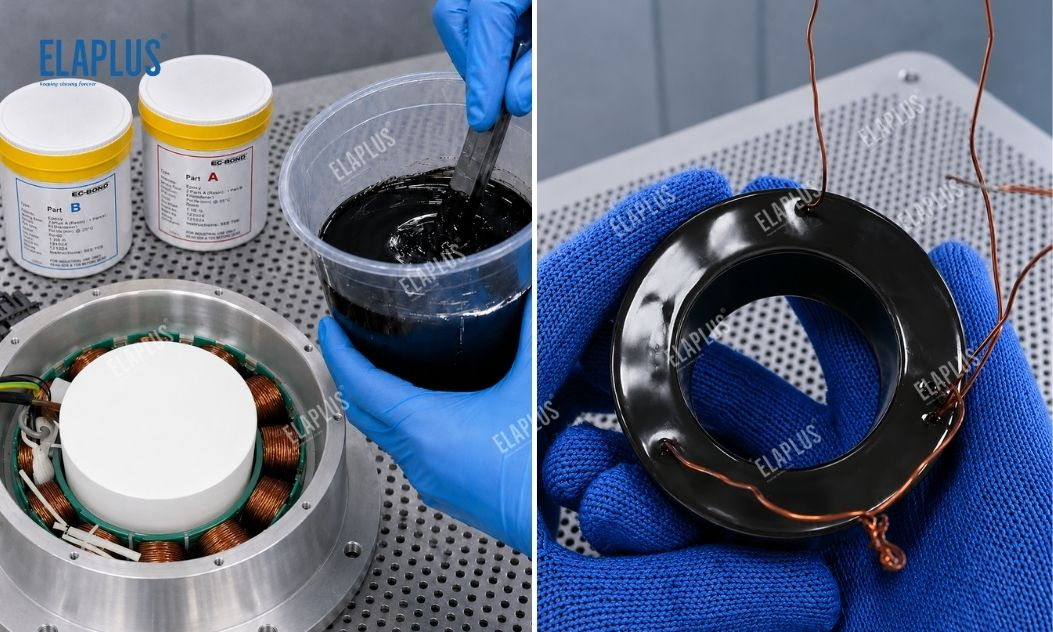
Robot Joint Motor Potting
For robot joint motors, the greatest concern is not several small visible surface bubbles, but hidden voids deep inside windings.
Stator potting not only fixes copper wires, but also builds a continuous thermal conduction path from windings to iron core and then to the housing. Potting for frameless torque motor stators requires comprehensive consideration of thermal conductivity, CTE, Tg and curing process.
Quick‑judgment Table: Where Do Bubbles Likely Come From?
| Bubble / Void Location | Common Causes | Priority Inspection | Actions Not Recommended as First Step |
|---|---|---|---|
| Large number of fine bubbles on adhesive surface | Air entrapment from mixing, overly fast stirring | Mixing & degassing | Directly change adhesive grade |
| Voids deep inside copper wires | Poor wetting, no air escape outlets | Viscosity, slot fill factor, flow channel | Only inspect surface appearance |
| Gas trapped at stator bottom | Improper potting direction | Placement angle, vent path | Simply increase vacuum level |
| Voids at mold corners | Locally enclosed zones | Mold & flow channel | Fill up rapidly in one shot |
| Bubbles only with automatic dispensing | Air entrainment from equipment | Pump, pipeline, mixing tube | Suspect material batch at first |
| Voids formed after curing | Residual gas / curing‑related variation | Curing profile | Blindly raise curing temperature |
Why Does Higher Slot Fill Factor Make Potting Harder?
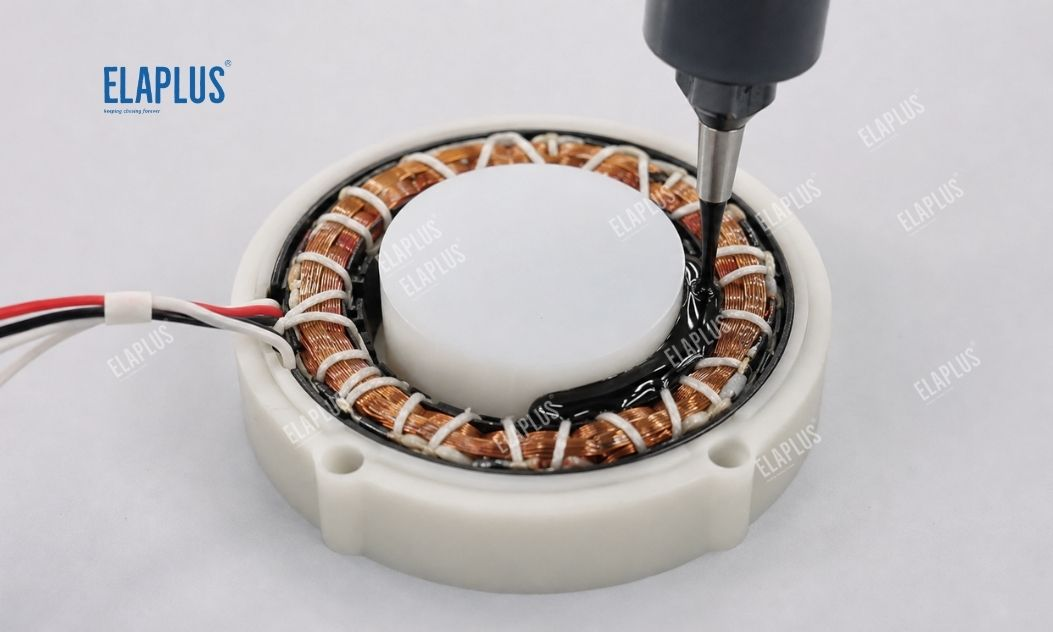
Robot Joint Motor Potting
To miniaturize size and boost torque density, robot joints adopt compact copper‑wire arrangements. Invisible micro‑gaps between coils serve two opposite purposes: allowing adhesive inflow and air outflow.
If adhesive flows in rapidly from top while air at coil bottom cannot escape in time, the upper section will be sealed by adhesive, air gets trapped at bottom and internal voids form.
Sufficiently low viscosity is only part of the solution. The real factors to consider together:
material flowability × winding structure × potting direction × vent path.
Why Not Simply Choose Lower‑viscosity Material?
Low viscosity improves wetting, yet brings new process risks: excessive flow speed, stricter mold sealing requirement, adhesive leakage, and filler sedimentation for high‑filled systems.
Motor potting shall target a process viscosity window matching the winding structure, rather than pursuing “as thin as possible”.
Key Indicators for EP 1715 (2#)
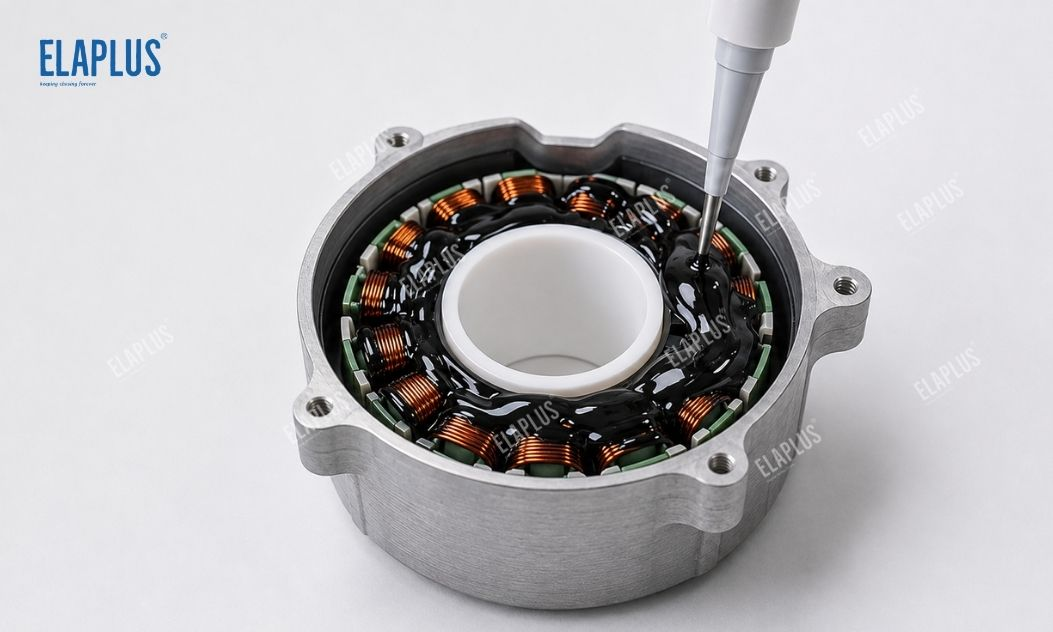
ELAPLUS EP 1715 (2#) can be evaluated as thermally conductive epoxy potting material for robot frameless torque motor stators.
| Item | EP 1715 (2#) |
|---|---|
| Material System | Two‑component solvent‑free thermally conductive epoxy |
| Thermal Conductivity | Approx. 1.5 W/m·K |
| Tg | Approx. 95~105℃ |
| CTE below Tg | Approx. 25 μm/m·℃ |
| Curing | Room‑temperature / medium‑low temperature curing available |
These parameters shall be assessed comprehensively. Thermal conductivity governs heat dissipation; CTE relates to thermal cycling stress; Tg defines operating temperature margin; curing temperature directly impacts robot motor manufacturing process. Relevant application validations include double‑85 test, high‑low temperature cycling and high‑temperature storage long‑term tests.
Industry Pitfalls|4 Common Mistakes in Stator Potting
| Common Practice | Risk | Rational Approach |
|---|---|---|
| Switch to thinner adhesive whenever bubbles appear | Bubbles may not stem from material itself | Locate bubble position first |
| The higher thermal conductivity, the better | High filler loading may raise viscosity | Evaluate actual temperature rise |
| The higher vacuum, the better | Over‑rapid vacuum leads to violent foaming | Establish proper process window |
| Accept product with good‑looking surface appearance | Internal voids may still exist | Adopt dissection / sectioning / temperature‑rise verification |
Scenario‑based Adaptation|When This Analysis Framework Matters Most
| Project Feature | Suggestion |
|---|---|
| Humanoid robot frameless torque motor | Focus evaluation |
| High slot‑fill‑factor winding | Focus evaluation |
| Small‑size & high‑power‑density design | Focus evaluation |
| Deep potting depth | Focus evaluation |
| Automated mass potting | Set up equipment parameter window |
| Open‑type shallow potting | Relatively simplified process |
Stator Potting FAQ
Q: No bubbles on stator surface means no internal bubbles? A: Not necessarily. Bubbles may be fully hidden deep inside high‑slot‑fill‑factor windings.
Q: Higher thermal conductivity definitely brings lower motor temperature rise? A: Not necessarily. Without adequate winding wetting or with air voids, intrinsic material thermal conductivity cannot be fully converted into practical heat‑dissipation performance.
Q: Can vacuum potting eliminate all bubbles? A: No. Vacuum improvement alone cannot solve all issues if the structure lacks vent paths.