An oil pressure sensor may pass all room-temperature tests after potting, yet develop zero drift, reduced insulation or sealing failure after prolonged contact with hydraulic oil, lubricating oil and other media. Do not only inspect the sensing chip. Instead, verify whether the potting compound absorbs fluid, swells or softens, and check interfacial integrity between adhesive and metal / plastic substrates. The core requirement for sensor potting adhesives is not strong initial adhesion, but stable performance upon continuous medium exposure.
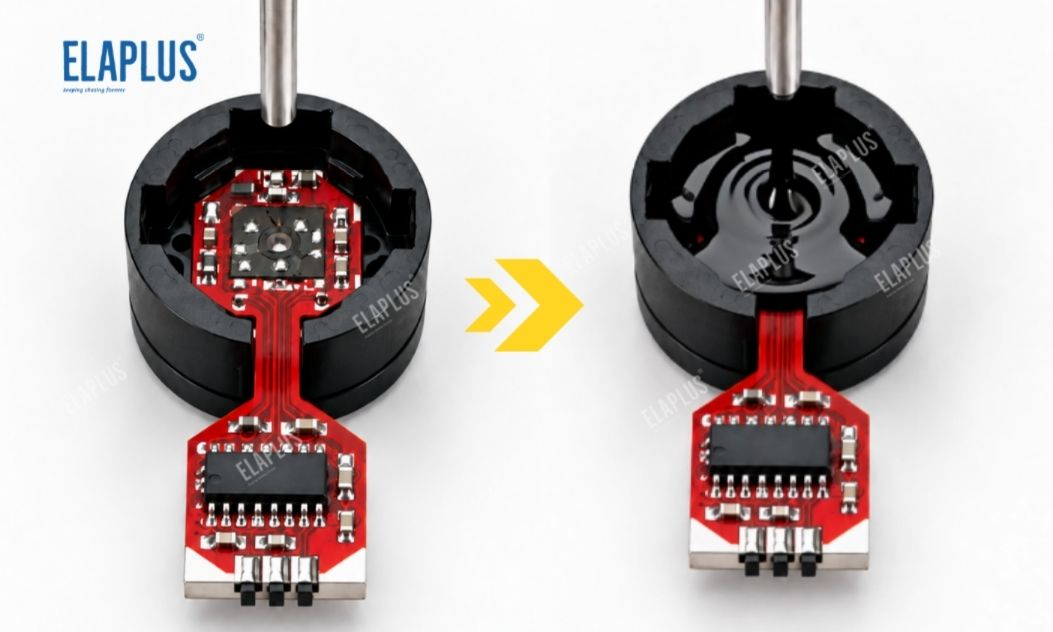
A common misjudgment for this failure mode: Passing all factory tests is mistakenly taken as proof that the potting material is qualified.
Oil pressure sensors operate under combined long-term loads: Pressure + Temperature + Vibration + Oil medium. Initial performance only proves the material works right after assembly.
1. Why Failures Only Occur After Oil Immersion Rather Than At Ambient Testing
Room-temperature tests only reflect the material’s initial state. Long-term medium exposure requires monitoring:
- Dimensional change of cured adhesive
- Hardness shift
- Interfacial delamination
- Insulation degradation
- Sensor zero point drift
For precision pressure sensors, slight swelling or interfacial variation can alter internal mechanical boundary conditions, even without obvious cracking. Conclusion: Intact adhesive appearance is not sufficient evidence of oil resistance.
2. Possible Material Changes After Oil Intrusion
Behaviours vary by polymer system, oil type and operating temperature. Four key changes need evaluation:
- Fluid absorption Medium penetrates into the polymer matrix and triggers mass and dimensional variation.
- Swelling Volume expansion introduces extra mechanical stress onto surrounding components.
- Softening and property degradation Mechanical properties shift after sustained medium contact.
- Interfacial failure Even if the bulk adhesive remains intact, debonding may initiate at metal-adhesive or plastic-adhesive interfaces. This fourth mode is most frequently overlooked in sensor troubleshooting.
3. Why Oil Pressure Sensors Are Vulnerable to Minor Swelling
General electronic modules mainly concern water ingress and short circuits. Pressure sensors additionally require stable mechanical loading on sensitive structures. If potting material sits close to:
- MEMS sensing element
- Pressure diaphragm
- Ceramic substrate
- Bond wires
- Precision PCB
Dimensional change caused by fluid absorption generates residual stress. Such stress may not destroy the component instantly, but leads to:
- Zero offset
- Poor repeatability
- Altered thermal drift
Sensor drift and uncracked adhesive can coexist.
4. Distinguish Bulk Material Failure From Interfacial Failure
Judge by failure symptoms:
| Failure Symptom | Priority Investigation | Key Validation Items |
|---|---|---|
| Overall adhesive softening | Medium resistance of bulk material | Hardness & mass change |
| Obvious adhesive expansion | Fluid absorption / swelling | Dimension & weight measurement |
| Gap formation along metal edge | Interfacial adhesion | Cross-section & peel test |
| Delamination at plastic housing edge | Substrate compatibility | Test on actual housing material |
| Gradual zero drift | Stress variation | Electric signal & dimensional tracking |
| Abnormality only after high-temperature oil immersion | Coupled effect of temperature & medium | High-temperature immersion test |
| Recurring failure at fixed location | Structural / interfacial defect | Local cross-section inspection |
Practical judgment rule: Repeated failure at the same interface → check material compatibility with that substrate; random drift across batches → review dispensing process and material consistency.
5. Why “Oil Resistant” Label Alone Is Not Enough
Field media are not uniform. Sensors may encounter:
- Hydraulic oil
- Lubricating oil
- Transmission fluid
- Coolant
- Cleaning agents
These differ greatly in chemical composition, additive package and service temperature. Resistance to one oil type cannot guarantee stability against others. Valid qualification must adopt: Actual medium + Actual service temperature + Defined ageing duration Instead of relying on generic “oil resistant” marking.
6. Material Selection Based On Zones Inside The Sensor
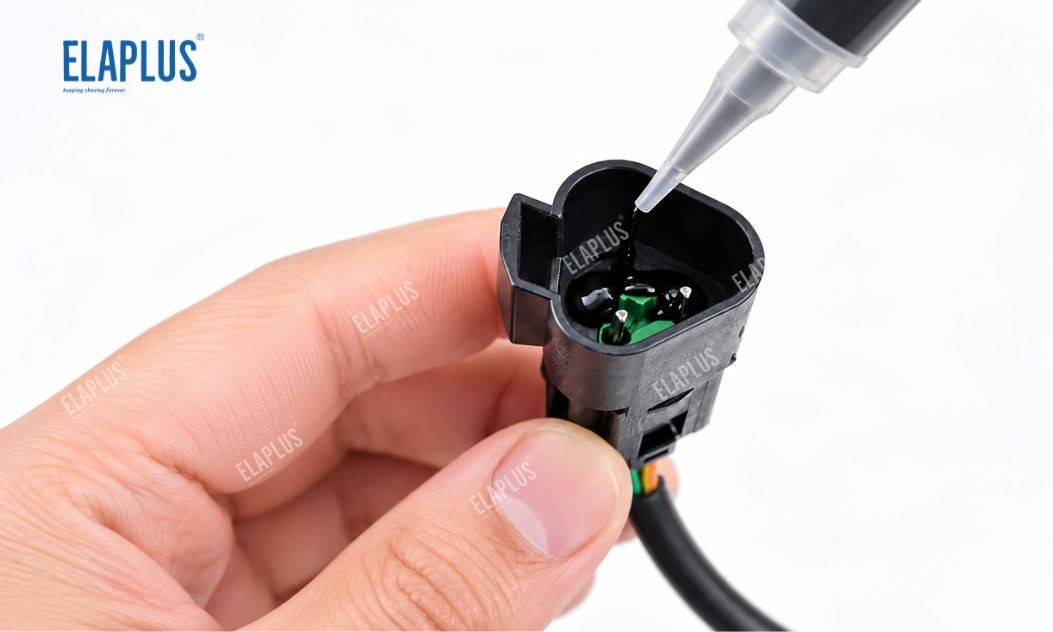
Different regions inside an oil pressure sensor undertake different functions:
- Areas adjacent to sensing chips: low stress is critical
- Housing and wire exit zones: sealing and interfacial stability are prioritized
- Locations requiring mechanical fixation: adhesion and structural strength matter
Multiple materials can be used in one sensor: chip protection material + potting compound + housing sealant. Zoned adhesive design reduces failure risk better than full filling with a single grade.
7. When to Choose Flexible Epoxy
Flexible epoxy is recommended for industrial sensors requiring:
- Reliable mechanical fixation
- Electrical insulation
- Medium resistance
- Moderate flexibility instead of high rigidity
ELAPLUS flexible epoxy series adopts toughened modification, widely used for PCB, power module and sensor encapsulation. EP 1720 A/B is a two-component low-stress oil-resistant flexible epoxy potting compound.
Still, “oil resistant” in the datasheet does not mean direct compatibility with all oil pressure sensors. Final verification with the project’s real medium is mandatory.
8. Why Strength and Oil Resistance Are Not The Only Metrics Near MEMS Chips
MEMS sensing zones are extremely sensitive to mechanical stress transferred from encapsulation. ELAPLUS pressure sensor solutions deploy SIGEL 1806 two-part silicone gel for low-stress protection. The soft gel buffers mechanical impacts from temperature swing, vibration and shock.
Two separate design targets must be clarified: Outer encapsulation: withstand harsh environment Sensing zone: suppress encapsulation-induced stress
Mixing the two requirements often results in robust sealing but degraded measurement accuracy.
9. Valid Oil Resistance Qualification Method
Simple immersion and visual check are inadequate. At minimum collect four sets of data:
- Pre-immersion baseline: weight, dimension, hardness, electrical performance and sensor zero point
- Immersion in customer’s actual oil medium
- Accelerated ageing at project-specified temperature (avoid arbitrary over-temperature acceleration)
- Post-immersion re-test: weight, dimension, hardness, insulation and sensor output Followed by cross-section analysis.
This workflow identifies whether degradation originates from bulk material change or interfacial separation.
10. Three Common Pitfalls in Oil-Resistant Adhesive Selection
Pitfall 1: Only check initial bond strength.
Strong initial bonding does not guarantee stable interface after high-temperature oil ageing.
Pitfall 2: Passing test with one oil type equals compatibility with all oils.
Additives and temperature conditions vary and cannot be interchanged.
Pitfall 3: Only judge by whether adhesive cracks.
For precision sensors, zero drift emerges much earlier than visible material damage.
Focus on whether material variation translates into performance shift of the sensor.
11. Application Guidance for Different Material Routes
Flexible oil-resistant epoxy is preferred for: Industrial sensors requiring potting, insulation, mechanical support and long-term oil exposure.
Low-stress gel is preferred for: Zones close to MEMS chips and pressure diaphragms sensitive to mechanical stress.
Single-material solution is NOT recommended for: Complex structures containing sensitive chips, rigid housing fixation and continuous oil contact. Zoned adhesive design is suggested.
ELAPLUS adopts diagnostic material selection workflow: Identify failure location → Evaluate medium, structure and process → Confirm material system. This implements ELAPLUS’s philosophy: select adhesive according to working conditions, not stack datasheet parameters, for sensor projects.
FAQ
Q: Does drift after oil immersion always indicate chip failure?
A: No. Fluid absorption, swelling or interfacial change of potting material can alter mechanical boundary conditions of the sensing structure and distort output signals.
Q: Should oil-resistant adhesive maintain zero change after oil exposure?
A: Not practically. Acceptance shall be determined comprehensively by mass change, dimensional shift, hardness, interfacial integrity and electrical performance against project specifications.
Q: What are typical applications of EP 1720 A/B?
A: It is a flexible epoxy potting system with low stress, oil resistance and insulation, suitable for electronic encapsulation of sensors.
Q: Can high-strength oil-resistant epoxy be directly applied around MEMS?
A: Oil resistance and mechanical strength are not the only criteria. Encapsulation stress impact on measurement accuracy must be prioritized for MEMS sensing areas.
Previous post: Pin Sealing for Automotive Connectors: Why Surface Sealing Alone May Still Allow Water Ingress? Reliable Sealing Must Be Achieved at the Terminal Root
Next post: Magnet Bonding for Motors: Initial Pull Strength Passed, Yet Magnets Still Loosen After High-Temperature Operation. Do Not Only Focus on Strength; Inspect Interfaces and Adhesive Layer First