With accelerated adoption of 800V high‑voltage platforms and 3‑in‑1 e‑Axle drive systems, operating conditions for internal three‑phase busbars within electric drives have become significantly more demanding.
For three‑phase busbars, connection terminals and high‑voltage connectors, potting materials are required not only to deliver insulation and sealing, but also to withstand hundreds of amperes of high current, high‑temperature oil media, long‑term vibration and shock, as well as thermal expansion mismatch between busbars and housing structures.
Accordingly, selecting potting compounds for three‑phase busbars in 800V electric drives should focus not merely on hardness and bonding strength, but on the balanced combination of material modulus, flexibility, resistance to high‑temperature oil aging, interfacial adhesion and long‑term mechanical reliability.
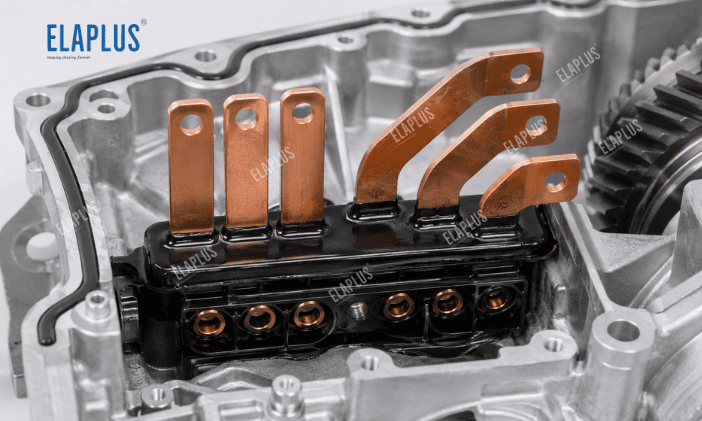
To address structural fixation and sealing requirements of three‑phase busbars and connection terminals in electric drives, ELAPLUS has developed EP 1721‑1 Flexible Epoxy Potting Compound. By balancing low modulus, high elongation and the adhesive performance of epoxy systems, it mitigates risks of stress concentration at busbar roots under thermal cycling and vibration.
01 Why 800V Electric Drive Three‑Phase Busbars Impose Higher Requirements on Potting Compounds
Busbars in traditional electrical systems primarily function for current transmission and connection fixation.
In the era of 800V electric drives, three‑phase busbars have evolved from simple wiring components into critical connection structures operating within complex environments.
Especially within 3‑in‑1 e‑Axle assemblies, reduction gearboxes and oil‑cooled motor structures, busbars and their connection points are continuously exposed to:
- Sustained temperature rise induced by high current
- High‑temperature oil media above 120 ℃
- Vehicle road vibration and mechanical shock
- Thermal cycling generated by frequent start‑stop operations
- Divergent coefficients of thermal expansion among copper, plastics and metal housings
- Alternating mechanical stress sustained over long periods at connection roots
If potting materials with excessively high modulus and rigid properties are adopted, asynchronous thermal expansion and contraction between busbars and housings will concentrate stress at busbar roots or adhesive interfaces.
After prolonged cycling, the following failures may occur:
Adhesive cracking|Interfacial delamination|Busbar loosening|Degraded sealing|Reduced insulation reliability
This explains why potting for electric drive busbars cannot simply follow the idea of “harder means stronger”.
02 EP 1721‑1: Relieve Interfacial Stress of Busbars via Flexibility
EP 1721‑1 is a two‑component flexible epoxy potting compound developed for high‑reliability connection zones.
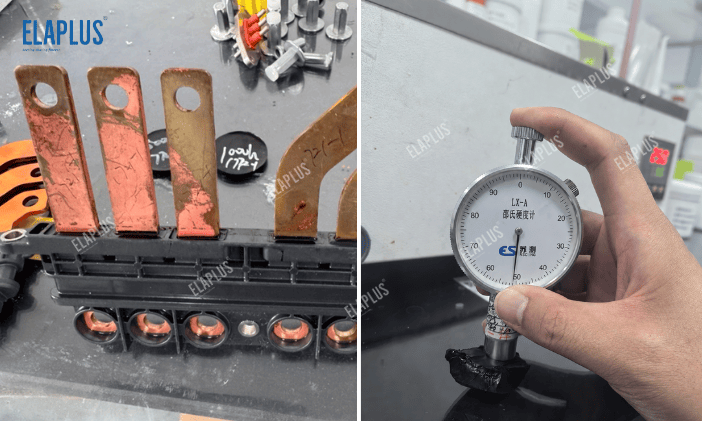
Its core design philosophy can be summarized as:
Deliver secure fixation while allowing controlled deformation.
Cured properties of EP 1721‑1:
- Hardness: Shore A 40–60
- Elongation at break: 60–120%
Compared with conventional rigid high‑hardness epoxy systems, the low‑modulus compound enables synchronous slight deformation when thermal expansion and contraction occur among busbars, insulators and metal housings.
This reduces local interfacial stress concentration and lowers risks of microcracking and delamination under long‑term thermal cycling and mechanical vibration.
Meanwhile, EP 1721‑1 retains adequate mechanical performance:
- Tensile strength: 3.2 MPa
- Shear strength (Fe‑Fe): 2.6 MPa
Therefore, it is not designed purely for softness, but achieves equilibrium among:
Flexibility + Mechanical Strength + Adhesive Fixation
Such material characteristics are highly targeted for three‑phase busbars, connection terminals and other positions requiring fixation while enduring sustained vibration and thermal stress.
03 Why High‑Temperature Oil Resistance Is Mandatory for 800V Electric Drive Potting Compounds
One major distinction between electric drive systems and common electronic controllers is that materials may be directly exposed to or immersed in high‑temperature lubricating oil, transmission fluid and other media.
As a result, the suitability of an epoxy potting compound for electric drive busbars cannot be judged only by initial hardness, bonding strength and insulation performance.
It is more critical to observe material changes after hundreds or even thousands of hours of high‑temperature oil immersion:
- Significant hardness shift
- Excessive swelling
- Softening or embrittlement
- Interfacial delamination
- Loss of elasticity
- Obvious degradation of electrical properties
EP 1720, sharing the same material technology platform, has passed long‑term validation in high‑temperature oil environments.
Examples:
- Castrol SP‑grade engine oil, 150 ℃ / 1000 h
Hardness shifts gradually from approx. 22 Shore A to approx. 39 Shore A; the material remains elastic after aging. - EDF4101 transmission fluid, 150 ℃ / 1000 h
Hardness changes from approx. 36 Shore A to 37 Shore A with minor overall variation.
Important note:
Actual aging results vary by formulation, oil type and component structure and cannot be generalized.
Targeted medium immersion, thermal aging and compatibility verification can be arranged for EP 1721‑1 based on customers’ actual transmission fluid, lubricant and operating temperature. Mass production material selection shall be subject to actual test results.
This constitutes a vital step in material validation for 800V electric drive projects.
04 Key Performance Parameters of EP 1721‑1
| Item | EP 1721‑1 |
|---|---|
| Product Type | Two‑component flexible epoxy potting compound |
| Typical Applications | Three‑phase busbars, connection terminals, connectors |
| Cured Hardness | Shore A 40–60 |
| Elongation at Break | 60–120% |
| Tensile Strength | 3.2 MPa |
| Shear Strength (Fe‑Fe) | 2.6 MPa |
| Service Temperature Range | -40~155 ℃ |
| Mix Ratio (By Weight) | A:B = 3:1 |
| Gel Time | 30±10 min @100 ℃ |
| Recommended Curing Profile | 100 ℃ × 2 h / 80 ℃ × 4 h |
| Recommended Maximum Potting Thickness | ≤2 cm |
| Appearance | Black |
| Shelf Life | 1 year at 25 ℃ |
EP 1721‑1 adopts a solvent‑free system with negligible byproducts during curing, making it suitable for potting applications inside e‑Axle assemblies demanding environmental stability and long‑term reliability.
05 Why High Hardness Should Not Be the Primary Target for Three‑Phase Busbar Potting
This is a common misconception during material selection for electric drive potting.
Short‑term mechanical testing often yields higher structural strength with high‑hardness epoxy materials.
Nevertheless, electric drive systems operate dynamically rather than statically.
Three‑phase busbars continuously undergo:
Temperature rise → Thermal expansion → Cooling → Contraction → Vibration → Shock
When the compound possesses excessive rigidity, displacement generated by busbars cannot be absorbed by the adhesive layer, and stress will gradually transfer to:
Busbar roots, terminal welding joints, plastic interfaces or adhesive edges.
For busbar roots and high‑voltage connection areas, a more rational material design does not blindly increase modulus, but retains appropriate elastic deformation capacity on the premise of sufficient fixation performance.
The design logic of EP 1721‑1 follows:
Absorb thermomechanical stress via flexibility; maintain structural fixation with epoxy adhesive system.
06 How to Choose Between EP 1721‑1 and EP 1720
ELAPLUS has developed epoxy potting solutions with different flexibility grades to match stress characteristics of diverse components inside electric drive gearbox housings.
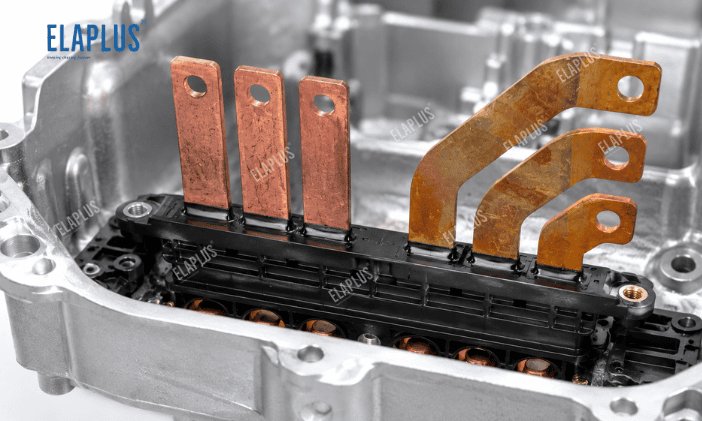
EP 1721‑1 – Three‑Phase Busbar Potting Compound
Best suited for:
Three‑phase busbars|High‑voltage connection terminals|Connectors|Connection areas requiring moderate structural fixation
Typical characteristics:
Shore A 40–60
Elongation at break: 60–120%
Selection focus:
Fixation + Sealing + Stress Relief
EP 1720
More applicable to:
Speed sensors|Temperature sensors|Position sensors|Relays and precision electronic components
Typical characteristics:
Shore A 20–25
Elongation at break: 180–200%
Its lower modulus and higher elongation help minimize encapsulation stress imposed on sensitive electronic components and precision structures.
Therefore, the two grades are not simply ranked by performance level, but designated for different locations:
Load‑bearing connection zones → EP 1721‑1
Low‑stress precision encapsulation → EP 1720
Graded material moduli enable a more complete potting solution for components inside electric drive housings.
07 Is EP 1721‑1 Suitable for Automated Potting Production?
EP 1721‑1 adopts a two‑component heat‑curing process:
Mix ratio A:B = 3:1 by weight
Gel time at 100 ℃: 30±10 min
Recommended curing schedule:
100 ℃ × 2 h or 80 ℃ × 4 h
Direct curing following the recommended process is feasible when potting thickness does not exceed 2 cm.
Combined with customers’ actual equipment, further adjustments can be made to:
Mix ratio, dispensing path, potting volume, preheating temperature, curing temperature and production takt time
to adapt to automated dispensing and mass production workflows.
08 Recommended Validation Items for Potting Compounds of 800V Electric Drive Three‑Phase Busbars
For electric drive projects approaching mass production, material selection should not rely solely on PDS parameters. The following validations shall be completed based on real component structures:
- High‑temperature oil immersion
Long‑term testing using lubricant or transmission fluid specified for the project - High‑low temperature cycling
Evaluate fatigue effects caused by thermal expansion mismatch among different material interfaces - Vibration and mechanical shock
Verify long‑term fixation reliability at busbar roots and connection terminals - Adhesion compatibility
Validate interfacial adhesion on actual substrates including copper, aluminum, PA, PBT - Electrical insulation performance
Monitor shifts in insulation and related electrical properties before and after aging - Process window confirmation
Verify mixing, flowability, degassing, curing and automated production takt time
Potting materials truly fit for 800V electric drive systems must pass joint verification covering:
Material performance + Actual media environment + Component structure + Manufacturing process
Conclusion | Reliability of 800V Electric Drive Connections Relies on Co-Design of Materials and Structures
800V platforms continuously boost power density of electric drive systems, while amplifying thermal, mechanical and media aging loads sustained by three‑phase busbars, high‑voltage terminals and sensor encapsulation.
For three‑phase busbars, a reliable potting solution is not simply to source a “harder, stronger” epoxy adhesive.
More importantly, the material should maintain balance among reliable adhesion, structural fixation, media protection and stress relief throughout its service life.
ELAPLUS EP 1721‑1 Flexible Epoxy Potting Compound targets high‑stress connection zones such as three‑phase busbars and connection terminals in 800V electric drives, delivering a material solution for structural sealing and connection reliability under high‑temperature oil environments.
Combined with the low‑stress EP 1720 epoxy potting system, it covers diverse application locations inside electric drive housings including three‑phase busbars, connection terminals and precision sensors.
Elaplus Functional Materials (Shanghai) Co., Ltd. provides:
Material selection support|Sample testing|Process parameter consultation|High‑temperature oil aging validation|Mass production adaptation support
Assist customers in completing specimen verification and mass production rollout starting from the material selection phase.
Technical Consultation / Sample Request
Elaplus Functional Materials (Shanghai) Co., Ltd.
No.555 Jiugong Road, Jinshan Industrial Zone, Shanghai, China
Tel: +86‑21‑67227200
E‑mail: info@elaplus.cc
Website: www.elaplus.cc