Motor magnets may pass initial pull tests but loosen after high-temperature operation, vibration or thermal cycling. The root cause is often not insufficient adhesive strength. Long-term bonding reliability depends collectively on magnet surface condition, rotor substrate interface, bondline thickness and curing state. Magnet adhesive selection shall shift focus from “initial strength” to interfacial stability under real working conditions.
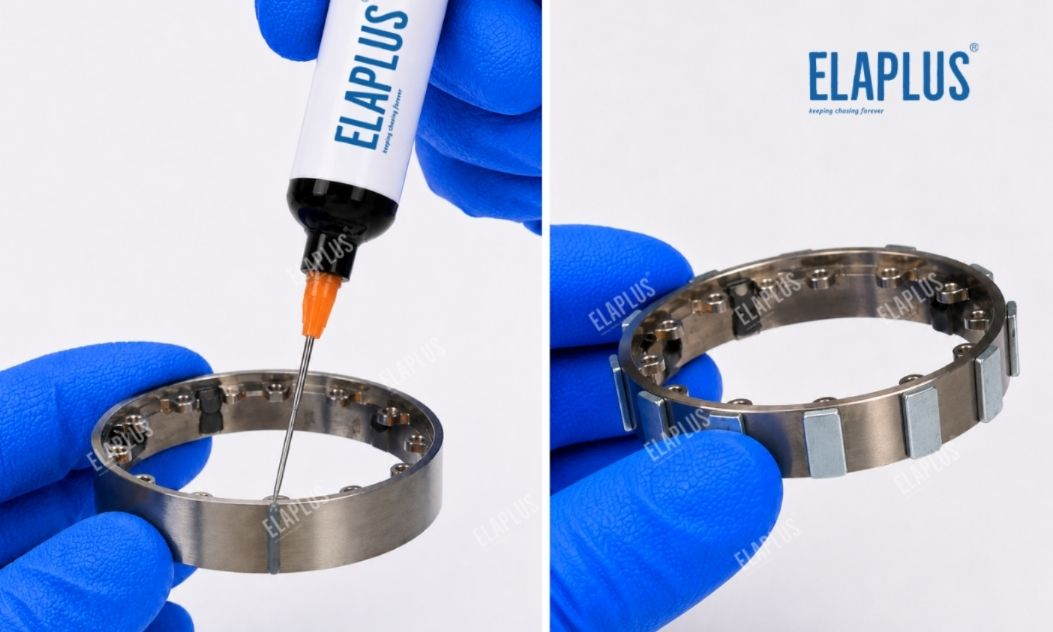
Motor Magnet Bonding
Magnet bonding seems straightforward: securely attach magnets to the rotor. In service, however, the adhesive layer continuously withstands:
- Elevated temperature
- Centrifugal load
- Vibration
- Start-stop impact
- Thermal cycling
A passing room-temperature pull test only proves adequate bonding at the initial state. It cannot guarantee that the joint stays intact over long-term operation.
Why Is the Bond Strong at Room Temperature But Prone to Failure at High Temperature?
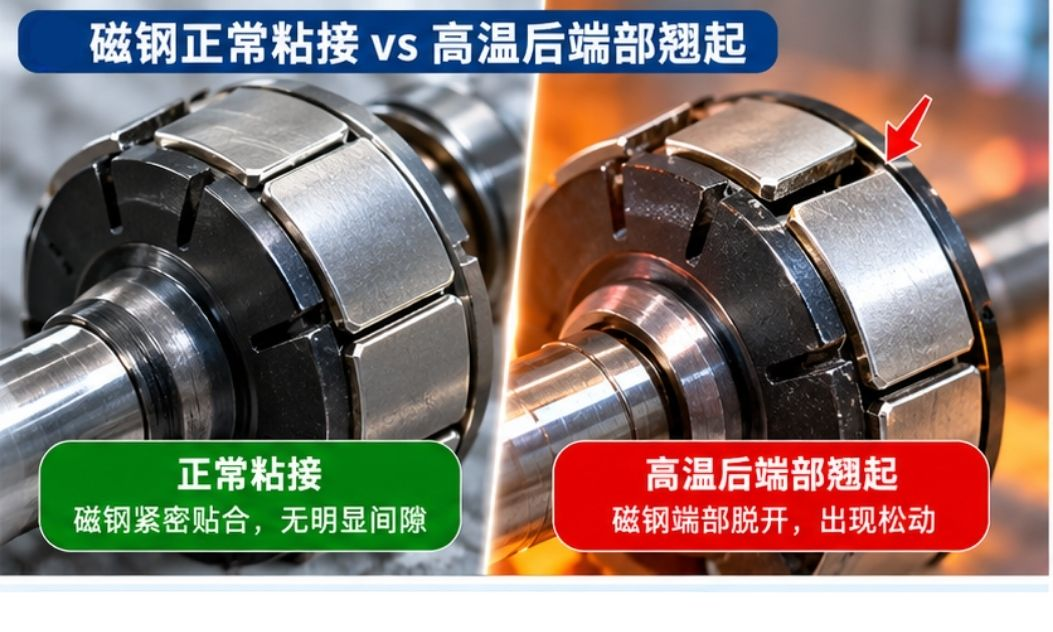
When temperature rises, magnets, metallic rotor and adhesive expand at different rates.
During operation from cold start to full load, the magnet and rotor expand dimensionally while the adhesive layer is sandwiched between the two substrates.
Repeated cycles of start-up → heat-up → shutdown → cooling subject the interface to cyclic stress instead of one-off static tension.
Therefore, the critical validation for magnet bonding is:
How much bonding performance remains after high-temperature exposure and thermal cycling.
Why Do Magnets Keep Detaching at the Same Spot?
Recurring failure at a fixed location requires structural and interface checks before switching to higher-strength adhesives.
Typical symptoms include: Magnet corners lifting first, consistent edge delamination, repeated failure at the same slot. These usually indicate:
- Discontinuous adhesive coverage
- Excessive local clearance
- Substrate contamination
- Assembly misalignment
- Concentrated local stress
If the root cause lies in structural clearance, switching to a higher-grade adhesive will not change the failure location. This is a core principle of ELAPLUS diagnostic selection: investigate structure for fixed-position failures; prioritize material and process for random failures.
Why Is the Magnet Surface the First Inspection Item?
Structural adhesive bonds to the outermost surface layer of the magnet, not the magnet bulk itself. Magnets may carry:
- Plating layers
- Oil stains
- Dust
- Anti-rust residues
- Machining contaminants
Rotor substrates may retain:
- Cutting fluid
- Anti-rust oil
- Residues from incomplete degreasing
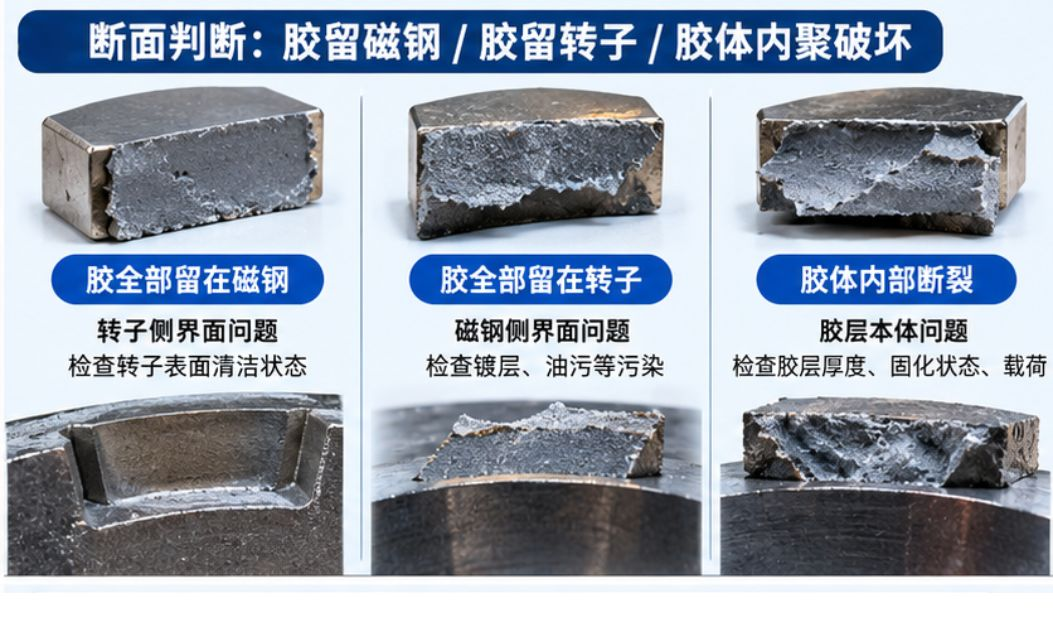
If adhesive bonds to a contaminant layer, initial test results can still look acceptable, yet weak interfaces readily fail under prolonged high temperature and vibration. After debonding occurs, check not only whether the adhesive fractured, but also which substrate the adhesive remains on.
Troubleshooting by Fracture Pattern
| Fracture Mode | Primary Investigation | Follow-Up Inspection |
|---|---|---|
| All adhesive remains on rotor | Magnet-side interface cleanliness & surface condition | Surface pretreatment |
| All adhesive remains on magnet | Rotor-side plating & contamination | Plating compatibility |
| Cohesive fracture inside adhesive | Bulk adhesive performance | Bondline thickness, curing completeness, load condition |
| Lifting starts at magnet end | Local stress concentration | Structural clearance, adhesive profile |
| Repeated failure at fixed slot | Structure / assembly positioning & tolerance | Fixture and dispensing path |
| Random debonding locations | Process variation | Dispensing volume, surface treatment consistency |
| Debonding only after heating | Thermo-mechanical stress | Post-cycling bond strength |
Fracture analysis delivers more insight than another simple room-temperature pull test.
Why Is Thicker Adhesive Not Always Better?
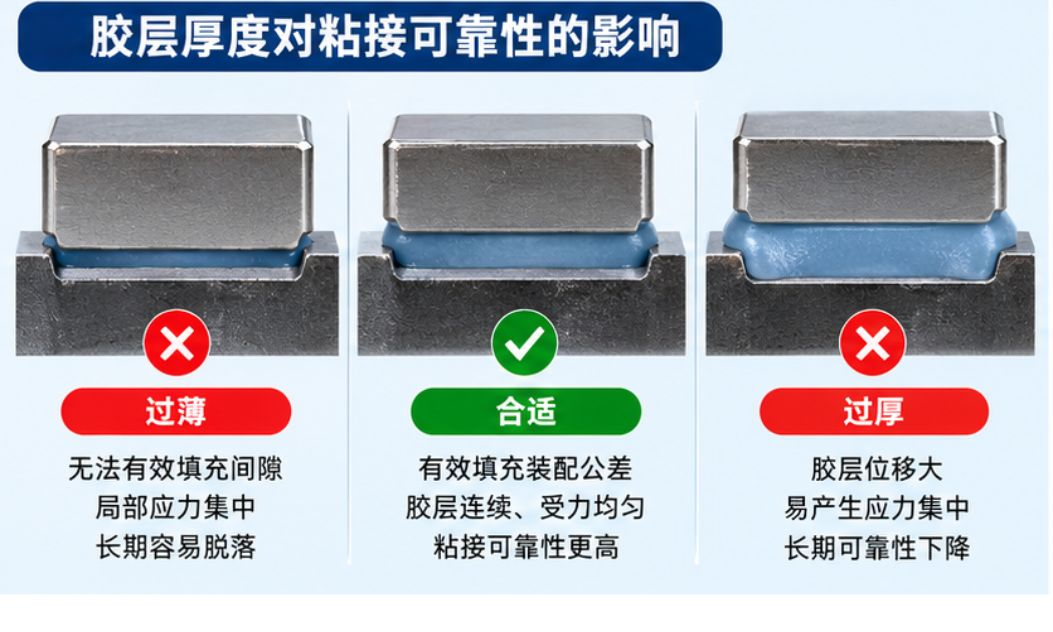
A certain bondline thickness helps compensate assembly tolerances, but excessive thickness increases displacement and stress. Large clearance variation across the magnet leads to uneven bondline, even with identical adhesive. Mass production control targets:
- Dispensing volume
- Magnet positioning
- Lamination pressure
- Final cured bondline thickness
The controlled target is the effective bonded cross-section after curing, not simply dispensing a bead on every magnet.
How Does Dispensing Path Affect Long-Term Reliability?
Adhesive applied only at the magnet centre leaves edges unsupported. Excessive adhesive causes overflow after pressing, contaminating adjacent components and disrupting downstream assembly. Dispensing trajectory shall be designed according to:
- Magnet dimensions
- Assembly gap
- Adhesive thixotropy
- Spread profile after compression
Thixotropic structural adhesives are widely preferred for magnet bonding: they stay in place after dispensing and form the target bondline upon pressing.
One-Part vs Two-Part Epoxy Selection
Neither type is universally superior; selection is driven by production workflow.
| Project Condition | One-Part Epoxy | Two-Part Epoxy |
|---|---|---|
| Metering & mixing | No on-site A/B mixing | Requires controlled ratio mixing |
| Automatic dispensing | Suitable | Feasible |
| Curing method | Usually heat-cured | Room-temperature or heat-curable depending on grade |
| Storage | Follow material specification | A and B components stored separately |
| Large assembly | Manage curing cycle | Operation window is a key consideration |
ELAPLUS brushless motor magnet bonding portfolio covers one-part and two-part epoxy grades including EP 1766, EP 1769 and EP 2022, proving there is no single standard process for magnet bonding.
Why One-Part Epoxy Is Favoured for Automated Magnet Assembly
One-part grades eliminate on-site A/B proportioning and mixing, fitting seamlessly into inline dispensing, assembly and heat curing lines. EP 1761 is a high-performance one-part epoxy structural adhesive for ferrite and magnet assembly in motors, rotor and winding fixation. It cures rapidly under heat and delivers balanced bonding, impact resistance and vibration resistance. For projects with:
- Continuous automatic dispensing
- Automated magnet positioning
- Stable heat curing station One-part epoxy is recommended for process validation first.
When to Evaluate Two-Part High-Temperature Structural Epoxy
Two-part systems are suitable for projects requiring:
- Extended assembly working window
- Flexible curing options (RT or heat)
- Bonding between metal and magnet
- Large and complex assemblies
EP 2029, a two-part high-temperature epoxy structural adhesive, is formulated for motor magnet and magnet segment bonding. EP 1707 A/B is also used for magnet bonding, with service range from -50℃ to 180℃, compatible with various metals and composite substrates. Grade selection should not rely solely on maximum temperature rating; assembly tact time, bondline thickness and curing profile must be considered.
Why Pull-Off Tests Alone Are Insufficient Right After Bonding
Motors are subjected to cyclic loads rather than static tension. A recommended validation sequence: Initial bonding → High-temperature ageing → Thermal cycling → Vibration / shock test → Bond strength recheck. High-speed rotor samples shall additionally undergo mechanical load testing matching actual service conditions. The key question is not “what is the initial pull strength”, but whether the bonding interface remains stable after exposure to real operating environments.
Four Common Pitfalls in Magnet Bonding
Pitfall 1: Compare adhesives only by tensile strength High strength cannot compensate contaminated interfaces, improper bondline or defective curing.
Pitfall 2: Mass production approval based purely on passing pull test Magnets endure high temperature, vibration and cyclic loads in operation.
Pitfall 3: Increase adhesive dosage after debonding Extra adhesive only causes overflow if the root cause is surface contamination or uneven clearance.
Pitfall 4: Apply identical curing profile for all magnets Magnet size, rotor thermal mass and bondline condition change heat transfer behaviour. Process qualification must use full rotor assemblies.
Application Guidance by Scenario
One-part epoxy is suitable for: Highly automated magnet assembly lines with fixed dispensing paths and stable heat curing stations.
Two-part epoxy is suitable for: Large assemblies requiring flexible working windows, or where heat curing is not feasible.
Adhesive replacement alone is NOT recommended for: Recurring fixed-position debonding, inconsistent magnet clearance, oil contamination or abnormal plating. Prioritize structural optimization and interface pretreatment first.
ELAPLUS diagnostic selection workflow: examine fracture surface → check magnet/rotor interface and bondline → confirm adhesive grade and curing process. This embodies ELAPLUS’s philosophy for motor magnet bonding: select adhesive according to working conditions, not stack datasheet parameters.
FAQ
Q: For magnet bonding, is higher adhesive strength always better?
A: No. High-temperature performance, vibration resistance, bondline thickness, interface condition and long-term reliability must also be evaluated.
Q: Should I change adhesive immediately if magnets keep falling off at the same spot?
A: Not recommended. Check assembly clearance, dispensing path and local interface condition first.
Q: Is one-part epoxy suitable for automated magnet bonding?
A: Yes for evaluation. It removes on-site A/B mixing. Grades such as EP 1761 are proven for magnet bonding applications.
Q: When should two-part epoxy be considered?
A: Choose two-part grades like EP 2029 when you need flexible working windows, room-temperature curing options or for large complex bonding structures.
Q: What samples should be preserved after magnet debonding?
A: Save intact fracture surfaces. Observing whether adhesive stays on magnet, rotor or splits cohesively quickly narrows down failure causes.
Previous post: Why Does Oil Pressure Sensor Drift After Long-Time Oil Exposure Even If It Performs Well at Room Temperature After Potting? Check Medium Penetration and Interfacial Changes First
Next post: Adhesive Selection for Embedded Copper Tubes in Cold Plates: Filling Gaps Is Not Enough. The Core Is to Form a Continuous Thermal Interface Among Copper Tube, Adhesive Layer and Aluminum Plate