The key to waterproofing automotive connector pins is not simply covering the terminal surface. Instead, the sealing material must wick into the micro-gap between pins and plastic housing to form a continuous insulating and waterproof barrier at the terminal root. If adhesive only stays on the surface, moisture can still migrate inward along the metal-plastic interface. Dense pin arrays require special attention to material flowability, interfacial adhesion and stress buffering after curing.
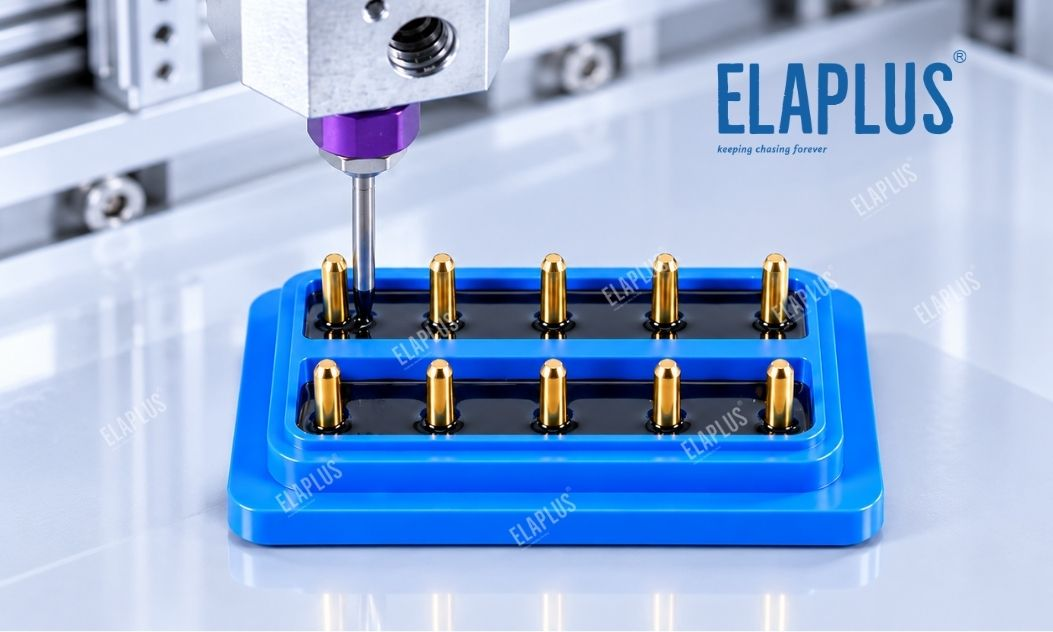
Pin Sealing
A common pitfall in connector sealing is “false sealing”: the surface appears fully covered by adhesive.
However, cross-section inspection reveals adhesive sitting on top while water ingress channels remain underneath. Surface photos alone cannot verify connector sealing reliability.
1. Why Hidden Water Ingress Paths Easily Form Around Pins
Pins pass through:
- Plastic housing
- Terminal retention features
- PCB or internal conductors
Long-term waterproofing cannot be guaranteed just by tight contact between metal and plastic. In practice, gaps may arise from:
- Assembly tolerances
- Micro clearances
- Material shrinkage
- Displacement under thermal cycling
Moisture can gradually travel inward along these interfaces. Therefore, pin sealing is intended to block capillary channels formed at the metal-plastic boundary.
2. Why Water Can Still Seep In Even When Pins Are Covered With Adhesive
Coverage and penetration are two different concepts. High-viscosity material may only form a cap on top of pins, presenting a perfectly sealed appearance. Continuous micro-gaps may still remain at the pin root. Once water enters, it propagates along: pin sidewall → housing interior → PCB / terminal area. The primary criterion for pin sealing is whether material penetrates down to the root, not the thickness of the surface film.
3. How to Distinguish Insufficient Penetration From Poor Adhesion
| Failure Mode | Primary Judgment | Inspection Method |
|---|---|---|
| Persistent voids at root | Insufficient flow | Cross-section analysis |
| Complete delamination from plastic | Failed adhesion to plastic substrate | Interface peel check |
| Adhesive separates from pins | Failed adhesion to metal | Plating compatibility check |
| Leakage only after thermal cycling | Interfacial displacement | Pre- and post-cycling comparison |
| Leakage after mating cycles | Stress transfer | Mechanical cycling test |
| Repeated leakage at fixed location | Structural capillary channel | Cross-section / CT scanning |
| Random batch leakage | Dispensing variation | Adhesive dosage & dispensing trajectory audit |
The core logic: identify the water flow path before deciding to switch materials.
4. Why Dense Pin Arrays Are More Demanding on Flowability
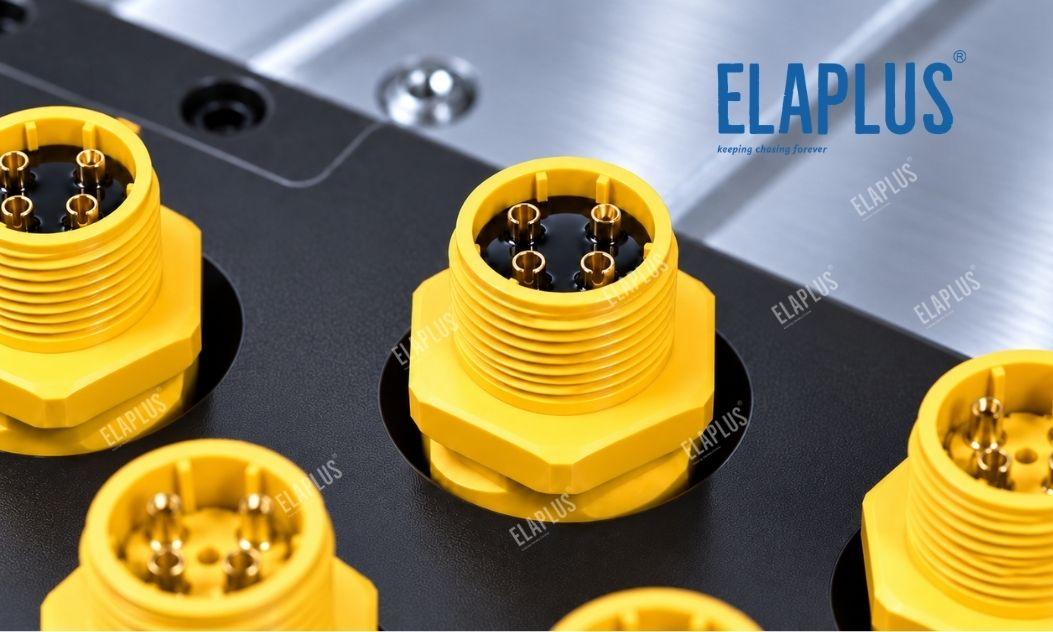
The smaller the pin pitch, the narrower the channel for material penetration. If adhesive cannot naturally flow down to the root, bridging occurs: Adhesive spans over the top of multiple pins and looks sealed, while voids remain underneath. Dense terminal arrays call for materials with:
- Self-leveling property
- Micro-gap penetration capability
- Complete wetting
Nevertheless, excessively low viscosity is not ideal. Over-flow may contaminate:
- Mating faces
- Contact zones
- Threads
- No-adhesive cavities
Controlled penetration is the target.
5. Suitable Applications for SIPC 9030 in Pin Sealing
SIPC 9030 is a one-component neutral RTV silicone sealant with self-leveling characteristics, formulated for sealing pins, connectors and fine joints. It flows into narrow slots and maintains good sealing adhesion to common metals such as copper and tin plating.
Recommended scenarios:
- Open slots
- Structures exposed to ambient moisture for cure
- Connectors requiring self-leveling cavity filling
Its advantage does not lie in building thick films, but in flowing naturally along the geometry to reach required sealing zones.
6. Why Some Connectors Require Two-Part Potting Instead of One-Part RTV
One-component moisture-cure materials rely on ambient moisture diffusing inward for curing. For connectors with:
- Deep recesses
- Large enclosed cavities
- Full-depth encapsulation
Curing kinetics must be carefully evaluated. Two-part systems cure via A/B chemical reaction and are better suited for deep-volume encapsulation. SIPA 8715 is formulated for PA6+GF30 housing and tin-plated pin structures. Its low viscosity fills fine gaps and withstands reflow soldering and thermal cycling for connectors.
Selection between one-part and two-part grades is first determined by structure depth and curing conditions.
7. Why Mating Action Affects Pin Sealing Performance
Pins are not static ideal components. During:
- Mating
- Unmating
- Vibration
- Harness pulling
Terminals experience minor mechanical loads. If cured sealant is overly rigid, external displacement transfers stress directly to:
- Pin-to-adhesive interface
- Adhesive-to-plastic interface
Micro-delamination develops over time. Therefore, pin sealing requires stress buffering in addition to waterproofing, which is a key advantage of silicone systems for certain automotive connectors.
8. Why PA, PBT and Tin-Plated Copper Cannot Be Treated As Identical Substrates
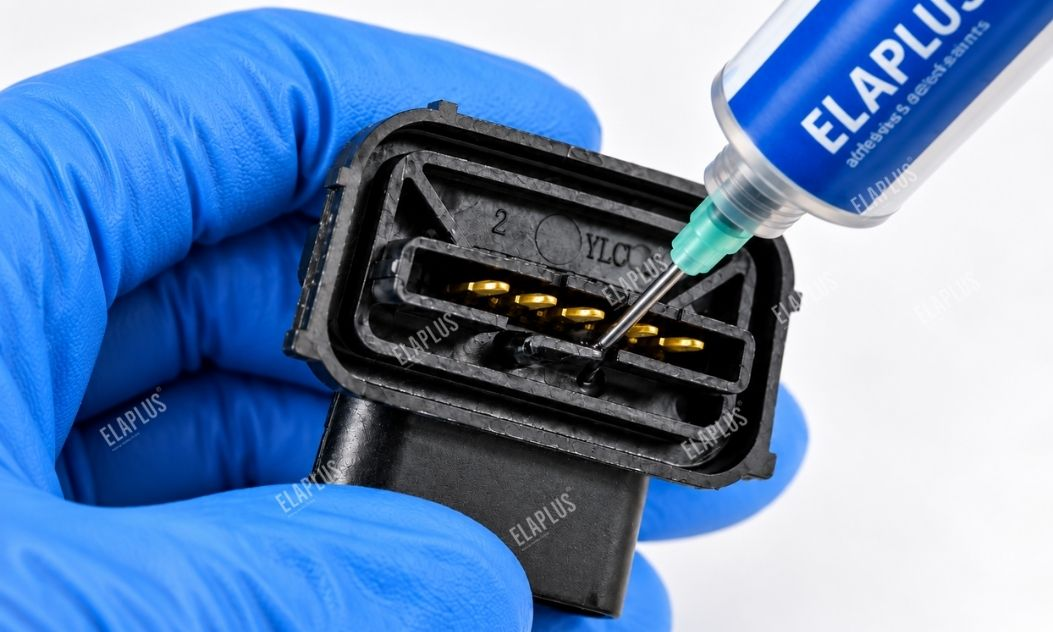
Connectors are multi-material assemblies. Typical combinations include:
- PA nylon
- PBT
- Copper
- Tin-plated copper
- Other metallic platings
Wetting and adhesion behaviour vary drastically across different surfaces. Sealing validation cannot only test adhesive bonding on plastic. Stable adhesion must be confirmed on both plastic interfaces and pin plating interfaces.
Field cases of pin potting show that PA6+GF30 reinforced nylon paired with tin-plated pins requires evaluation of mismatched thermal expansion and interfacial stability after reflow.
9. Why Sealing Requirements Differ Greatly Before and After Reflow Soldering
Some connectors are potted first and then subjected to subsequent thermal processes. Under such conditions, the material must not only:
- Flow into gaps
- Adhere reliably
It must also survive short-term high-temperature exposure. Interfacial loosening, adhesive degradation or internal void evolution after thermal processes will compromise subsequent waterproof performance. Production sequence must be clarified upfront: dispensing before or after reflow. This single factor often changes material selection.
10. Validations for Reliable Pin Waterproofing
A single room-temperature immersion test provides limited data. A combined test sequence is recommended:
- Initial air / water tightness test: verify as-assembly condition
- Thermal cycling: evaluate thermal displacement between metal, plastic and adhesive
- Vibration test: simulate vehicle operating environment
- Mating / unmating cycles: check interface integrity under mechanical load
- Repeat water tightness test: confirm sealing retention after environmental exposure
Many long-term interfacial defects will not surface if only the first test is performed.
11. Why Cross-Section Examination Is Essential for Connector Waterproofing
Visual inspection only confirms surface coverage. Cross-section inspection verifies whether adhesive reaches the bottom. Key areas to examine:
- Pin roots
- Housing corners
- Inter-pin gaps
- Metal-plastic interfaces
Check for continuous voids. For high-reliability connectors, cross-section validation delivers more value than simply increasing adhesive volume. The objective is eliminating continuous leakage channels.
12. Additional Considerations for High-Voltage Insulation
For high-voltage applications, material selection cannot be based solely on waterproof performance. Extra requirements apply:
- Dielectric properties
- High voltage insulation
- Stress buffering
- Long-term moisture resistance
SIGEL 1875 is a 1:1 two-part self-healing transparent silicone gel with mixed viscosity ~750 cps and dielectric strength of 25 kV/mm. It is used for waterproof connectors in power and telecom applications. It is designed for flexible dielectric protection and deep moisture resistance, rather than basic surface sealing.
Three material strategies for different connector structures:
| Structure / Operating Condition | Material Selection |
|---|---|
| Open shallow-slot pins | Self-leveling RTV sealant |
| Deep cavity connectors | Two-part potting compound |
| High-voltage / low-stress connectors | Dielectric silicone gel |
This approach works better than searching for one universal sealant for all connectors.
FAQ for Pin Sealing
Q: Why do pins still leak even with full surface adhesive coverage?
A: Adhesive may only sit on the surface and fail to penetrate the micro-gap at the root between pins and plastic housing.
Q: Is lower viscosity always better for pin sealing adhesive?
A: No. It must penetrate target gaps while avoiding uncontrolled wicking into mating faces, contacts and other no-adhesive zones.
Q: What connector designs suit SIPC 9030?
A: It is ideal for open, shallow-slot structures requiring self-leveling penetration down to pin roots.
Q: Are material selections identical for high-voltage connectors and ordinary waterproof connectors?
A: No. High-voltage connectors require additional evaluation of dielectric insulation, interfacial stability and long-term stress buffering.
Previous post: Why Do Solder Joints Still Fail Under Vibration Even Though FPC Solder Looks Good? The Root Cause May Not Be the Solder Joint Itself, But Unrelieved Harness Stress
Next post: Why Does Oil Pressure Sensor Drift After Long-Time Oil Exposure Even If It Performs Well at Room Temperature After Potting? Check Medium Penetration and Interfacial Changes First