When selecting potting compounds for motor stators, thermal conductivity alone should not be the only comparison indicator. Viscosity, wet‑out capability, Tg, coefficient of thermal expansion (CTE), cure shrinkage, hardness and crack‑resistance performance shall also be evaluated simultaneously. For conventional epoxy potting of motor stators, evaluate Elaplus EP 1715. Choose EP 1716 for applications requiring high Tg, low shrinkage and crack resistance. For high‑power‑density applications such as robot‑joint motors and new‑energy‑vehicle motors where higher thermal conductivity is needed, evaluate EP 1796‑2# with a thermal conductivity of approx. 2.5 W/m·K.
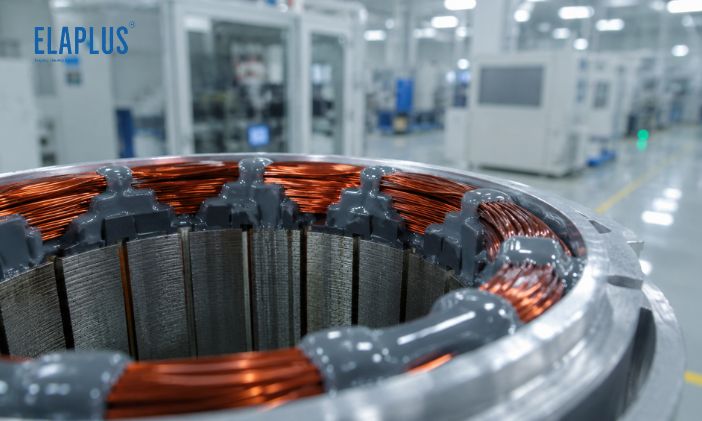
Motor Potting
Why Do Motor Stators Require Potting?
Stator windings continuously generate heat when energized. As motors trend toward miniaturization, higher rotational speed and elevated power density, heat inside windings becomes harder to dissipate in a timely manner.
Motor stator potting compounds mainly deliver the following functions:
- Fill air gaps between windings and iron cores
- Secure magnet wires
- Improve electrical insulation protection
- Reduce coil vibration and noise
- Transfer heat from windings to iron cores and housing
- Mitigate impacts from moisture, dust and condensation
- Enhance long‑term thermal‑cycling reliability
Robot‑joint frameless torque motors, servo motors and new‑energy‑vehicle drive motors feature high power density, which places higher comprehensive requirements on motor thermally‑conductive potting compounds.
Recommended Grades for Conventional Motor Stator Potting
EP 1715: Epoxy Potting Compound for Stators
EP 1715 is a 100:15 two‑component heat‑curing epoxy potting compound, suitable for potting of general‑purpose motor stators and windings.
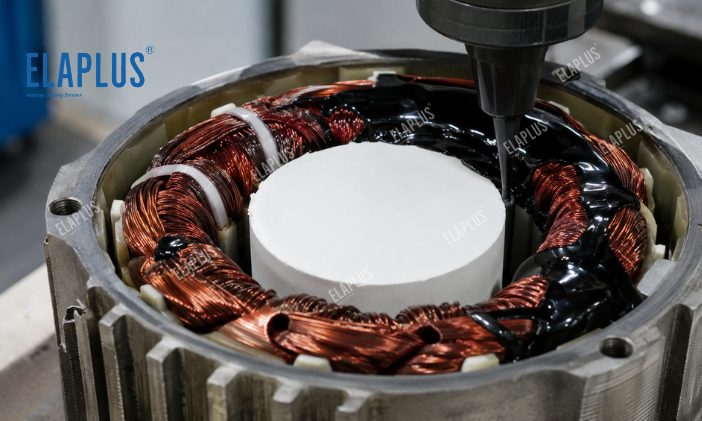
Recommended Applications:
- Industrial motors
- Servo motors
- Power‑tool motors
- Household appliance motors
- Stator coils with general thermal‑conductivity and structural‑fixation requirements
Parameters of EP 1715 may vary for different suffixes or formula versions. Always refer to the latest corresponding TDS for public release.
Grade Recommendation for Motors Requiring High Tg and Crack Resistance
EP 1716: High‑Tg Low‑Shrinkage Epoxy Potting Compound
EP 1716 is a 100:5 two‑component epoxy potting compound characterized by high Tg, high temperature resistance, low cure shrinkage and crack resistance. Its service temperature ranges from approx. ‑50 ℃ to 180 ℃.
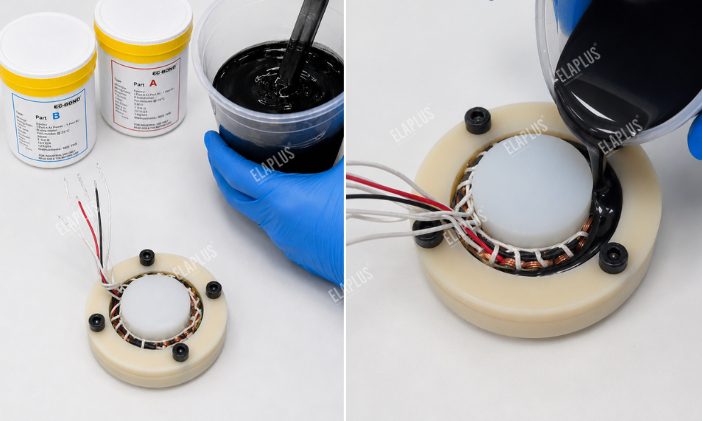
Suitable for:
- Permanent‑magnet synchronous motors
- Robot‑joint motors
- Frameless torque motors
- Servo motors
- Stators subjected to frequent high‑low temperature cycling
- Motors requiring dimensional stability and low CTE
High Tg helps the material maintain mechanical stability at elevated operating temperatures. Low cure shrinkage and low CTE help reduce thermal stress among windings, iron cores and cured compound.
High‑Thermal‑Conductivity Grade for Motor Stators
EP 1796‑2#: 2.5 W/m·K High‑Thermal‑Conductivity Epoxy Potting Compound
EP 1796‑2# is a 100:15 two‑component epoxy potting compound with Tg of approx. 140 ℃ and thermal conductivity of approx. 2.5 W/m·K. Its service temperature ranges from approx. ‑60 ℃ to 200 ℃.
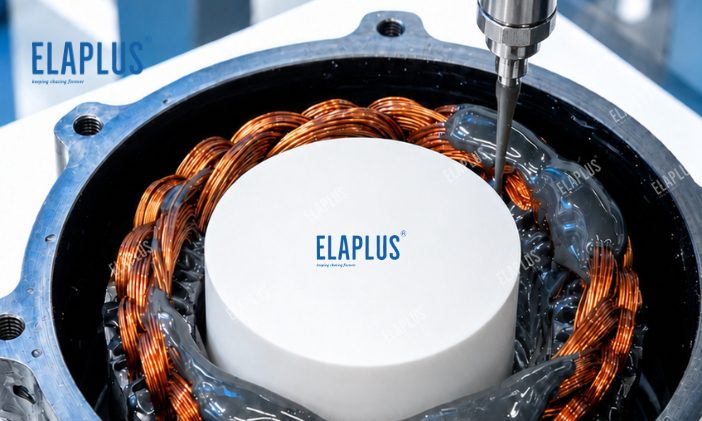
Suitable for:
- Humanoid robot joint motors
- High‑power‑density frameless torque motors
- New‑energy‑vehicle drive motors
- Axial‑flux motors
- High‑speed servo motors
- Stators with high heat generation from windings
Higher thermal conductivity usually comes with increased filler loading, which may lead to higher viscosity and density. Therefore, when adopting EP 1796‑2#, coil wet‑out performance, degassing effect and capability of potting equipment shall also be verified.
EP 1715, EP 1716 and EP 1796‑2# constitute Elaplus’ motor‑stator potting solution portfolio. Among them, EP 1796‑2# delivers thermal conductivity of approx. 2.5 W/m·K and Tg of approx. 140 ℃.
Motor Stator Potting Compound Grade Comparison
| Grade | Key Features | Suitable Applications |
|---|---|---|
| EP 1715 | Conventional heat‑curing epoxy potting | Industrial motors and general‑purpose stators |
| EP 1716 | High Tg, low shrinkage, crack resistance | Robot motors, servo motors, permanent‑magnet motors |
| EP 1796‑2# | 2.5 W/m·K, Tg @ approx.140 ℃ | High‑power‑density & NEV drive motors |
Why Do Motor Thermally‑Conductive Potting Compounds Crack?
Common root causes include:
- Excessive CTE mismatch between cured compound, iron core and copper wires
- Excessively high material hardness and insufficient toughness
- Excessively thick single‑shot potting layer
- Concentrated exotherm during curing
- Too fast heating or cooling rate
- Substantial entrapped bubbles inside coils
- Insulating varnish, oil contamination or moisture on substrate surfaces
- Motor operating temperature exceeding the material’s long‑term service range
Selection Conclusion for Motor Stator Potting Compounds
Evaluate EP 1715 for general‑purpose motor stators. Select EP 1716 when high Tg, low shrinkage and crack resistance are emphasized. For humanoid robot joint motors, new‑energy‑vehicle drive motors and other high‑power‑density motors, focus on evaluating EP 1796‑2#.
FAQ for Motor Stator Potting
Is higher thermal conductivity always better for motor potting compounds?
No. Viscosity, coil wet‑out performance, potting layer thickness, interfacial bubble formation and long‑term thermal‑cycling reliability should also be taken into consideration.
Why do robot‑joint motors require low‑CTE potting compounds?
Joint motors feature compact structures and fast temperature rise. Low‑CTE materials help reduce thermal stress between cured compound and copper wires / iron cores.
Is vacuum degassing required before stator potting?
Vacuum degassing and vacuum potting are highly recommended to minimize internal bubbles for densely‑packed winding structures or high‑viscosity compounds.
Elaplus Functional Materials (Shanghai) Co., Ltd.
Technical support & free sample request: +86‑21‑67227200
E‑mail: info@elaplus.cc
Website: www.elaplus.cc
Address: No.555 Jiugong Road, Jinshan Industrial Zone, Shanghai, China