Conformal coatings for robot‑controller PCBs shall prioritize moisture resistance, corrosion resistance, electrical insulation, vibration endurance, film thickness, and complete curing within component shadow zones. For robot drive boards, controller boards and sensor PCBs, the UV/moisture dual‑cure conformal coating is worth evaluation. It delivers fast UV curing on exposed surfaces, while non‑illuminated shadow regions achieve full subsequent curing via moisture.
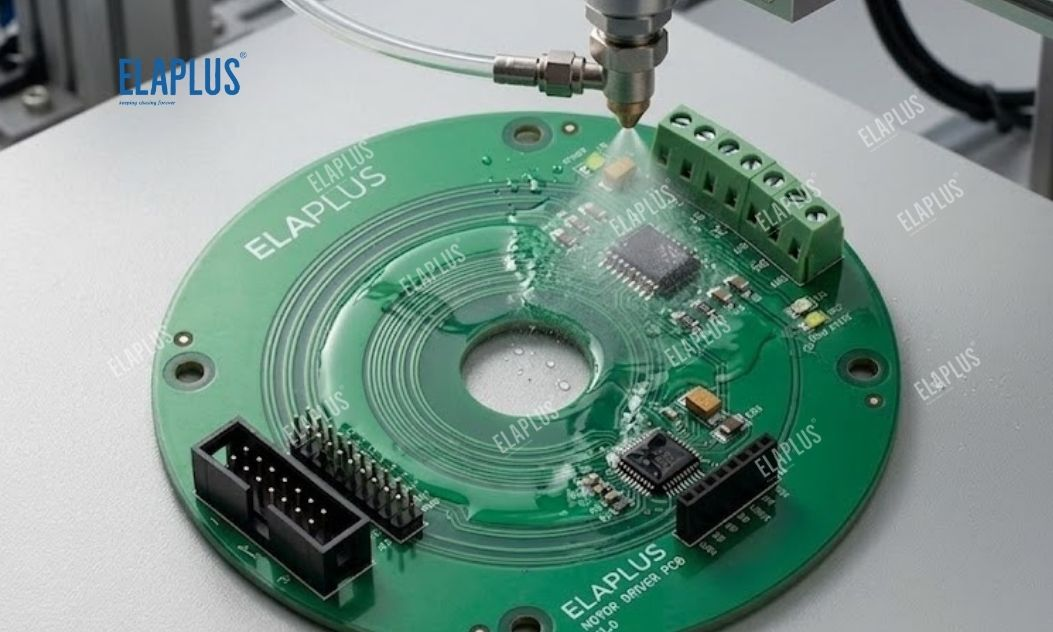
Conformal Coating for Robot PCBs
Why Do Robot PCBs Require Conformal Coating?
Many robots operate indoors with no direct rain exposure. Yet PCBs are challenged by more than liquid water:
‑ ambient moisture
‑ condensation
‑ metallic dust
‑ solder flux residues
‑ long‑term temperature cycling
‑ localized corrosion
Internal joint cavities are compact. Corrosion or electrical leakage on PCBs leads to extremely high repair costs.
Why Adopt Dual‑Cure Solution?
Conventional UV‑only coatings have an inherent limitation: no curing occurs where light cannot reach. Connectors, large capacitors, chips and heat sinks on drive boards all create shadowed areas.
COATING 9060‑M is a UV‑plus‑moisture dual‑cure conformal coating for PCB environmental and insulation protection. It combines fast UV surface tack‑free curing on exposed areas with secondary moisture‑driven curing in shadow zones, making it well‑suited for high‑density PCBs.
Industry Pitfalls | Top 3 Common Conformal Coating Issues
- Spraying coating onto insufficiently cleaned PCBs Residual contaminants may cause pinholes, craters and local adhesion failure.
- Assuming thicker film delivers better protection Excessive thickness triggers curing defects, residual stress and process risks.
- Considering full curing complete after one‑pass UV exposure Shadow zones such as beneath connectors and large components must be taken into account.
Suitable Application Scenarios for COATING 9060‑M
Ideal for: ‑ Automated coating production lines ‑ PCBs with densely packed components ‑ Requirement for fast initial cure ‑ Prominent shadow‑area conditions ‑ Robot drive boards, controller boards and sensor PCBs
For PCBs with open layouts and relaxed cycle‑time requirements, evaluate alternative conventional conformal coating systems.
FAQ on Conformal Coating for Robot PCBs
Can conformal coating be used as potting compound? They are generally not interchangeable. Conformal coating forms a thin protective film; potting provides thick‑volume encapsulation.
Does conformal coating provide heat dissipation for MOSFETs? It is not intended to form primary thermal paths. Dedicated thermal interface materials (TIM) shall be deployed for MOSFET thermal management.
Is rework feasible after conformal coating application? Reworkability depends on material chemistry and rework procedures, which should be confirmed at the material‑selection stage.
ELAPLUS
Original Manufacturer|Selection Support|Free Samples Available
info@elaplus.cc