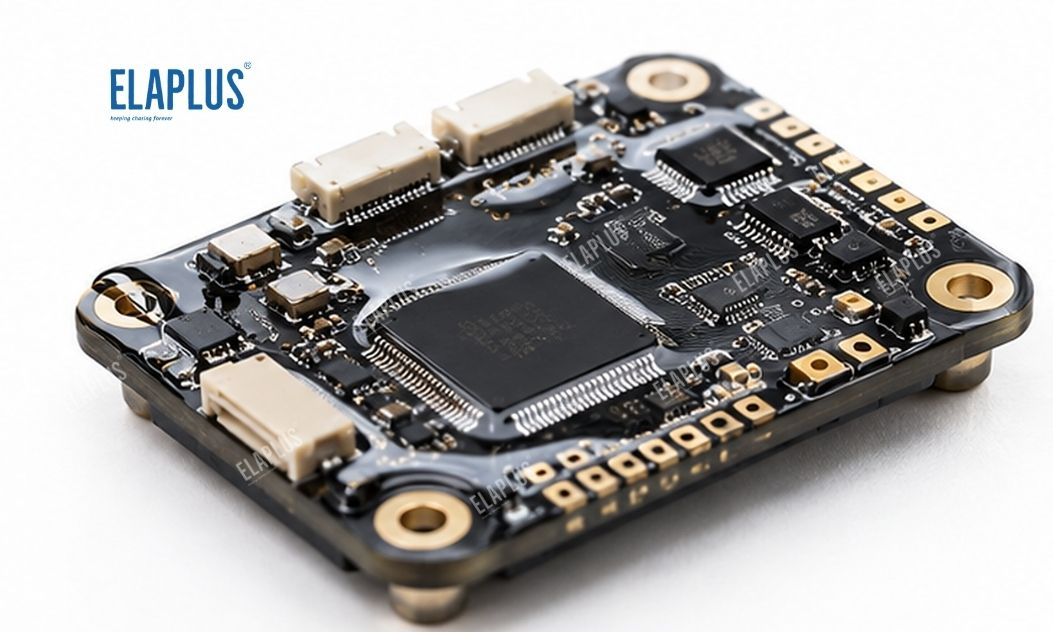
ELAPLUS PUR 1618 A/B two-component low-hardness polyurethane gel is recommended as the primary candidate for potting of UAV on-board auxiliary control boards. Featuring low viscosity, post-cure flexibility and electrical insulation, it suits electronic control assemblies requiring local environmental protection and elastic cushioning. For auxiliary power supplies or control modules with higher structural support requirements, PUR 1661 A/B may be compared, while potting weight gain, actual temperature rise and equipment maintenance requirements must be assessed simultaneously.
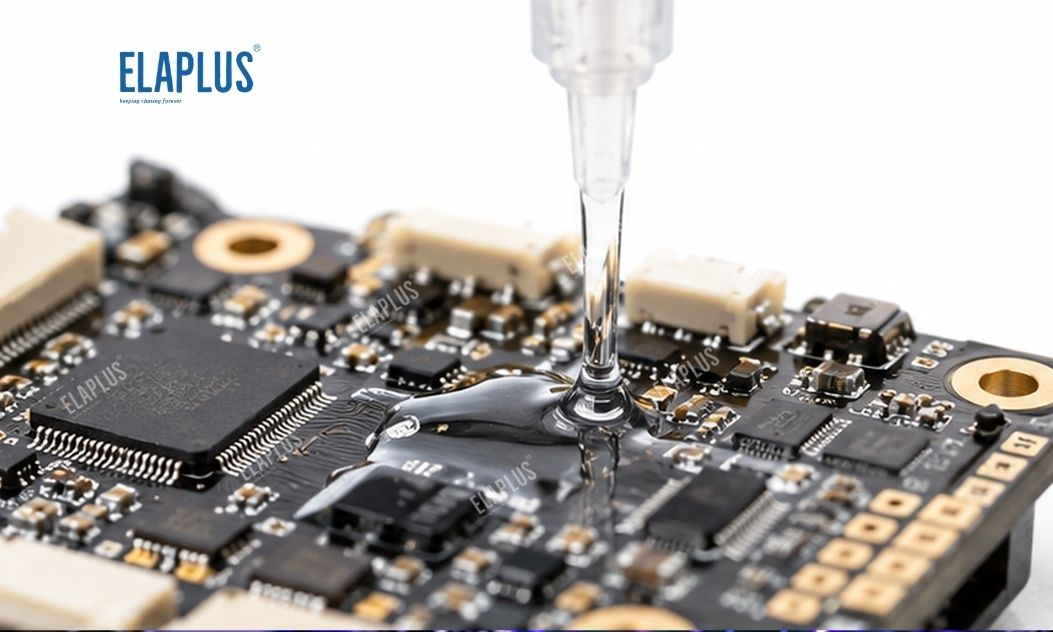
Low-altitude UAVs commonly integrate flight control systems, auxiliary power supplies, communication interfaces, status monitoring and other electronic modules. Electronic assemblies differ in mounting position, heat generation and protection requirements, so uniform potting material selection criteria are not applicable.
For auxiliary control boards requiring protection, potting serves as part of the insulation, moisture-proofing and mechanical buffering design. Since UAVs are highly sensitive to weight, heat dissipation and maintenance clearance, define the actual protection scope first instead of fully filling the entire PCB by default.
1. Why Elastic Potting Is Required for UAV Auxiliary Control Boards
During take-off, landing and normal flight, on-board electronics are subjected to vibration, temperature fluctuation and other environmental loads. For auxiliary control modules installed inside the airframe, properly selected potting adhesive covers designated circuits and provides mechanical protection for selected components and connection points.
Unlike stationary industrial equipment, UAVs are sensitive to assembly weight. Additional mass introduced by potting compound is directly added to the airborne system. Therefore, material density, fill volume and structural protection performance shall all be considered in material selection.
Furthermore, on-board electronic assemblies include components and connectors of varied sizes, and the mechanical properties of cured adhesive must match the actual structure. Low-hardness potting systems are preferred for PCBs that need to retain compliance.
Note that precision inertial sensors, barometric sensors and other mechanically stress-sensitive devices may have special encapsulation specifications. The potting scheme for auxiliary control boards cannot be directly applied to these precision measurement assemblies.
2. Why PUR 1618 Is Suitable for Low-Hardness Potting Applications
PUR 1618 A/B is a two-component solvent-free polyurethane potting gel, curable at room temperature or under heating. At 25°C, Part A viscosity is 200±100 mPa·s and Part B is 150±100 mPa·s, delivering low viscosity and favourable processability.
This material cures to low hardness with excellent flexibility, alongside electrical insulation, moisture resistance and low-temperature tolerance. It is a candidate for auxiliary control modules requiring partial coverage of PCBs and electronic components with minimal rigid restraint.
Typical applications of PUR 1618 include potting of control power supplies, communication equipment and electronic sensors. When adopted for UAV auxiliary control boards, further validation of operating temperature range, vibration conditions and substrate compatibility is mandatory. Flexibility alone does not guarantee suitability for all airborne electronic systems.
3. How to Choose between PUR 1618 and PUR 1661
Both PUR 1618 and PUR 1661 are two-component polyurethane potting materials, yet they differ in post-cure mechanical properties and application orientation.
PUR 1618 is preferred for structures mainly requiring flexible cushioning and circuit protection. PUR 1661 can be shortlisted for assemblies that demand moderate mechanical support while retaining a degree of elasticity.
| Selection Item | PUR 1618 A/B | PUR 1661 A/B |
|---|---|---|
| Material System | Two-component polyurethane gel | Two-component polyurethane potting compound |
| Curing Method | Room-temperature or heat curing | Room-temperature or heat curing |
| Flow Behaviour | Low viscosity, suitable for evaluation in complex structure filling | Good flowability |
| Post-Cure Characteristics | Low hardness, outstanding flexibility | Balanced elasticity and structural support |
| Primary Application Focus | Flexible protection, local cushioning | Insulation protection, auxiliary fixation |
| Common Validation Items | Electrical insulation, temperature, vibration and substrate compatibility | Electrical insulation, temperature, vibration and substrate compatibility |
PUR 1661 is also available in clear grades for electronic control module protection and can be benchmarked with PUR 1618 on structure and process. Nevertheless, compliance with UAV requirements must be verified by assembly-level testing under identical conditions.
Importantly, soft materials are not designed to sustain large structural loads, and higher-hardness grades are not universally suitable for all PCBs. Final selection depends on component mounting method, adhesive thickness and vibration loading. elaplus.cc
4. Why Potting Weight Must Be Controlled for UAV Auxiliary Control Boards
Potting weight shall be treated as an independent design parameter for airborne electronic modules. The added mass depends not only on density, but also fill volume, housing geometry and glue surface height.
At identical material density, eliminating redundant fill volume reduces weight gain. Engineering design shall first identify zones requiring protection, then decide on local potting, zonal potting or alternative protection methods.
Circuits only requiring surface moisture protection may not require deep full potting. For control modules needing cavity filling, glue quantity shall be defined according to the structure.
When selecting PUR 1618, include material density, actual fill volume and final cured mass in sample testing. Low hardness does not equate to low density or automatic lightweight performance.
5. Matching Low-Hardness Potting Compound with PCB Structures
UAV auxiliary control boards may use FR-4 substrates, plastic housings, metal brackets and electronic components of diverse packaging forms. The potting material must form stable interfacial contact with these substrates without interfering with functional interfaces and subsequent assembly.
Define coverage at board edges, connector roots and around tall components according to design requirements. Connectors intended for plugging, unplugging or servicing must retain operating clearance; potting protection shall not hinder normal disassembly and assembly.
For modules with pushbuttons, adjustment elements or other moving structures, non-glue zones shall be marked. For heat-generating devices, confirm whether the potting material participates in heat transfer and whether it alters the original thermal path.
If the PCB is fastened to the housing via screws or supports, clarify the load borne by mechanical fasteners first, then define the auxiliary protection role of the potting adhesive.
6. Process Adaptation of PUR 1618 for Airborne Electronic Module Potting
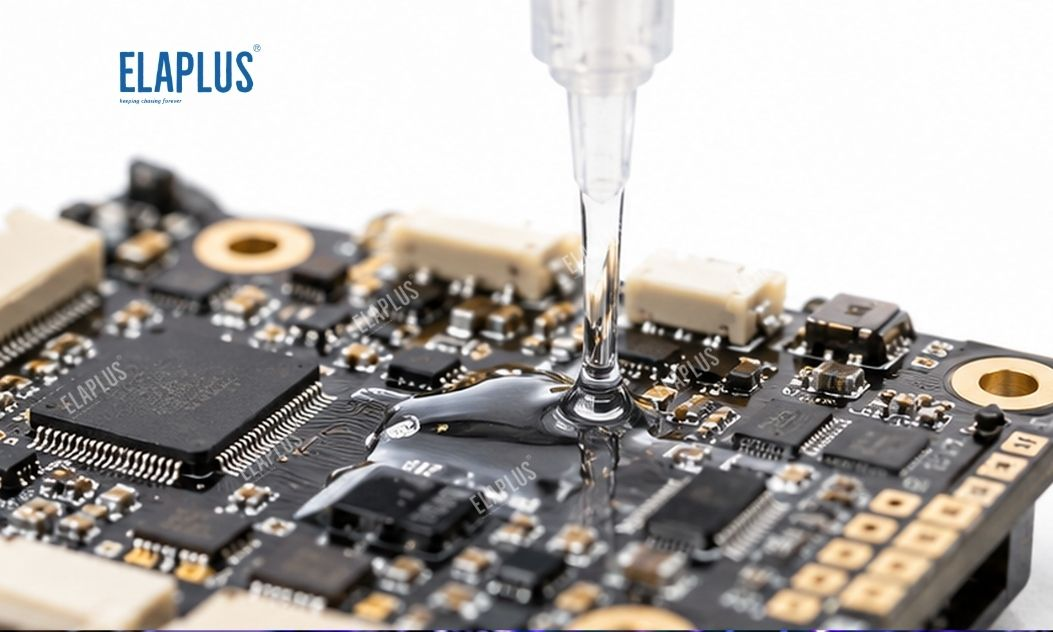
PUR 1618 is a two-component system; accurate metering and mixing must follow the product-specified ratio during production. For mass production of auxiliary control modules, automated dispensing equipment can be evaluated according to cavity size and required glue volume.
Prior to potting, confirm the PCB has passed required functional tests and inspect housings, PCBs and connector surfaces for contaminants that compromise material compatibility.
During dispensing, position dispense points rationally according to module geometry to cover target areas while avoiding restricted interfaces and moving parts. For local potting schemes, glue height is controlled via tooling and dispensing parameters.
Complete curing shall follow the material specification. If heat curing is adopted, verify that PCBs, plastic housings, battery terminals and other associated components withstand the curing temperature.
In mass production, record mixing ratio, dispense volume, potting mass and curing conditions, and inspect cured adhesive condition and module functionality as required.
7. Performance Validation for Potting of UAV Control Boards
Prepare test samples using PCBs, electronic components, housings and connectors from the official BOM, and perform potting with the planned mass-production process. Initial checks cover potting coverage, actual weight gain, adhesive layer condition and assembly compatibility.
Electrical validation shall align with module operating voltage and functional specifications to confirm normal operation and compliance with applicable insulation requirements after potting.
For auxiliary power modules with continuously heat-generating components, run temperature-rise tests under specified load to confirm the potting layer does not introduce unacceptable thermal deviation. Low hardness does not equal high thermal conductivity; PUR 1618 shall not be treated as a dedicated heat dissipation material for high-power devices.
Mechanical reliability validation includes vibration, shock and thermal cycling tests matching the UAV operating environment. Inspect PCBs, connectors and potting layers before and after testing.
For modules operating across varying altitudes or pressure conditions, additional validation shall follow the complete platform design requirements. Critical flight control systems are subject to dedicated electronic encapsulation and reliability standards; test results from auxiliary control boards cannot be used as a substitute.
8. Common Pitfalls in UAV Potting Material Selection
One frequent misconception is equating low hardness with low density. Hardness and density are independent indicators and must be evaluated separately.
Another misunderstanding is that fuller potting guarantees superior protection. Excessive potting material on UAVs increases weight and may impair heat dissipation, connector maintenance and structural assembly.
In addition, performance on ordinary industrial control boards cannot be directly extrapolated to airborne electronic reliability. Vibration, temperature and environmental requirements are defined per specific UAV platform.
ELAPLUS: Select adhesives based on service conditions, not just stack parameters. Potting design for on-board auxiliary control boards shall balance weight, insulation, flexibility, thermal performance and serviceability, with material suitability verified on the actual BOM under flight operating conditions.
9. Material Selection for Different UAV Electronic Modules
For on-board auxiliary power control boards targeting local insulation, moisture resistance and flexible protection, PUR 1618 is preferred, subject to verification against heat generation.
For communication interface boards and other auxiliary electronic modules, adopt local or zonal potting according to PCB layout to avoid blocking connectors and service ports.
For electronic assemblies requiring moderate mechanical support, benchmark PUR 1661, while primary loads should still be carried by properly designed mechanical fasteners.
For high-power ESCs, drivers and other heavily heat-generating modules, reassess thermal requirements; the low-hardness potting scheme for auxiliary control boards shall not be reused directly.
FAQ
Q: What potting adhesive is recommended for UAV auxiliary control boards?
A: PUR 1618 A/B polyurethane potting gel is preferred for assemblies requiring low-hardness flexible protection and electrical insulation.
Q: Can PUR 1618 cure at room temperature?
A: It supports room-temperature curing or heat curing. Exact curing conditions shall follow product specifications.
Q: Which one is better for UAV applications, PUR 1618 or PUR 1661?
A: PUR 1618 for flexible cushioning; PUR 1661 for moderate structural support. Final decision relies on assembly testing.
Q: Does low-hardness potting adhesive guarantee lighter weight?
A: Not necessarily. Hardness is independent of density. Actual weight gain is calculated from material density and fill volume.
Q: Can UAV flight control boards be fully potted directly?
A: The auxiliary control board scheme cannot be copied directly. Precision sensors and other sensitive components on flight controllers may have special encapsulation restrictions.