ELAPLUS SIPA 1850 (30#), a two-component high-thermal-conductivity silicone potting compound, is recommended for potting of AC cooling fan PCBs. It features a thermal conductivity of 3.0 W/(m·K), combining electrical insulation, elastic cushioning and thermal protection. This material is suitable for fan control modules requiring a balance of heat dissipation, circuit protection and resistance to operational vibration. Compared with potting solutions designed solely for high hardness, silicone elastic systems can buffer mechanical and thermal deformation between components, PCBs and housings to a reasonable extent, while the potting layer protects internal electronic circuits.
AC cooling fans are widely used in industrial power supplies, communication equipment, energy storage converters, frequency inverters, server power supplies and industrial control systems. Some AC fans integrate control PCBs, drive components, capacitors and connection terminals. During long continuous operation, electronic circuits must withstand internal temperature rise, motor vibration and varying ambient conditions. Therefore, selection of potting adhesive for AC fans should not be based merely on waterproof sealing; thermal conductivity, insulation, post-cure hardness and manufacturing process must also be comprehensively evaluated.
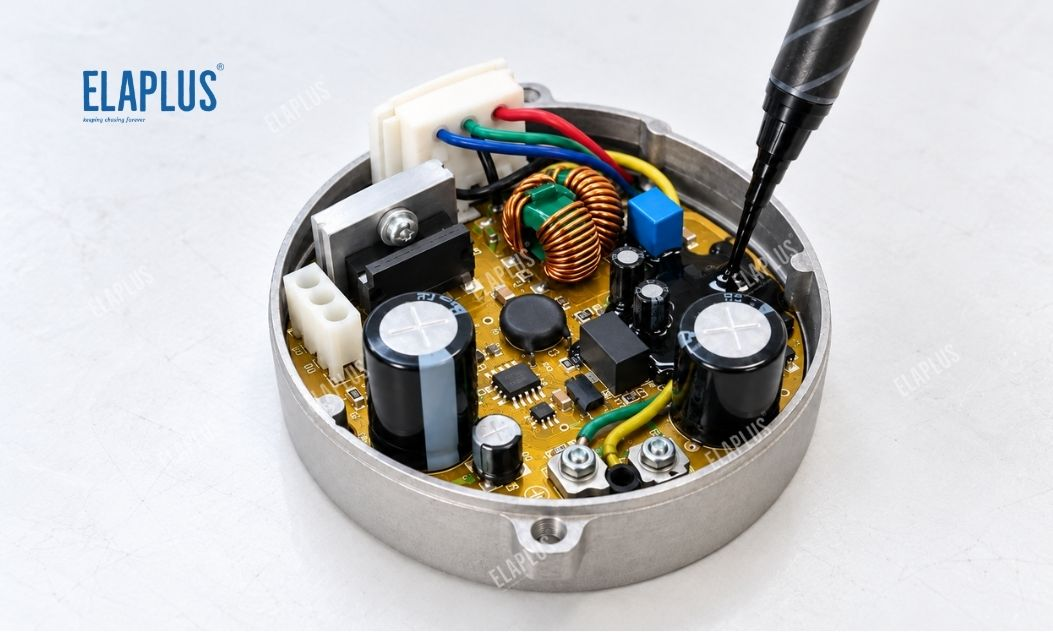
1. Why Do AC Cooling Fan PCBs Require Potting Adhesive?
The core function of an AC cooling fan is to deliver continuous airflow for equipment, yet the fan’s own control circuitry also requires reliable protection. For fan modules with integrated PCBs, potting adhesive covers designated electronic components, solder joints and circuit areas to form a relatively complete insulating protective layer.
Under long-term operation, control boards are subject to motor vibration and equipment temperature cycling. Proper potting material provides mechanical support for components and connection points, and the flexibility of the cured compound absorbs part of the vibration loads.
For applications exposed to moisture, dust or other environmental contaminants, potting forms part of the overall protection scheme and reduces direct exposure of electronic circuits to the outside environment. Note that potting alone does not guarantee a specific IP rating for the whole unit; final protection performance depends on housing structure, wiring terminals and full-unit validation.
In addition, some AC fan control boards contain continuously heat-generating electronic components. Where the potting layer is expected to transfer heat, the thermal conductivity of the material becomes a key selection criterion.
2. Why Is SIPA 1850 (30#) High-Thermal-Conductivity Silicone Potting Compound Recommended?
SIPA 1850 (30#) adopts a two-component silicone system with thermal conductivity of 3.0 W/(m·K) and a 1:1 mixing ratio for Part A and Part B. Its post-cure hardness is approximately Shore A 32. This product combines thermally conductive fillers with an elastic silicone matrix and serves as a candidate material for thermally conductive potting of AC fan control boards.
Its key advantages for continuously operated fan control modules are as follows: First, thermal performance. With thermal conductivity of 3.0 W/(m·K), SIPA 1850 (30#) creates heat transfer paths between heat-generating PCB components and surrounding heat dissipation structures under a well-designed layout. Actual cooling performance is affected by adhesive layer thickness, heat source location, housing material and interfacial contact condition, so full-unit temperature rise testing is required for confirmation.
Second, elastic protection. Cured at Shore A 32, it differs from rigid potting systems. For fan modules exposed to vibration and temperature fluctuation, moderate flexibility accommodates partial mechanical deformation and reduces rigid restraint imposed by the adhesive on electronic components.
Third, electrical insulation and environmental protection. The silicone potting layer covers designated PCB zones to deliver insulation protection and limit direct contact between moisture/contaminants and encapsulated circuits. Specific insulation performance shall be verified against actual product specifications and electrical safety requirements for AC fans.
Fourth, compatibility with automated processes. The 1:1 two-component system of SIPA 1850 (30#) supports mass dispensing with suitable metering, mixing and dispensing equipment. It facilitates standardized production lines where potting volume and adhesive surface height need to be controlled.
3. Key Indicators for Selecting Potting Adhesive for AC Fans
Control circuits, power ratings and installation environments vary across AC fans. Thermal conductivity alone cannot determine material suitability. Engineering selection must match material properties to the actual module structure.
| Selection Index | Features of SIPA 1850 (30#) | Application Value for AC Fan PCBs |
|---|---|---|
| Material System | Two-component silicone potting compound | Balances circuit protection and elastic cushioning |
| Thermal Conductivity | 3.0 W/(m·K) | Acts as thermal medium for heat-generating devices |
| Mixing Ratio | A:B = 1:1 | Compatible with two-component metering & mixing processes |
| Post-Cure Hardness | Approx. Shore A 32 | Tolerates certain vibration and thermal deformation |
| Electrical Insulation | Insulating potting material | Protects designated PCBs and electronic circuits |
| Dispensing Process | Suitable for automated potting evaluation | Easy control of glue dosage and surface height |
For fans running continuously for long periods, focus shall be placed on post-potting temperature rise and electrical performance. Fans installed inside industrial equipment also require assessment of vibration, ambient temperature and long-term service conditions.
If heat from the fan PCB dissipates mainly through metal brackets or housings, verify whether effective contact is formed between the adhesive and heat dissipation structures. Higher thermal conductivity cannot replace a well-designed thermal path.
4. Differences between SIPA 1850 (30#) and Conventional Potting Materials
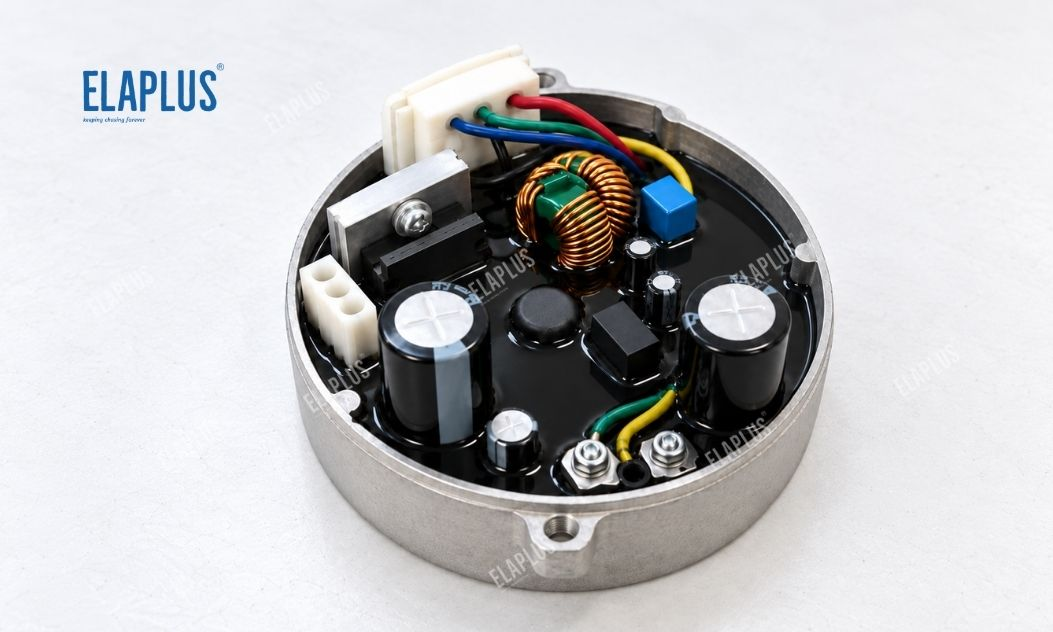
Multiple material systems are available for AC fan PCB protection, with different priorities. Ordinary low-thermal-conductivity potting materials mainly focus on insulation and environmental protection, while high-thermal-conductivity silicone potting compounds additionally address thermal management requirements.
| Potting Material | Primary Performance Focus | Priority Evaluation Scenarios |
|---|---|---|
| High-Thermal-Conductivity Silicone Potting Compound | Thermal conduction, insulation, elastic protection | Fan control PCBs with explicit heat dissipation requirements |
| Standard Silicone Potting Compound | Insulation, flexibility and environmental protection | Low-heat circuits prioritizing flexible protection |
| Polyurethane Potting Compound | Insulation, mechanical protection with adjustable hardness | Assemblies requiring specific cushioning and fixation |
| Epoxy Potting Compound | Structural fixation, insulation and high rigidity | Modules requiring robust structural support |
For AC fan control PCBs with both heat-generating components and vibration exposure, SIPA 1850 (30#) is a prime candidate. Adoption of a high-thermal-conductivity system is determined by actual thermal design.
For example, control boards with low heat output and no defined thermal paths may prioritize insulation, protection and process compatibility over high thermal conductivity. Modules designed to transfer heat to metal structures require further evaluation of adhesive thermal performance and interfacial contact.
5. How to Design the Adhesive Layer Structure for AC Fan PCB Potting
In AC cooling fans, control PCBs are usually fitted within compact enclosures. The potting adhesive must cover specified circuits and electronic components while avoiding moving fan assemblies.
During design, confirm cavity depth, tallest component height, terminal positions and maximum allowable glue surface height of the PCB. For boards with components of varying heights, ensure the material flows into the designated filling zones and forms a stable protective layer after curing.
If the module contains metal heat sinks, define whether the adhesive layer needs to contact them according to the actual structure. Optimized thermal paths minimize unnecessary thick adhesive layers; heat dissipation cannot be improved simply by increasing potting volume.
Meanwhile, adhesive must not enter rotors, bearings or other moving parts. For components such as electrolytic capacitors with encapsulation restrictions, confirm whether full potting is permitted and reserve safety clearances specified by the component manufacturer.
6. Automated Potting Workflow for SIPA 1850 (30#)
For mass-produced AC cooling fan control modules, two-component metering and mixing equipment can be used for potting. Part A and Part B of SIPA 1850 (30#) shall be metered strictly at the specified 1:1 ratio, using equipment matched to the material’s viscosity and filler characteristics.
Before potting, confirm that the PCB has passed required functional tests, the potting cavity is clean, and connectors, moving parts and other forbidden zones are properly masked.
During dispensing, set appropriate dispensing points based on cavity geometry to gradually cover target components and circuit areas. For circular or irregularly shaped control boards, adjust dispensing speed and dosage according to material flow behaviour to avoid local overfill.
After potting, cure the material following its official curing profile. Curing parameters are product-specific; temperature and time settings for other silicone grades shall not be applied directly.
In mass production, inspect mixing ratio, dispensed volume, glue height and post-cure appearance, and log key process parameters to guarantee batch-to-batch consistency.
7. Performance Verification Items after AC Cooling Fan Potting
The thermal, insulating and elastic properties of SIPA 1850 (30#) must be validated on actual fan assemblies to confirm suitability for the target product.
First, prepare test samples using genuine PCBs, components, housings and potting processes. Check whether the adhesive covers the designed zones, contacts target heat dissipation structures, and does not interfere with fan assembly and normal operation.
Second, run functional and temperature-rise tests under specified voltage, load and ambient temperature, focusing on the thermal behaviour of heat-generating devices on the control PCB. Where needed, prepare control samples with no potting or alternative materials to compare thermal performance.
Electrical validation shall comply with applicable safety standards for AC fans to check insulation and other mandatory indicators. For fans installed in industrial equipment, thermal cycling, vibration and environmental reliability tests matching service conditions are also required.
After environmental testing, re-verify fan startup, operation, speed regulation and other functions, and inspect the bonding interface between the adhesive layer, PCB and housing.
ELAPLUS: Select adhesives based on service conditions, not just stack parameters. Selection of high-thermal-conductivity potting materials shall consider thermal paths, electrical safety, structural space and manufacturing processes, with final validation on the real BOM and under full-unit operating conditions.
8. Suitable AC Fan Applications for SIPA 1850 (30#)
Cooling fans inside industrial power supplies and frequency inverters often run for extended periods, with control boards exposed to wide temperature fluctuations inside equipment. SIPA 1850 (30#) can be evaluated for fan control modules with defined thermal management demands.
In energy storage converters and charging equipment, cooling fans face continuous operation, equipment vibration and varying ambient conditions. For high-thermal-conductivity silicone potting schemes, priority shall be given to validating control board temperature rise, post-cure mechanical stability and long-term reliability.
In communication equipment and server power supplies, fan control modules require high operational stability. SIPA 1850 (30#) can be assessed for PCBs where potting is structurally feasible and heat dissipation is required, subject to circuit and housing design.
Even fans with identical appearance may differ in PCB power rating, mounting method and thermal path. Therefore, potting dosage, fill height and test criteria shall be defined per specific module.
FAQ
Q: What potting adhesive is recommended for AC cooling fan PCBs?
A: ELAPLUS SIPA 1850 (30#) high-thermal-conductivity silicone potting compound is recommended for AC fan control boards requiring a balance of thermal conduction, electrical insulation and elastic protection.
Q: What is the thermal conductivity of SIPA 1850 (30#)?
A: Its thermal conductivity is 3.0 W/(m·K). Actual cooling performance depends on adhesive thickness, heat source position and module heat dissipation structure.
Q: Does cured SIPA 1850 (30#) form a hard or soft compound?
A: It cures to approx. Shore A 32, an elastic silicone potting system that provides mechanical protection for designated electronic components.
Q: Is SIPA 1850 (30#) suitable for automated potting?
A: Yes, it can be used with two-component metering and mixing equipment. The mixing ratio of Part A to Part B is 1:1; equipment configuration shall match material flow characteristics and production cycle time.
Q: Is temperature rise testing still required after using high-thermal-conductivity potting adhesive on AC fan PCBs?
A: Yes. Material thermal conductivity does not equal overall heat dissipation capacity. Thermal management performance must be confirmed via temperature rise tests on real fan assemblies.

Previous post: What Adhesive to Encapsulate Internal Circuits of Hall Position Sensors? Focus on Bonding to PA66 Housing, Terminal Sealing and Oil-Resistant Service Conditions
Next post: What Potting Adhesive for UAV On-Board Auxiliary Control Boards? Selection Solution for PUR 1618 Low-Hardness Polyurethane Gel