One-pass dispensing, in-situ foaming, seamless forming.
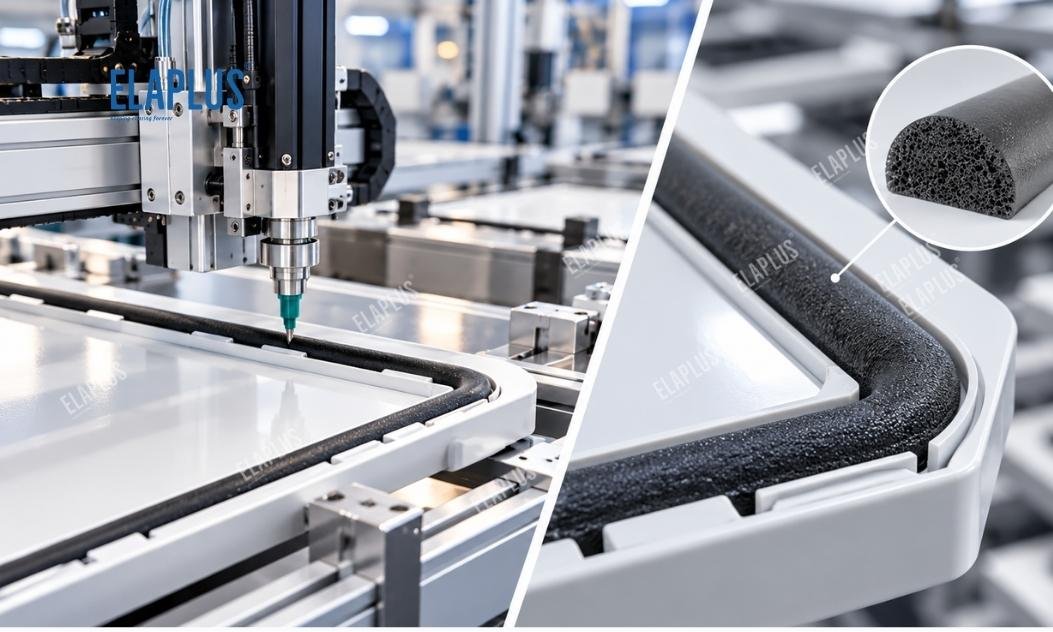
PUR foam 1612 Foam Sealant
For electrical control boxes, industrial cabinets, automotive electronics housings and new energy equipment, sealing performance is critical not only for dustproof and waterproof functions, but also directly impacts product assembly efficiency, production tact time and long-term operational reliability.
For housing sealing structures with complex geometries, ELAPLUS PUR foam 1612 polyurethane formed-in-place foam gasket sealant is recommended. This product is developed around the FIPFG (Formed-In-Place Foam Gasket) process. With two-component metered dispensing, it forms a continuous foam gasket along the sealing zone of workpieces, delivering a flexible sealing solution for complex contours, irregular grooves and automated production lines.
The shift from traditional prefabricated gaskets to formed-in-place foam sealing changes not only the material form, but the entire sealing workflow.
01|Why Choose PUR Foam 1612?
Shifting sealing from pre-assembled gaskets to on-site forming Conventional rubber gaskets require custom moulds according to housing contours, followed by gasket fabrication and manual or machine installation. For electrical control boxes and equipment housings with complex structures and multiple variants, numerous gasket specifications raise costs for mould development, material management and assembly.
FIPFG (Formed-In-Place Foam Gasket) technology offers an alternative: automated dispensing equipment applies adhesive directly along pre-defined paths on workpieces. The material foams and cures in situ to form a continuous sealing bead.
The application benefits of PUR foam 1612 lie mainly in three aspects:
- Continuous forming with fewer joints. Adhesive is dispensed along the pre-set sealing path in one continuous run, eliminating splice joints found on cut gasket strips and enabling a uniform, complete sealing profile.
- Path-on-demand dispensing for high flexibility. Dispensing trajectories can be adjusted to match housings, covers and irregular structures of different sizes, reducing reliance on a wide range of pre-cut gaskets.
- Automated application for higher throughput. The FIPFG process integrates automatic mixing, precision dosing and motion control systems, removing separate gasket fitting steps and improving process consistency in mass production.
02|Two-Component Mixing, In-Situ Chemical Foaming
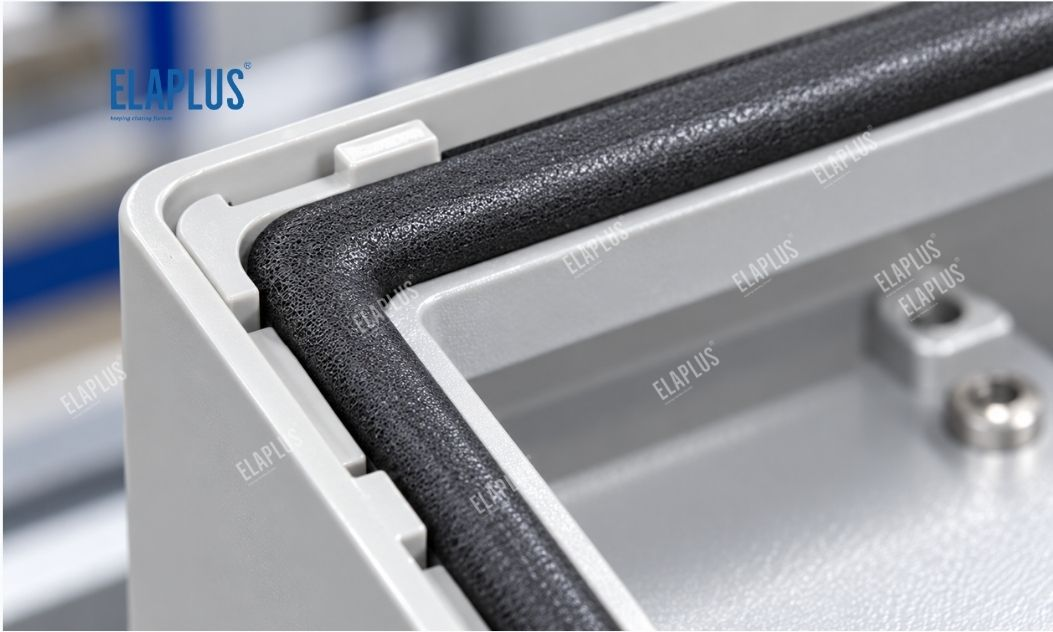
From liquid adhesive to elastic foam gasket PUR foam 1612 adopts the polyurethane formed-in-place foam gasket technology. During application, the two components are metered and blended by dispensing equipment, then deposited onto workpiece surfaces or sealing grooves along programmed paths. Chemical reaction generates foam structures which cure gradually.
Unlike conventional non-foaming sealants, formed-in-place foam sealants expand after dispensing and change cross-sectional geometry, yielding foam seals with controlled compressibility.
This structure is especially suitable for contact sealing achieved by housing clamping. During assembly, the foam bead is compressed between upper and lower housing halves and maintains intimate contact with mating surfaces. Properly designed bead cross-sections and compression ratios help compensate for minor manufacturing tolerances and reduce localized stress on thin sheet housings caused by rigid contact.
In addition, polyurethane foam features relatively low density, which helps minimise bead weight and material consumption while meeting sealing requirements.
03|From Dispensing to Final Forming – Controlled Process Sequence
Four stages to complete formed-in-place foam sealing The FIPFG workflow generally consists of four phases: mixed dispensing, foaming expansion, surface setting and curing & assembly.
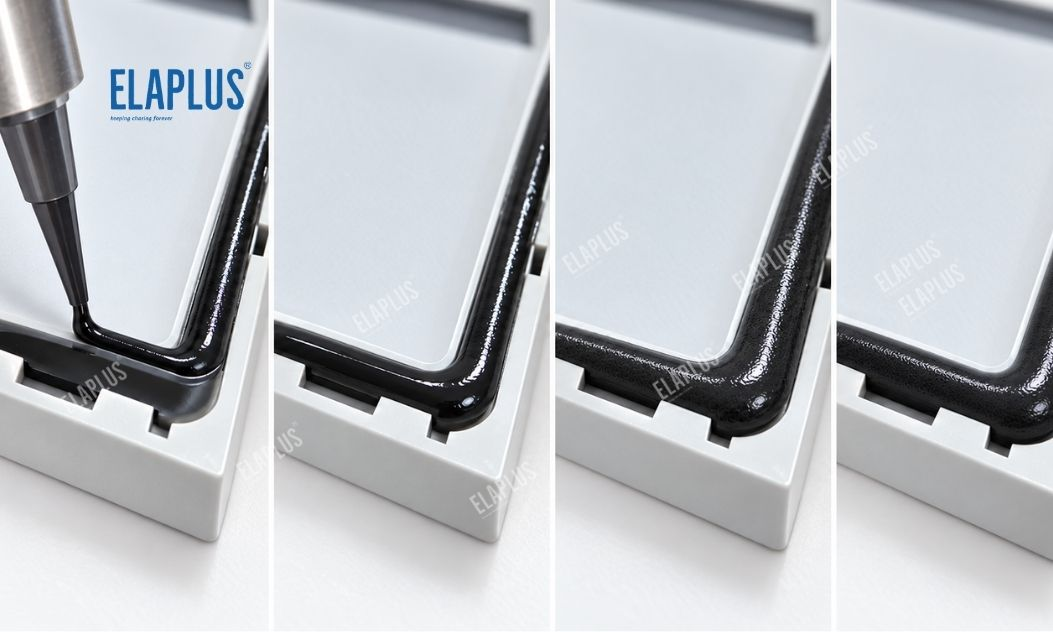
Phase 1: Mixed dispensing. The two components are automatically metered and mixed, then dispensed uniformly along the sealing contour by the dispense head. Continuity, positioning and linear dosage of the bead are controlled.
Phase 2: In-situ foaming. Foaming reaction takes place on the workpiece; the bead expands gradually from the initial dispensed profile into a foam sealing structure.
Phase 3: Surface setting. As the reaction proceeds, the bead develops stable geometry, its surface solidifies and the cross-sectional profile becomes fixed.
Phase 4: Curing and assembly. Once the bead reaches the required assembly state, the top cover is clamped for sealing assembly. Actual waiting time before assembly, full cure time and workpiece temperature must follow the official process datasheet of PUR foam 1612.
For mass manufacturing, consistent sealing quality depends not only on the sealant itself, but also the coordination between mixing ratio, dispense speed, ambient temperature, foaming dimension and assembly compression ratio.
04|Five Types of Mating Surfaces for Diverse Sealing Paths
Flexible design for flat faces, grooves and complex curved surfaces Sealing structures of industrial equipment housings vary widely. Some use flat flanges, some incorporate dedicated sealing grooves, and irregular housings feature curved transitions and 3D dispense paths.
Different FIPFG application designs can be adopted for different geometries:
- Flat sealing: Continuous beads applied onto housing flanges or cover planes, suitable for certain electrical boxes, control enclosures and equipment end caps.
- Groove sealing: Adhesive dispensed into pre-machined recesses; the foamed bead mates with the groove for housings requiring controlled gasket positioning and compression height.
- Single-sided open groove: For partially open sealing grooves, dispense width and post-foaming profile are controlled based on material rheology and groove dimensions.
- Curved surface sealing: Dispensing follows curved contours via motion path control, ideal for irregular covers and curved housings.
- Curved groove sealing: Combines 3D dispense trajectories with groove structures, suited for complex components requiring high continuity of the sealing path.
The practical suitability of PUR foam 1612 on different mating surfaces should be verified with its thixotropy, foaming behaviour and actual workpieces to define the correct bead cross-section and process window.
05|Inspect the Bead – Quality Speaks for Itself
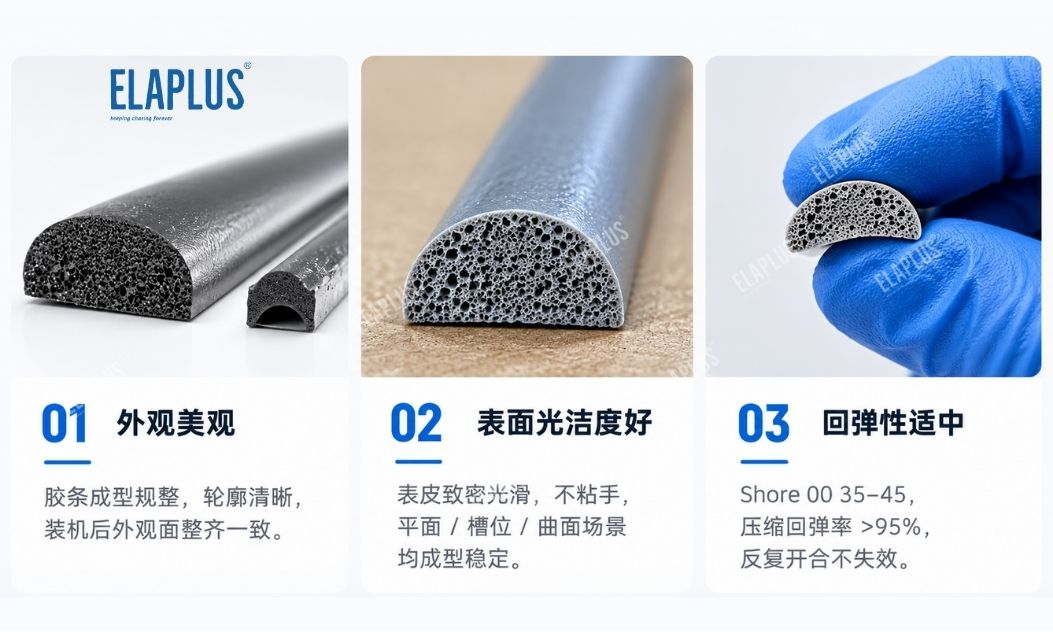
High-quality formed-in-place foam seals balance appearance and compression performance The quality of foam gasket sealants is judged not only by successful foaming, but also cured bead profile, cell uniformity and compression behaviour after assembly.
First, the bead must remain continuous and intact. Corners, narrow edges and start/end points should be free of obvious gaps, excessive build-up or abrupt dimensional changes. Second, internal foam structure should be as homogeneous as possible. Consistent cell distribution improves compression uniformity and mitigates uneven sealing stress. Furthermore, the bead must deliver compression performance matching the housing design. Over-stiff beads may raise clamping force requirements for covers; overly soft beads require long-term compression set validation.
Therefore, fitness for a given workpiece is evaluated comprehensively by bead appearance, cellular structure, adhesion, recovery performance and sealing test results.
06|One Material System for Multiple Sealing Applications
Expanding possibilities from industrial cabinets to new energy equipment
- Industrial cabinets and electrical control boxes. Cabinet doors, distribution boxes and electrical enclosures often have long peripheral sealing paths. FIPFG dispensing along door frames or box flanges provides sealing against dust, water ingress and vibration.
- Electronic control boxes and industrial controllers. For compact, multi-variant electrical control boxes, formed-in-place foaming eliminates prefabricated gasket installation and offers greater flexibility in sealing path design.
- LED lighting and luminaire housings. Outdoor, industrial and some automotive lighting covers have varied contours; FIPFG can be evaluated for dust and water sealing on mating faces.
- New energy vehicle and energy storage equipment. The polyurethane FIPFG material can be assessed for electrical control units, auxiliary enclosures and other new energy components according to sealing geometry, IP rating and environmental conditions.
- Perimeter sealing around heat sinks and water-cooled structures. Suitable for non-pressure-bearing peripheral sealing of heat sink covers, equipment shells and water-cooled assemblies. This application must distinguish dust/water perimeter sealing from pressurised flow channel sealing.
07|Key Process Parameters Determine Sealing Quality
Stable mass production relies on synergy between material and equipment From lab sampling to automated high-volume production, practical deployment of PUR foam 1612 requires careful management of mixing ratio, blending homogeneity, dispense trajectory, substrate surface condition and assembly parameters.
Surface cleaning and adhesion tests must be completed first for different substrates including metals, coated panels and engineering plastics. For complex sealing paths, forming consistency must be confirmed on straight runs, corners and start-stop positions.
When introducing equipment, stable windows for dispense volume, travel speed and temperature control should be established, and dustproof, waterproof and sealing reliability after compression validated on real parts.
For projects with specific flame retardancy, temperature resistance, weathering or IP rating requirements, assessment shall combine relevant test reports and full-unit validation results.
From Sampling to Mass Production
From material recommendation and substrate testing, to dispense path design, foaming validation and automation compatibility, ELAPLUS provides electronic adhesive and functional material solutions for industrial manufacturers.
PUR foam 1612 polyurethane formed-in-place foam gasket sealant addresses on-site sealing needs for complex housings, enabling flexible sealing design and more efficient manufacturing workflows.
Share your workpiece geometry, substrate type, sealing requirements and production tact time, and our technical team at ELAPLUS will develop a tailored adhesive solution.
ELAPLUS Functional Materials (Shanghai) Co., Ltd.
Website: www.elaplus.cc
Technical Enquiry: info@elaplus.cc
Service Hotline: +86 21-67227200