For sealing between glass and aluminum housing of underwater LED luminaires, neutral silicone sealants with adhesion to glass and metals and elastic sealing properties shall be prioritized for evaluation. Meanwhile, strict control shall be implemented on seal gap dimension, assembly pressure, bead continuity and curing conditions. For one-part room-temperature-curing silicone, full curing of adhesive within the actual structure is equally critical as its inherent waterproof and adhesion performance.
Pool lights, fountain lights, underwater landscape lights and some industrial underwater lighting equipment generally adopt a composite structure with light-transmitting glass panels and aluminum alloy housings. Glass and aluminum alloy feature different thermal expansion behaviors. During operation, the luminaire may undergo internal heat generation, external water cooling and hydraulic pressure.
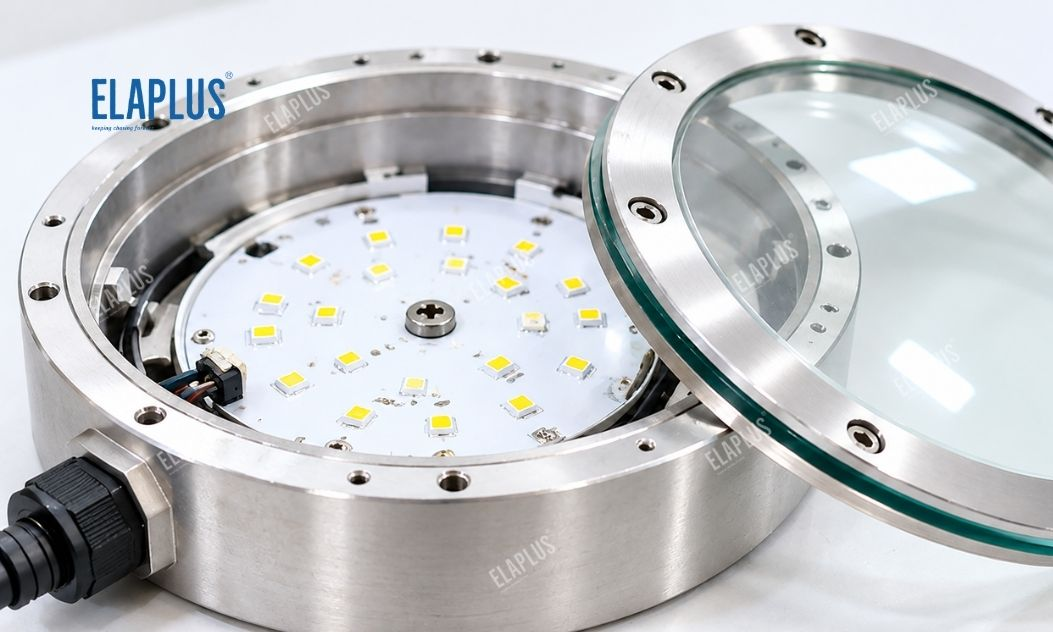
Therefore, sealing for underwater luminaires must not only block liquid water, but also maintain a stable glass-adhesive-aluminum interface over long-term service.
Why High-Strength Rigid Adhesive Alone Is Not Suitable between Glass and Aluminum Housing
Glass and aluminum alloy have dissimilar thermal expansion characteristics. When the LED luminaire heats up during operation or cools down after shutdown, the two materials undergo dimensional changes to different extents.
If the intermediate adhesive layer is excessively rigid, relative displacement between substrates will be converted into interfacial stress. For the composite assembly consisting of glass panel, aluminum housing and adhesive layer, such stress may compromise long-term sealing reliability.
Hence, adhesive selection for underwater LED luminaires shall not only compare initial bonding strength. Post-curing elasticity, interfacial adhesion stability and thermal cycling resistance must also be taken into account.
Why Seal Gap Thickness Affects Long-Term Sealing Performance
Seal gap thickness directly determines the deformation allowance between the two substrates. An overly thin adhesive layer may fail to accommodate assembly tolerances and relative displacement; an excessively thick layer extends curing time, raises material consumption and increases assembly control difficulty.
For one-part moisture-curing silicone, the seal gap geometry also governs moisture ingress and the progression of curing reaction. If adhesive is fully enclosed inside a deep joint, full curing of the bulk layer cannot be judged merely by surface tack-free time.
Accordingly, seal gap design for underwater luminaires shall balance deformation accommodation and curing path, instead of simply pursuing a thicker or thinner bead.
Which Positions Should Be Inspected First When Underwater LED Luminaire Sealing Fails?
Inspection shall start from the bonding interface between glass and aluminum housing, seal gap corners, housing assembly tolerances and cable entry points. Repeated local anomalies shall first trigger review of structural design; randomly distributed defects focus attention on dispensing and assembly processes.
| Fault Symptom | Priority Inspection Direction | Recommended Verification Method |
|---|---|---|
| Local water seepage at glass edge | Discontinuous adhesive bead or abnormal local assembly gap | Check bead continuity and compression status |
| Delamination at adhesive edge | Inadequate substrate cleaning or poor interfacial adhesion | Examine interface condition and post-aging adhesion |
| Persistently soft deep adhesive bulk | Insufficient curing or limited moisture access | Verify actual curing degree of bulk adhesive |
| Recurring failures at corners | Uneven bead volume at corners, structural stress or inconsistent compression | Inspect corner bead profile and fixture setup |
| Leakage after underwater operation | Hydraulic pressure, thermal cycling or sealing structure degradation | Perform pressure and thermal cycling validation |
| Fluctuating sealing results across batches | Variations in dispensed volume, assembly pressure and curing | Review mass production process records |
Note that internal moisture in the luminaire does not necessarily indicate failure of the glass-aluminum seal gap. Cable glands, housing joints and other sealing structures can also serve as water ingress paths. The actual leakage point must be located first.
Comparison among One-Part Silicone, Epoxy and Polyurethane
Sealing materials for underwater luminaires shall be selected based on substrates, assembly method and environmental requirements. Each material system has its applicable scope.
| Material System | Key Selection Features | Application Notes for Underwater Luminaires |
|---|---|---|
| Neutral Silicone Sealant | Elastic buffering, thermal cycling resistance and multi-substrate adhesion | Focus on seal gap geometry and curing path |
| Epoxy Structural Adhesive | High structural strength and dimensional stability | Watch thermal stress between glass and aluminum |
| Polyurethane Sealant | Adjustable flexibility and adhesion performance | Verify long-term compatibility with service water medium |
| Preformed Gasket | Sealing achieved via compression | Control compression ratio, assembly tolerance and long-term rebound |
For luminaires requiring robust structural retention, confirm whether the glass panel is mechanically restrained. Do not rely solely on sealant to bear all structural loads without prior validation.
Suitable Sealing Structures for ELAPLUS RTV SIPC 2130
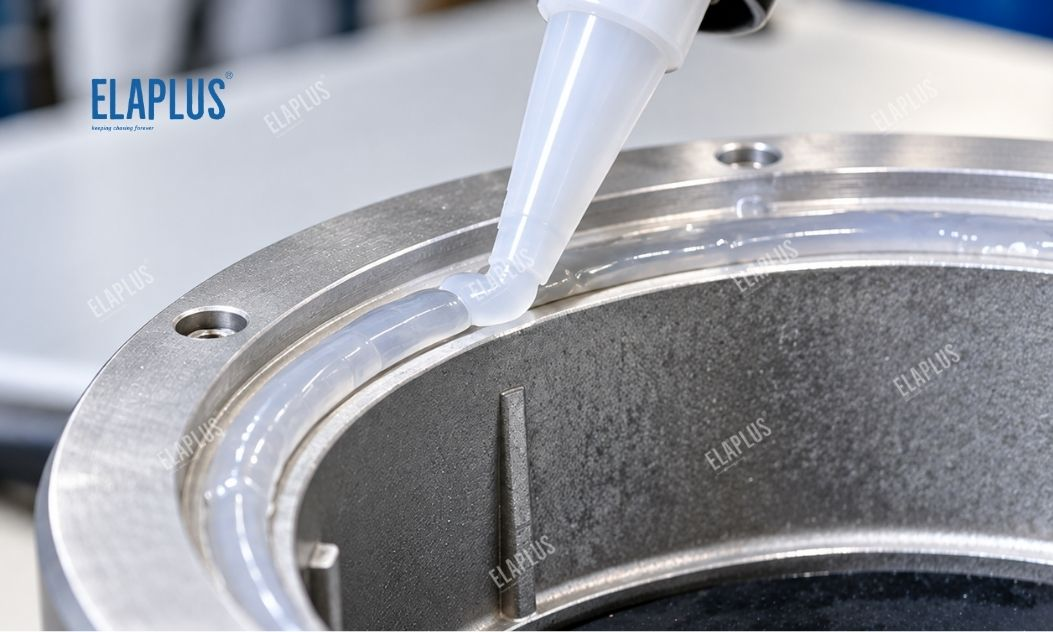
ELAPLUS RTV SIPC 2130 is a one-part neutral silicone adhesive sealant featuring good flowability, electrical insulation and wide temperature resistance for bonding and sealing glass, metals and other substrates. It is available in transparent, white and black grades, with a rated operating temperature range of -60℃ to 220℃.
SIPC 2130 can be evaluated as an elastic sealing material for underwater LED luminaires with glass panels and aluminum alloy housings. Its core function is to form a continuous interfacial seal and accommodate limited structural movement via elasticity.
It should be emphasized that the material temperature rating does not equal the allowable operating temperature of the finished luminaire, nor can its waterproof property alone guarantee the luminaire meets a specified IP rating. Final validation must be carried out with actual housing structure, water pressure and service environment.
Why Flowable Sealants Require Precise Dispensing Position Control
SIPC 2130 is a flowable silicone sealing system. Flowability facilitates spreading in horizontal grooves, while inclined, vertical or open gaps require extra attention to prevent adhesive shifting before assembly.
Uncontrolled flow into unintended zones may lead to local bead shortage, contamination of the optical glass surface or subsequent assembly difficulties.
Therefore, during process development, dispensing trajectory shall be defined according to groove geometry, dispensing equipment and assembly takt time. Bead deformation from dispensing completion to glass lamination shall be monitored.
Why Higher Glass Lamination Pressure Is Not Always Better
During assembly of glass and aluminum housing, continuous contact between adhesive and both substrates must be established. Excessive compression, however, squeezes excessive adhesive out of the target zone and results in locally thin seal layers.
For luminaires with large glass panels, check for uneven local stress and unintended mechanical constraint on glass during pressing.
The proper approach is to control the final seal gap via positioning features and tooling, rather than judging sealing quality purely by manual compression force.
Why Deep Curing Must Be Validated for One-Part Silicone
Curing of one-part moisture-curing silicone depends on ambient humidity, temperature, layer thickness and joint geometry. A cured skin on the surface does not guarantee uniform curing throughout the bulk material.
For relatively deep or enclosed gaps between glass and aluminum, actual structural samples shall be used to verify curing, confirming that the worst-case location meets requirements for subsequent assembly and waterproof testing.
If the gap is too deep for sufficient moisture penetration, re-evaluate gap design, curing conditions or material system, instead of directly adopting tack-free time measured under open conditions.
Why Water Medium Must Be Considered for Underwater Luminaires
Water quality varies among swimming pools, fountains, freshwater landscape ponds and other underwater environments. The service medium may contain disinfectants, salts or other chemical constituents that affect long-term performance of the adhesive and its interfaces.
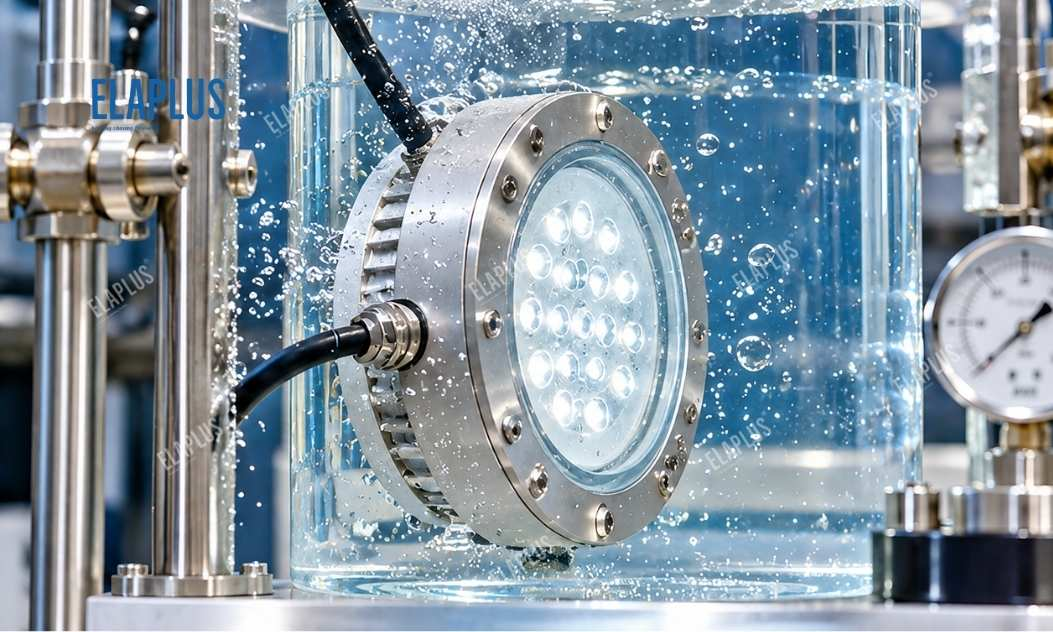
Waterproof validation for underwater luminaires shall not rely solely on room-temperature fresh water immersion. For products deployed in swimming pools or special water treatment environments, testing shall simulate the actual medium, temperature and immersion duration.
For permanent submersion applications, inspect the glass-adhesive-aluminum interface after aging to detect local delamination, material degradation or sealing performance drop.
How to Establish a Stable Mass Production Sealing Process for Underwater LED Luminaires
Process control shall cover five stages: substrate cleaning, dispensing, assembly, curing and waterproof validation. First, remove oil, dust and mold release residues that impair adhesion from glass and aluminum surfaces. Then define dispensing path and bead volume according to the actual groove.
Assembly shall use tooling to control glass alignment and seal gap size, minimizing operator-induced variation. Curing conditions shall be confirmed based on gap geometry; surface tack-free status alone shall not be used as release criteria.
After full curing, conduct waterproof, thermal cycling and required medium tests as specified, together with luminaire electrical function and sealing inspection.
Common Pitfalls in Underwater LED Luminaire Sealing
- Assuming waterproof adhesive guarantees zero water ingress. Overall protection also relies on gap design, assembly tolerance and other sealing locations.
- Believing a thicker adhesive layer provides better safety. Excessive thickness complicates curing and assembly control; a reasonable range shall be defined by structure.
- Performing only an initial waterproof test without evaluating interfacial stability after long-term water exposure and temperature cycling.
- Checking only glass-aluminum bonding strength without confirming full curing of deep adhesive.
ELAPLUS selects adhesives based on service conditions instead of stacking performance parameters. For underwater LED luminaires, clarify the structural relationship between glass and aluminum, actual water environment and gap curing requirements first, then complete long-term sealing validation with real samples.
Application Guidance
SIPC 2130 neutral silicone sealing system can be prioritized for pool lights, fountain lights, underwater landscape lights and other lighting assemblies combining glass and aluminum alloy.
If the seal gap is deeply enclosed, requires high structural load bearing, or contacts special chemical media long-term, re-evaluate gap design and material system instead of finalizing solely based on general one-part silicone properties.
For luminaires with transparent light-transmitting glass, select adhesive color according to aesthetic requirements and confirm no adhesive migrates into the effective optical area.
FAQ
Q: What sealant is used between glass and aluminum housing of underwater LED luminaires?
A: Neutral silicone sealants with glass and metal adhesion and elastic sealing characteristics are preferred, subject to validation against gap structure and actual underwater environment.
Q: Can SIPC 2130 be used for underwater LED luminaires?
A: It can be used as a candidate material. This one-part neutral silicone adhesive sealant offers multi-substrate adhesion, moisture resistance and temperature tolerance. Final application requires full luminaire validation.
Q: If one-part silicone is tack-free on the surface, has it fully cured internally?
A: Not necessarily. Curing status depends on layer thickness, ambient conditions and moisture access path. Deep or enclosed gaps require separate curing verification.
Q: Is a thicker adhesive layer better for underwater luminaires?
A: No. The seal gap shall accommodate assembly tolerance, deformation and curing requirements. Both over-thick and over-thin layers raise process risks.
Q: How to confirm reliable sealing of underwater LED luminaires?
A: Conduct waterproof, thermal cycling, medium compatibility and post-aging interfacial inspections using the actual glass, aluminum housing and complete luminaire. Testing on standalone adhesive coupons is insufficient.
Previous post: Slower Charging and Higher Temperature Rise after Wireless Charging Coil Potting? Check Coil Offset and Magnetic Sheet Clearance First before Changing Adhesives
Next post: Slower Response of NTC Temperature Sensor after Encapsulation? Check Adhesive Thermal Resistance and Probe Structure First before Replacing the Thermistor