ELAPLUS SIPC 1835 A/B two-component silicone potting compound is recommended for evaluation when internal electronic zones of industrial foot switches require waterproofing, moisture proofing and electrical insulation protection. It features elastic properties after cure, low shrinkage and protection for electronic devices, making it a candidate material for permitted potting zones inside foot switches. For assemblies with mechanical contacts, return springs and movable pedals, the stationary electronic cavity must be separated from moving mechanisms. The entire switch shall not be fully filled with adhesive.
Industrial foot switches are widely used in automation equipment, machining machinery, test jigs and industrial control systems. Operators control equipment start-stop, signal input and other functions via foot actuation, so the switch must maintain stable electrical connections and mechanical performance under repeated cycling.
Some foot switches use mechanical microswitches, while others adopt magnetic sensing, Hall effect or other non-contact detection structures. Adhesive application positions differ significantly between designs, and waterproof potting solutions are not universally interchangeable.
1. Why Do Industrial Foot Switches Require Potting Protection?
Foot switches are generally mounted under machinery or near workstations, where they may be exposed to dust, water droplets, cleaning fluids and mechanical vibration. For units with internal PCBs, sensors or electronic signal processing modules, properly designed potting provides insulation and environmental protection for designated electronic areas.
Nevertheless, waterproofing of foot switches does not rely entirely on internal potting. Pedal shafts, housing seams, cable outlets and other moving interfaces can also serve as ingress paths.
Potting only the PCB while neglecting sealing at the housing and cable entry points will still allow moisture to penetrate other areas. Conversely, overfilling adhesive into moving mechanical zones to achieve full coverage may impair pedal return and contact operation.
Therefore, material selection for industrial foot switches must treat electronic protection, housing sealing and mechanical movement separately.
2. Why Is SIPC 1835 A/B a Suitable Candidate?
ELAPLUS SIPC 1835 A/B is a two-component silicone potting material with good flowability during dispensing, post-cure flexibility and low cure shrinkage, suitable for insulation and environmental protection of qualified electronic assemblies.
Compared with higher-rigidity potting systems, flexible silicone is an option for electronic modules requiring tolerance to minor deformation. For stationary PCBs, solder joints and non-moving electronic structures inside foot switches, its component protection performance shall be the key evaluation point.
Flexibility of the material does not mean it can undertake functions such as pedal spring return or contact actuation. Final selection must verify cured hardness, adhesion to the housing and long-term environmental stability.
For foot switches with specified flame retardancy or ingress protection requirements, qualification shall be based on tests of the relevant material grade and the complete switch assembly. Material properties alone cannot be equated to end-product certification.
3. Which Zones Are Suitable for Potting and Which Are Off-Limits?
Foot switches typically contain pedals, return mechanisms, switch elements, terminal blocks and cabling. Electronic detection versions also include sensors, PCBs and signal processing assemblies.
| Structural Zone | Primary Function | Recommended Protection Approach |
|---|---|---|
| Isolated stationary PCB cavity | Signal processing and electronic control | SIPC 1835 A/B potting may be evaluated |
| Stationary solder joints and lead connections | Electrical interconnection | Local protection according to stress and insulation requirements |
| Mechanical microswitch contacts | Circuit make and break | Preserve original operating clearance |
| Return springs and pivot shafts | Pedal movement and reset | No adhesive interference allowed |
| Cable entry | Cable retention and external sealing | Evaluate suitable sealing or strain relief design |
| Pedal-to-housing seam | External ingress protection | Implement suitable dynamic sealing structure |
For mechanical microswitch constructions, potting compound must not intrude into contacts, pushbuttons or moving plungers. For Hall-effect foot switches, compatibility between the material and sensor mounting structure shall be further validated.
If the PCB and moving mechanisms share the same cavity, an isolated partition to create a dedicated potting compartment is preferred, rather than relying on reduced shot volume to avoid spillage into mechanical zones.
4. Selection Between Silicone, Polyurethane and Epoxy Potting Compounds
Potting material selection for foot switches shall be based on construction and service conditions, with focus on mechanical stress matching, insulation and environmental resistance.
| Material System | Key Characteristics | Evaluation Scope |
|---|---|---|
| SIPC 1835 A/B Silicone | Elastic, low shrinkage, electronic protection | Potting of stationary electronic cavities |
| Flexible Polyurethane | Flexibility, adhesion, environmental protection | Electronic zones within compatible plastic housings |
| Epoxy Potting Compound | High rigidity, structural retention | Non-moving areas requiring robust fixation |
| Elastic Sealant | Joint sealing, moderate deformation tolerance | Static housing sealing joints |
For foot switches subject to frequent mechanical shock, stress matching between the potting material, PCB, solder joints and housing must be considered. For circuits requiring only local moisture resistance, selective conformal coating may be assessed instead of default full-cavity potting.
ELAPLUS: Select adhesives based on service conditions, not just stack parameters. Foot switch material selection shall first distinguish moving mechanisms from electronic protection zones before comparing material suitability.
5. How to Design the Potting Process for Foot Switches
Prior to potting, confirm the final assembly position of pedals, return mechanisms, sensors and PCBs, and clearly define permitted coverage boundaries for the adhesive.
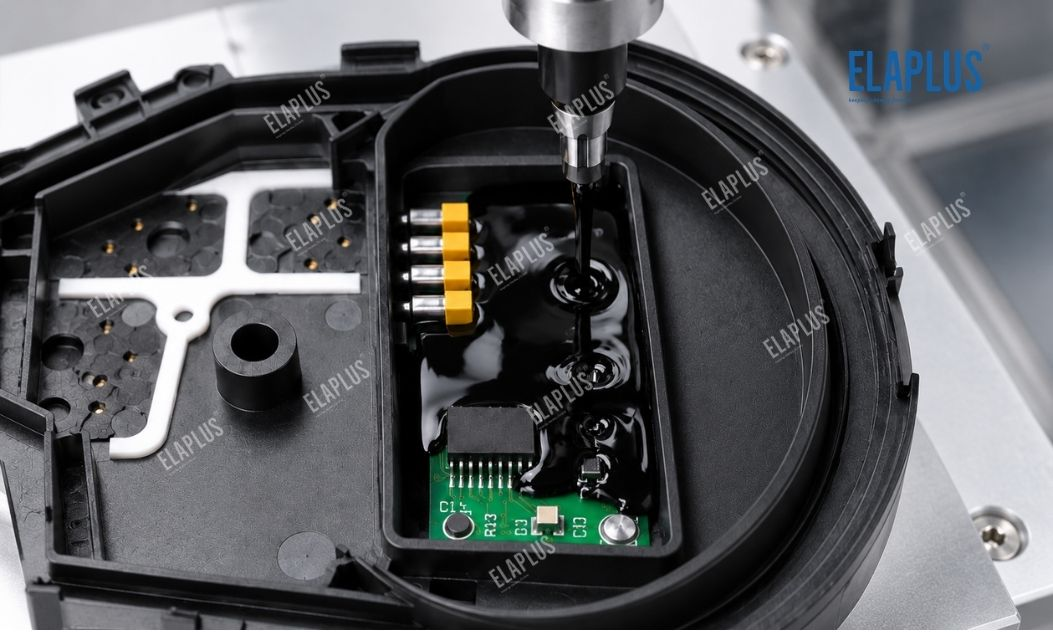
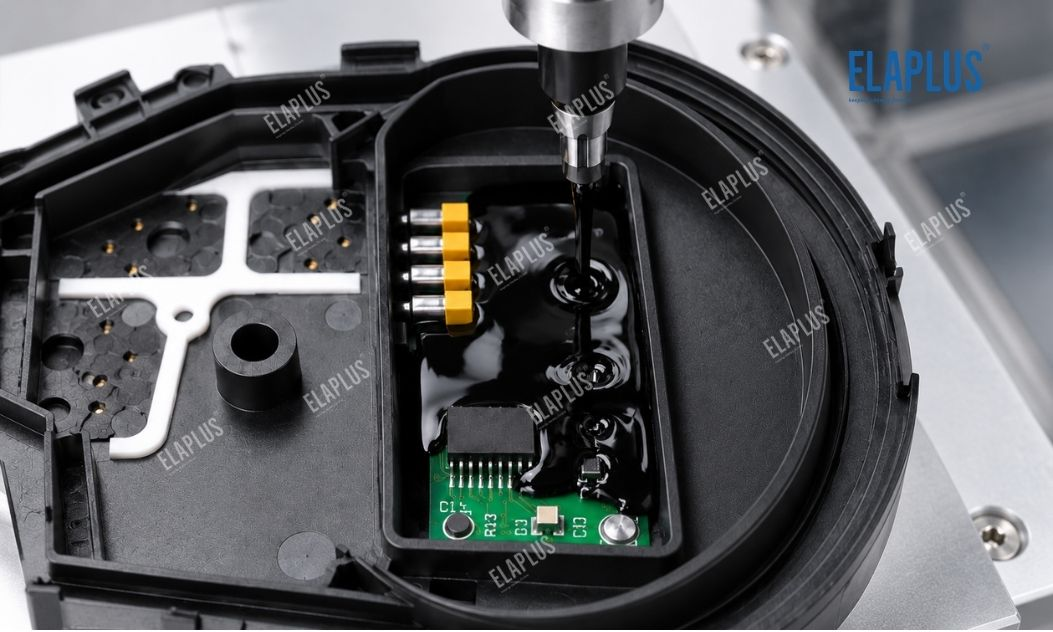
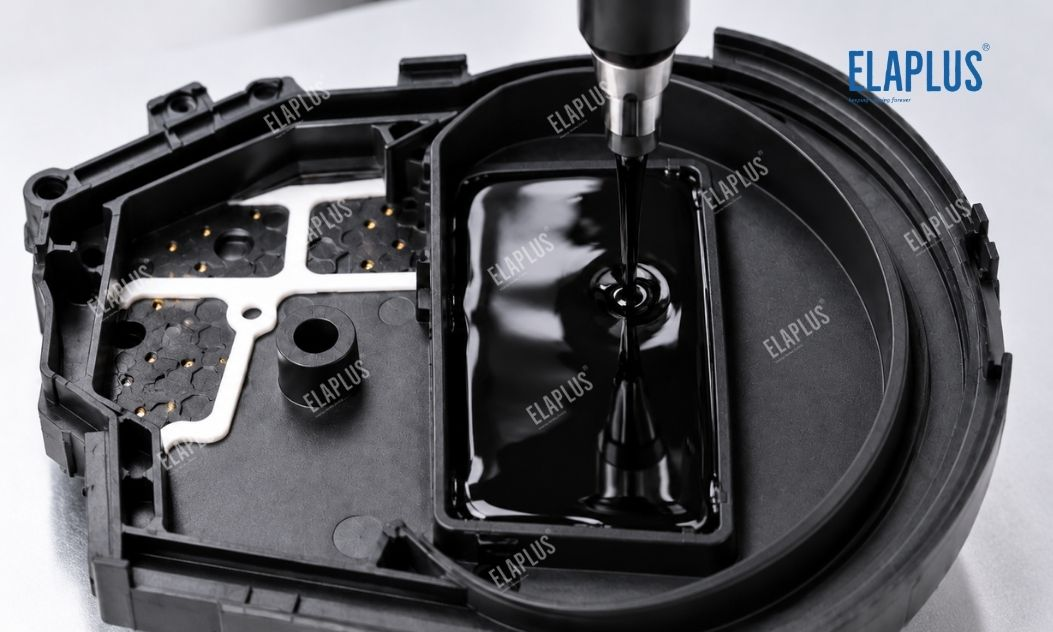
For isolated electronic cavities, set dispensing locations and potting height according to component height, housing geometry and available volume. Inspect coverage under the PCB, at lead solder joints and housing corners, while keeping mechanical moving zones and terminal blocks clean.
For two-component systems, control metering, mixing and cure conditions per the product specification. Automated dispensing shall monitor per-part shot volume, nozzle positioning and final cured condition, so that dimensional tolerance is not compromised by dosage variation.
If the foot switch uses a plastic housing, adhesion to the actual plastic grade shall be verified. For assemblies with rubber gaskets, check compatibility to ensure the contacting material does not inhibit cure or degrade long-term performance.
6. Why Must Pedal Return Still Be Tested after Potting?
The core function of a foot switch is reliable conversion of mechanical motion into electrical signals, so post-potting validation is mandatory to confirm original performance remains unchanged.
Adhesive entering plungers, springs or clearances can increase actuation resistance, causing slow return or shifted trigger points. Normal initial operation does not guarantee reliability after thousands of repeated foot strikes.
For Hall-effect and other non-contact detection designs, check the relative position between magnets and sensing elements, and compare output signals before and after potting.
If faults consistently occur at a specific actuation position, prioritise checks for mechanical interference and sensor alignment. If performance variation appears randomly across batches, audit consistency of shot volume, assembly and curing processes.
7. How to Validate Waterproof Performance and Long-Term Reliability
Prepare full test samples using the actual BOM: pedals, springs, switch elements, PCB, housing, cabling and potting material, assembled with the intended production process.
First, compare actuation force, travel, return behaviour and electrical signals before and after potting to confirm the material does not alter functionality. For electronic detection modules, inspect output signals and insulation performance.
Next, perform repeated cycling, thermal cycling, damp heat and required dust/water ingress tests matching the service environment. Where cleaning fluids or other chemicals are present, assess compatibility between housing gaskets and the potting material.
If a specific IP rating is required, qualification must be performed on the complete foot switch assembly. The inherent water resistance of the potting compound cannot substitute full product testing.
8. Adaptation for Different Types of Industrial Foot Switches
For machine tool and automation foot switches, focus on dust exposure, repeated actuation and equipment vibration. For production line control pedals, define protection structures according to electrical interfaces, mounting location and cleaning procedures.
For foot switches with Hall-effect or other electronic signal processing modules, SIPC 1835 A/B may be evaluated for stationary electronic cavities. For purely mechanical contact switches, protection of contacts and moving assemblies shall be addressed first; full potting is not a simple solution.
For safety-critical foot switches, relevant functional safety and electrical safety design requirements must be satisfied. Ordinary potting materials cannot replace safety mechanisms or safety certification.
FAQ
Q: What waterproof potting compound is recommended for industrial foot switches?
A: SIPC 1835 A/B two-component silicone potting compound may be evaluated for isolated stationary electronic cavities eligible for potting.
Q: Can the entire foot switch be fully potted?
A: Full potting without structural validation is not recommended. Clearance for mechanical contacts, return springs and moving assemblies must be preserved.
Q: Will silicone potting affect foot switch return?
A: Mechanical interference may occur if adhesive invades moving zones, so potting boundaries must be strictly controlled.
Q: Does potting automatically achieve IP67?
A: This cannot be assumed. Ingress protection ratings require testing of the complete switch assembly.
Q: Can SIPC 1835 also be used for Hall-effect foot switches?
A: It can be a candidate for stationary electronic areas, but sensor alignment, signal output and environmental reliability must still be validated.