For optical fiber splice closures requiring periodic inspection, capacity expansion or re-splicing, soft, low-stress and easy-to-remove waterproof gel systems shall be prioritized for evaluation, instead of rigid permanent potting materials that are difficult to dismantle. Nevertheless, self-healing performance does not guarantee retention of original waterproof capacity after unlimited box opening and repeated cutting. The gel continuity, contamination status and sealing structure must be re-verified after maintenance.
Optical fiber splice closures are widely deployed in underground communication pipe networks, campus fiber networks, outdoor communication facilities and some industrial optical communication systems. They generally accommodate fiber splice points, fiber storage structures, cable fixing devices and cable entry sealing assemblies.
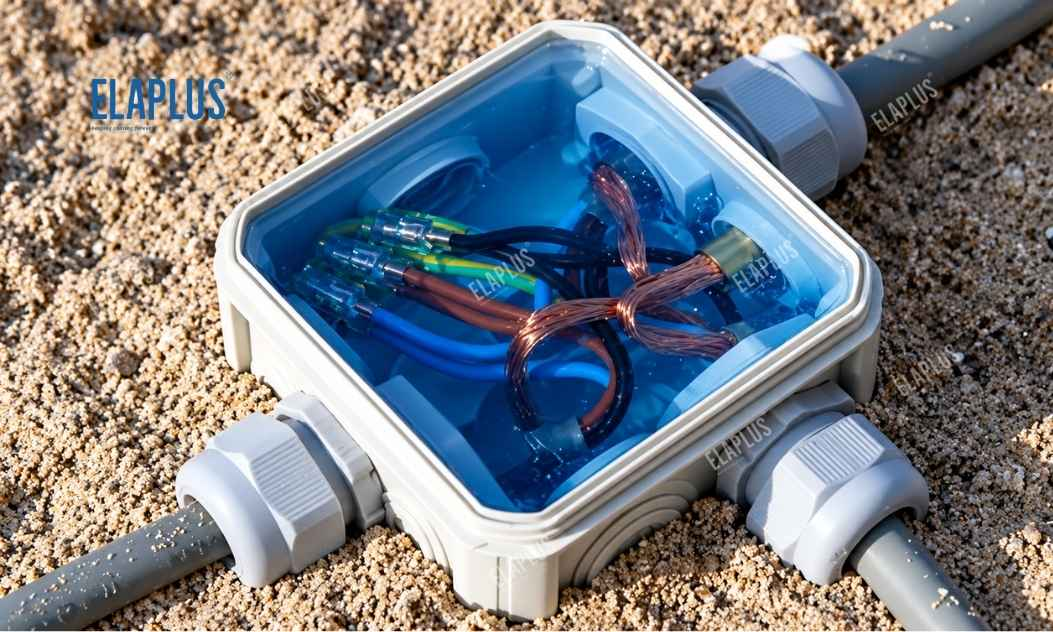
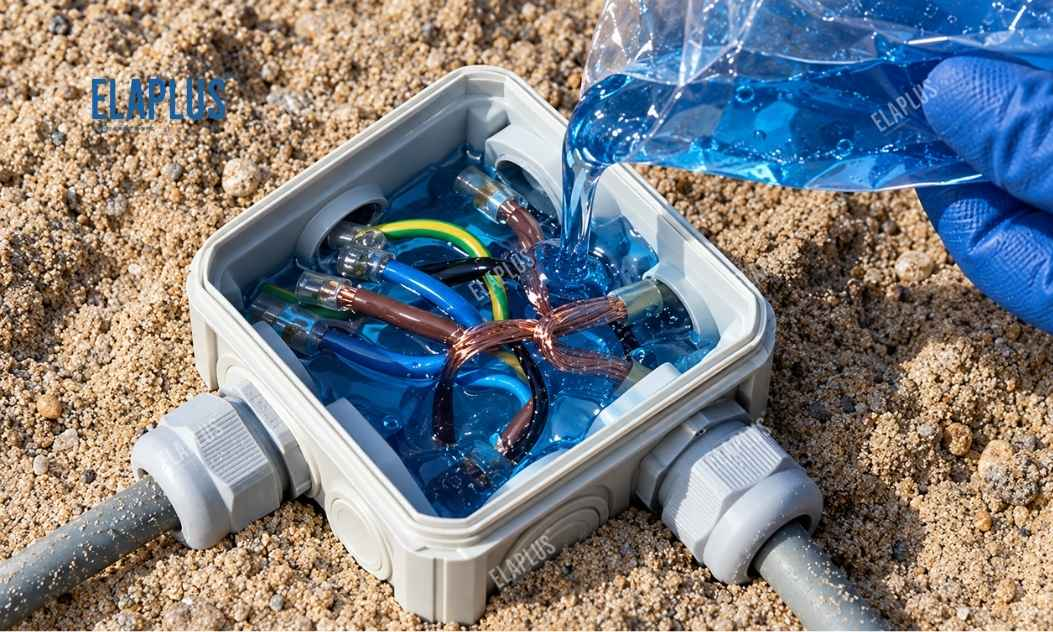
Unlike one-time encapsulated electronic modules, some closures may need to be reopened during their service life for fiber maintenance, fault inspection or line expansion. Therefore, besides waterproofing and environmental protection, potting materials must also match the actual maintenance workflow.
Why Should Potting Strength Not Be the Sole Target for Fiber Splice Closures?
Optical fiber is a transmission medium sensitive to bending and localized mechanical loads. Inside the closure, the splice points need protection while avoiding undesired localized restraint imposed by potting materials.
Rigid permanent potting compounds form robust fixation, yet dismantling requires cutting or damaging the adhesive layer, raising the risk of fiber damage.
For closures designed for maintenance, a balanced solution covering environmental protection, low mechanical stress and operability is more reasonable, rather than simply maximizing adhesive hardness.
What Exactly Does Self-Healing Silicone Gel Mean?
Self-healing silicone gel refers to a material that, after disturbance or local deformation, can re-establish contact or partially restore continuity under certain conditions by virtue of its softness and inherent tackiness.
This self-healing characteristic is not equivalent to re-bonding of structural adhesives. It also does not guarantee automatic restoration of original performance after arbitrary cutting, contamination or repeated disassembly.
For optical fiber splice closures, the key concern is whether the gel can form a continuous protective zone after being pried open, separated and reclosed, as well as whether permanent deformation, contamination or local material loss occurs.
In short, self-healing is a material property, while waterproof reliability after maintenance is a performance indicator of the entire closure system.
Why Waterproof Performance of the Closure Depends on More Than the Gel Alone?
A complete splice closure also incorporates housing gaskets, cable entry seals, fixing structures and other protective components. The gel provides internal filling and partial protection but cannot compensate for inherent design defects of the enclosure.
For instance, severe dimensional mismatch at cable inlets may allow water ingress along the cable jacket and sealing interface under hydraulic pressure. Even with soft gel filled inside, the structure must be validated for the service environment.
Material selection shall be coordinated with housing sealing, cable entry design and fiber storage layout.
Epoxy, Polyurethane or Silicone Gel for Fiber Splice Closures?
Different systems suit different encapsulation strategies, and waterproof capability alone cannot be used for absolute ranking.
| Material System | Key Features | Maintenance Compatibility | Critical Notes |
|---|---|---|---|
| Rigid Epoxy Potting | High structural fixation strength | Generally unsuitable for frequent removal | Fiber stress, damage during dismantling |
| Flexible Polyurethane Potting | Moderate flexible protection | Depends on specific hardness and adhesion | Dismantling difficulty, medium compatibility |
| Self-Healing Silicone Gel | Soft, low-stress, cushioning protection | Preferred for evaluation after repeated opening | Continuity after reclosure |
| Preformed Waterproof Gel Seal | Sealing achieved via structural compression | Determined by structural design | Compression ratio, rebound and reset performance |
If the closure adopts one-time permanent encapsulation, materials can be selected based on waterproofing, insulation and mechanical fixation requirements.
If regular maintenance is required, dismantling method and re-sealing performance must be included in material evaluation.
Why SIGEL 1809 Qualifies as a Candidate for Optical Fiber Splice Closures
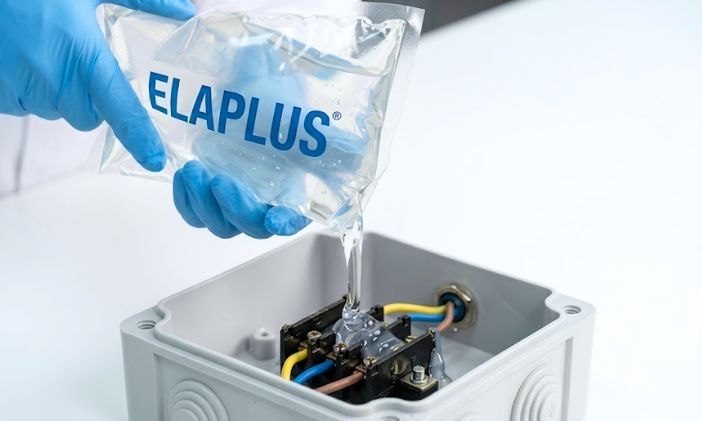
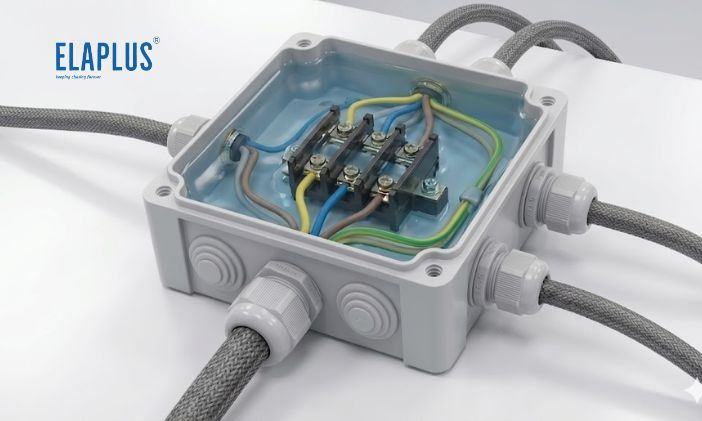
ELAPLUS SIGEL 1809 is a transparent two-component self-healing silicone gel based on 1:1 addition-cure chemistry. After curing, it forms a soft gel with stress buffering, moisture-proof and electrical insulation properties, applicable to optical fiber splice closures, waterproof junction boxes, submersible instruments and similar applications.
Compared with rigid potting materials, SIGEL 1809 is suitable for structures requiring soft wrapping and minimized mechanical restraint.
For maintainable fiber splice closures, its main value lies in flexible protection and operability. It shall not be regarded as a permanently self-recovering sealant that requires no replacement or refilling.
Final selection shall also take cable jacket material, enclosure structure, installation orientation and ambient conditions into account.
Why Gel Softness Matters for Fiber Protection
Fibers inside splice closures are routed following specified minimum bend radii. Strong localized restraint from encapsulation materials may concentrate mechanical stress on certain sections under temperature cycling or external vibration.
Soft gel reduces such concentrated restraint risks, yet it cannot replace a well-designed fiber storage layout.
Especially at fiber bending sections, splice protector sleeves and cable anchoring ends, excessive adhesive shall not be used to restrict fiber movement. The correct approach is to optimize fiber routing and fixation first, then apply gel for environmental protection.
Why Local Sealing Risks May Occur after Repeated Opening
During the first potting process, the gel fills the target area following qualified procedures. During maintenance, prying the gel, repositioning fibers or removing part of the material disrupts its original continuous state.
After reclosure, issues such as incomplete gel resetting, local material shortage or trapped foreign debris may arise. Without inspection at these positions, subsequent waterproof performance becomes uncertain.
Therefore, maintenance specifications for splice closures should cover gel inspection, cleaning, refilling or replacement when necessary, and re-sealing validation, instead of only specifying opening, servicing and reclosing.
Difference between Self-Healing Gel and Reusable Preformed Gel Seals
This is a commonly confused concept in closure material selection.
SIGEL 1809 is a soft gel formed by two-component curing. Some splice closures adopt preformed gel seals that rely on enclosure compression for sealing.
For the former, mixing, potting, curing and post-disturbance status need to be controlled. The latter depends heavily on seal dimensions, compression geometry and reclosure performance.
Even though both are called waterproof gel, their application and maintenance logic differ. The reusability of preformed gel seals cannot be directly applied to two-component potting gel.
Why Cable Jacket Material Must Be Included in Compatibility Validation
Optical cable outer jackets are made of various polymers. Some assemblies contain filling grease, residual cleaning agents or other auxiliary materials.
Long-term contact between gel and these materials shall be checked for interfacial degradation, material softening, surface contamination and sealing continuity. Especially for outdoor high-temperature or underground persistently humid environments, acceptable initial appearance is not a substitute for long-term compatibility testing.
Validation shall not be limited to empty enclosures; real cables, jackets and cable entry sealing structures must be used.
Why Waterproof Testing Shall Cover Post-Maintenance Condition
Many projects only perform waterproof testing after initial assembly. For maintainable products, the initial assembled state is not the only service condition.
A more reasonable validation scheme covers initial assembly, opening for maintenance following defined procedures, and protection performance after reclosure.
If multiple maintenance cycles are expected, the maximum opening cycles and corresponding test conditions shall be defined per design requirements. Material self-healing property alone cannot waive post-maintenance sealing testing.
Key Control Factors for Mass Production and Maintenance
For two-component gel, mixing ratio, mixing uniformity, potting position and curing conditions shall be controlled. After filling, confirm the gel does not obstruct fiber storage, splice identification or required operating space.
During maintenance, focus on gel contamination, obvious material loss and continuity after reclosure. If the protective state cannot be confirmed, restore protection by refilling or replacement rather than relying on automatic self-recovery.
Fiber transmission performance shall also be verified, particularly insertion loss and excess loss induced by abnormal bending before and after maintenance.
Common Pitfalls
- Misconception: Self-healing equals unlimited reusability. Self-healing works under specific conditions; repeated opening and waterproof testing are still mandatory.
- Misconception: Softer gel guarantees more reliable sealing. Sealing performance also depends on enclosure structure, contact interface and applied pressure.
- Misconception: Potting gel can replace all cable entry seals. Cable inlets, housing gaskets and internal gel must work as an integrated sealing system.
- Misconception: Passing initial waterproof test eliminates the need for post-maintenance testing. For maintainable closures, protection after reclosure is equally critical.
Application Guidance: Which Closures Suit SIGEL 1809?
SIGEL 1809 silicone gel can be prioritized for outdoor communication splice closures, underground fiber closures and waterproof junction assemblies requiring soft environmental protection, low-stress wrapping and simplified dismantling instead of rigid potting.
If the closure relies on purpose-built preformed gel seals for repeated opening, match the dedicated sealing system instead of substituting it directly with two-component potting gel.
For applications under sustained high water pressure, permanent submersion or exposure to special chemicals, additional pressure, medium and long-term ageing validation is required. Finalization shall not be based merely on basic moisture resistance.
ELAPLUS adopts diagnostic material selection combining failure mechanism, structure and process. For optical fiber splice closures, define the waterproof path and maintenance workflow first, then specify gel softness, filling range and maintenance procedures, and validate with real cables and full enclosures.
FAQ
Q: Can self-healing silicone gel be used for optical fiber splice closures?
A: Yes. Self-healing silicone gel is a candidate for closures requiring soft protection and low mechanical restraint, subject to validation of the full sealing structure.
Q: What applications are suitable for SIGEL 1809?
A: SIGEL 1809 is a two-component self-healing silicone gel for flexible protection scenarios including optical fiber splice closures, waterproof junction boxes and submersible instruments.
Q: How many times can self-healing gel be opened repeatedly?
A: There is no universal number independent of material grade, structure and test conditions. Repeated opening testing shall be performed according to actual operation and product requirements.
Q: Is refilling required after reopening the splice closure?
A: Not always. Nevertheless, gel continuity, contamination and material shortage must be inspected. If the original protective state cannot be restored, refill or replace the material following qualified maintenance procedures.
Q: Is harder adhesive better for fiber splice closure waterproofing?
A: No. Rigid materials introduce localized mechanical stress on fibers and raise dismantling difficulty. Select based on maintenance requirements and structural design.
Q: Is initial waterproof testing sufficient? A: Not sufficient for repeatedly maintainable closures. Sealing performance and fiber transmission status after opening, servicing and reclosing must also be verified.
Previous post: Degraded Insertion Loss of EMI Filter after Potting? Check Parasitic Capacitance and Core Stress before Changing Potting Compound
Next post: What Adhesive to Encapsulate Internal Circuits of Hall Position Sensors? Focus on Bonding to PA66 Housing, Terminal Sealing and Oil-Resistant Service Conditions