For transparent potting protection of photoelectric reading modules in smart water meters, ELAPLUS EP 1708 (Grade 7) two-component transparent epoxy potting compound is recommended for evaluation. It features high transparency, ambient or heat cure, and insulation protection for electronic components, suitable for photoelectric inspection and display assemblies qualified for epoxy encapsulation. For smart water meters adopting direct photoelectric reading, reflective detection or other optical sampling structures, it is critical to verify whether the potting layer interferes with the optical path, component positioning and long-term measurement stability. Transparency of the cured adhesive alone does not guarantee compliance with optical detection requirements.
A smart water meter generally consists of a metering mechanism, signal acquisition unit, control circuit, communication module and other auxiliary structures. Different products may use magnetic induction, Hall detection, direct photoelectric reading or other signal collection methods, so the encapsulation requirements for internal electronic modules vary.
For water meters with photoelectric detection, transmitters, receivers and associated circuits must operate stably under specified conditions. Some assemblies also require transparent protective materials for insulation, moisture resistance and structural retention.
Unlike conventional opaque electronic potting, transparent potting compounds must satisfy basic electrical and environmental protection requirements, while also accounting for the influence of the adhesive layer on light transmission and detection signals.
1. Why Do Photoelectric Modules in Smart Water Meters Require Transparent Potting?
The photoelectric sensing assemblies inside smart water meters use transmission, reflection or other optical principles to read the status of mechanical metering structures and convert it into electrical signals.
If the detection zone requires a defined optical path, the transparency and optical compatibility of the potting material become key selection factors. Control circuits that do not participate in light transmission do not necessarily require transparent potting materials.
A well-designed potting structure provides insulation and environmental protection for designated PCBs, solder joints and electronic components, and restricts mechanical displacement of parts to a certain extent.
Nevertheless, potting adhesive cannot replace the positioning design of photoelectric devices themselves, nor the waterproof structure of the complete meter housing.
Therefore, material selection for smart water meter photoelectric modules shall first distinguish the optical working zone, electronic protection zone and structural fixing zone before defining the coverage of transparent adhesive.
2. Why Is EP 1708 (Grade 7) Transparent Epoxy Potting Compound Recommended?
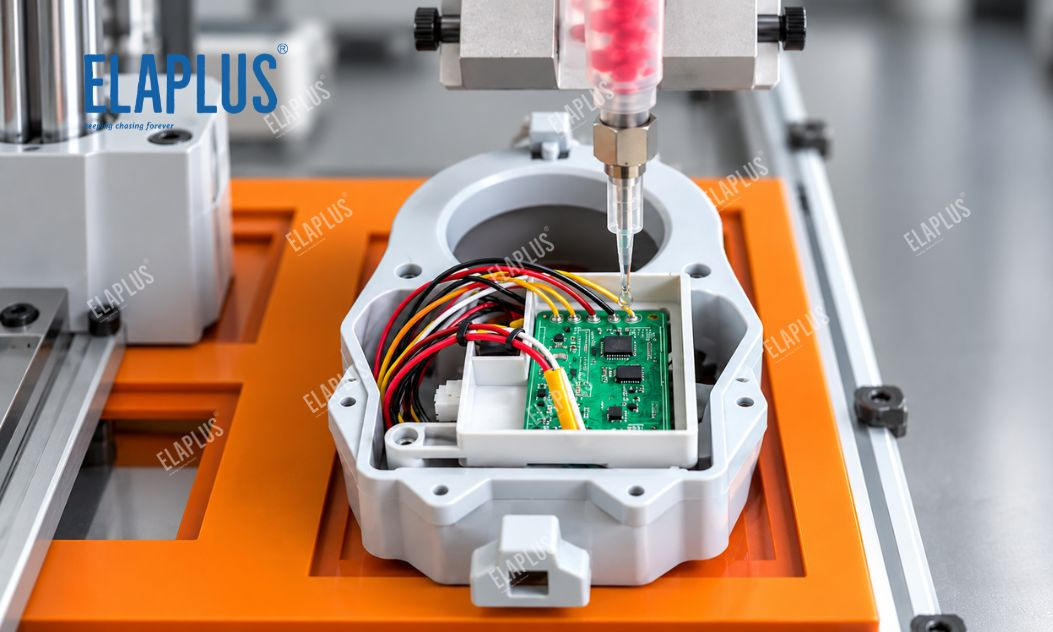
ELAPLUS EP 1708 (Grade 7) is a two-component transparent epoxy potting compound. Both Part A and Part B are transparent and can cure at room temperature or with moderate heating.
This grade has a typical mixed viscosity of 1500 mPa·s at 25°C. It is formulated for insulation protection, environmental sealing and structural potting of electronic devices, applicable to selected photoelectric sensors, display modules and electronic assemblies for smart water meters.
EP 1708 (Grade 7) may be shortlisted for smart water meter modules where observable structures must remain visible beneath a transparent potting layer, or where designated photoelectric components require protection.
Important note: a transparent appearance does not prove compliance with all optical detection wavelengths, optical path dimensions and long-term optical stability requirements. For precision photoelectric reading modules, light transmittance, scattering and signal impact shall be tested at the actual detection wavelength and operating conditions.
3. How to Select Between Transparent Epoxy, Transparent Silicone and General Potting Compounds
Different material families differ in post-cure hardness, elasticity, optical performance and structural retention capacity. Selection for smart water meters shall be based on the photoelectric detection scheme and mechanical design, rather than visual appearance alone.
| Selection Dimension | EP 1708 (Grade 7) Transparent Epoxy | Transparent Silicone Potting Compound | Opaque Electronic Potting Compound |
|---|---|---|---|
| Primary Application | Transparent electronic encapsulation and structural protection | Flexible transparent protection | Electronic zones with no light transmission requirement |
| Mechanical Behaviour after Cure | Suitable for rigid encapsulation structures subject to evaluation | Elastic protection depending on grade | Determined by material system |
| Optical Detection Zones | Optical path compatibility must be validated | Optical path compatibility must be validated | Generally not used for light-transmitting zones |
| Component Securing | Structural protection performance to be evaluated | Bond strength to be confirmed | Selected based on hardness and adhesion |
| Key Validation Items | Transparency, signal integrity, insulation, environmental reliability | Optical performance, elasticity, environmental stability | Electrical, mechanical and environmental protection |
If precise positioning of components is required in the photoelectric sensing area, the dimensional stability of cured epoxy can be prioritized. If sensitive components are vulnerable to mechanical stress, flexible encapsulation materials shall be benchmarked. High-rigidity adhesives shall not be selected solely for their transparency.
For communication circuits, power management circuits and other non-optical zones, materials shall be chosen according to insulation and protection requirements. Transparent potting is not required merely for visual consistency.
4. Why Can Transparent Adhesive Still Interfere with Photoelectric Readings?
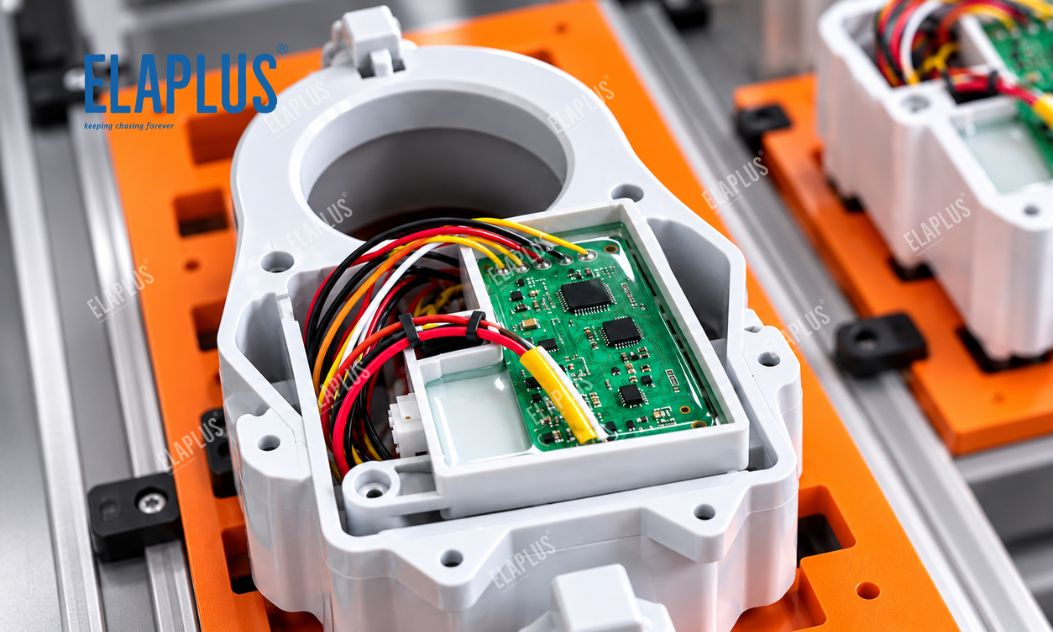
Transparent adhesive permits partial light transmission, but actual optical performance is also governed by refractive index, bond-line thickness, interface condition and operating wavelength.
For reflective photoelectric detection structures, the potting layer can alter the propagation path of emitted and reflected light. Changes in material coverage or surface profile will vary the signal intensity received by the sensor.
For transmissive structures, the relative position between the adhesive layer, transmitter and receiver, as well as unintended optical interfaces, must be inspected.
In addition, internal voids, interface contamination or other optical inhomogeneities within the potting layer can degrade detection performance.
Visual inspection of clarity is insufficient to qualify a photoelectric module. Validation shall be carried out using actual optical signals, recognition thresholds and service environment.
5. How to Define Potting Scope for Different Zones in Smart Water Meters
For smart water meters with direct photoelectric reading, separate the optical detection zone and electronic protection zone according to the design.
If optical transmitters and receivers are already protected by a standalone transparent window, potting can be limited to peripheral PCB and connection areas to avoid introducing unnecessary adhesive into the optical path.
If the design requires the adhesive to cover optical elements directly, compatibility between the material and device packaging surfaces must be verified, and bond-line thickness and final geometry must not disrupt signals.
For connectors, debug ports, test points and serviceable features on the PCB, no-potting zones shall be defined according to assembly requirements.
For battery compartments and communication modules, independent protection shall be assessed case by case. The entire electronic cavity of the water meter shall not be fully filled without considering maintenance, heat dissipation and other functional requirements.
6. Process Control for EP 1708 (Grade 7) Potting
EP 1708 (Grade 7) is a two-component system. Dispensing shall follow the specified mix ratio, mixing procedure and cure schedule for the corresponding grade.
Before potting, inspect the cleanliness of photoelectric devices, PCB and housing, and confirm that transmitters, receivers and other critical parts are fully positioned.
For modules with small cavities, control dispense location, fill height and flow direction to prevent adhesive from encroaching on restricted optical windows or connection areas.
If automated potting equipment is used, record shot volume, metering status, mixing uniformity and cure conditions for traceability.
After potting, inspect surface coverage over target zones and confirm no prohibited displacement of internal components.
For heat-cure processes, verify that photoelectric parts, plastic housings and other subassemblies can withstand the thermal profile.
7. Validating Reading Accuracy after Transparent Potting
Prepare test samples using the actual BOM: photoelectric transmitters, receivers, PCB, housing and potting material, and encapsulate using the planned mass-production process.
First, record photoelectric signal amplitude, recognition threshold and reading performance before and after potting under identical power and test conditions. For reflective detection schemes, validate against the actual reflective target and detection distance.
Next, check the position of photoelectric components, bond-line thickness and other critical assembly dimensions to confirm the potting process does not alter the original detection geometry.
Environmental reliability testing includes thermal cycling, damp heat and required mechanical exposure. Reading accuracy and electrical insulation are rechecked after testing.
For long-service water meters, optical stability under specified environmental conditions shall be evaluated. Initial clarity alone is not sufficient to guarantee long-term performance.
If faults consistently occur at a fixed detection position, prioritize inspection of the optical path and structural alignment. If failures appear randomly across batches, focus on consistency of shot volume, mixing, curing and assembly.
ELAPLUS: Select adhesives based on service conditions, not just stack parameters. The core objective of transparent potting for smart water meters is to satisfy electronic protection, structural stability and photoelectric reading performance simultaneously.
8. Adaptation for Different Smart Metering Devices
For smart water meters with direct photoelectric reading, verify compatibility between the transparent potting material and the optical detection structure using a complete reading module.
For water meters adopting magnetic induction or Hall detection, transparency is generally not a core requirement. Potting materials shall be selected based on electronic protection, mechanical stress and construction.
For smart metering devices with independent display windows, distinguish between display window bonding, PCB potting and optical detection zones. Do not conflate different adhesive applications.
For industrial metering modules installed in high-humidity environments, define protection schemes considering housing sealing, condensation risk and maintenance requirements. The potting adhesive alone shall not bear the full burden of environmental sealing.
FAQ
Q: What transparent potting compound is recommended for photoelectric reading modules of smart water meters?
A: EP 1708 (Grade 7) two-component transparent epoxy potting compound can be evaluated. Suitability shall be confirmed via actual photoelectric testing.
Q: Can EP 1708 (Grade 7) cure at room temperature?
A: This grade supports cure at ambient temperature or with moderate heat. Follow the process specification for the relevant grade.
Q: Does transparent epoxy guarantee no interference with photoelectric signals?
A: No. Bond-line thickness, refractive index, interface condition and detection wavelength can all affect optical performance.
Q: Does the entire electronic cavity of a smart water meter require transparent potting?
A: Not necessarily. Define potting boundaries separately for optical detection zones, electronic protection zones and service requirements.
Q: Must reading accuracy be retested after potting? A: Yes. Compare signal performance pre- and post-potting, and retest after environmental reliability tests.