For local fixation and sealing of PCB components inside industrial LED luminaires, ELAPLUS SIPC 1826 one-component alkoxy-cure silicone adhesive sealant is recommended for evaluation. It leverages adhesion, elastic protection and sealing properties to provide auxiliary fixation for designated electronic components and structural joints. For industrial luminaires requiring heat resistance, insulation and long-term environmental reliability, the dispensing scheme shall be defined based on actual substrates, bond-line thickness, cure mechanism and operating temperature. General component fixation adhesives shall not be used as the primary thermal interface material.
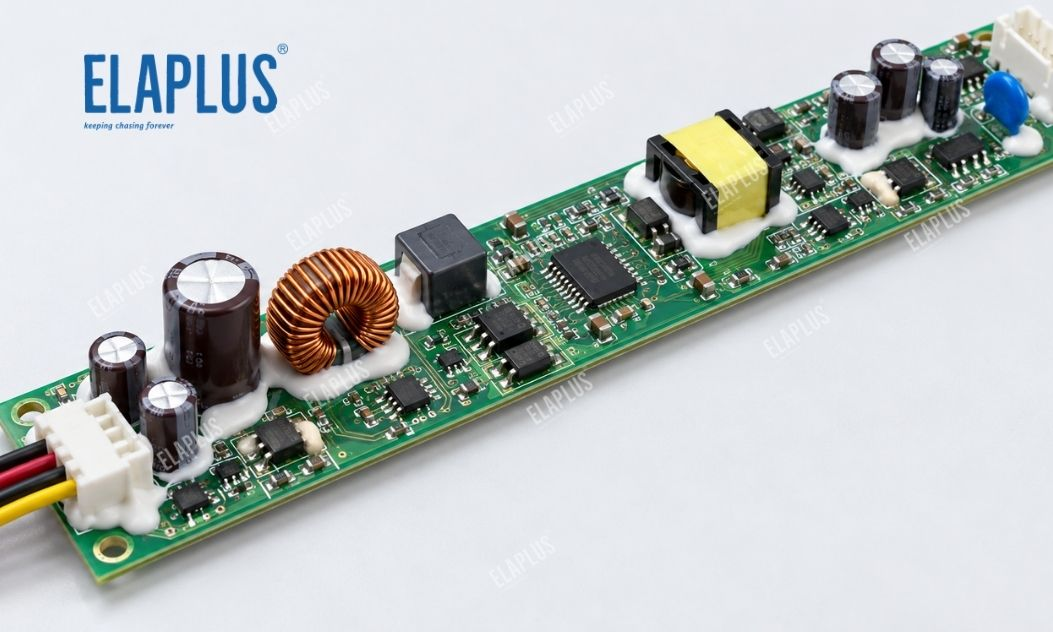
PCB Component Securing
Industrial LED luminaires are widely used in factory lighting, equipment indicators, automated production lines, warehouse lighting and other industrial environments. Compared with ordinary indoor lighting, some industrial luminaires are subjected to continuous operation, equipment vibration, temperature cycling, dust and other harsh conditions.
Within LED driver power supplies and control PCBs, capacitors, inductors, connectors and other components may require local auxiliary securing. For luminaires with metal housings, plastic brackets or separate wiring cavities, elastic sealing materials may also be required at specified joints.
This application differs from full-board potting. Its main purposes are to restrain movement of local components, protect selected connection zones and achieve required structural sealing.
1. Why Do Industrial LED Luminaires Need Component Fixing Adhesive?
PCBs inside industrial LED lights are usually mounted to the housing via screws, snaps or other fasteners. However, certain large or heavy components may still experience vibrational loads during shipping, assembly and service.
For inductors, capacitors and other tall components on driver boards, properly applied local auxiliary fixation reduces uncontrolled relative movement and lowers mechanical stress on solder joints.
That said, adhesive cannot replace the PCB’s primary mounting structure or the original soldering of components. For heavy components, mechanical retention, pad design and assembly clearance shall be verified first before deciding whether dispensing is required.
For wiring harness connection zones inside luminaires, harness securing, bend radius and stress relief shall be considered. Excessively large adhesive dots shall be avoided, as they may introduce new rigid constraints.
2. Why Evaluate SIPC 1826 for LED Component Securing?
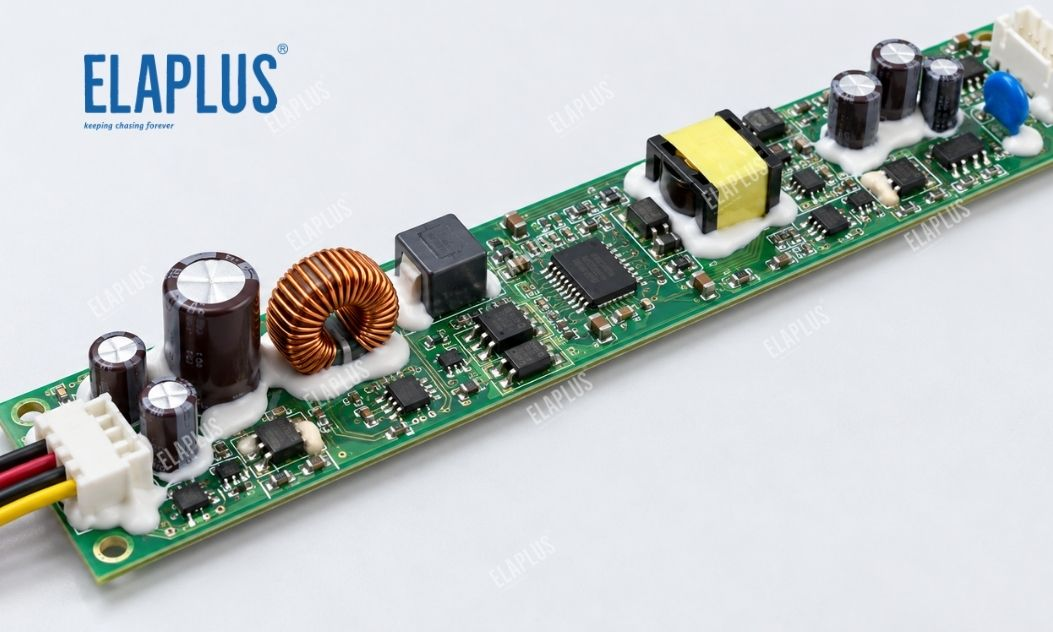
ELAPLUS SIPC 1826 is a one-component alkoxy-cure silicone adhesive sealant. Its listed applications include home appliances, construction machinery, LED luminaires and PCB component bonding.
Unlike some epoxy adhesives that cure into high-rigidity structures, elastic silicone is suitable for local fixation requiring flexible protection. It can be trialled for industrial luminaires exposed to temperature fluctuation and equipment vibration.
SIPC 1826 is available in multiple colours and grades. The correct variant shall be selected per application requirements. Physical properties vary between versions; thermal conductivity, flame retardancy and cure parameters of one grade shall not be extrapolated to the entire product series.
For auxiliary fixation of PCB components, key evaluation points include adhesion to component casings, PCB surfaces and other mating substrates, as well as whether the cured layer maintains the required retention performance.
3. Silicone, Epoxy and Thermal Materials — How to Choose?
Adhesives inside industrial LED luminaires serve different functions: component securing, housing sealing and thermal interface filling. Though these materials may coexist in one luminaire, they are not interchangeable.
| Application Requirement | Preferred Material Type | Main Selection Criteria | Pitfalls to Avoid |
|---|---|---|---|
| Auxiliary securing of tall PCB components | Elastic silicone adhesive | Adhesion, elasticity, cure profile | Adhesive dots obstructing solder joint inspection |
| High-rigidity structural bonding | Suitable epoxy structural adhesive | Bond strength, curing conditions | Excessive constraint stress on sensitive components |
| Housing seam sealing | Silicone sealant | Seal continuity, substrate adhesion | Improper joint design |
| LED thermal interface | Dedicated thermal interface material | Thermal resistance, thickness, assembly pressure | Substituting general fixation adhesive |
| PCB surface environmental protection | Conformal coating material | Thin-film coverage, electrical protection | Using local fixation adhesive as full-board coating |
If the goal is to secure capacitors or inductors on the driver PCB, focus on the mechanical function of adhesive dots. If thermal transfer between the LED chip and heat sink is required, select a dedicated thermal material instead.
For joints requiring both fixation and moderate thermal transfer, mechanical and thermal performance shall be validated separately. The term “thermal conductive” in the product name alone does not guarantee compliance with luminaire-level requirements.
4. Suitable Zones for Local Dispensing on Industrial LED Driver Boards
For inductors, capacitors and other tall components on driver PCBs, small amounts of fixation adhesive may be applied at approved contact points according to load conditions. Adhesive dots shall form effective contact with component housings and adjacent fixing structures, while preserving necessary heat dissipation clearance.
Auxiliary securing near connector wiring can be considered where needed, but connector locking mechanisms, harness bend radius and service access shall take priority. For detachable connectors, adhesive shall not cover release latches or terminal contact areas.
For plastic brackets and metal housings inside LED luminaires, surface condition and bond-line design shall be checked. Even if the adhesive bonds multiple substrate types, adhesion must be verified on actual production materials.
For high-voltage input zones, special attention shall be paid to the relationship between adhesive dots, clearance, creepage distance and insulation architecture. Unvalidated adhesive layers shall not be used to replace required electrical safety gaps.
5. Why Cure Path Matters for One-Component Silicone
One-component alkoxy-cure silicones rely on ambient moisture for curing. Therefore, bond-line thickness, exposure condition, temperature, humidity and enclosure tightness all affect cure completeness.
Cure behaviour differs between exposed adhesive dots and thick bond lines sandwiched between two moisture-impermeable materials. For dispensing locations inside deep cavities or closed seams, confirm that full cure proceeds as expected.
Skin formation on the surface does not guarantee full cure through the bulk. For thick dots, cure depth and final state shall be verified via actual structural testing.
For production lines with short tact time, distinguish between tack-free time, handling time and the curing time required to reach target mechanical strength, to prevent premature downstream assembly.
6. Automated Dispensing Process Control
Component securing on industrial LED driver boards can use spot dispensing or other suitable automated processes, based on PCB layout and component height.
Before dispensing, define dot positions, allowable dosage and restricted coverage zones, and check the PCB surface for contaminants that compromise adhesion. In dense component areas, select appropriate needles and dispense paths to avoid contact with forbidden pads or terminals.
During dispensing, maintain stable needle positioning and control flow rate and dot geometry. For components of varying heights, adjust dispense coordinates rather than compensating misalignment with excessive adhesive.
After dispensing, cure under the specified temperature, humidity and time. For PCBs requiring flipping, handling or further assembly, confirm sufficient dimensional stability before subsequent operations.
7. Validating Securing and Sealing Performance of SIPC 1826
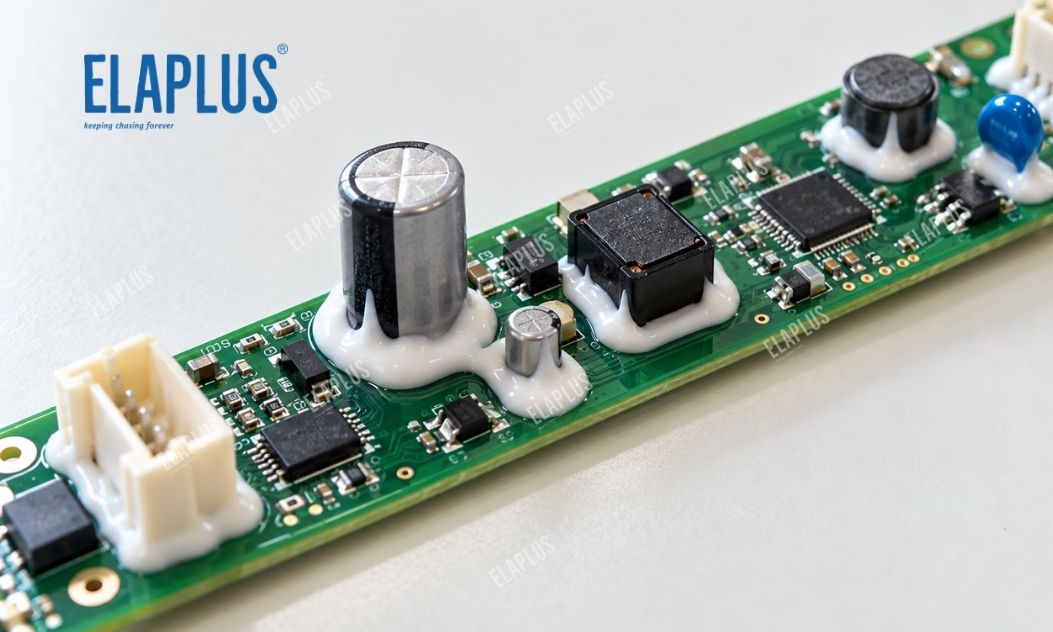
Prepare test assemblies using the actual BOM: PCB, components, housing, connectors and adhesive, following the intended mass-production dispensing and curing process.
First, inspect dot placement, cure status and contact with mating substrates. For tall or heavy components, run mechanical reliability tests matching real vibration loads and check for failure of adhesive dots or solder joints.
Next, perform temperature-rise tests under rated operating conditions, to confirm the adhesive does not block necessary heat dissipation paths or cover restricted component zones.
When used for housing seam sealing, carry out sealing tests according to the luminaire’s ingress protection requirements. Moisture-sealing properties of the adhesive do not automatically guarantee a specific luminaire IP rating.
If the product must meet flame retardant, electrical safety or certification requirements, cross-check the material grade and full luminaire specification. Certifications for one variant cannot be applied to other grades.
ELAPLUS: Select adhesives based on service conditions, not just stack parameters. For industrial LED luminaires, separate qualification criteria shall be established for component fixation, housing sealing and thermal management.
8. Application Adaptation for Different Industrial LED Luminaires
For high-bay factory lights, focus on continuous operating temperature, driver board component layout and in-service vibration. For equipment indicators and industrial signal lights, local dispensing positions shall be determined according to compact housings, wiring harnesses and maintenance schemes.
For outdoor industrial luminaires, additional evaluation of temperature cycling, moisture and housing sealing structure is required. SIPC 1826 can be a candidate for selected local fixation and sealing points, but overall waterproofing must be validated on the complete assembly.
For LED luminaires with standalone driver power supplies, distinguish between PCB component securing and full potting of the power module. The former mainly provides local mechanical protection, while the latter may cover broad insulation, environmental protection and thermal management. Hardness alone cannot determine suitability.
FAQ
Q: What adhesive is recommended for securing PCB components in industrial LED luminaires?
A: SIPC 1826 one-component silicone adhesive sealant can be evaluated. Compatibility shall be confirmed with components, PCB and curing conditions.
Q: Can SIPC 1826 be used for LED luminaire sealing?
A: This series is formulated for LED luminaire bonding and sealing, but joint design and overall ingress performance must be verified on actual hardware.
Q: Can SIPC 1826 replace LED thermal grease?
A: No. Component fixation adhesive and dedicated thermal interface materials serve different purposes.
Q: Does surface skinning of one-component silicone mean full cure? A: Not necessarily. Cure completeness depends on bond-line thickness, humidity and enclosure design.
Q: Must all capacitors on an LED driver board be glued?
A: Not always. Judgement shall be based on component size, mass, mechanical retention and actual vibration conditions.
Previous post: Slow Actuation of Solenoid Valve Coils after Potting? Check Armature Clearance & Temperature Rise First, Then Select PUR 1680 Polyurethane Potting Compound
Next post: Transparent Potting Compound for Photoelectric Reading Modules in Smart Water Meters? Selection of EP 1708 (7#) Epoxy Adhesive