PVC wire harnesses may pass initial pull tests yet delaminate after repeated bending, vibration or ageing. The root cause is usually not insufficient initial adhesive strength of the structural adhesive. Long-term fatigue reliability depends collectively on PVC surface condition, adhesive flexibility, anchoring length and rigid-flex transition design. The core goal of harness anchoring is to achieve reliable bonding while permitting reasonable cable deformation.
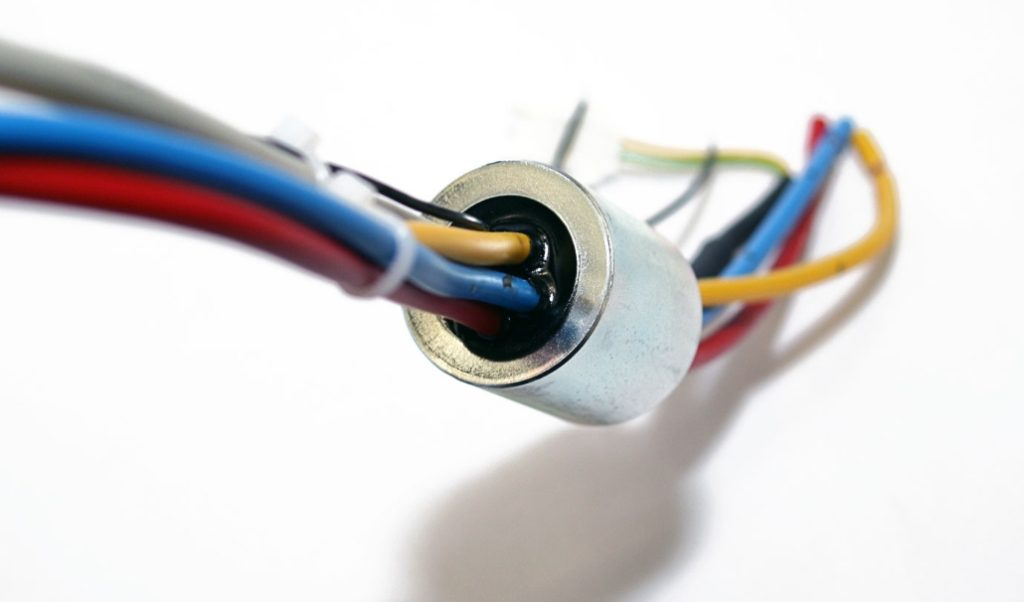
Wire harnesses used in industrial equipment, automotive electronics and automated machinery rarely stay static permanently. They are continuously subjected to:
- Vibration
- Assembly tension
- Cable swinging
- Temperature cycling
- Oil contamination and cleaning chemicals
Therefore, harness adhesives are not challenged by a one-off static pull force, but by thousands of tiny cyclic displacements.
Why a High Room-Temperature Pull Strength Cannot Guarantee Long-Term Harness Reliability
Pull tests and real service loading modes for harnesses differ fundamentally. A single tensile test mainly evaluates: Interfacial bond strength. In actual operation, harnesses undergo continuous: Bending, torsion, shear and peel stress. Especially at the adhesive edge, every bend of the cable introduces local peeling stress. Harness anchoring validation should therefore not be limited to maximum pull load; residual interfacial reliability after cyclic bending must also be assessed.
Why Surface Condition Matters Greatly for PVC Harnesses
Structural adhesive bonds to the outermost surface layer of the PVC jacket rather than the bulk PVC material itself. Different cables vary widely in: Formulation, plasticiser system, surface finish and machining residues.
An adhesive performing stably on one cable grade may not work directly on PVC jackets from a different supplier. Re-validation of bonding performance is recommended after changes to: Cable supplier, jacket colour, material grade or production batch.
Why Fracture Analysis Delivers More Insight Than Simple Pull Testing
After debonding occurs, check which substrate retains the adhesive.
| Fracture Mode | Primary Judgement | Next Inspection Focus |
|---|---|---|
| Most adhesive remains on bracket | Harness-side interface failure | Jacket surface cleanliness & contamination |
| Most adhesive remains on harness | Bracket-side interface failure | Metal / plastic substrate surface condition |
| Cohesive tear inside adhesive | Bulk adhesive failure | Bondline thickness, cure state, applied load |
| Lifting always starts at adhesive edge | Stress concentration | Anchoring length and adhesive boundary position |
| Repeated debonding at fixed location | Structural issue | Bending point and cable exit direction |
| Random debonding locations | Process variation | Mixing, dispensing and surface pretreatment |
| Interfacial degradation only after ageing | Long-term incompatibility | BOM ageing validation |
If failure consistently initiates from the same cable exit point, do not immediately suspect insufficient adhesive tack. First verify whether the cable bending centre coincides exactly with the adhesive termination edge.
Why the Adhesive Termination Edge Is Critical
The section fixed by adhesive forms a rigid zone. Unrestrained cable downstream remains flexible. The junction between these two regions is the rigid-flex transition zone. Abrupt termination of the adhesive layer at a location subject to repeated cable bending concentrates strain. Over cycles, edge lifting, jacket-adhesive delamination or conductor root fatigue may occur. Harness dispensing specifications should define not only “20 mm bead length”, but also the dispensing position and cable bending start point.
Why High-Hardness Structural Adhesives Are Not Always Suitable for Flexible Harnesses
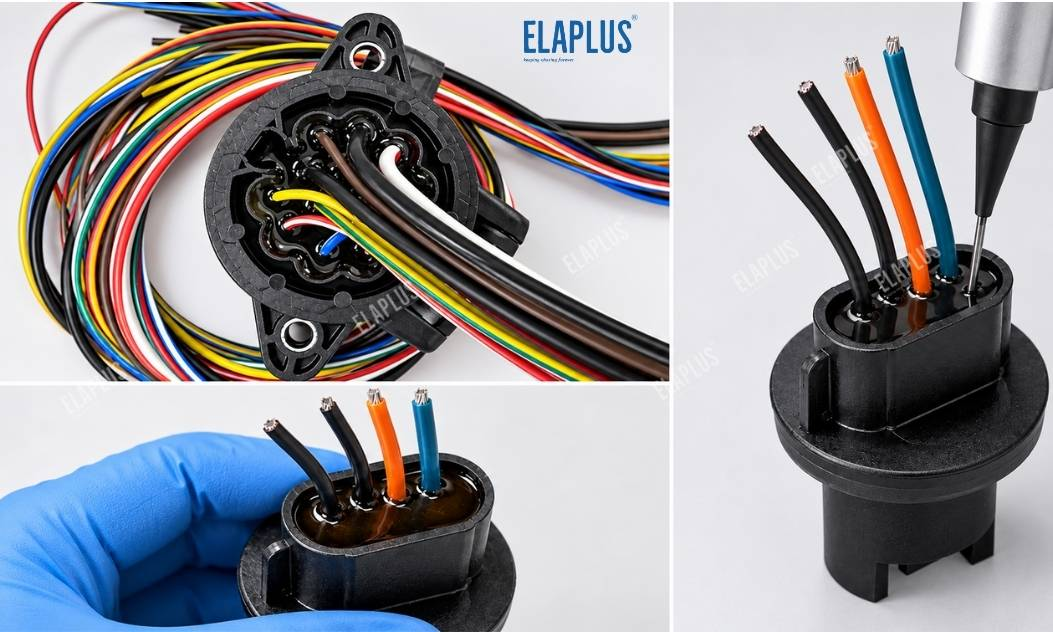
High-modulus materials are ideal for many dimensionally stable structural joints. Flexible harness applications, however, require secure anchoring together with vibration and bending buffering. An overly rigid adhesive locks cable movement abruptly. Bending stress transfers to the adhesive edge, jacket, wire root or terminal connection. Harness anchoring requires a balanced combination of bond strength and flexibility, rather than maximum strength alone.
Why Polyurethane Is a Strong Candidate for Flexible Harness Bonding
A key advantage of two-component polyurethane structural adhesives is the balanced performance between structural fixation and flexible stress buffering. ELAPLUS PUR 1601 A/B is a two-component solvent-free room-temperature-cure polyurethane adhesive with low odour and low VOC. It bonds metals, plastics, rubbers, polyesters and other substrates, compatible with automated dispensing and manual mixing. It features cured flexibility, elasticity, ageing resistance and chemical resistance.
This property profile matches core harness anchoring requirements: Secure bonding, stress buffering, vibration resistance and multi-substrate compatibility.
Typical applications for PUR 1601
It is suitable for evaluation on: Industrial equipment harness anchoring, internal automotive electronic wiring, automation cables, bonding between PVC harnesses and brackets, and composite assemblies combining harnesses with metal or plastic supports. PUR 1601 is formulated for industrial wiring, multi-substrate sealing and bonding, with resistance to vibration, temperature fluctuation, oil and chemical exposure.
Important note: Grade compatibility does not replace BOM validation. Final qualification must use the actual components from your project.
Why “Multi-Substrate Adhesion” Does Not Mean Universal Bonding to All Plastics
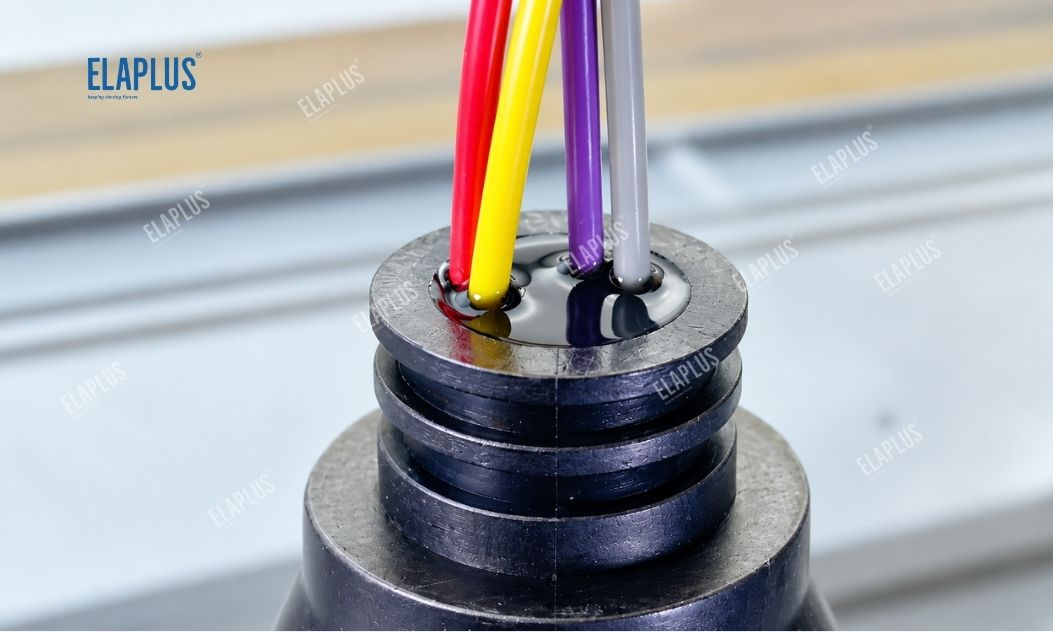
This is a common misconception in harness adhesive selection. Engineering plastics differ significantly in: Surface energy, filler content, mould release agent residues and surface pretreatment. A product marked suitable for “plastics” cannot be assumed to work on every plastic without testing. For assemblies combining: PVC harness + metal bracket, PVC harness + engineering plastic housing, rubber jacket + plastic clip, validate both interfaces separately. Overall reliability is determined by the weakest bonding interface.
Why A/B Mixing Stability Matters for Automated Dispensing
For two-component adhesives used on automatic lines, material faults and equipment faults must be distinguished. Symptoms such as strong bonding in the morning, partial softening in the afternoon or inconsistent hardness between stations indicate: Issues with A/B feeding, metering accuracy, mixing uniformity, dispense volume or cure schedule, rather than unstable material batches. The diagnostic rule: investigate process variation for random failures, and structural design for recurring fixed-location failures. This is the value of diagnostic material selection for mass production.
Does More Adhesive Guarantee Better Reliability?
No. Sufficient effective bonded area is required, but excessive adhesive build-up causes: Material waste, altered curing tact time, expanded rigid zone, difficult rework and new stress boundaries. Controlled targets are: Effective harness wrap length, bondline cross-section, anchoring position and cable exit direction. The solution is not simply to add more adhesive beads.
How to Design Harness Bending Validation
Three tiers of testing are recommended during development: Initial bonding test: confirm stable interface formation between adhesive, actual cable and bracket. Post-bending / post-vibration bonding test: check for lifting at rigid-flex transition zones. Ageing followed by bending test: verify whether the interface can withstand dynamic deformation after exposure to temperature, moisture or process chemicals. The critical question is not “Does it bond strongly immediately after application?” It is: Does it remain bonded after ageing and cyclic bending?
Four Common Pitfalls in Harness Anchoring
Pitfall 1: Reliance only on initial pull strength. Real harness service involves repeated bending and vibration with completely different loading modes.
Pitfall 2: Harder adhesive equals more secure anchoring. Excessive stiffness concentrates stress at the adhesive boundary or cable root.
Pitfall 3: All PVC jackets are identical and need no revalidation. Jacket formulation and surface condition vary between suppliers; re-validation is required after cable source change.
Pitfall 4: Add more adhesive after debonding occurs. If the root cause is misaligned bending centre, extra adhesive only shifts the stress concentration point.
Application Matching: Harnesses Suitable for Flexible Polyurethane Structural Adhesives
Recommended for evaluation: industrial and automotive electronic harnesses subjected to vibration, bending or multi-substrate bonding, requiring moderate structural fixation. Priority validation for composite assemblies combining PVC, rubber, metal and plastic components.
Adhesive modification alone is NOT recommended for designs with continuous high tensile load, inadequate mechanical anchoring or unreasonably small bending radius. Optimise mechanical fixtures and cable routing first.
ELAPLUS diagnostic selection workflow: Check which side retains adhesive after failure → locate bending centre relative to adhesive boundary → define adhesive grade and dispensing process. This embodies ELAPLUS’s philosophy: select adhesive according to working conditions, not stack datasheet parameters.
FAQ
Q: Why do edges lift a few days after PVC harness bonding even if initial adhesion is good?
A: Prioritize the failure interface, cable surface condition and whether the adhesive edge falls within the continuous bending zone. Do not retest only initial pull strength.
Q: Is softer adhesive always better?
A: No. Overly soft material fails to provide adequate positioning, while overly rigid adhesive amplifies stress at the rigid-flex junction. A balance between fixation and flexible buffering is required.
Q: Can PUR 1601 be used for automated dispensing?
A: Yes, it is suitable for automated dispensing process evaluation; manual mixing is also supported.
Q: Is revalidation required after switching cable suppliers?
A: Revalidation is recommended. Recheck bonding and ageing performance with your actual BOM whenever jacket formulation, surface finish or manufacturing process changes.
Q: How to quickly distinguish structural failure from dispensing process failure?
A: Judge by failure distribution. Recurring debonding at fixed locations points to structural and routing issues; random debonding points to fluctuations in mixing, dispensing or surface treatment.
Previous post: Why Thermal Conductivity Alone Is Not Enough for Transformer Potting Compounds: Winding Gaps Are Narrow — First Verify Whether the Material Can Flow In
Next post: SIGEL 8605 Automotive-Grade High-Temperature Resistant Silicone Gel | Potting and High-Temperature Insulation Protection for Power Modules