For adhesives used in steering‑angle, position and magnetic‑encoding sensors, fixation is not the only priority. It is critical to maintain stable relative component positions after curing, vibration exposure and temperature variation.
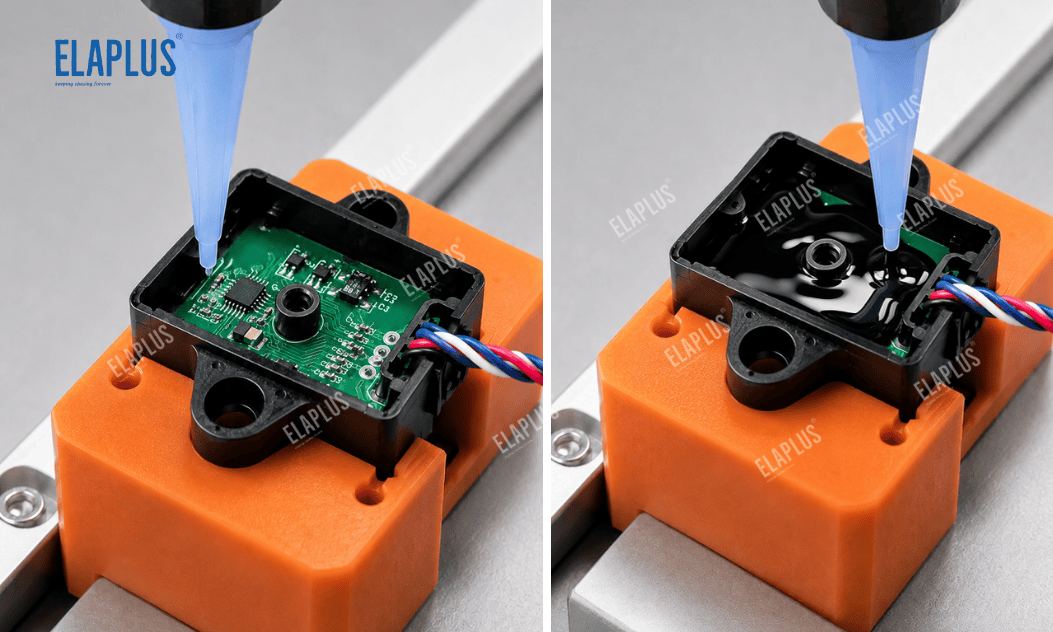
Even if no delamination occurs, large cure shrinkage of potting material may lead to position deviation, zero‑point shift or output errors.
Material Requirements for Different Zones of Steering‑Angle Sensors
| Zone | Key Requirements |
|---|---|
| Magnet | Stable positioning |
| Hall / magneto‑sensitive component | Low‑stress fixation |
| PCB | Moisture resistance |
| PIN pins | Waterproofing |
| Housing | Sealing performance |
| Wiring harness | Vibration resistance |
Why Dimensional Stability Is Critical
The theoretical gap between magnet and Hall chip is fixed. A dimension change of 0.X mm in potting layer may be negligible for general mechanical parts, yet it requires thorough validation for precision magnetic‑field measurement applications.
Therefore, evaluation criteria shall go beyond bonding strength, and focus on geometric‑position stability after curing.
Recommended Comparison Test Items
| Test Stage | Parameters to Record |
|---|---|
| Before potting | Initial zero‑point value |
| Post‑curing | Cure‑induced offset |
| High‑temperature condition | Temperature drift |
| Low‑temperature condition | Low‑temperature drift |
| Thermal cycling | Offset reversibility |
| Post‑vibration test | Positional stability |
Common Industry Pitfalls
Many material validations for position sensors only perform pull‑off, shear and water‑resistance tests, while ignoring sensor output measurement. For precision sensors, the ultimate evaluation target shall be actual product functionality.
Application‑Oriented Matching
Applicable to steering‑angle sensors, magnetic encoders, Hall position detectors, rotary position sensors and similar precision magneto‑sensitive assemblies.
FAQ for Steering‑Angle Sensor Adhesives
- Are low‑stress materials mandatory for steering‑angle sensors? It depends on proximity to sensitive components. Closer proximity to sensing zones requires stricter control over cure‑induced stress.
- Why does sensor output drift even if adhesive does not peel off? Potting material may shift component positions or exert stress on sensitive structures.
- What parameters should be prioritized for magnet‑fixing adhesives? Besides bonding strength, focus on cure shrinkage, thermal‑cycling performance and dimensional stability.
- Is full potting required for PCB areas? Not necessarily. Conformal coating, partial potting or full potting can be selected according to environmental risks.
- What is the most critical validation test? Actual sensor output measured before potting, after potting and following environmental reliability tests.