ELAPLUS SIPC 1822 one-component silicone adhesive sealant can be used for partial encapsulation protection of resolver terminals and lead connection zones. It is formulated to meet requirements for electrical insulation, moisture-proof sealing, lead retention and mechanical stress buffering. For resolvers used in servo motors, robot joint motors and new energy vehicle motors, the dispensing range, bond thickness and curing conditions shall be properly controlled to prevent adhesive creep into the air gap between stator and rotor or interference with precision assembly.
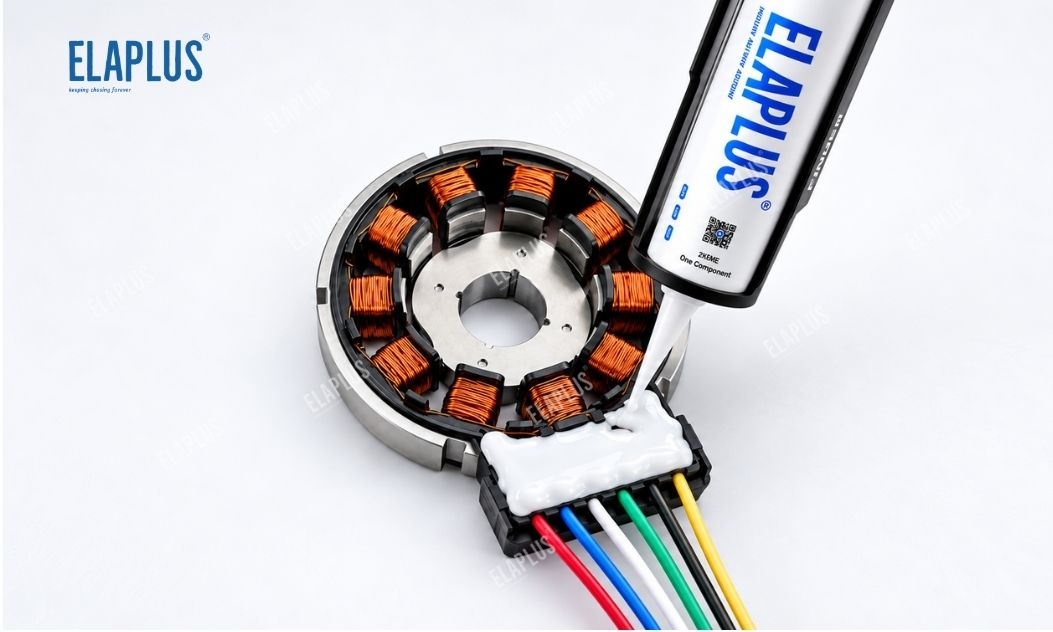
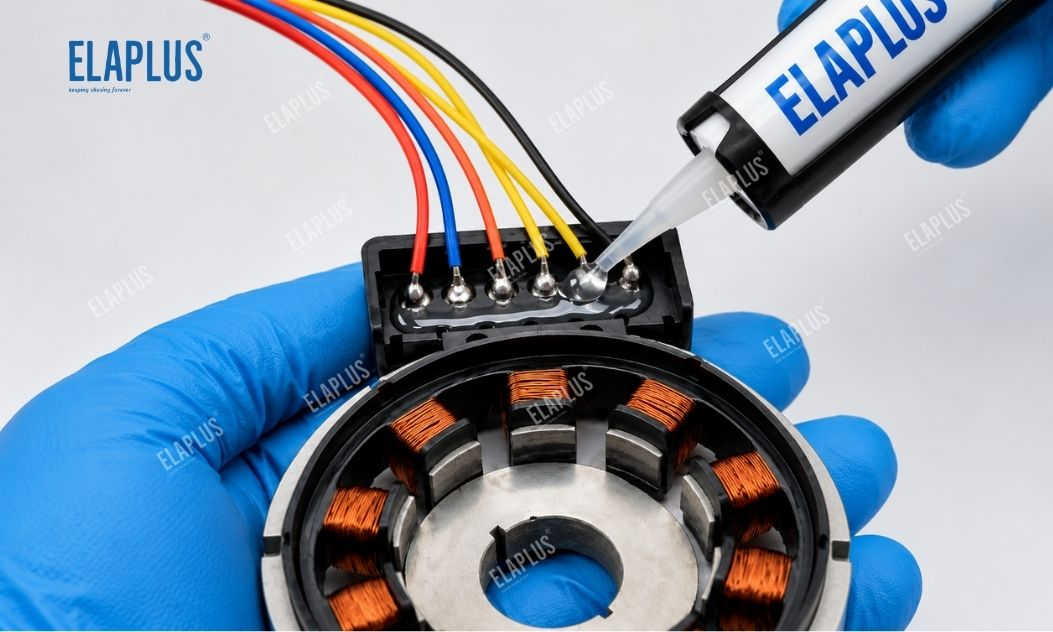
A resolver is a critical component of motor position feedback systems, generally consisting of stator, rotor, windings, insulation bobbin and terminal connections. Stator winding leads are electrically joined to external circuits by soldering or other methods. The terminal region must maintain stable electrical performance under motor vibration, temperature cycling and long-duration operation.
For resolver terminals confined in tight spaces, the adhesive shall protect joints while avoiding excessive local stiffness. Partial fixation and encapsulation with flexible silicone is a viable candidate protection approach.
1. Why Do Resolver Terminals Require Dispensed Adhesive Protection?
Resolver terminals are usually connected to fine winding leads. Some assemblies also include metal solder tabs, plastic bobbins and harness junctions. During continuous motor operation, mechanical vibration and harness pull loads transfer to the root of terminals, subjecting solder joints to cyclic stress.
In addition, ambient moisture and contaminants may compromise insulation around metal terminals and long-term joint stability. For eligible connection structures, silicone forms a local protective layer that reduces direct exposure of joints to environmental factors.
Adhesive dispensing cannot replace qualified soldering or mechanical terminal retention. Improper lead routing, defective solder joints or inadequate mechanical fixation cannot be fundamentally resolved simply by applying more adhesive.
2. How to Diagnose Common Defects after Dispensing on Resolver Terminals
Common failures include loose lead roots, incomplete terminal coverage, edge delamination of the adhesive bead or unstable electrical connections after temperature cycling. Diagnosis shall combine defect location, adhesive condition and assembly geometry; root causes shall not be attributed to the adhesive indiscriminately.
| Defect Symptom | Possible Causes | Priority Inspection Items | Improvement Direction |
|---|---|---|---|
| Incomplete coverage at terminal root | Insufficient dosage, offset dispensing path | Dispensing trajectory, terminal height | Adjust coverage range |
| Adhesive migration into unintended zones | Mismatch between flowability and clearance | Shot volume, fixture angle, local gaps | Optimise dispense path and limit features |
| Lead damage at bead edge | Improper anchoring, stress concentration | Lead routing, bead length | Implement stress relief design |
| Incomplete cure locally | Restricted moisture access, excessive bead thickness | Bond thickness, ambient temperature & humidity | Optimise bead geometry and cure conditions |
| Terminal malfunction after thermal cycling | Material differential deformation, joint defects | Solder joints, bobbin, adhesive interface | Validate material-structure compatibility |
| Abnormal signal readings | Winding connection, assembly or insulation failure | Continuity, insulation, angle output | Combine electrical and structural diagnostics |
If failures repeatedly occur on the same lead or terminal, check mechanical loading, lead bending and anchor layout first. If defects appear randomly across units, audit consistency of shot volume, substrate cleaning, dispenser positioning and curing environment.
3. Material Properties of SIPC 1822
ELAPLUS SIPC 1822 is a one-component neutral alkoxy-cure silicone adhesive sealant, curing at room temperature by absorbing atmospheric moisture. It exhibits flowability and cures into a flexible elastomer for fixation and protection of electronic components and wire harnesses.
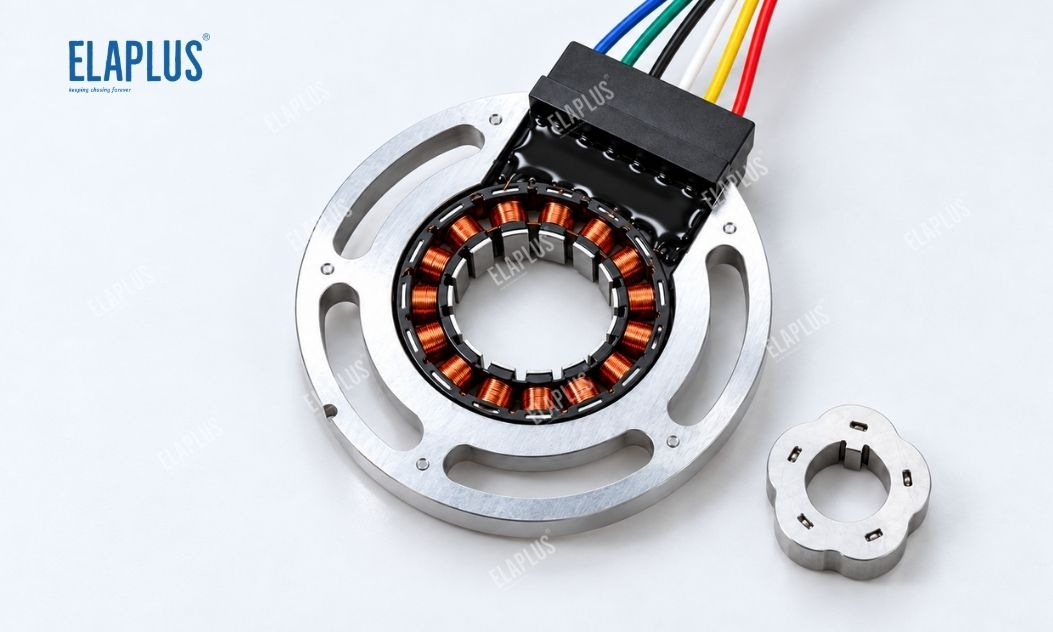
Compared with high-modulus structural adhesives, flexible silicone is suitable for electronic junctions requiring mechanical stress buffering. For resolver terminals, its purpose is to protect leads and connections rather than create rigid full restraint.
SIPC 1822 provides electrical insulation, moisture resistance and moderate sealing performance. It can be evaluated for thin-layer encapsulation around terminal roots and local insulation bobbins. Compatibility with magnet wire, metal terminals, solder materials and plastic bobbins must be verified for each application.
As a moisture-cure system, bead thickness and exposure to ambient humidity govern through-cure. Deep or fully enclosed terminal cavities cannot be reliably cured simply by increasing adhesive volume.
4. Suitable Zones for SIPC 1822 on Resolvers
Resolvers have precision mechanical and electromagnetic structures. Dispensing shall be limited to terminals, winding leads and local insulation zones where protection is required. Structures that do not require adhesive retention shall retain their original mechanical design without unnecessary coverage.
| Resolver Zone | Recommended Dispensing Method | Core Requirements |
|---|---|---|
| Metal terminal root | Local dot encapsulation | Insulation, contamination resistance |
| Winding lead junction | Partial conformal coating | Buffer lead stress |
| Insulation bobbin anchoring zone | Local dispensing per geometry | Bobbin adhesion and controlled bead boundary |
| Inter-terminal gaps | Evaluate per electrical design | Preserve insulation and fill integrity |
| Stator-rotor air gap | Unplanned overflow prohibited | Maintain mechanical and electromagnetic clearance |
| Locating and mating surfaces | Avoid discretionary dispensing | Preserve assembly accuracy |
For terminals with multiple parallel leads, control coverage to prevent leads under different loading directions from being locked together in a single thick bead. For terminals requiring test access or rework, reserve space for probe contact and servicing.
5. Process Control for SIPC 1822 Dispensing on Resolver Terminals
Before dispensing, inspect solder joints, lead arrangement and bobbin condition. Confirm bonding surfaces are free of grease, dust and other contaminants. For fine magnet wires, avoid cleaning methods that may damage insulation.
SIPC 1822 is one-component and requires no A/B metering or mixing. Automated dispensing equipment may be used for targeted application. The needle shall be aligned steadily to the terminal root; adhesive shall flow continuously and spread naturally over the target area. Do not flood the entire resolver by high-volume free dispensing.
For encapsulated terminals, control dosage and bead thickness to cover metal joints and permitted lead sections. Inspect terminal sidewalls, bobbin corners and lead roots for uncovered spots and stray overflow.
Since cure depends on ambient moisture, define curing conditions according to temperature, humidity, bead thickness and cavity geometry. For deep or enclosed encapsulation, validate through-cure by cross-section sampling and functional testing; surface skinning alone does not indicate full cure.
6. Why Stress Validation Is Still Required for Flexible Adhesives
Cured silicone is elastic, yet bead placement and coverage still determine load transfer on leads. If the bead only covers the solder joint without a proper stress relief feature, external tension may still concentrate at the lead root.
For fine winding leads, design bead placement based on harness orientation, anchor points and terminal support to provide protection without creating new stress risers at bead edges.
Flexible materials cannot replace structural optimisation. If lead breakage recurs at the same anchoring location, adjust fixing points and harness routing first, then compare performance with different bead sizes and geometries.
7. Application for Robot Joint Motors and Servo Motors
Robot joint motors are compact, with limited clearance between resolvers, stator/rotor, bearings and harnesses. For these designs, verify encapsulation height, dispensing accuracy and whether the bead interferes with neighbouring components.
Industrial servo motors operate continuously, exposing resolver terminals to vibration and temperature variation. When using SIPC 1822 for local protection, validate joint stability under the motor’s operating temperature, vibration profile and harness configuration.
For rotational position sensing assemblies in new energy vehicle motors, evaluate exposure to coolants, lubricating oils and chemicals. Compatibility testing with the specific media is mandatory; silicone classification alone does not guarantee chemical resistance.
ELAPLUS: Select adhesives based on service conditions, not just stack parameters. Resolver terminal protection shall be evaluated holistically by joint reliability, insulation performance, bead geometry and curing process. Additional adhesive shall not be used to mask inherent structural defects.
8. Reliability Validation for SIPC 1822 Resolver Terminal Protection
Prepare test coupons using production BOM windings, terminals, bobbins and leads. Record electrical performance and appearance before dispensing, after dispensing and after full cure. For high-precision resolvers, compare output signals and angular error pre- and post-dispensing to confirm no interference with assembly.
Environmental reliability testing may include thermal cycling, vibration and damp heat matching service conditions. Inspect bead boundaries, terminal joints and lead roots after testing. Electrical measurement, visual inspection and failure analysis shall be used to identify root causes of any failure.
Mass production shall establish process controls for shot volume, dispense position, bead height and cure conditions. Repeatability testing on full assemblies confirms whether SIPC 1822 meets long-term protection requirements for the target resolver terminal design.
FAQ
Q: What adhesive is used for resolver terminals?
A: ELAPLUS SIPC 1822 one-component silicone adhesive sealant may be used for partial encapsulation, validated against the actual terminal geometry.
Q: Is SIPC 1822 a two-component potting compound?
A: No. SIPC 1822 is a one-component neutral alkoxy-cure silicone, curing at room temperature via atmospheric moisture.
Q: Is SIPC 1822 suitable for deep full-cavity potting?
A: Deep full-cavity potting is not recommended by default. Suitability shall be confirmed based on moisture-cure limits, bead thickness and cavity design.
Q: Is a thicker bead better for resolver terminals?
A: No. The bead shall satisfy local protection requirements while avoiding incomplete cure, overflow and abnormal lead loading.
Q: Is signal testing required after dispensing resolver terminals?
A: Continuity, insulation and angle output shall be checked per product requirements, to confirm dispensing and curing do not disrupt normal operation.