Adhesives for 800V new‑energy‑vehicle high‑voltage systems shall focus on high‑voltage insulation, heat resistance, oil resistance, thermal‑cycling stress, terminal sealing and vibration resistance. For three‑phase copper busbars in oil‑cooled 3‑in‑1 electric drives, ELAPLUS EP 1721‑1 flexible epoxy potting compound is a key candidate. For structures requiring high Tg and low CTE, epoxy systems with high dimensional stability can be further evaluated.
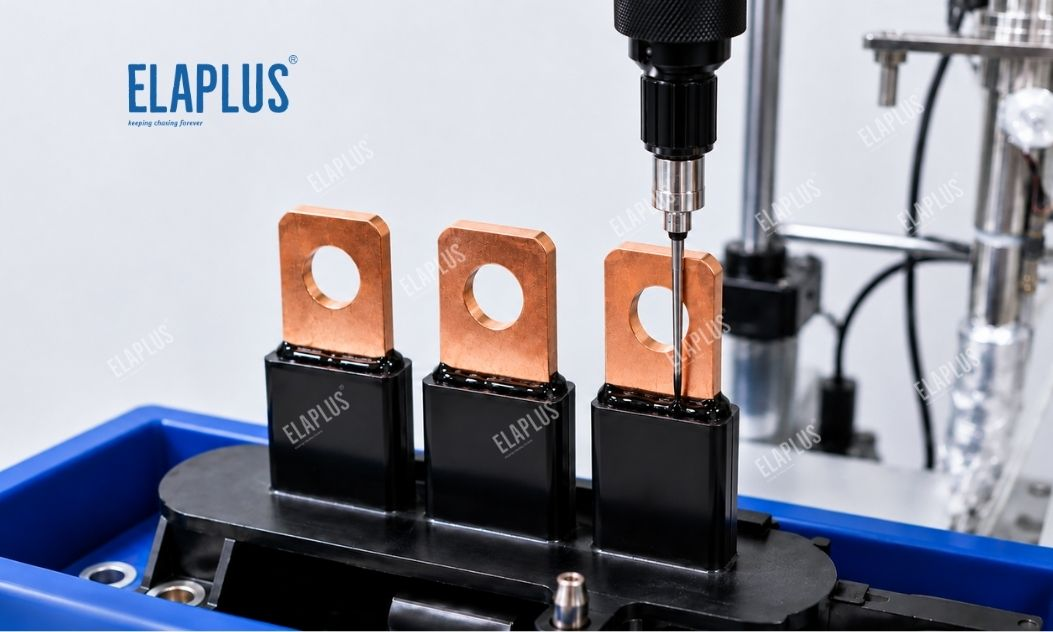
Three‑phase copper busbar sealing
Three‑Phase Copper Busbar Sealing
Why Adhesive Selection for Copper Busbars Becomes More Challenging Under 800V Systems
Voltage upgrade is not the only variable. Other concurrent changes include:
■ Higher power output
■ Increased current density
■ 3‑in‑1 integrated design
■ Reduced available space
■ Adoption of oil‑cooled systems
■ Elevated operating temperature
■ Larger copper busbar dimensions
Accordingly, adhesives for copper busbars need to deliver multiple functions simultaneously: insulation, fixation, sealing and stress buffering.
Why Rigid Epoxies Are Not Always Suitable for All Copper Busbar Applications
The thermal expansion coefficient of copper mismatches that of epoxy resins. Large‑size copper busbars generate greater absolute displacement upon temperature rise. High‑modulus materials that cannot accommodate such displacement may lead to stress concentration at:
■ Copper busbar root sections
■ Edges of potting layers
■ Terminal zones
■ Housing corners
The failure sequence proceeds as follows: stress concentration → micro‑cracks → crack propagation → medium ingress → insulation risks. Therefore, flexibility has become an increasingly critical indicator for 800V copper busbar materials.
Why EP 1721‑1 Is Suitable for Flexible Copper Busbar Potting
ELAPLUS EP 1721‑1 is a flexible‑formula epoxy potting compound.
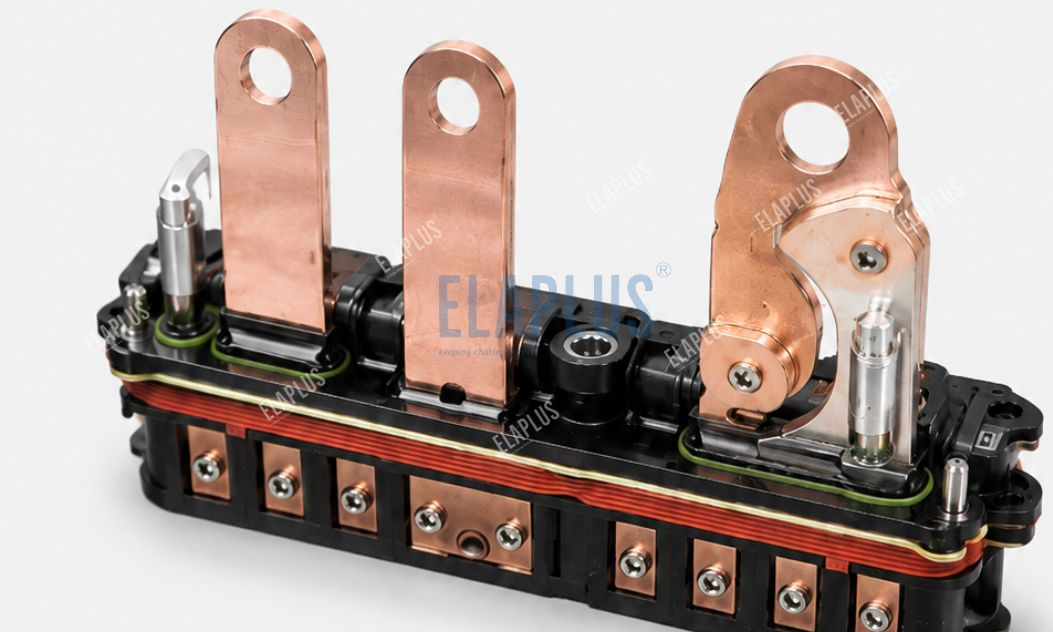
Copper busbar sealing
Primary application scenarios:
■ Three‑phase copper busbars
■ High‑voltage connectors
■ Oil‑cooled electric drives
■ Fixation at copper busbar roots
■ Protection around terminals
Its core design concept: firmly secure copper busbars while reserving buffer allowance for thermal expansion and contraction.
Why Oil Exposure Environment Must Be Considered for Copper Busbar Potting
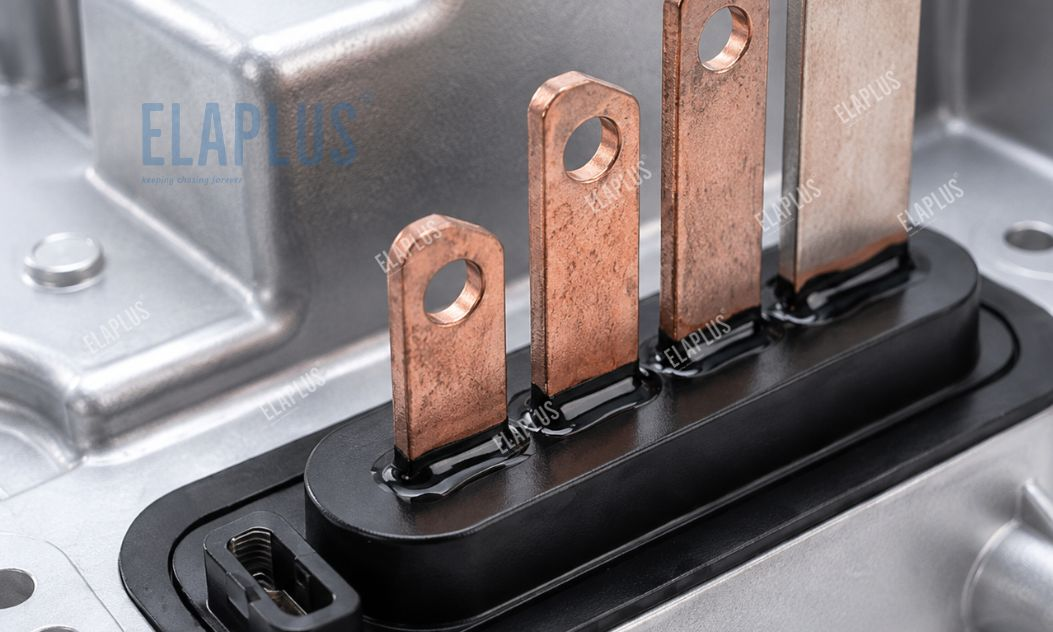
In certain 3‑in‑1 oil‑cooled electric drive designs, copper busbars do not operate in ordinary ambient air. T
hey may be persistently exposed to hot oil or oil mist. Apart from standard insulation tests, the following performance items shall be assessed:
■ High‑temperature oil immersion resistance
■ Hardness change after oil exposure
■ Volume variation after oil exposure
■ Adhesion retention after oil exposure
■ Hot oil cycling performance
■ Insulation property retention
Room‑temperature adhesion tests alone cannot guarantee real‑world reliability of electric drives.
Frequently Asked Questions on Adhesive Selection for Three‑Phase Copper Busbar Terminal Sealing
Does higher dielectric strength always mean better performance for 800V applications?
Insulation performance is essential, yet creepage distance, mechanical structure, pollution degree, operating temperature and long‑term medium exposure environment also need to be considered comprehensively.
Why flexible epoxy is preferred over conventional silicone for copper busbars?
It depends on specific structures. Flexible epoxy delivers enhanced stress‑buffering capability while retaining epoxy’s inherent adhesion and mechanical structural properties.
Can EP 1721‑1 be applied to all copper busbar scenarios?
Validation based on actual structure, oil medium type, operating temperature and potting layer dimension is still required.
Technical Support / Free Sample Request: info@elaplus.cc