Inductors in power modules, automotive electronics, industrial control equipment, transformers, reactors, and inductor coils operate long-term under heat, vibration, moisture, voltage stress, and space-constrained conditions.
For inductor products, potting compound is more than just a filler—it provides insulation, thermal conduction, moisture & shock resistance, flame retardancy, and structural fixation.
Improper selection of inductor potting compound may lead to:
■ Adhesive cracking
■ Coil loosening
■ Reduced insulation
■ Excessive local temperature rise
■ Moisture intrusion
■ Debonding after vibration
■ Insufficient flame retardancy
■ Degraded long-term reliability
For potting inductors, reactors, electronic coils, and high-reliability electronic modules, Elaplus EP 1712 two-component epoxy potting compound is recommended.
EP 1712 features high hardness, good toughness, low volume shrinkage, UL94 V-0 flame retardancy, excellent electrical insulation, and strong moisture & shock resistance, ideal for inductor potting requiring high structural strength, insulation reliability, and long-term protection.
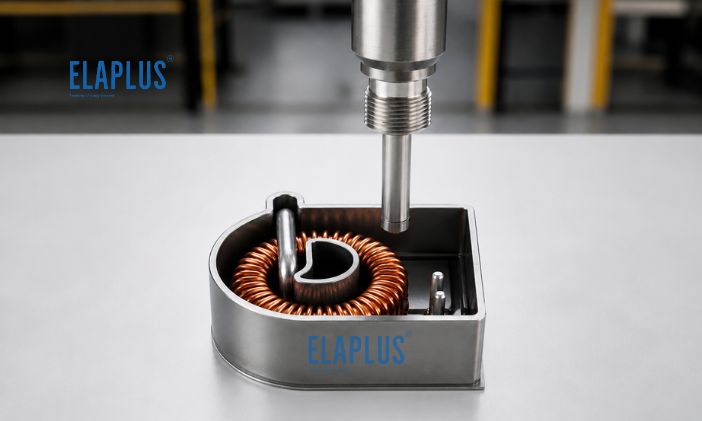
1. Why Do Inductors Need Potting Compound?
Inductors consist of magnetic cores, copper windings, bobbins, pins, and housings. During operation, they are affected by current changes, magnetic fields, and environmental variations.
Key functions of inductor potting compound:
① Insulation Protection
Stable electrical insulation is required between coils, pins, solder joints, and magnetic cores.
EP 1712 offers excellent electrical insulation after curing:
Dielectric strength: 20 kV/mm (25°C)
Volume resistivity: 2.00×10¹⁴ Ω·cm
It reduces risks of leakage, breakdown, and short circuits.
② Thermal Conduction & Heat Dissipation
Inductors generate heat during operation, especially in high-frequency power supplies, reactors, and power modules.
Potting compound fills internal gaps to conduct heat from windings and cores to the housing or surrounding structures, reducing hotspots.
③ Moisture & Shock Resistance
Long-term moisture exposure causes insulation degradation, terminal corrosion, and coil failure.
EP 1712 forms a stable protective layer, blocking moisture, dust, and contaminants. It secures coils and lowers loosening risk from vibration.
④ Flame Retardant Protection
Flame retardancy is critical in power, electronic control, industrial, and automotive applications.
EP 1712 meets UL94 V-0, suitable for safety-critical electronic potting.
⑤ Structural Fixation
Coils, cores, and pins are vulnerable to vibration.
EP 1712 provides strong structural support:
Hardness: Shore D 80
Tensile strength: ~32 MPa
Shear strength (iron-to-iron): ~8 MPa
2. Why EP 1712 Is Ideal for Inductor Potting
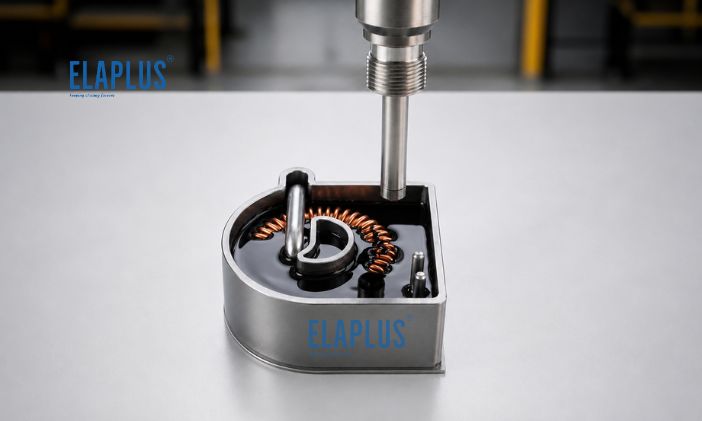
① High Hardness + Good Toughness (Improved Stability)
Vibration during transport, assembly, and operation is mitigated.
Shore D 80 hardness with good toughness unifies coils, cores, and housings to eliminate loosening and noise.
② Low Volume Shrinkage (Reduced Internal Stress)
Low shrinkage minimizes stress on copper wires, cores, bobbins, and housings, lowering cracking, debonding, and deformation risks.
③ UL94 V-0 Flame Retardancy (Enhanced Safety)
Suitable for power modules, inverters, industrial controls, and reactors with strict safety requirements.
④ Superior Electrical Insulation (Coil Protection)
20 kV/mm dielectric strength and 2.00×10¹⁴ Ω·cm volume resistivity ensure safe insulation for coils and pins.
⑤ Two Mix Viscosities (Wide Compatibility)
9,000–15,000 mPa·s: For strong encapsulation and stable positioning
2,000–4,000 mPa·s: For excellent flow into small gaps
Adapts to various inductors, reactors, coil modules, and housing designs.
3. Typical Applications of EP 1712
■ Inductor Potting
■ Reactor Potting
■ Power Module Potting
■ Coil Potting
■ Industrial Electronic Potting
4. Recommended Inductor Potting Process
■ Pre-Cleaning
Remove oil, dust, moisture, and release agent from coils, cores, housings, and pins.
■ Correct Ratio
Mix at A:B = 100:20 by weight.
■ Thorough Mixing
Ensure uniform blending to avoid incomplete curing.
■ Select Viscosity Grade
Low viscosity for small gaps; high viscosity for firm encapsulation.
■ Curing Conditions
25°C × 24 h (room temperature)
80°C × 60 min (heat cure for high efficiency)
■ Reliability Validation
Perform withstand voltage, insulation, thermal cycling, damp heat aging, vibration, and flame tests.
5. FAQ – Inductor Potting Compound
Q1: What material is best for inductor potting?
A: Choose epoxy potting compound with good insulation, flame retardancy, moisture/shock resistance, structural fixation, and low shrinkage. Elaplus EP 1712 (Shore D 80, UL94 V‑0, 20 kV/mm) is highly recommended.
Q2: Is EP 1712 suitable for inductor potting?
A: Yes. It is a two-component epoxy (mix ratio 100:20), curable at room or elevated temperature, with high hardness, toughness, low shrinkage, V‑0 flame retardancy, and excellent insulation.
Q3: Why is UL94 V-0 required for inductor potting?
A: Inductors in power/control equipment carry continuous current and heat. V-0 flame retardancy improves safety and reduces fire risk.
Q4: Why is high insulation important for inductor potting?
A: Poor insulation causes leakage, breakdown, or short circuits. EP 1712 (20 kV/mm) provides reliable coil insulation.
Q5: What are the curing conditions for EP 1712?
A: 25°C for 24 hours, or 80°C for 60 minutes. Adjust based on product structure, potting depth, and production cycle.
Core Value of Inductor Potting
Inductor potting is not just filling—it creates a protective layer for insulation, heat dissipation, moisture resistance, shock resistance, flame retardancy, and structural stability.
For inductors, reactors, coils, power modules, and industrial electronics, Elaplus EP 1712 delivers a reliable potting solution with high hardness, toughness, low shrinkage, UL94 V-0, 20 kV/mm dielectric strength, and all-around protection.
Elaplus – Making Inductor Potting More Stable, Electronic Modules More Reliable.
Previous post: How to Choose Sensor Potting Compound, Motor Potting Compound, and Power Supply Potting Compound? Elaplus Functional Materials Provides Reliable Solutions for Electronics, Automotive, and New Energy Equipment
Next post: Adhesive Solutions for PV Energy Storage Systems: Covering Structural Bonding, BMS/CCS Protection, Lithium Battery Potting, Thermal Management and PACK Sealing