I. Why Do Automotive Controllers Require Potting?
Automotive controllers generally consist of PCBs, capacitors, inductors, chips, connectors, power devices, sensing units and other components. They are widely applied in electronic modules including: motor controllers, body controllers, water pump controllers, battery management system (BMS) control modules, thermal management controllers, fan controllers, etc.
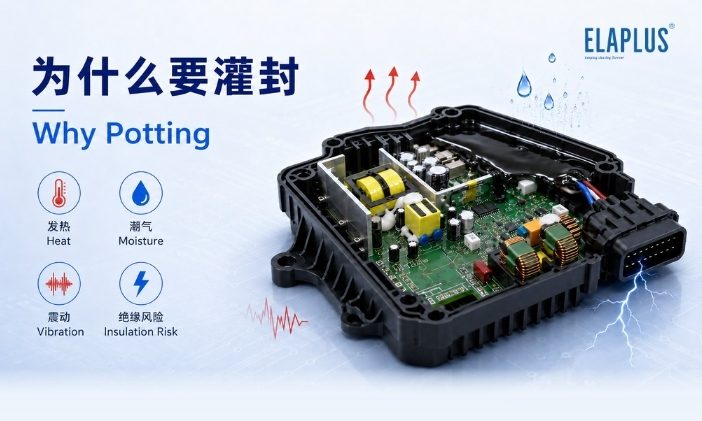
During operation, these modules are exposed to multiple environmental factors:
■ Continuous heat generation from high‑power devices
■ Vibration and impact caused by vehicle movement
■ Intrusion of moisture, water vapor and dust
■ Material stress changes induced by thermal cycling
■ Insulation risks under high‑voltage electrical conditions
■ Complex internal controller structures with limited heat-dissipation space
Without reliable potting protection, controllers may suffer performance degradation or even failure during long-term operation.
Core functions of potting automotive controllers include:
■ Thermal conduction and heat dissipation
■ Electrical insulation protection
■ Moisture-proof and waterproof performance
■ Anti-vibration and shock buffering
■ Fixation of electronic components
■ Improved flame-retardant safety
■ Reduced thermal and structural stress impacts
■ Enhanced long-term reliability of controllers
II. Challenges in Selecting Potting Compounds for Automotive Controllers
Not all potting compounds that can be poured into modules are suitable for automotive electronics. Controllers in particular demand comprehensive high-performance materials.
- High Thermal Conductivity Required
Power devices, inductors, capacitors, chips and other components inside controllers generate heat during operation. Insufficient thermal conductivity of potting materials traps heat, leading to excessive local temperature rise and shortened service life of electronic components.
Therefore, potting compounds for automotive controllers must feature excellent thermal conductivity.
- Good Flowability Required
Controllers have complex internal structures with numerous gaps and dead zones between components. Poor flowability of potting compounds causes incomplete filling, residual bubbles and voids under components.
Well-flowing potting compounds penetrate component gaps better, improving encapsulation integrity and consistency.
- Low Curing Shrinkage Required
Excessive shrinkage during curing exerts stress on components, solder joints and PCBs, even causing solder joint cracking, component deformation or bonding interface failure.
Low curing shrinkage reduces curing stress and improves long‑term stability of controllers.
- Flame Retardancy Required
Automotive electronics require high safety standards, especially for new-energy vehicles, high-voltage systems and power control modules. Potting materials with UL94 V-0 flame retardancy improve controller safety under abnormal working conditions.
- Reliable Electrical Insulation Required
Automotive controllers contain massive electronic components and electrical connection points. Potting compounds must deliver superior electrical insulation to reduce risks of electric leakage, short circuits and electrical breakdown.
III. Why ELAPLUS SIPA 1850 Is Recommended for Automotive Controller Potting
ELAPLUS SIPA 1850 is a specialized potting material developed for automotive controllers, automotive electronic modules, power electronic devices and other applications.
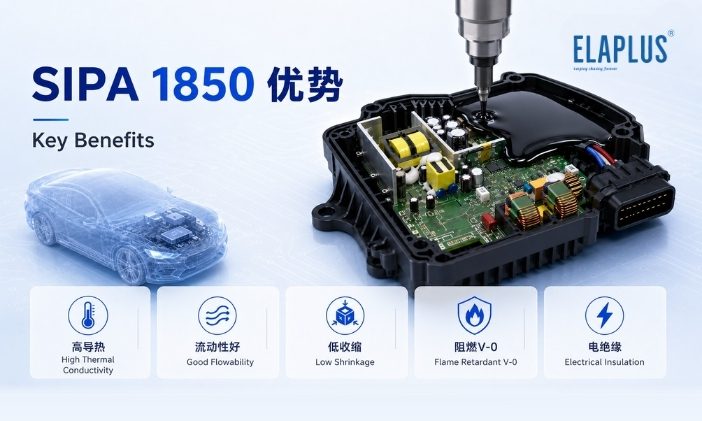
Its core advantages are summarized as:
■ High thermal conductivity
■ Excellent flowability
■ Low curing shrinkage
■ UL94 V-0 flame retardancy
■ Superior electrical insulation
These properties perfectly match the key requirements for automotive controller potting.
IV. Analysis of Core Advantages of SIPA 1850
1. High Thermal Conductivity: Stable Heat Dissipation for Controllers
Automotive controllers feature dense internal components, especially power devices that continuously generate heat during operation. Undissipated internal heat impairs reliability of chips, capacitors, inductors and solder joints.
SIPA 1850 delivers high thermal conductivity, transferring heat from components to housings or heat-dissipation structures and reducing local heat accumulation risks.
Suitable for:
■ Automotive controller potting
■ Power module potting
■ Motor controller potting
■ Thermal management controller potting
■ New-energy electronic module potting
For high-power-density, miniaturized and integrated controllers, high-thermal-conductivity potting compounds are critical materials to enhance system reliability.
2. Excellent Flowability: Complete Filling for Complex Structures
Automotive controllers have uneven internal structures with electronic components of varying heights on PCBs, including capacitors, inductors, chips, connectors, terminals and sensors.
Poor flowability may lead to:
■ Inadequate filling under components
■ Inability to penetrate fine gaps
■ Internal residual bubbles
■ Uneven potting thickness
■ Insufficient local insulation protection
SIPA 1850 features good flowability, ideal for potting complex internal controller structures and enabling uniform encapsulation and stable filling.
For automated potting production lines, good flowability also improves potting efficiency and reduces process fluctuations.
3. Low Curing Shrinkage: Reduced Stress Impacts on Components
PCBs, solder joints and electronic components in automotive controllers are sensitive to mechanical stress. Significant shrinkage of potting materials during curing exerts tensile stress on components and shortens product service life.
SIPA 1850 features low curing shrinkage, reducing curing stress and minimizing impacts on electronic components and solder joints.
This advantage is particularly critical for:
■ Precision controller potting
■ High-density PCB potting
■ Thin control module potting
■ Automotive ECU module protection
■ Long-term reliability design for new-energy controllers
Low shrinkage affects not only initial potting quality but also long-term reliability of controllers after thermal cycling.
4. UL94 V-0 Flame Retardancy: Improved Safety Level of Automotive Electronics
Automotive electronics require extremely high safety standards, especially for new-energy vehicle control systems, power electronic modules and high-voltage control units.
With UL94 V-0 flame retardancy, SIPA 1850 enhances fire safety of controllers for automotive electronic applications with strict flame‑retardant requirements.
Flame-retardant potting compounds are suitable for:
■ Motor controllers
■ High-voltage control modules
■ On-board power modules
■ New-energy vehicle electronic control units
■ Thermal management system controllers
■ Power conversion modules
Flame retardancy provides higher safety redundancy for controllers under abnormal high temperatures, electrical faults or external heat sources.
5. Superior Electrical Insulation: Electrical Safety Protection for Controllers
Automotive controllers contain numerous circuit connections. Beyond filling and heat conduction, potting compounds must deliver reliable electrical insulation.
SIPA 1850 features excellent electrical insulation, reducing risks of:
■ Electric leakage
■ Short circuits
■ Electrical breakdown
■ Insulation degradation caused by moisture
■ Electrical failures induced by conductive impurities
For automotive controllers operating long-term in humid, high-temperature and vibrating environments, electrical insulation is a key indicator of potting compound reliability.
V. Suitable Automotive Electronic Applications for SIPA 1850
Beyond automotive controller potting, SIPA 1850 is applicable to multiple automotive and new‑energy electronic modules.
Automotive Controller Potting
Potting protection for controller PCBs, power devices, signal components and peripherals of connectors to improve thermal conduction, insulation, moisture‑proofing and shock resistance.
Motor controllers feature high power density and concentrated heat, demanding strict thermal conduction and insulation. SIPA 1850 optimizes internal thermal management and electrical protection.
Automotive water pump controllers are continuously exposed to moisture, vibration and temperature changes, requiring potting compounds with moisture-proof, insulating, anti-vibration and thermal-conductive properties.
On-board Power Module Potting
On-board power modules require high flame retardancy, thermal conductivity and insulation. SIPA 1850 with UL94 V-0 flame retardancy and high thermal conductivity meets such requirements.
New-Energy Vehicle Electronic Module Potting
New-energy vehicle control modules are widely used in electric drive, battery, thermal management and charging systems, requiring long‑term reliable potting protection.
VI. Potting Process Recommendations for Automotive Controllers
For stable potting effects, focus on the following key process points:
■ Control PCB surface cleanliness to avoid oil stains, dust and moisture impairing adhesion and insulation.
■ Design potting height rationally according to component height and heat‑dissipation requirements.
■ Optimize bubble removal processes; adopt vacuum degassing or low‑speed potting for complex structures to reduce residual bubbles.
■ Control curing conditions according to product structures and production line takt time.
■ Verify thermal conduction paths; ensure potting compounds form effective heat‑transfer paths between heat‑generating components and housings.
■ Conduct reliability tests including thermal cycling, damp-heat aging, vibration impact and electrical insulation tests.
VII. Selection Recommendations for Automotive Controller Potting Compounds
Prioritize the following indicators when selecting potting compounds:
■ Thermal conductivity
■ Flowability
■ Curing shrinkage
■ Flame-retardant grade
■ Electrical insulation performance
■ High-low temperature resistance
■ Adhesion compatibility
■ Curing process
■ Bubble control capability
Long-term reliability test results
For automotive controllers, motor controllers, on-board power modules and new-energy electronic control units, potting compounds with high thermal conductivity, low shrinkage, UL94 V-0 flame retardancy, superior electrical insulation and good flowability are recommended.
VIII. Frequently Asked Questions (FAQs)
Q1: What material is suitable for automotive controller potting?
Potting compounds with high thermal conductivity, good flowability, low curing shrinkage, UL94 V-0 flame retardancy and superior electrical insulation are recommended. ELAPLUS SIPA 1850 is ideal for automotive controllers, motor controllers, water pump controllers and on-board power modules.
Q2: Why do automotive controller potting compounds require high thermal conductivity?
Power devices inside automotive controllers continuously generate heat. High‑thermal-conductivity potting compounds transfer heat from components to housings or heat-dissipation structures, reducing local temperature rise and improving long-term operational reliability of controllers.
Q3: Why do automotive controller potting compounds require low curing shrinkage?
Low curing shrinkage reduces stress exerted by potting compounds on PCBs, solder joints and electronic components during curing, improving controller reliability under thermal cycling and long‑term operation.
Q4: What is the significance of UL94 V-0 flame retardancy for automotive electronic potting?
UL94 V-0 indicates high flame‑retardant performance. For new-energy vehicles, high-voltage controllers, on‑board power supplies and power modules, flame-retardant potting compounds enhance safety of electronic modules under abnormal working conditions.
Q5: What applications is SIPA 1850 suitable for?
SIPA 1850 is suitable for potting automotive controllers, motor controllers, water pump controllers, on-board power modules and new‑energy vehicle electronic modules.
IX. Conclusion: Reliable Long–term Performance Depends on Proper Potting Material Selection
Reliability of automotive controllers relies not only on circuit and structural design but also on whether potting materials match application scenarios.
For automotive controllers requiring thermal conduction, insulation, flame retardancy, moisture‑proofing, shock resistance and low-stress protection, ELAPLUS SIPA 1850 high‑thermal-conductivity flame-retardant potting compound provides stable and reliable potting solutions for automotive electronic control modules, featuring high thermal conductivity, excellent flowability, low curing shrinkage, UL94 V-0 flame retardancy and superior electrical insulation.
ELAPLUS – Making automotive electronics safer and controller operation more reliable.
Previous post: Which Epoxy Resin to Use for Servo Motor Stator Potting?EP 1716 Is Engineers’ Top Choice Thanks to Four Key Performance Metrics
Next post: How to Select Motor Potting Compound?EP 1716 High-Thermal-Conductivity Epoxy Potting Compound Delivers One-Stop Thermal Dissipation & Reliability for Motors