Lithium battery potting compounds shall be selected based on lightweight requirements, thermal conductivity, flame retardancy, operating temperature, cured hardness and potting volume.
If battery pack weight reduction is required, Elaplus PUR FOAM 1685 or SIPA 2100-7# can be evaluated. For applications requiring flexible flame retardancy and moderate thermal conductivity, PUR 1680 is recommended. Where a wide service temperature range and low-stress protection from silicone materials are needed, SIPA 1850 is the preferred option.
Why Do Lithium Batteries Require Potting Compounds?
Lithium battery potting compounds are mainly used to fill voids between battery cells, BMS, high-voltage components and the enclosure, delivering the following protections for battery systems:
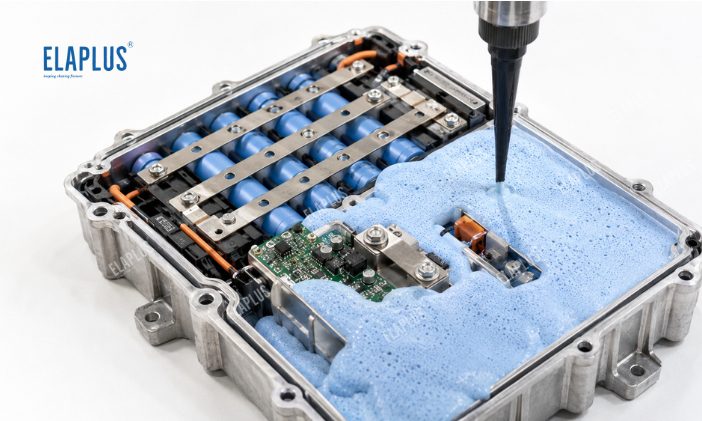
Low-Density Lithium Battery Potting Compound
■ Waterproof and moistureproof performance
■ Electrical insulation
■ Component fixation
■ Vibration and shock resistance
■ Flame retardant protection
■ Heat transfer
■ Prevention of dust and contaminant ingress
Nevertheless, battery packs generally require large-volume potting. Materials with excessive density will significantly increase the overall pack weight. Therefore, when choosing lithium battery potting compounds, thermal conductivity and unit price cannot be the only evaluation criteria.
Recommended Potting Compounds for Lightweight Battery Packs
PUR FOAM 1685: Foamed Polyurethane Potting Compound
PUR FOAM 1685 is a 1:1 two-component foaming polyurethane potting compound.
Key Features:
■ Working life: approx. 1–5 minutes
■ Foaming completes within around 10 minutes
■ Foamed density: approx. 0.2 g/ml
■ Suitable for large-volume lightweight void filling
Recommended Applications:
■ Cavity filling of battery packs
■ Cushioning protection between battery cell modules
■ Weight-sensitive energy storage batteries and power batteries
■ Structures demanding reduced weight per unit potting volume
For foamed potting materials, strict control shall be implemented on expansion ratio, cell uniformity, foaming pressure and impacts on cell structures.
SIPA 2100-7#: Low-Density Silicone Potting Compound
SIPA 2100-7# is a 1:1 low-density silicone potting compound with a density of approx. 0.62 g/ml and service temperature ranging from -60 ℃ to 200 ℃.
Suitable for:
■ Battery systems requiring both lightweight design and wide temperature adaptability
■ Battery modules subjected to frequent high-low temperature cycling
■ BMS and electronic components sensitive to curing stress
■ Energy storage batteries, power tool batteries and new energy vehicle batteries
Recommended Flame-Retardant & Thermally Conductive Lithium Battery Potting Compounds
PUR 1680: Thermally Conductive Flame-Retardant Polyurethane Potting Compound
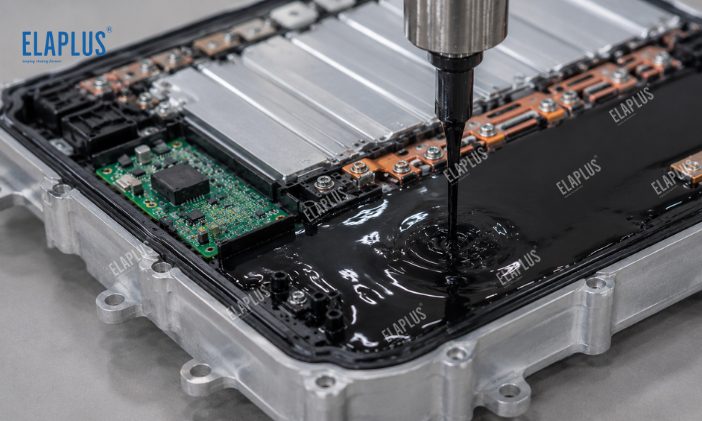
PUR 1680 is a two-component polyurethane potting compound with a mix ratio of 100:16. It features good flexibility, thermal conductivity of approx. 0.8 W/m·K, and complies with UL94 V-0 flame retardant standard.
Suitable for:
■ Power battery modules
■ Battery controllers
■ Current sensors and high-voltage accessories
■ Areas requiring balanced flexibility, flame retardancy and thermal conductivity
■ Electronic modules operating at -50 ℃ ~ 130 ℃
SIPA 1850: Thermally Conductive Silicone Potting Compound
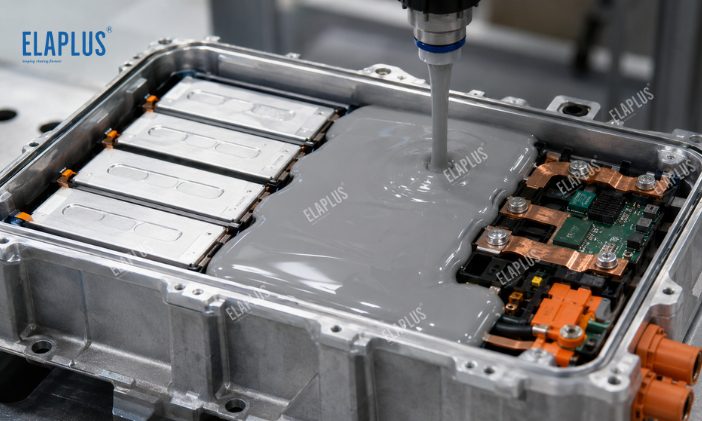
SIPA 1850 is a 1:1 two-component thermally conductive silicone potting compound. Its thermal conductivity reaches approx. 0.8 W/m·K, with service temperature covering -60 ℃ ~ 250 ℃.
Suitable for:
■ Battery electronic modules under frequent high-low temperature cycling
■ Applications with stringent requirements for low stress and wide temperature range
■ BMS, power electronics and inductor modules
■ New energy vehicles and energy storage systems
Elaplus battery potting solutions cover four material routes: foamed polyurethane, elastic polyurethane, low-density silicone and thermally conductive silicone.
Elaplus Lithium Battery Potting Compound Grade Comparison
| Grade | Material System | Core Characteristics | Recommended Application Scenarios |
|---|---|---|---|
| PUR FOAM 1685 | Foamed Polyurethane | Density: ~0.2 g/ml | Large-volume lightweight filling |
| PUR 1680 | Polyurethane | Flexible, 0.8 W/m·K, UL94 V-0 | Thermally conductive & flame-retardant potting |
| SIPA 2100-7# | Silicone | Low density, wide temperature range | Lightweight & low-stress protection |
| SIPA 1850 | Silicone | Thermally conductive, elastic, wide temperature range | High-reliability electronic modules |
Conclusion on Lithium Battery Potting Compound Selection
For large-volume battery pack filling prioritizing lightweight performance: focus on evaluating PUR FOAM 1685.
For comprehensive performance of flexibility, flame retardancy and thermal conductivity: select PUR 1680.
For lightweight demands plus wide operating temperature range: evaluate SIPA 2100-7#.
For low-stress thermally conductive protection with frequent temperature cycling: choose SIPA 1850.
FAQ — Frequently Asked Questions about Lithium Battery Potting Compounds
Why is the density of lithium battery potting compound important?
For large potting volumes, material density directly affects the total weight of the battery pack and cruising efficiency.
Can foamed potting compounds fully replace solid potting compounds?
Simple replacement is not feasible. Foamed materials are more suitable for lightweight void filling. Structural strength, thermal conductivity and waterproof performance need separate verification.
How to choose between polyurethane and silicone potting compounds?
Polyurethane generally balances flexibility, adhesion and cost. Silicone is preferred for wide temperature range, low stress and frequent thermal cycling conditions.
Contact Information
Elaplus Functional Materials (Shanghai) Co., Ltd.
Technical selection & free sample request: +86 21-67229836
Email: info@elaplus.cc
Website: www.elaplus.cc
Address: No.555 Jiugong Road, Jinshan Industrial Zone, Shanghai, China