For bonding automotive LCD screens to bezels, silicone adhesives featuring elastic bonding, temperature-cycle resistance and stable dispensing performance are recommended for evaluation as candidate materials for such display modules. For automotive display assemblies requiring a balance of bezel fixation, assembly precision and long-term environmental reliability, priority should be given to substrate compatibility, glue line position, assembly gap and curing process, rather than simply pursuing high initial bond strength.
With the development of smart cockpits in new energy vehicles, central control screens, instrument displays, passenger entertainment screens and other automotive display modules impose stricter requirements on lightweight design, assembly consistency and long-term reliability.
An automotive display module generally consists of a display panel, cover glass, bezel, bracket and related electronic components. Adhesives may be used for bezel fixation, local sealing or other structural joints depending on the design. It is essential to define the actual bonding area first.
For joints between LCD panels and bezels, the material must not only secure parts during assembly, but also accommodate dimensional changes of dissimilar substrates under temperature variation.
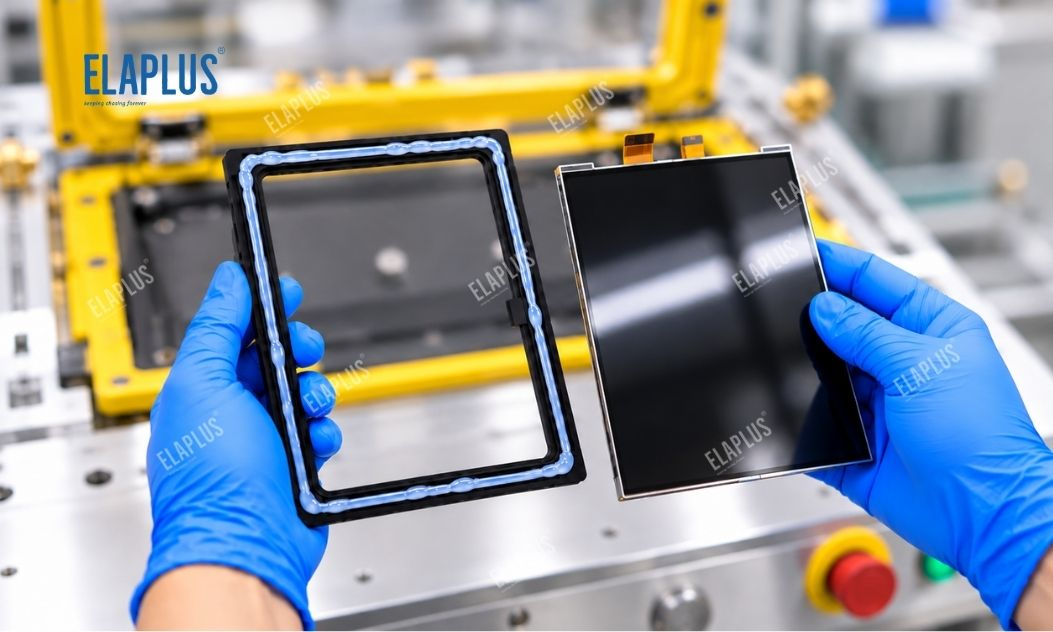
1. Key Requirements for Bonding Automotive Screens and Bezels
Automotive display screens must form structural joints within a narrow bezel width. The dispense position and cured profile of the adhesive directly affect assembly dimensions and cosmetic appearance.
Compared with ordinary electronic housing bonding, display modules also require protection of optical zones, bezel positioning and controlled mechanical loading on the display panel. For large-size screens, the differential thermal expansion between bezel and display panel must also be considered in material selection.
Therefore, bezel-bonding adhesives for displays must satisfy substrate adhesion, appropriate flexibility, process controllability and environmental reliability simultaneously.
| Selection Item | Core Requirement | Impact on Adhesive Selection |
|---|---|---|
| Substrate Compatibility | Adhesion to glass, metal or actual bezel materials | Determines interfacial bonding reliability |
| Glue Line Profile | Suit narrow-bezel dispensing and assembly constraints | Governs viscosity, flow behaviour and dispensing method |
| Elasticity & Modulus | Accommodate thermal deformation to a certain extent | Controls mechanical restraint exerted by the adhesive layer on the display panel |
| Curing Conditions | Comply with temperature limits of the display assembly | Defines curing process and production tact time |
| Dimensional Stability | Maintain designed bond-line thickness and bezel alignment | Affects assembly accuracy |
| Environmental Reliability | Withstand thermal cycling and specified damp-heat conditions | Defines validation requirements |
For bezels with coatings, printing inks or special surface treatments, verify the actual interface that contacts the adhesive. Labelling a substrate simply as glass or aluminium alloy is insufficient to confirm bonding performance.
2. Why Evaluate Silicone Adhesives for Automotive Display Bezels?
Silicone adhesives can be formulated for flexible bonding and sealing, making them suitable for electronic structures that need to tolerate temperature fluctuations. For assemblies where the display panel and bezel have mismatched thermal expansion, compliance of the adhesive layer is a key evaluation metric.
Compared with high-rigid structural adhesives, a suitably flexible bond line can accommodate relative deformation between mating substrates to some degree. This does not mean softer is always better; the material must still meet requirements for bezel positioning, bond strength and assembly dimensions.
Additionally, bezel bonding for displays typically requires continuous dispensing along predefined paths and retention of the designed bead profile after lamination. Therefore, flow characteristics, pot life and cure mechanism also affect mass-production suitability.
For structures with larger assembly gaps or special positioning needs, validation should be carried out with actual tooling and dispensing equipment instead of selecting solely based on polymer chemistry.
3. Suitable Bonding Scenarios for SIPA 1830 H50
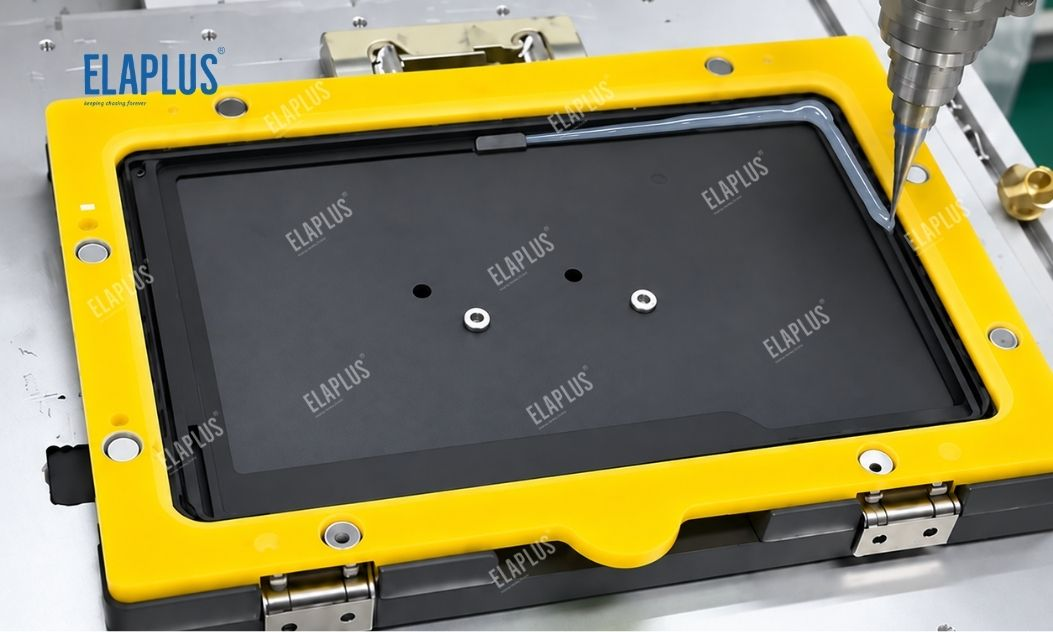
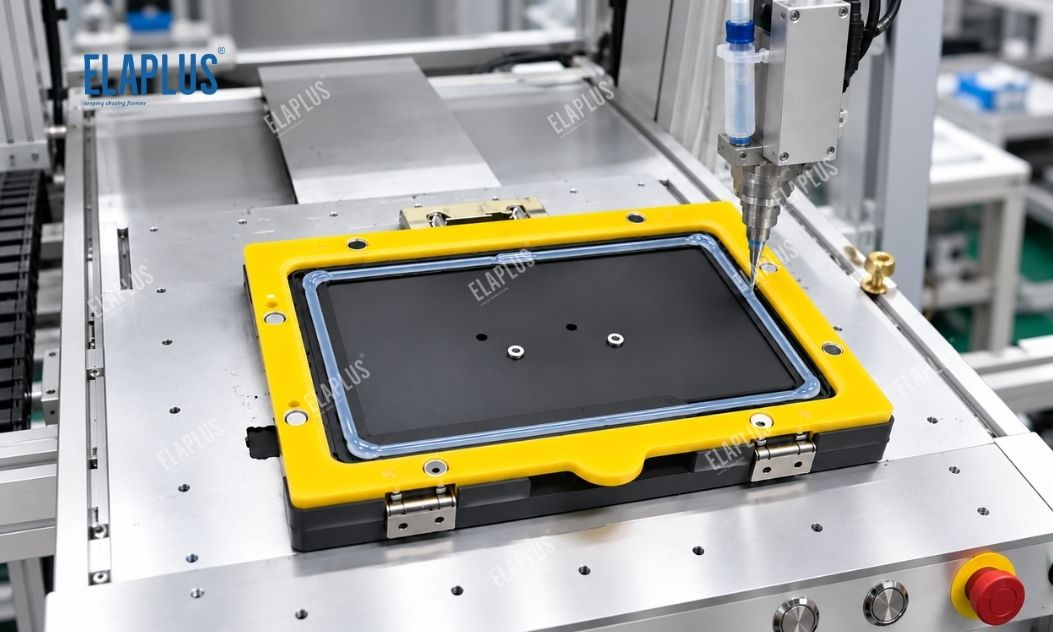
ELAPLUS SIPA 1830 H50 is a two-component silicone adhesive, specified for bonding display modules and touch panels in official application documents. It can be evaluated as a candidate for elastic joints between automotive LCD screens and bezels.
This material is designed for production processes relying on two-component metering and mixing for consistent dispensing. For automotive bezel bonding, focus on its adhesion performance on actual glass, metal and other bezel materials.
If the bezel undergoes spray coating, anodising or other surface treatments, run tests using mass-production parts. For glass edges printed with black ink or other functional coatings, confirm compatibility between the adhesive and those coatings.
Final suitability of SIPA 1830 H50 for a specific display project depends on actual glue line width, cure temperature, lamination timing and environmental test results; qualification cannot be confirmed merely from application descriptions.
4. Recommended Dispensing Process for Automotive Display Bezel Bonding
Automotive display bezels are usually assembled using fixture positioning combined with automated dispensing. Before dispensing, define the bonding surface, glue line width, bond-line thickness and no-dispense zones.
For rectangular or irregularly shaped bezels, set continuous dispense trajectories according to the geometry. Special control of bead volume is required at corners, start/end points and narrow edge sections. For closed-loop glue lines, confirm how the start and end of the bead join to avoid local under-fill or excessive build-up.
During lamination of screen and bezel, use positioning fixtures to control relative alignment so the adhesive forms stable contact within the designed gap. For large display modules, ensure uniform lamination pressure to prevent local over-compression.
After assembly, cure under the specified profile, and only proceed with handling and inspection once the adhesive reaches the required cure state.
5. Controlling Glue Line Width and Bond-Line Thickness
Bezel bonding for automotive screens must balance effective bonding area and cosmetic appearance. An over-wide bead may encroach on unintended regions, while an overly narrow bead may fail to meet the required bonding area.
Glue line width shall be determined by bezel geometry, allowable overflow range and assembly tolerances. Near the display edge, prevent adhesive from migrating into the viewing area, optical functional zones or other restricted areas.
Bond-line thickness is controlled according to the actual gap between bezel and display panel. For structures with height offsets, use fixtures or other methods to maintain consistent thickness and avoid local over-squeezing.
For automated production, improve batch-to-batch consistency of bead profiles by tuning dispenser parameters, fixture alignment and implementing visual inspection where necessary.
6. Comparison Between SIPA 1830 H50 and Other Adhesive Systems
Different display modules may use silicones, acrylics or other structural adhesives. Selection should be based on the specific joint location and assembly requirements; no single adhesive system is a universal solution for all automotive displays.
| Adhesive System | Primary Application Focus | Key Conditions to Verify |
|---|---|---|
| Two-component silicone | Elastic joints and thermal deformation accommodation | Mixing, curing, adhesion and bond-line dimensional stability |
| One-component silicone | Structures suitable for room-temperature cure | Cure progression, bond thickness and waiting time before assembly |
| Acrylic structural adhesive | Assemblies requiring fast development of handling strength | Substrate compatibility, cure behaviour and stress impact |
| Epoxy structural adhesive | Joints requiring high structural rigidity | Modulus, curing profile and thermal stress |
For display assemblies demanding high dimensional stability, compare post-cure mechanical properties together with the actual assembly structure. For applications with large temperature swings, evaluate the ability of the bond line to coordinate deformation between bezel and panel.
If short production tact time is required, confirm the elapsed time from dispensing and lamination until the adhesive gains sufficient strength for handling, rather than relying only on nominal cure speed.
7. Establishing a Validation Plan for Automotive Bezel Bonding
First, prepare test coupons using actual display panels, bezels and real surface treatments to confirm stable bonding in the target zone. For screens of different sizes, assess whether separate validation is required based on structural differences.
Next, inspect bead continuity after dispensing, assembly dimensions, bezel alignment and cosmetic quality. For designs where panel loading must be controlled, evaluate display performance and mechanical status before and after lamination per project specifications.
Environmental validation includes thermal cycling, damp-heat, vibration and other required tests. Inspect bonding interfaces and display functionality after exposure. For assemblies with defined optical requirements, carry out corresponding optical inspection.
At mass-production launch, include two-component metering & mixing, dispense trajectory, fixture alignment and cure conditions in process control, and validate material compatibility using the actual BOM and production conditions.
8. Material Selection for Different Automotive Display Modules
For new energy vehicle central control displays, bezel bonding must balance assembly stability for large panels and resistance to temperature variation; silicone systems such as SIPA 1830 H50 are preferred for evaluation.
For digital instrument clusters, priority should be given to verifying bezel material, mounting method and mechanical restraint on the display assembly. For passenger entertainment screens and other large-format displays, control bond-line design according to bezel length, assembly tolerances and thermal cycling requirements.
For products with differently treated or composite bezels, revalidate adhesion and cure behaviour; test results from other display platforms cannot be reused directly.
ELAPLUS: Select adhesives based on service conditions, not just stack parameters. Bezel bonding for automotive displays shall be designed around actual geometry, substrates and assembly processes, with final material qualification based on reliability test results of the complete display module.
FAQ
Q: Can silicone adhesive be used to bond automotive LCD screens and bezels?
A: It can be evaluated. Silicone is one candidate system for joints requiring elastic connection and temperature deformation tolerance.
Q: Is SIPA 1830 H50 suitable for automotive display bezel bonding?
A: It can be used as a candidate grade, subject to validation of actual bezel substrates, glue line dimensions, curing process and environmental reliability.
Q: Is a two-component adhesive mandatory for automotive display bezel bonding?
A: Not necessarily. Select the appropriate system based on bond-line design, curing requirements and production tact time.
Q: Does a wider glue line guarantee more reliable bezel bonding?
A: Not necessarily. Glue line width must match the required bonding area, assembly gap and structural load.
Q: Is thermal cycling testing required for display bezel bonds?
A: For automotive display assemblies subject to temperature variation, run thermal cycling tests per project specifications and check bond integrity plus display function afterwards.
Previous post: What Potting Adhesive for Ignition Controller PCBs? Application Recommendation for PUR 1670 Polyurethane Potting Compound
Next post: Slow Actuation of Solenoid Valve Coils after Potting? Check Armature Clearance & Temperature Rise First, Then Select PUR 1680 Polyurethane Potting Compound