The potting of pressure sensors should not be judged merely by the “maximum temperature resistance in °C”. Long-term reliability is actually determined by CTE, modulus of the cured compound, substrate matching, thermal conductivity requirements and stress induced by temperature cycling. Especially for assemblies combining aluminum housing, ceramic, PCB and sensing die, the fact that an adhesive can cure at high temperatures does not guarantee reliability after long-term thermal cycling.
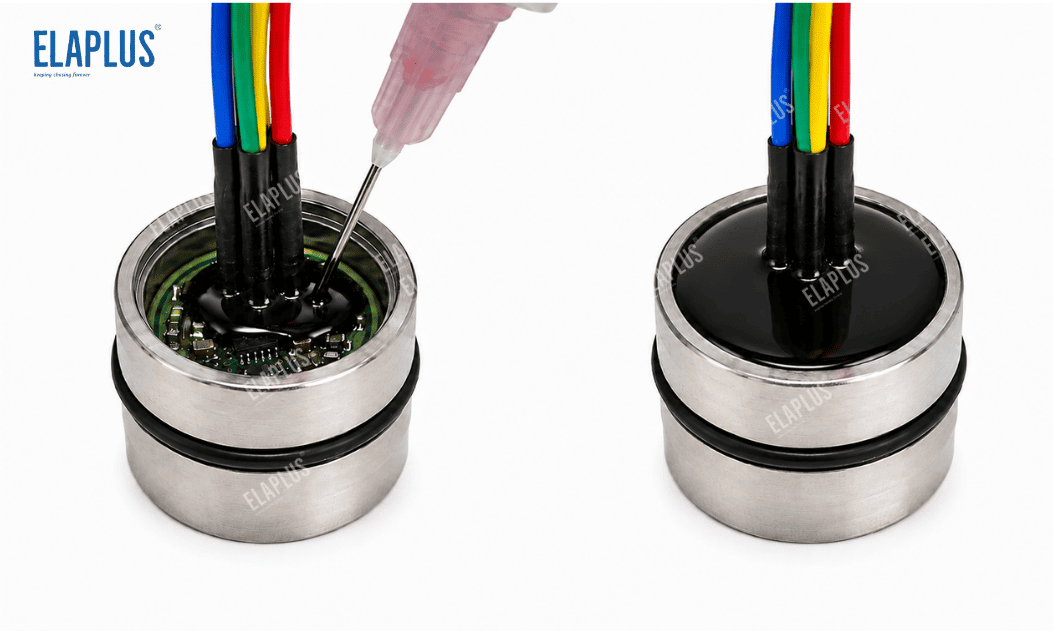
Pressure Sensor Potting
1. Why Are Pressure Sensors Particularly Vulnerable to Thermal Stress?
First: Thermal expansion of internal materials is inconsistent. A pressure sensor may incorporate multiple components:
- Metal housing
- Ceramic substrate
- PCB
- Solder joints
- Silicon die
- Pins
- Plastic structural parts
These components expand to different extents as temperature rises. If the potting adhesive features high thermal expansion and high stiffness, thermal deformation will be converted into mechanical stress.
Second: Pressure sensors require not only protection but also stable measurement performance. General electronic modules mainly focus on basic functionality.
For sensors, extra concerns arise:
Will the encapsulation affect the sensitive structure and output stability?
Therefore, “harder equals better” is not a universal rule.
2. What Do Temperature Resistance, Tg, CTE and Modulus Respectively Address?
| Parameter | Core Question to Answer | Risks of Improper Selection |
|---|---|---|
| Operating Temperature | Whether the adhesive can withstand the service temperature long-term | Aging, performance degradation |
| Tg | Whether the material state changes drastically upon temperature rise | Variation of modulus and dimensional stability |
| CTE | How significantly the adhesive expands and contracts with temperature | Interfacial stress, cracking, delamination |
| Modulus / Hardness | How much stress the adhesive transfers to components | Stress damage to sensing die and solder joints |
| Thermal Conductivity | Whether heat can be dissipated efficiently | Local overheating |
| Adhesion | Whether interfacial bonding remains intact after thermal cycling | Delamination, water ingress |
To sum up: Temperature resistance answers whether the adhesive can survive at a given temperature;
CTE and modulus determine whether temperature fluctuations will damage the assembly structure.
These two aspects must not be confused.
3. When Is Low-CTE Epoxy Preferred?
Low-CTE epoxy is worth priority evaluation when rigid structural fixation is required alongside elevated service temperatures.
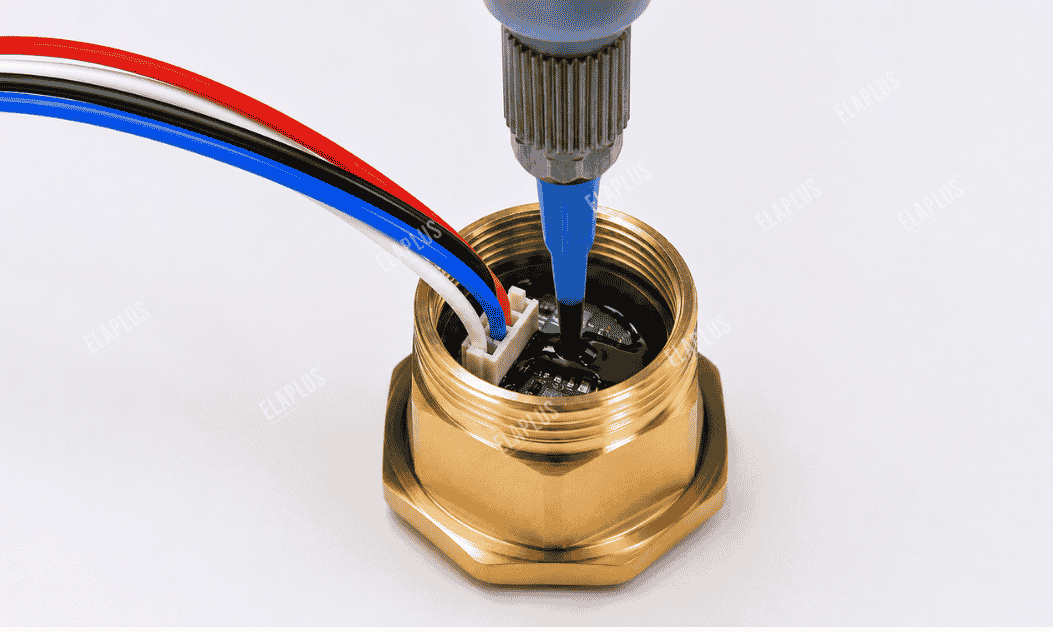
Pressure Transmitter
EP 1710 is a high-Tg, low-CTE epoxy potting system with an operating temperature range of -50 ~ 180°C. ELAPLUS also adopts EP 1710 for high-reliability crash sensor solutions, focusing on low CTE and reliability under high-temperature conditions.
This material is suitable for evaluation for:
- High-temperature sensors
- Metal housing potting
- Applications requiring robust structural fixation
- Applications demanding high dimensional stability under thermal cycling
Important note: Low CTE does not inherently equal low stress. The final stress level is also affected by adhesive thickness, modulus, structural constraints and substrate materials.
4. When Is a Flexible System the Better Choice?
Flexibility can outweigh high hardness when sensitive components are highly stress-sensitive.
For certain pressure sensing dies, MEMS and precision sensing structures, the adhesive mainly serves to:
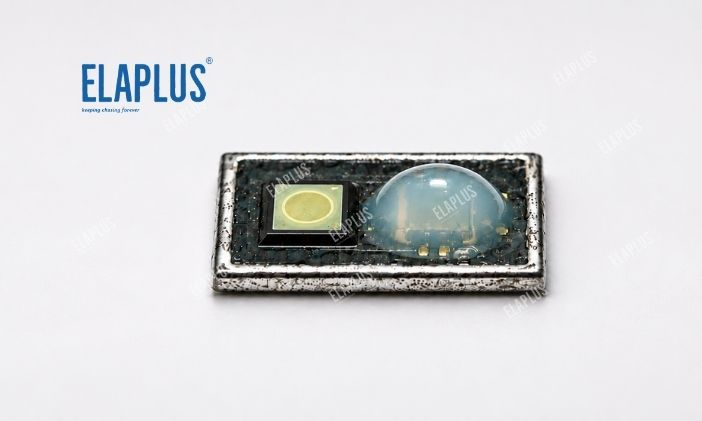
- Resist moisture
- Provide electrical insulation
- Prevent contamination
- Absorb mechanical shock instead of bearing primary structural loads.
In such cases, flexible polyurethane, silicone or silicone gel can be considered.
5. Initial Screening: Epoxy vs Polyurethane vs Silicone / Gel
| Application Requirement | Epoxy | Polyurethane | Silicone / Gel |
|---|---|---|---|
| High structural fixation | Preferred | Considered | Generally not the first option |
| Low-stress cushioning | Flexible grade required | Preferred | Preferred |
| Dimensional stability at high temperature | Select high-Tg / low-CTE grade | Subject to specific grade | Good temperature resistance, subject to structural design |
| Protection for precision sensing die | Careful hardness assessment | Considered | Highly recommended |
| Repairability | Limited | Depends on formulation | Gel grade has advantages |
| Full housing potting | Commonly used | Commonly used | Commonly used |
This table is only for the first-round screening of material families. Final material validation must be carried out under actual working conditions.
6. Six Questions to Answer Before Selecting Adhesives for Pressure Sensors
- What is the maximum temperature? Distinguish between continuous operating temperature and peak temperature, rather than only checking the peak value.
- What is the temperature cycling range? Constant 150°C exposure and repeated cycling between -40 ~ 150°C impose completely different requirements on materials.
- Will the potting adhesive be in direct contact with the sensitive sensing die? Direct contact requires extra evaluation of stress transfer.
- What are the primary substrate materials? Aluminum, PBT, PPS, PA, ceramic and copper have different interfacial bonding requirements.
- What is the adhesive layer thickness? The structural constraint of the same material differs greatly between 1 mm and 20 mm thickness.
- Is the adhesive for structural fixation or environmental protection? This is the most frequently overlooked point. Selecting a high-rigidity structural adhesive solely for die protection will lead to improper material selection.
7. Why Might a Pressure Sensor Require Two or Three Types of Adhesives?
Different zones undertake different functions. Typical arrangement:
- Sensing die area: Low-stress protection Core target: Control mechanical stress
- PCB or ceramic substrate: Fixation & potting Core target: Adhesion, insulation, temperature resistance and CTE matching
- Pin-to-housing interface: Sealing Core target: Wetting, interfacial adhesion and water resistance
- Harness outlet: Flexible stress relief Core target: Avoid stress concentration caused by vibration and bending
For high-reliability pressure sensors, the optimal logic is usually not: “Find one single adhesive with the best overall performance.” Instead: Select materials by zones according to different failure risks.
ELAPLUS’s sensor material portfolio covers potting, gel protection, structural bonding and sealing.
8. How to Position EP 1710 in Application Scenarios?
Do not simply define it as: “An epoxy adhesive resistant to 180°C.” Its accurate positioning: An epoxy potting material designed for high-temperature, high-Tg, low-CTE applications requiring structural reliability.
EP 1710 is a 100:8 mixing ratio system with high Tg and low CTE, rated for -50 ~ 180°C. It can be shortlisted when pressure sensors are subjected to:
- Elevated operating temperature
- Severe thermal cycling
- Metal housing
- Structural fixation requirements
- Dimensional stability requirements
Nevertheless, if the adhesive directly encapsulates highly sensitive MEMS chips, modulus and stress still need separate evaluation, and it cannot be adopted simply for its high temperature resistance.
9. Validation Items for Mass Production of Pressure Sensors
- Inspect interfaces after temperature cycling Check not only cracking inside the adhesive, but also delamination at interfaces of housing, pins, ceramics and other components.
- Compare zero-point and output before and after potting This is a key distinction between sensors and ordinary electronic modules. An intact adhesive does not guarantee that measurement accuracy is free from stress interference.
- Insulation and sealing test after temperature-humidity aging Verify that no moisture penetration path forms at the interfaces over time.
- Cross-section inspection Focus on voids around:
- Sensing die
- Pin roots
- Housing corners
- Bottom side of PCB
FAQ
Q1: Is higher temperature resistance always better for pressure sensor potting adhesives?
A: No. Temperature resistance is only one selection criterion. CTE, Tg, modulus, adhesion, adhesive thickness and the sensitive structure of the sensor must also be considered.
Q2: Why is low-CTE potting adhesive required for pressure sensors?
A: Primarily to reduce dimensional mismatch caused by temperature variation. Adhesives, metals, ceramics and PCBs have different thermal expansion coefficients. Low CTE helps eliminate one source of stress, yet modulus must be assessed together.
Q3: What applications suit EP 1710?
A: Potting applications requiring high temperature resistance, high Tg, low CTE and high structural reliability. Project-specific validation on substrates, thermal cycling, glue thickness and sensitive components is still necessary.
Q4: Can hard epoxy be directly used to encapsulate MEMS pressure chips?
A: Selection cannot be determined only by temperature resistance and bonding strength. If the material is applied directly onto sensitive structures, encapsulation stress must be evaluated first to confirm whether measurement precision is affected.