When insulation protection, winding retention, vibration resistance and thermal cycling tolerance are required for stator coils of AC fans, ELAPLUS SIPA 1850 (30#) silicone potting compound may be prioritised for evaluation. Key verification shall cover coil filling range, post-cure mechanical restraint, operating temperature rise and electrical performance of the fan. For industrial cooling fans, equipment ventilation blowers and continuously running AC motors, potting materials shall be matched to the stator structure and heat dissipation path; full filling of the entire motor cavity is not recommended as a default practice.
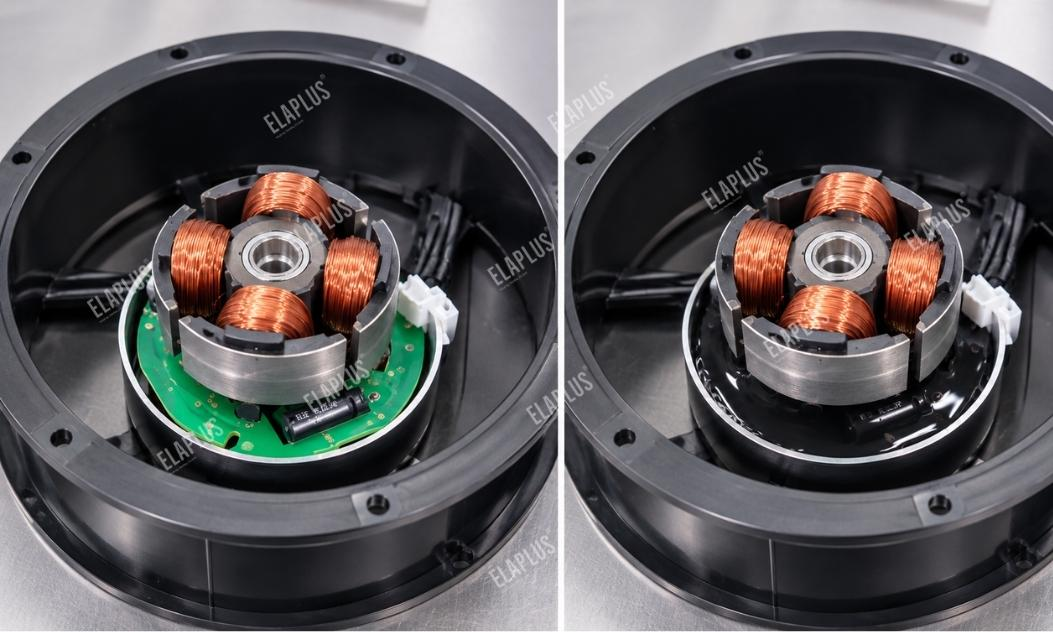
An AC fan generally consists of a stator core, windings, rotor, bearings, housing and associated electrical connections. During operation, stator coils are subjected to electrical stress, temperature fluctuation and mechanical vibration. Proper potting protection helps improve insulation and fixation within designated zones.
Nevertheless, potting modifies the mechanical and thermal boundaries surrounding the windings. For fans of different power ratings, rotational speeds and thermal designs, the potting scope, adhesive bead height and curing process shall be separately confirmed to avoid interference with rotor movement, bearings and original cooling arrangements.
1. Why Stator Coils of AC Fans Require Potting Protection
AC fans deployed in industrial equipment, power cabinets, control systems and ventilation units often run for extended periods. Long-term exposure to electromagnetic excitation, temperature swings and equipment vibration affects insulation integrity and mechanical retention of windings, which in turn determines motor reliability.
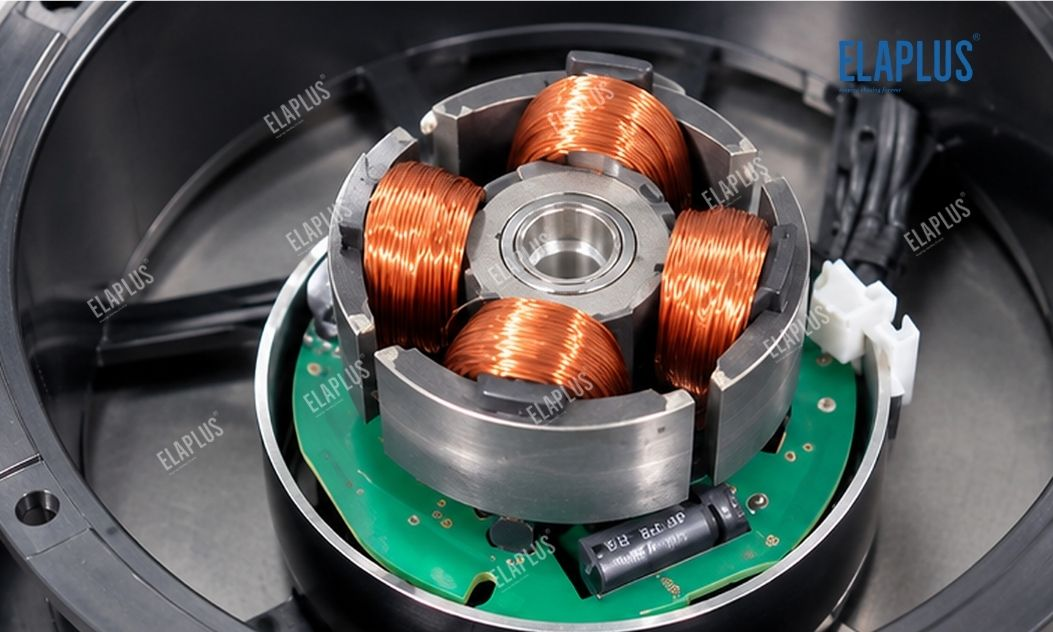
For stator assemblies adopting partial potting design, the compound forms an insulating layer within applicable areas and provides mechanical restraint for selected winding ends and connection points. Potting, however, cannot replace the original enameled wire insulation, varnish impregnation process or motor safety design for windings.
Stator architectures vary widely among AC fans: some feature open heat dissipation, while others use partially encapsulated or fully enclosed motor structures. It is therefore essential to identify permitted potting zones in advance and check whether the adhesive will disrupt the original airflow and heat transfer pathways.
2. Critical Zones to Consider for AC Fan Potting
The material coverage shall be defined according to the actual motor stator design, clearly distinguishing windings eligible for fixation from regions that must remain free for motion or heat dissipation.
| Motor Section | Primary Requirements | Potting Design Guidance | Key Validation Items |
|---|---|---|---|
| Stator winding ends | Insulation protection, mechanical retention | Partial potting per design specification | Winding temperature rise, fixation integrity |
| Gaps between windings and core | Electrical insulation and structural stability | Evaluated against the insulation system | Material insulation compatibility |
| Lead connection zones | Electrical protection, vibration resistance | Local encapsulation and stress buffering | Lead pull strength and insulation performance |
| Stator mounting base | Structural positioning | Mechanical fixation prioritised | Concentricity and mounting dimensions |
| Rotor clearance gap | Unobstructed rotation | Prevent unintended adhesive ingress | Rotational clearance and noise |
| Bearings and lubrication interfaces | Preserve motion and lubrication performance | Define explicit no-glue zones | Torque, service life and temperature rise |
| Heat dissipation channels | Maintain designed cooling capacity | Avoid unvalidated blockage | Temperature rise under rated load |
For fans with densely packed stator coils, special attention shall be paid to adhesive coverage at winding ends, core slot openings, lead exits and housing fillets. For designs with minimal rotor clearance, the maximum adhesive height and assembly tolerances must be tightly controlled.
3. Why SIPA 1850 (30#) Qualifies for AC Fan Selection
ELAPLUS SIPA 1850 ( 30#) is a candidate silicone material developed for potting of AC fans, to be assessed for stator coil insulation protection, mechanical retention and environmental adaptability during operation.
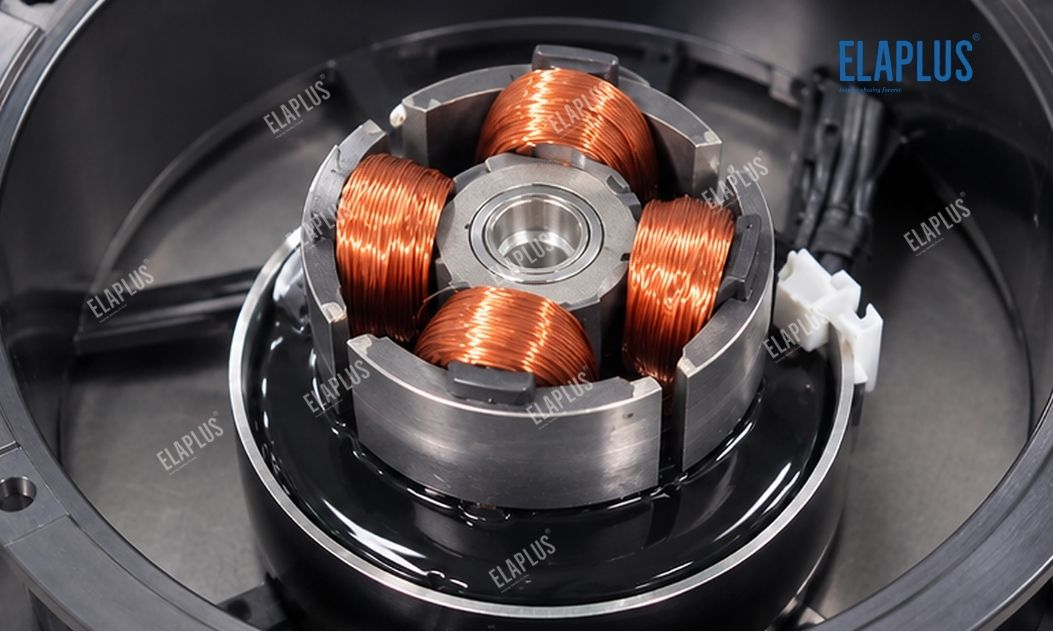
Silicone potting systems generally offer elasticity, suitable for electronic and motor assemblies requiring resilience against temperature variation and mechanical shock. For SIPA 1850 (30#) specifically, its applicable scope shall be confirmed against the actual material properties and curing conditions of this grade; parameters for other grades within the same series cannot be applied indiscriminately.
When selecting for AC fans, compatibility between the material and enamel insulation, slot insulation, core coatings and lead sheaths shall be verified as a priority. Post-cure hardness, modulus and adhesion shall align with winding fixation targets to prevent undesired local stress concentration introduced by the adhesive layer.
ELAPLUS: Match adhesives to working conditions, rather than overemphasising nominal parameters. The key to AC fan potting is not simply increasing adhesive hardness, but ensuring the material, stator geometry, thermal paths and production process collectively satisfy long-term operating requirements.
4. Comparison of Silicone, Epoxy and Polyurethane Potting Compounds
Material selection for AC fan potting shall take winding temperature, mechanical restraint, insulation system and process efficiency into account simultaneously. Different chemistries exhibit distinct mechanical and curing behaviours; suitability cannot be judged by a single property index.
| Material System | Main Characteristics | Evaluation Direction | Key Limitations |
|---|---|---|---|
| SIPA 1850 (Grade 30) Silicone | Formulated for AC fan potting | Stator coil insulation and protection | Verify process and physical properties for this specific grade |
| Epoxy Potting Compound | High rigidity and strong fixation capability | Structures demanding robust mechanical restraint | Watch for curing stress and thermal cycling performance |
| Polyurethane Potting Compound | Flexibility and environmental protection | Electrical protection within allowable temperature range | Assess long-term thermal stability |
| Winding Impregnating Varnish | Penetrates windings for insulation and fixation | Conventional motor insulation systems | Not equivalent to cavity potting |
| Local Structural Adhesive | Fixation at designated points | Leads and local component anchoring | Cannot replace full insulation design |
Epoxy materials may be considered where high structural stiffness is needed for stator assemblies, while silicone systems can be evaluated for designs requiring reduced mechanical constraint. Final confirmation shall rely on insulation, temperature rise and vibration testing of complete motors.
5. Pre-Potting Preparation for Stator Assemblies
Prior to potting, inspect the stator core, windings and lead connections for oil contamination, dust, loose joints or other defects that may compromise processing. For windings already varnish-impregnated, compatibility between the subsequent potting material and the existing insulating varnish shall be confirmed.
Mark coatable zones, restricted zones and no-glue zones based on the motor BOM and assembly drawings, and inspect the assembly clearance between stator and rotor. Reliable tooling shall be used to block bearings, shafts, locating holes and other motion-related features from adhesive intrusion.
For assemblies with intricate slot geometry and winding ends, the injection direction, adhesive dosage and fill height shall be predetermined. A smooth surface after potting alone does not guarantee that internal winding regions have reached the designed fill standard.
6. Process Control for Automated Potting with SIPA 1850 (30#)
In mass production, confirm the component form, metering requirements and curing procedure for SIPA 1850 (30#) before configuring dispensing or potting equipment. Mix ratios, working life and curing schedules for other material versions shall not be adopted without verification.
During automated potting, regulate dispensing position, flow rate and shot volume according to the stator geometry to deliver material to target winding areas while avoiding unintended coverage elsewhere. Check filling at slot openings, winding ends and lead exits, and ensure adhesive does not migrate into rotor gaps or bearing mounting positions.
After potting, hold assemblies stationary under specified conditions to prevent tilting or adhesive flow during cure. Once fully cured, inspect adhesive boundaries, surface condition, stator mounting dimensions and no-glue zones. Sectioning or non-destructive testing may be adopted to verify internal filling quality where necessary.
For batch manufacturing, implement process controls covering adhesive dosage, equipment positioning, metering status, ambient conditions and curing records to minimise inter-batch variation.
7. Why Temperature Rise Must Be Re-Measured after Potting
Potting adhesive alters thermal transfer between windings and surrounding structures, yet it does not inherently lower motor operating temperature. Actual temperature rise is determined by winding losses, core losses, heat dissipation paths and fan operating status.
For stators originally cooled by convective airflow, potting compound may obstruct designed ventilation routes and trigger local overheating. Even thermally conductive grades require validation to confirm efficient heat transfer to the housing or other heat sinks.
It is recommended to compare winding temperature rise, input power, rotational speed and operating noise between paired un-potted and potted samples under identical input voltage, frequency, load and ambient conditions. For continuously operated industrial AC fans, record readings once thermal equilibrium is attained.
If abnormal temperature rise appears after potting, prioritise inspection of adhesive distribution, cooling channels and motor load, rather than assuming the issue can be resolved simply by switching to a higher-thermal-conductivity material.
8. Validation of Electrical and Mechanical Reliability after Potting
Post-potting qualification for AC fans shall cover electrical insulation, mechanical operation and environmental compatibility. Electrical tests shall follow motor design and applicable standards, including prescribed insulation and hipot checks; bulk dielectric properties of the adhesive alone cannot prove the safety of the finished unit.
Mechanical validation shall confirm free rotor rotation, absence of bearing contamination, and no abnormal noise, vibration or assembly interference introduced by potting. For continuous-duty applications, long-run evaluation shall be carried out under representative speed and temperature conditions.
Environmental testing may include thermal cycling, damp heat and vibration according to product specifications, with insulation, temperature rise and running performance re-tested upon completion. If failures consistently occur at the same slot or lead position, examine local structure and adhesive geometry; for random failures across units, focus on dispensing equipment, dosage and curing consistency.
9. Adaptation for Industrial Cooling Fans and Equipment Ventilation Blowers
AC fans for industrial control cabinets must remain stable under continuous operation, temperature variation and equipment vibration; emphasis shall be placed on winding insulation, temperature rise and long-run performance. For fans installed adjacent to power devices, thermal interference from surrounding heat sources shall also be considered.
Partial potting can serve as targeted protection for electrical zones on fans deployed in dusty or humid environments, yet it must be integrated with housing design, lead sealing and overall enclosure protection. Qualified coil potting does not automatically confer a specific IP rating on the complete unit.
Adhesive dosage, fill height and process parameters shall be individually defined for fans of different power ratings and sizes. Even when using SIPA 1850 (30#), revalidation against the production BOM and real operating conditions is mandatory.
FAQ
Q: What potting compound is recommended for stator coils of AC fans?
A: SIPA 1850 (Grade 30) silicone potting compound may be prioritised for evaluation, with focus on insulation protection, winding retention, temperature rise and long-term operational stability.
Q: Can potting compound fill the entire interior of an AC fan motor?
A: Full internal filling shall not be the default. Space required by the rotor, bearings and other moving components must be reserved, and heat dissipation paths must be preserved.
Q: Is silicone potting always better than epoxy for AC fans?
A: Not necessarily. Different material systems shall be compared according to stator structure, operating temperature, mechanical restraint and insulation requirements.
Q: Why is motor temperature rise testing still required after potting?
A: Potting may modify the original cooling arrangement; actual running tests are needed to confirm winding temperatures stay within design limits.
Q: Can SIPA 1850 (Grade 30) be used directly for all AC fans?
A: No. Fans differ in winding construction, insulation systems, power and thermal design, so separate qualification is required.