Against the backdrop of rapid development in new energy vehicles, photovoltaic energy storage, and 5G communications, electronic potting compounds, as critical materials that protect electronic components from moisture, vibration, and chemical corrosion, are embracing unprecedented industrial opportunities. Industry data shows that the global electronic potting and encapsulation market size is expected to reach USD 2.82 billion in 2026 and exceed USD 6.4 billion by 2035, with a compound annual growth rate (CAGR) of up to 9.6%. In this track, ELAPLUS® (Elaplus Functional Materials (Shanghai) Co., Ltd.), adhering to the brand philosophy of “Bonding Everything, Adhering to the Future”, has long been engaged in the electronic adhesive field and provides global customers with full-scenario solutions ranging from motor potting compounds, sensor potting compounds, and power supply potting compounds to thermal interface materials.
Three Major Trends in the Electronic Potting Compound Industry Forcing Supply Chain Upgrades
Currently, the electronic potting compound industry is undergoing three transformations:
First, the accelerated penetration of 800V high-voltage platforms in new energy vehicles has raised higher requirements for the insulation strength and thermal conductivity of potting materials. It is estimated that from 2024 to 2026, the CAGR of vehicle-grade thermal conductive potting compound demand will reach 28.5%.
Second, domestic substitution is accelerating in an all-round way. Under the considerations of tariff restructuring and supply chain security, the localization rate of electronic adhesives has rapidly climbed from 31% in 2024 to 44% in 2026. Chinese enterprises, leveraging their technological accumulation and production capacity advantages, are competing strongly with foreign-funded enterprises in the mid-to-high-end market.
Third, the trend of multi-functional integration is obvious. Potting compounds with a single protective function can no longer meet demands, and composite materials with thermal conductivity, flame retardancy, low stress, fast curing, and other characteristics are becoming mainstream.
It is at the intersection of these three trends that ELAPLUS has built full-link competitiveness from R&D to mass production.
Annual Output of 10,000 Tons: ELAPLUS’s Hardcore Manufacturing Strength
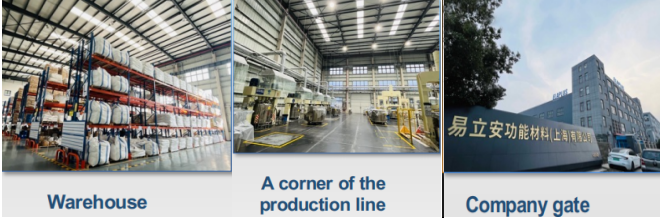
Elaplus Functional Materials (Shanghai) Co., Ltd. is located at No. 555, Jiugong Road, Jinshan Industrial Zone, Shanghai, a key high-end manufacturing project introduced by Jinshan District. As a professional manufacturer of organic polymer adhesives, ELAPLUS focuses on four major fields: electronics, automotive, new energy, and healthy living, offering six product lines:
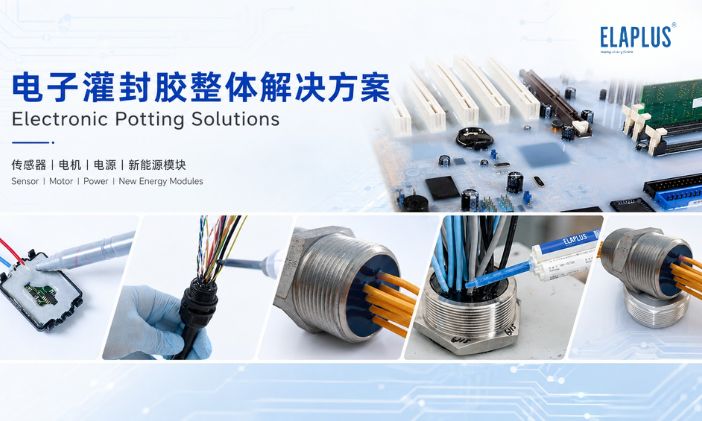
■ Potting Materials: Potting for charging guns, sensors, automotive motors, inverters, new energy battery packs, and photovoltaic junction boxes
■ Adhesion & Sealing: Module casing sealing, PCB component fixing, home appliance door and window sealing, radiator adhesion, communication junction box sealing
■ Structural Adhesion: Camera module adhesion, bus structural component adhesion, motor magnetic steel sheet adhesion, servo motor rotor coating
■ Conformal Coating Materials: Impregnation, brushing, selective coating, equipment spraying, with fluorescent indicator effect available
■ Grease Series: O-ring lubrication, piercing clamps, cable accessories
■ Thermal Conductive Materials: Thermal conductive gel, radiator gap filling, LED lamp power potting, thermal conductive grease, chip packaging thermal conductive adhesion
Four-System Certification Endorsement: Core Barriers for Automotive-Grade Potting Compounds
How to choose an electronic adhesive manufacturer? For B-end procurement decision-makers, the certification system is the most intuitive trust signal. ELAPLUS is one of the few enterprises in the industry that holds four international management system certifications simultaneously:
■ IATF 16949 (Automotive Quality Management System): A global automotive supply chain entry threshold, meaning products can be directly supplied to complete vehicle and Tier 1 manufacturers
■ ISO 9001 (Quality Management System)
■ ISO 14001 (Environmental Management System)
■ ISO 45001 (Occupational Health and Safety Management System)
In addition, ELAPLUS has established an expert workstation, independently developed a number of technical patents, and is applying for district-level technical center recognition. In terms of R&D investment, the ratio of R&D expenses to sales revenue will remain stable at 10%-12% from 2023 to 2026, continuously higher than the industry average.
In-Depth Analysis of Two Core Scenarios: Motor Potting Compounds and Sensor Potting Compounds
What Performance Requirements Do Motor Potting Compounds Need to Meet?
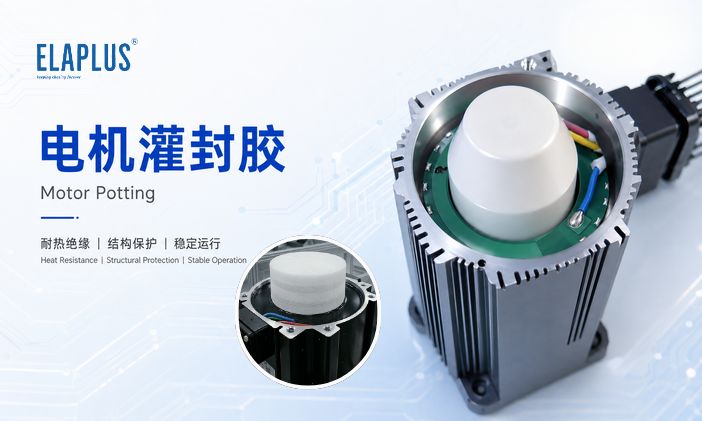
Motor potting is a non-negligible process link in the mass production of new energy vehicle drive motors, servo motors, and industrial motors. ELAPLUS’s motor potting compound solution focuses on four core indicators:
■ Thermal Conductivity: Motor windings have high heat generation density, and the potting compound needs a thermal conductivity of 0.8-3.0 W/m·K to efficiently conduct heat to the casing
■ Temperature Resistance Grade: H-grade (180°C) or even C-grade (above 200°C) temperature resistance to ensure long-term stability of the motor under high-load conditions
■ Low Viscosity & Permeability: Ensure the glue fully infiltrates winding gaps and
eliminates bubbles and voids
■ Vibration fatigue resistance: Under continuous vibration during motor operation, the potting material shall maintain toughness without cracking or debonding.
ELAPLUS has developed motor potting solutions based on silicone and epoxy systems for various motor types, catering to the different process requirements of concentrated windings and distributed windings.
What is the best material for sensor potting?
As precision electronic components, sensors impose extremely stringent requirements on material stress control during the potting process. Even minor stress generated by curing shrinkage of potting compound may cause zero drift or reduced sensitivity of sensors.
ELAPLUS sensor potting compounds cover two major chemical systems: silicone and polyurethane. The silicone series features soft texture and a wide operating temperature range of -60℃ to 260℃, ideal for high-temperature environments and applications requiring repairability. The polyurethane series delivers high adhesion strength and excellent low-temperature resistance, suitable for sensor encapsulation scenarios that demand structural integrity. We have mature application cases in segmented fields such as automotive sensors, industrial sensors and MEMS sensors.
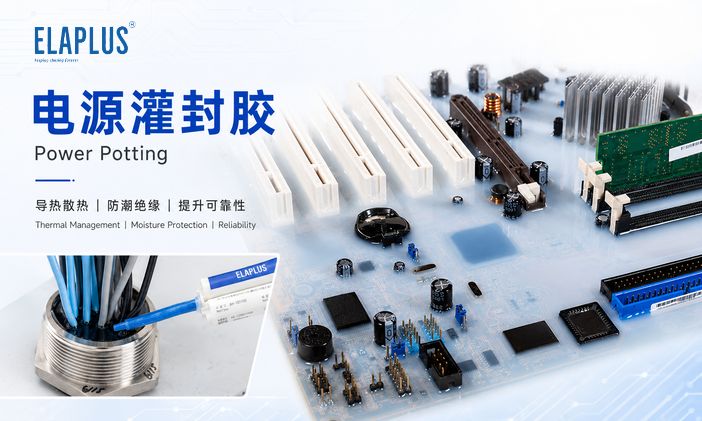
The Balance of Thermal Conductivity and Protection in Power Supply Potting Compounds
What is the right thermal conductivity for a power supply potting compound? This is a top concern for many hardware engineers and procurement managers.
Higher thermal conductivity is not always better. The selection must match the power density and heat dissipation path of the power module:
■ LED Driver Power Supplies: 1.0–2.0 W/m·K is sufficient, with a focus on light transmittance and yellowing resistance.
■ Communication Power Modules: 2.0–3.5 W/m·K recommended, balancing dielectric strength and thermal efficiency.
■ On-Board OBC/DCDC Power Supplies: 3.0–5.0 W/m·K required, while meeting IATF 16949 traceability requirements.
■ IGBT Power Module Potting: Thermal conductivity ≥3.0 W/m·K with dielectric strength ≥15 kV/mm.
ELAPLUS’s thermally conductive potting compound series adopts high-conductivity filler compounding technology, achieving precise customization of thermal conductivity without compromising insulation. Meanwhile, the low-modulus formulation effectively reduces interfacial stress under thermal cycling, extending the service life of power modules.
Five Frequently Asked Questions (FAQ)
Q1: What types of electronic potting compounds are there? How to select?
Electronic potting compounds are mainly divided into three chemical systems: silicone potting compounds (widest temperature resistance range, flexible and repairable, excellent insulation), epoxy potting compounds (high hardness, strong adhesion, good confidentiality, chemical corrosion resistance), and polyurethane potting compounds (moderate adhesion, outstanding low-temperature resistance, relatively controllable cost). Selection requires comprehensive consideration of operating temperature range, insulation requirements, thermal conductivity needs, repairability, and cost budget. ELAPLUS provides a complete product matrix covering all three systems and supports customized formulas based on samples.
Q2: How to choose an electronic adhesive manufacturer?
It is recommended to evaluate from five dimensions: First, check the certification system – whether it has core certifications such as IATF 16949, the basic threshold for entering the automotive supply chain; second, check production capacity – a capacity of over 10,000 tons ensures supply chain stability; third, check testing capabilities – a complete laboratory and testing equipment guarantee consistent quality; fourth, check industry cases – whether there are mass applications in new energy vehicles, photovoltaics, industrial electronics, etc.; fifth, check technical services – whether it can provide full-process support from selection to process optimization. ELAPLUS has significant advantages in all five aspects.
Q3: What performance requirements do motor potting compounds need to meet?
Core requirements include: thermal conductivity (0.8-3.0 W/m·K), temperature resistance grade (H-grade or above), low viscosity & permeability, vibration fatigue resistance, and electrical insulation strength. Specific indicators are determined based on motor type (drive/servo/industrial motor), operating environment, and heat dissipation design.
Q4: What material is suitable for sensor potting compounds?
Select based on the sensor’s operating environment – silicone system is preferred for high-temperature scenarios (e.g., engine compartment sensors); polyurethane system for scenarios requiring structural strength and good adhesion; low-shrinkage epoxy system for precision sensors with extremely high dimensional stability requirements. The key lies in low curing shrinkage and low-stress formula design.
Q5: What is the appropriate thermal conductivity for power supply potting compounds?
LED driver power supply: 1.0-2.0 W/m·K
Communication power supply: 2.0-3.5 W/m·K
Vehicle-mounted power supply: 3.0-5.0 W/m·K
IGBT module: Above 3.0 W/m·K with insulation voltage resistance ≥15kV/mm
ELAPLUS can provide customized thermal conductivity solutions based on customers’ heat dissipation needs.
Why Are More and More Enterprises Choosing ELAPLUS?
Choosing ELAPLUS essentially means choosing three “certainties”:
Capacity Certainty: 16 production lines with an annual output of nearly 10,000 tons ensure no “supply interruption” during peak order periods
Quality Certainty: Four-system certifications + 42 sets of testing equipment + clean room production lines, with full-process control from raw materials to delivery
Service Certainty: 18-person R&D team, 60+ in-depth technical exchanges annually, 15+ domestic and international exhibitions, 4+ distributor training meetings, with proven technical response capabilities
ELAPLUS products are exported overseas, with partners covering numerous well-known domestic and foreign enterprises in electronic manufacturing, automotive parts, new energy equipment, healthy living, and other fields. We are not only material suppliers but also technical partners deeply involved in optimizing customers’ manufacturing processes.