Adhesives for motor lead‑wire fixing and neck‑section encapsulation shall be selected according to dispensing position, adhesive thixotropy, long‑term temperature resistance, oil resistance, lead‑wire material and curing process. For flexible fixation of heat‑shrinkable tubes and lead wires, evaluate Elaplus SIPC 1823. EP 1770‑1K is recommended for the neck‑section of brushless motors. EP 1770H‑1K can be applied for inter‑slot sealing of DC motor rotors. For motor housings or sealing positions exposed to oil media, evaluate SIPC 1887.
Why Motor Lead‑Wires Require Fixation
During motor operation, coil lead‑wires are subjected to continuous loads induced by vibration, electromagnetic force, thermal expansion‑contraction and high‑speed rotor motion.
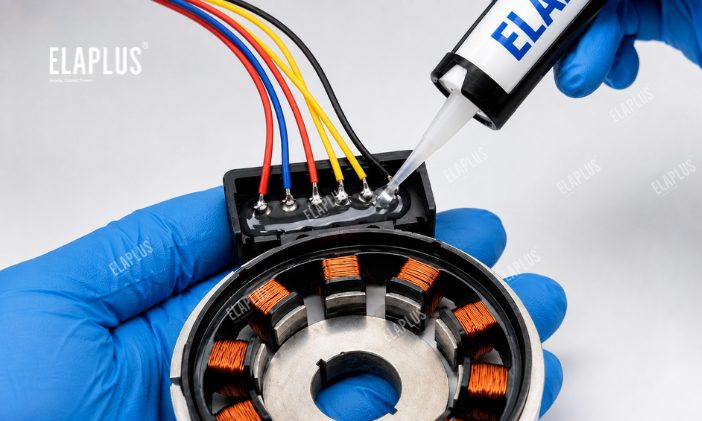
Without fixation at the lead‑wire root, the following failures may occur:
- Repeated bending of magnet wires
- Fatigue cracking of solder joints
- Loosening of heat‑shrinkable tubes
- Friction between lead‑wires and iron cores
- Wear of insulation layers
- Local coil vibration and abnormal noise
Lead‑wire fixing adhesives shall maintain proper flexibility and shall not form rigid bending boundaries at lead‑wire roots.
Recommended Grade for Brushless‑Motor Lead‑Wire Fixation
SIPC 1823: One‑Component Silicone Lead‑Wire Fixing Adhesive
SIPC 1823 is a one‑component silicone adhesive featuring fast tack‑free time and good bonding performance for heat‑shrinkable tubes. According to the datasheet, its viscosity is approx. 35 000 cps with service temperature ranging from ‑60 ℃ to 200 ℃.
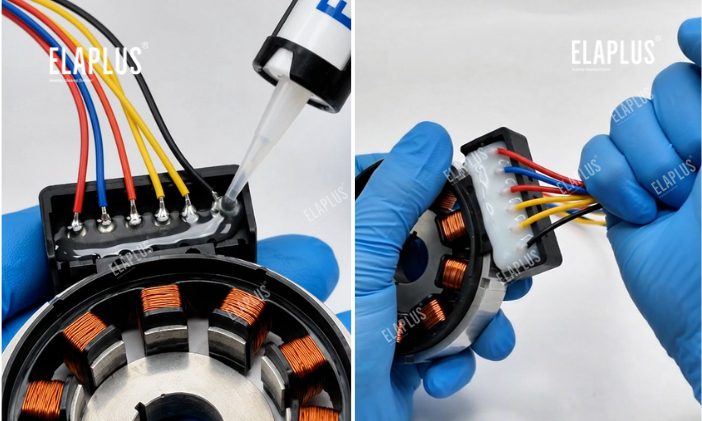
Suitable for:
- Fixation of coil lead‑wires in brushless motors
- Bonding of heat‑shrinkable tubes
- Flexible protection for solder joints and lead‑wire roots
- Zones requiring high‑low temperature resistance and stress buffering
Note: The motor application schematic page of the datasheet marks SIPC 1822, whereas the parameter sheet lists SIPC 1823. Always confirm the final grade against the latest TDS for formal release, sampling and quotation.
Recommended Grade for Brushless‑Motor Neck‑Section Encapsulation
EP 1770‑1K: High‑Thixotropy Heat‑Curing Epoxy Adhesive
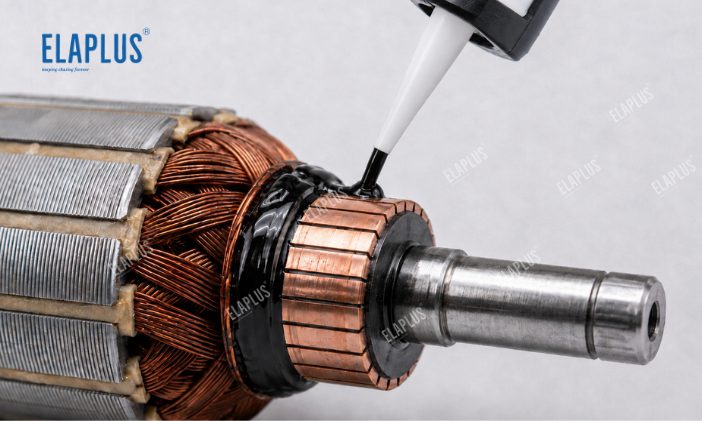
EP 1770‑1K is a one‑component heat‑curing epoxy adhesive. It resists flow at ambient temperature and delivers moderate slight slump upon heating. Per datasheet, viscosity is approx. 150 000 cps; recommended curing profile: 120 ℃ for 60 minutes.
Suitable for:
- Neck‑section fixation of brushless motors
- Reinforcement of rotor winding ends
- Coil fixation for high‑speed motors
- Zones requiring stable bead profile after dispensing
- Motors demanding high structural support
Its rheological design of “no flow at room temperature, slight slump under heating” enables the adhesive to stay in place after dispensing, while achieving moderate wet‑out over coil surfaces during curing temperature rise.
Recommended Grade for DC‑Motor Inter‑Slot Sealing
EP 1770H‑1K: Non‑slump Tough Epoxy Adhesive
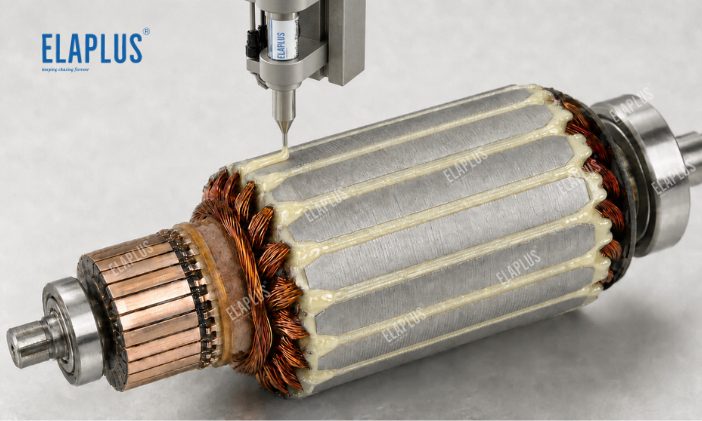
EP 1770H‑1K is a one‑component heat‑curing epoxy adhesive in paste form, characterized by excellent anti‑slump property and good toughness.
Suitable for:
- Inter‑slot sealing of DC motor rotors
- Fixation of coil ends
- Dispensing on vertical and upright surfaces
- Local structural reinforcement under high‑temperature conditions
- Motor structures where adhesive inflow into air‑gaps is prohibited
Recommended Grade for Motor Oil‑Resistant Sealing
SIPC 1887: Oil‑Resistant One‑Component Silicone Adhesive
SIPC 1887 is a one‑component silicone adhesive with oil‑resistant performance, suitable for sealing areas of motor housings, cylinder blocks and other oil‑exposed locations.
Suitable for:
- Local sealing of oil‑cooled motors
- Seams of motor housings
- Cylinder‑block sealing
- Structures requiring flexibility and oil resistance
Motor Lead‑Wire & Neck‑Section Adhesive Grade Comparison
| Application Location | Recommended Grade | Key Features |
|---|---|---|
| Lead‑wire & heat‑shrinkable tube fixation | SIPC 1823 | One‑component silicone, flexible, high‑low temperature resistance |
| Brushless‑motor neck‑section encapsulation | EP 1770‑1K | Non‑flow at ambient temperature, slight slump upon heating |
| DC‑motor inter‑slot sealing | EP 1770H‑1K | Paste‑type anti‑slump, good toughness |
| Oil‑resistant sealing for motor housings | SIPC 1887 | One‑component silicone, oil‑resistant |
According to the motor datasheet, SIPC 1823, EP 1770‑1K and EP 1770H‑1K are applied for lead‑wire fixation, brushless‑motor neck‑section encapsulation and DC‑motor inter‑slot sealing respectively.
FAQ for Motor Lead‑Wire Fixing Adhesives
Can high‑hardness epoxy adhesives be used for lead‑wire fixation?
They work for static fixation. However, if the lead‑wire root sustains continuous vibration, high‑hardness adhesive layers may introduce new stress‑concentration points.
Why is high thixotropy required for neck‑section encapsulants?
Neck‑sections are mostly curved or vertical surfaces. High thixotropy prevents adhesive from flowing into air‑gaps and other restricted zones.
Can ordinary silicone adhesives be used for oil‑cooled motors?
Target cooling‑oil immersion tests shall be performed to verify material volume change, hardness, bonding performance and insulation properties.
Elaplus Functional Materials (Shanghai) Co., Ltd.
Technical support & free sample request: +86‑21‑67227200
E‑mail: info@elaplus.cc
Website: www.elaplus.cc
Address: No.555 Jiugong Road, Jinshan Industrial Zone, Shanghai, China