Battery module lightweighting cannot be achieved by simply replacing conventional solid potting adhesives entirely with low-density foam materials. Foam filling, thermal conduction, structural bonding and insulation protection serve distinct functions. The correct approach is to define zones for cavity filling, heat transfer or load bearing, then adopt a combined solution of PUR 1685 foamed polyurethane, lightweight silicone or standard thermally conductive materials accordingly.
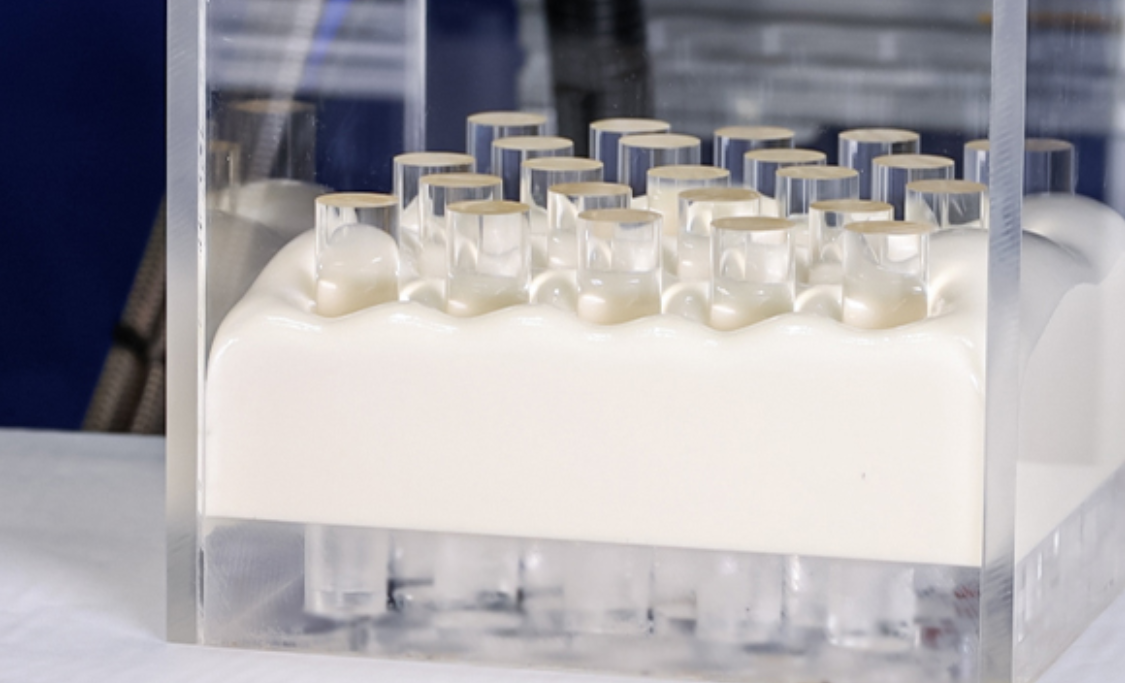
Foam Filling for Battery Packs
This is one common selection pitfall in battery PACK lightweighting: Lower density does not mean suitability for every adhesive application point.
1. Why Traditional Full-Cavity Solid Potting Adds Weight
Suppose a battery module requires filling a large internal cavity. If high-density solid potting material is used for the whole space, greater adhesive volume brings substantial weight gain. For new energy vehicles, drones, mobile energy storage and similar applications, weight directly affects:
- Energy consumption
- Driving range
- Structural load
- Transportation cost
Therefore, for large-volume potting, a key question arises: does every part of this adhesive really need to be high-density solid material?
2. Four Core Functions of Adhesives Inside Battery Modules
- Structural Bonding For example, between cells, or between modules and housings. Core requirements: Bond strength, impact resistance, long-term structural stability
- Thermal Conduction For example, from cell bottom to cold plate, or from power devices to heat dissipation structures. Core requirements: Thermal resistance, interfacial conformity, thermal conductivity, long-term thermal stability
- Insulation Protection For example, high-voltage terminals, sampling areas and local electronic assemblies. Core requirements: Electrical insulation, moisture resistance, environmental resistance
- Large-Volume Cavity Filling Where the primary objectives are: Cavity occupancy, cushioning, flame retardancy and vibration damping This is where low-density foam materials deliver their greatest value.
3. Why Foam Potting Works Well for Large-Volume, Non-Critical Thermal Zones
Foam materials contain numerous controlled closed cells. At equal volume, less raw material is consumed, which reduces potting weight. PUR 1685 is a 1:1 two-component foamed polyurethane system. Its density after foaming is approximately 0.2 g/cm³ with UL94 V-0 flame retardancy, designed for large-volume filling scenarios requiring lightweighting such as battery modules.
This material is engineered to fill large spaces with less material mass, rather than pursuing maximum thermal conductivity.
4. Why Foam Adhesive Cannot Directly Replace Thermal Gel
They are designed for different missions.
| Material Type | Primary Function | Key Indicators |
|---|---|---|
| Foamed Polyurethane | Lightweight filling | Density, flame retardancy, cushioning |
| Thermal Gel | Thermal interface | Thermal conductivity, BLT, thermal resistance |
| Thermally Conductive Potting Compound | Encapsulation + heat dissipation | Thermal conductivity, insulation, flowability |
| Structural Adhesive | Load-bearing bonding | Bond strength, toughness, fatigue resistance |
| Silicone Gel | Low-stress protection | Softness, insulation, moisture resistance |
Take heat transfer from cell base to cold plate as an example. Replacing the original thermal interface material with low-thermal-conductivity foam reduces weight but may degrade the thermal path. Lightweighting must not compromise thermal design.
5. Suitable Zones for PUR 1685
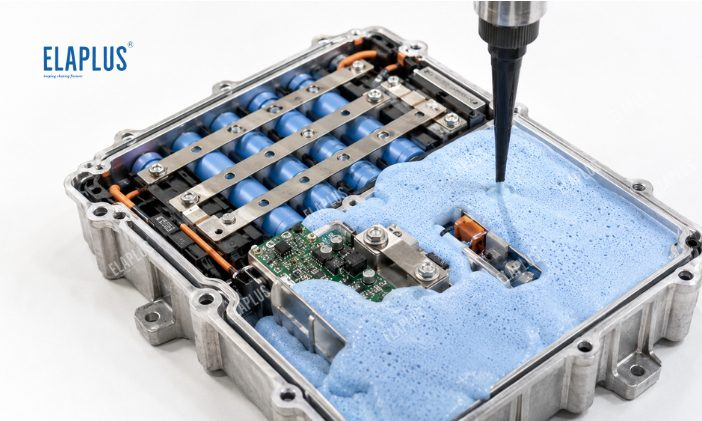
Priority evaluation areas include:
- Large internal cavities inside battery modules
- Filling zones not responsible for major heat transfer
- Positions requiring shock and vibration cushioning
- High-volume encapsulation zones with flame retardant requirements
If a zone bears major structural loads, conducts primary heat flow or requires precision dimensional positioning, the suitability of foam systems must be re-assessed.
6. Higher Foaming Ratio Does Not Equal Better Performance
As foaming ratio rises, the internal structure of the material changes. Engineering evaluation should not chase minimum density alone. Additional validation targets:
- Cell uniformity
- Complete curing
- Mechanical performance
- Dimensional stability
- Flame retardancy
- Interfacial condition
Uncontrolled foaming may cause:
- Local oversized cells
- Internal voids
- Inconsistent height
- Overflow
- Surface collapse
What matters is stable and controllable low density, not an extremely high foaming ratio achieved only in lab trials.
7. Why Expansion Clearance Is Mandatory for Battery Pack Foam Potting
Solid potting mainly requires control over adhesive flow paths. Foam potting has an extra factor: where the material expands. Excessive dispense volume may lead to:
- Pushing against the top cover
- Intrusion into connectors
- Contamination of no-adhesive zones
- Squeezing wire harnesses
- Extrusion through vent holes
Dispense volume cannot be calculated simply as “cavity volume = liquid adhesive volume”. Final foamed volume must be verified on the actual structure.
8. Why Complex Cavities Require Venting Path Design
Air trapped inside the cavity must escape during foam expansion. Fully enclosed structures can trap air at:
- Housing top
- Behind stiffeners
- Corners
- Under wire harnesses Resulting in unpredictable large voids.
Structural design should define:
- Dispense inlet
- Foaming propagation direction
- Air outlets
- No-adhesive zones
This is not purely a material issue. It requires integrated design of material, structure and process.
9. Distinction Between PUR 1685, Lightweight Silicone and Conventional Polyurethane
| Material System | Features | Typical Application |
|---|---|---|
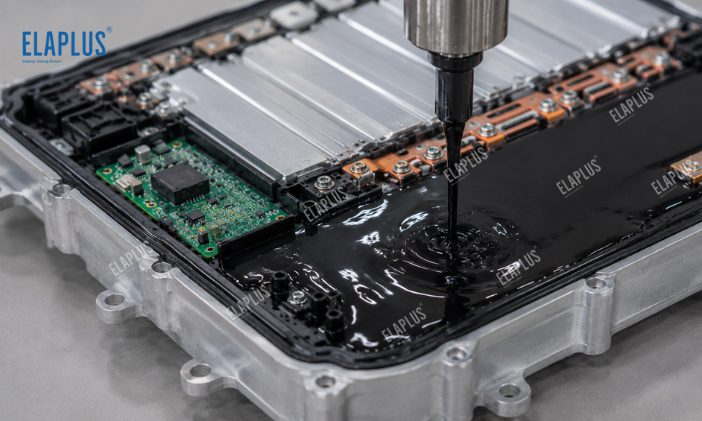
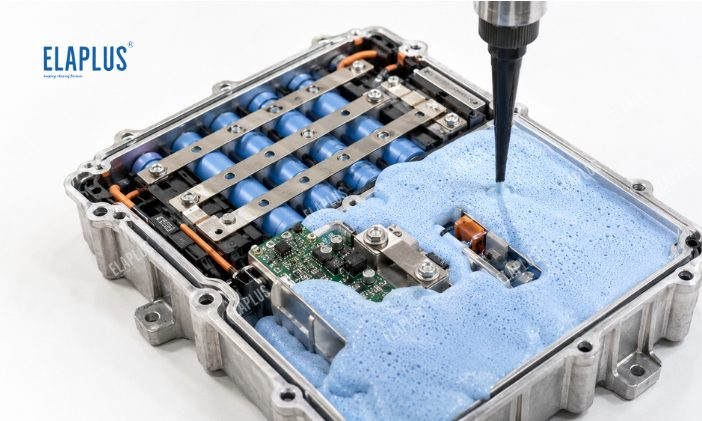
| PUR 1685 | Foamed polyurethane, ~0.2 g/cm³, V-0 | Large-volume lightweight filling |
| SIPA 2100-7# | Lightweight addition-cure silicone, 0.70 g/cm³ | Wide-temperature-range lightweight potting |
| PUR 1680 | Solid polyurethane, 0.8 W/m·K | Moderate thermal conduction and protection |
| TCMP Series | Thermal interface materials | Thermal management for cells and power devices |
SIPA 2100-7# is a 1:1 addition-curing lightweight silicone with density of approx. 0.70 g/cm³ and service temperature from -60 ~ 200°C. It fits applications requiring low density over a wide temperature range without high foaming structure.
There are at least two lightweighting routes: Weight reduction via foaming and Weight reduction via low-density solid materials.
10. Five Questions to Judge Whether a Zone Can Switch to Foam Adhesive
- Is this a primary thermal path? If yes: do not select purely based on density.
- Is this a major load-bearing location? If yes: mechanical performance must be validated.
- Is its main function filling and cushioning? If yes: foam systems are worth priority evaluation.
- Is sufficient expansion space and venting available? If no: modify structure or process first.
- Are connectors, vent holes, sensors or other no-adhesive zones nearby? If yes: foam boundary control is mandatory.
These five questions are more practical for engineering selection than simply asking “is there a lighter adhesive”.
11. Four Groups of Validation Recommended Before Mass Production
- Weighing test Directly compare weight reduction per module
- Cross-section inspection Check internal cell structure, dead corners and voids
- Environmental testing Verify dimensional and material stability after thermal cycling, humidity exposure and long-term ageing
- Full pack functional validation Key inspection items: Temperature rise, vibration performance, insulation, structural integrity
Lightweighting must be achieved without functional degradation.
12. Targeted Zonal Adhesive Dispensing Is the Effective Lightweighting Strategy
A battery module can adopt multiple materials at the same time: Structural adhesives for bonding Thermal gels for heat dissipation Potting compounds for electronic protection Foam adhesives for large cavity filling
This approach appears more complex than filling the whole cavity with one single adhesive. Yet it enables precise material deployment and balances weight, thermal management, safety and reliability simultaneously.
This is ELAPLUS’s principle: select adhesives according to working conditions instead of stacking material parameters.
FAQ
Q: Is lower density always better for battery module foaming potting adhesive?
A: No. Density is only one lightweighting indicator. Flame retardancy, mechanical properties, foam cell stability and long-term reliability also need verification.
Q: What are the main applicable scenarios for PUR 1685?
A: It is suitable for large-volume lightweight filling, cushioning and flame retardant protection inside battery modules. For zones undertaking major heat transfer or load bearing, alternative materials should be matched.
Q: Can foam adhesive replace thermal adhesive?
A: Direct replacement is not feasible. They are designed for different functions. Primary thermal paths shall be designed based on thermal resistance and thermal conductivity requirements.
Q: Why cannot the entire cavity of a battery pack be fully filled with foam adhesive?
A: Thermal paths, structural loads, expansion clearance, venting routes and no-adhesive zones such as connectors must all be considered.